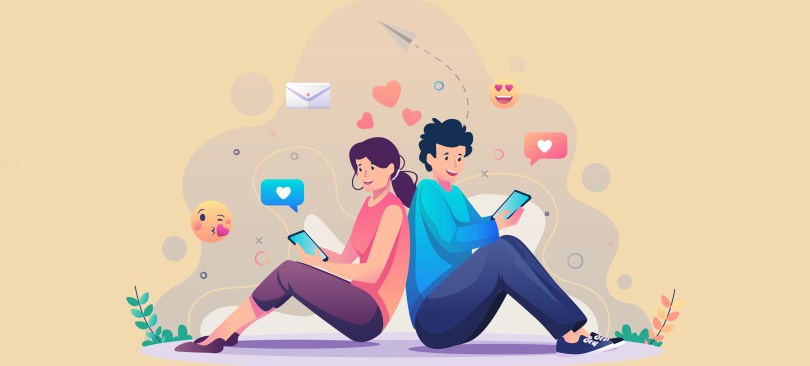
Modern dating is changing us. Not just how we meet partners, but how we relate to ourselves, our self-worth, our boundaries, our hope for connection. Something in today’s dating culture is making us forget who we are, what we deserve, and how to love ourselves first.
I’ve been watching, not just in my life, but in conversations, in friends’ stories, in what feels like the general pulse of modern love, and I’ve realised there’s something dark and quiet happening inside us. There’s something about today’s post-COVID dating world that’s not just reshaping the way we date, but the way we see ourselves. and I think it’s worth calling it out and us taking time to visit this…
Today’s post-COVID dating world is fast, unpredictable, and constantly in motion. Apps give us swipe-based access to hundreds of faces we never would have met 20 years ago. On paper, it looks like endless choice. In reality, it often produces:
- emotional burnout
- attachment anxiety
- confusion and insecurity
- fear of intimacy
- fear of rejection
We’re wired for love – but we’re living in a culture that prioritises availability over authenticity and options over depth.
We’re wired for connection – but the environment keeps pulling us away
As human beings, our biology and psychology are designed for connection, belonging, intimacy. From the moment we were born, being seen, held, accepted mattered. Security, attachment, we evolved to crave these things because they helped us survive and thrive.
But fast forward to now, apps, social media, endless options, midnight messages, “situationships,” and ghosting. On paper, we have more “freedom” and “choice” than ever. But in practice, many of us are more isolated, more anxious, more starved for real connection.
We’ve built a dating culture that normalises disposability and emotional detachment, a culture where it’s normal to treat intimacy like a transaction, and then wonder why we feel hollow.
So when someone shows even a gesture of interest, a kind smile, a compliment, a deep chat, even just attention, our nervous system reacts like it’s light. We crave that light. We lean into that possibility of warmth the way a plant leans toward the sun. It’s instinct, it awakens us, we WANT the light!
The biology of intimacy – why “casual” doesn’t stay casual
We tell ourselves we’re fine with casual. However our biology often thinks differently. Intimacy, emotional or physical – releases chemicals: hormones like oxytocin, bound up with bonding and trust; neurotransmitters like dopamine, tied with reward, pleasure, anticipation. Touch, warmth, closeness – they make us feel safe, seen, wanted.
Human beings aren’t built for disposability. Physically, emotionally, chemically:
- Oxytocin (bonding + connection hormone)
- Dopamine (reward + longing chemical)
- Vasopressin (attachment + pair-bonding hormone)
These aren’t psychological myths — they’re biology. Intimacy signals to the brain:
Once those signals hit us, we begin to tether, Not necessarily consciously, but deep in our limbic system: “This person made me feel something real.” Maybe for a night, Maybe for a conversation. But real enough.
When that tether is formed, the weight of rejection doesn’t just feel like a lost relationship – it feels like a disruption of safety, of attachment, of self-value.
That’s why sometimes, after the “casual thing,” heartbreak doesn’t feel casual at all. It feels raw, visceral, heavy, because we attached, and tried to convince ourselves “We just wanted fun”.
Attachment styles, vulnerability and the modern dating trap
Part of the struggle lies in our variation in attachment styles. Some of us find comfort in closeness; some recoil at it; some oscillate between the two. Roughly a third to two-fifths of adults show some kind of insecure attachment style (anxious, avoidant or disorganised). Among those, some lean toward anxious attachment – craving closeness and validation, but haunted by fear of abandonment or rejection.
In a dating environment rife with uncertainty (ghosting, mixed signals, hot-and-cold behaviour, ambiguous “situationships”), anxious people get caught in a loop:
- They seek validation: “If I can just get this person to like me – text me, stay with me – I’ll feel safe.”
- They become available, open, emotionally generous, seeking connection.
- But availability sometimes gets misinterpreted as access, not value.
- They stay, hoping for stability or love; but often meet inconsistency, indifference, or rejection.
- Their own emotional need is dismissed, ignored, or undercut – and they’re left feeling replaceable.
That leaves a deeper wound than just being single. It chips away at self-worth. It consumes us. We try to convince ourselves we have the power, but we don’t! We don’t at all, but our conscious mind will do anything to convince us, ‘We’re ok!’
The paradox of “availability” vs “value” in modern dating
Here’s the painful paradox I keep seeing and not only that, what I have experienced myself:
- If a person (often a woman) is warm, available, open to love – they are ready for connection. They offer emotional honesty, clarity, possibility.
- Yet, sometimes the people who are genuinely looking for that kind of connection don’t recognise its value. They expect something easier: fun, convenience, less emotional labour.
- On the other hand, a person who seems harder to get – more aloof, more “mysterious,” more reserved – can sometimes be perceived as more desirable simply because there’s a sense of challenge, of scarcity, of chase.
Sociologically and psychologically, it’s a glaring mismatch between what we need (authentic connection, emotional honesty, mutual respect) and what gets rewarded (scarcity, challenge, detachment).
It’s not about “blame” – it’s about recognising that the marketplace of modern dating values the wrong things and for those who come to it with softness, vulnerability, readiness for love – it’s often the hardest place to find what they genuinely seek.
Rejection: more than just “loss” it’s an identity fracture
When we get rejected, when someone disappears, or treats us like we were never a priority, it doesn’t just sting. It shakes something deeper. I myself have struggled over the years with this, even trying with various therapists to understand the root cause of it all, and I know the answers now, however for most of my life, I was left feeling unwanted, unloved and rejected..
- Validation-based self-worth: If a lot of our self-esteem depends on “being wanted,” then rejection becomes proof of inadequacy, unworthiness, or invisibility.
- Attachment rupture: Because our nervous system may have already started to bond, rejection doesn’t feel like a story that ends , it feels like a safe place collapsing, and our whole world is crumbling
- Internalising blame: We tend to whisper (or shout) to ourselves: “I’m too much / not enough / unlovable.” And instead of seeing that the system is what’s broken, we turn the mirror on ourselves.
In today’s environment, rejection isn’t just a breakup. It’s often felt like a personal failure.
What are we really chasing and what’s missing?
Maybe what we’re seeking is not another person. Maybe we’re seeking:
- To be seen, to feel that someone understands us beyond the surface.
- To be valued, to believe that who we are, what we bring, matters.
- To be safe , emotionally, physically, mentally.
- To belong, to connect, to share, to build.
What so many of us discover and sometimes too late, is that these things likely begin with self. If we don’t see ourselves as worthy, safe, valuable, and whole … then no external validation can truly fill that void.
And what gets missing in that chase is often self-respect, self-compassion, self-understanding.
Healing isn’t about “not wanting love” – it’s about redefining where love starts
We can’t necessarily change the system. We can’t rename apps. We can’t make society stop valuing challenge over emotional availability. But we can start changing ourselves. We can build a different inner story. One grounded not in external validation, but internal integrity.
Here’s a rough “healing script” I’m writing for myself , maybe you, or anyone reading this, might relate too:
- Recognise my own worth – independent of attention. I am worthy whether someone texts me or not. I am love; I don’t need someone else to confirm it.
- Slow down intimacy – emotional and physical. Intimacy doesn’t have to be fast. I give my body, my heart the time to read: “Is this person safe? Do I feel respected?” before I lean in. Of course as any sexual being, of course I crave intimacy, but after my celibacy journey I realised, what I have holds value to me.
- Cultivate inner validation, with self-care, self-love, self-respect. I get to look in the mirror and say: “You matter. You deserve respect. You don’t need to chase love – you need to walk towards it.”
- Seek emotional clarity – not just physical. I value people who show up with words and actions that match. I’m not afraid to ask: “What do you want? Why are you here?”!!! Don’t be afraid to as that! Sleeping with someone will not suddenly make them fall in love with you! Trust me im pretty confident in the bedroom, but it doesn’t cast them under some love spell!
- Set boundaries – protect my time, energy, heart. I will not compromise my self-respect just to feel desired or accepted. I will leave what feels like convenience rather than connection.
- Find belonging in my community and self-worth in purpose. Real love, trust, and belonging may come from friendships, passions, creativity – not just romantic pursuit.
- Hold space for growth, patience, and self-compassion. Healing takes time. I might stumble, I might be impatient. I choose to believe that I and the people who deserve me, are worth waiting for.
Conclusion: Relearning love from the inside out
This isn’t a manifesto against dating, sex, or modern love. I still believe in love. I still believe in connection. I still believe in the power of human closeness.
What we’re really fighting against, what we need to heal from, is the dissonance between what our hearts and bodies crave, and what this fast-moving world offers.
We’re not broken for wanting love, or for wanting closeness. We’re human. We’re wired for bonding, for care, for tenderness.
But maybe the first step is to stop chasing love as a drug. Maybe the first step is to reclaim love from within, to remind ourselves that we are already whole, already worthy, already enough. To remind ourselves its all just chemical reactions…
Maybe then, when we do open ourselves to another person, it won’t be out of desperation, longing, or validation-hunger, but out of a surplus of self-love.
Because the love we truly deserve isn’t transactional. It’s not earned by being “easy to get” or “hard to win.” It’s simply a reflection, of how much we respect ourselves, believe in ourselves, and hold ourselves worthy of loyalty, kindness, and care.
Maybe, if enough of us do that , change the way we love ourselves first, we begin to change the way we let others love us.
 The Girl Who