The Girl Who

1 am Kerry.

The girl who was never really seen.

The girl who learned to read a room before she learned to read a book.

The girl who knew when to be quiet, when to disappear, when to hold her breath and wait for the storm to pass.

The girl who experienced things no child should ever have to live through.

The girl who learned that sometimes the people who should protect you are the people who hurt you.

The girl who grew up too quickly, The girl who learned to cope, to adapt, to make herself small, to survive.

The girl who carried pain that wasn’t hers to carry, and learned to keep going anyway.

The girl who, later in life, found herself in relationships that were unsafe, where love became control,

where kindness could turn to cruelty, and the people she trusted again chose their own needs over her safety.

The girl who learned that home isn’t always a safe place,

and that leaving can be the bravest thing you ever do.

The girl who picked herself up.

The girl who carried herself out.

The girl who learned not to ask for too much, not to need too much, not to expect too much.

The girl who could survive anything.

The girl who turned her pain into purpose.

The girl who fights for every woman to make a stand against those who hurt them.

The girl who believes every woman should be in charge of their own body, their own choices and hold their own agency.

The girl who speaks up when other women are silenced.

The girl who uses her story to support, empower and help other women.

And everyone called her strong.

But nobody knew that strong was simply

what happened when a little girl had no other choice.

Because underneath the woman is still the girl who sometimes wonders

what it might feel like to be someone’s first thought.

The girl who wanted someone to notice when she was tired.

The girl who wanted someone to say,

“You don’t have to be brave today.”

The girl who wanted somewhere safe to put down everything she’s been carrying.

The girl who wanted arms around her that didn’t eventually let go.

The girl who wanted to be loved

without having to be so strong all the time.

The girl who wanted to know what it felt like to be rescued, without having to fall apart first.

She didn’t want saving because she was weak.

She wanted to be held because she had been holding herself for far too long

And now, when I look back at her, I don’t see a girl who was broken.

I see the girl who survived

The girl who kept going even when nobody knew how hard going was.

But perhaps she deserves more than survival.

Perhaps she deserves to know what it feels like when somebody else stays.

When somebody else holds on.

When somebody else looks at her and decides,

“T’ve got you.”

Maybe every girl out there is a girl who doesn’t need rescuing, but needs somebody to notice.

A girl who needs to be loved.

A girl who needs to be held.

A girl who needs someone just to hold out their hand and say, “I’ve got you”

Because in each and every one of us, there is

‘A Girl Who.’

We’ve all overcome things in our lives that have brought us to where we are now.

And maybe, just maybe, we can stop trying to rescue ourselves and not be ashamed to ever ask for help.

Christianity and Sex: What does the Bible really say about Premarital Sex?

The Christian Sex Debate Nobody Wants to Have

From premarital sex and sexual compatibility to fantasies, fidelity, and whether God really cares what happens in the bedroom.

Try Before You Buy? Does Christian sexual morality still make sense in 2026?

Let’s talk about sex.

More specifically, let’s talk about Christianity and sex.

Because there is something rather fascinating about the relationship between the two.

Christianity has a lot to say about love, marriage, fidelity, temptation, desire, self-control and sexual morality. And yet, for something that is such a fundamental part of being human, sex can still be one of those subjects that Christians find incredibly difficult to talk about openly.

And perhaps that is why I wanted to write this.

Not to attack Christianity, not to tell Christians what they should or shouldn’t believe and certainly not to suggest that there is only one way to be a Christian.

I am a Christian woman myself.

I have been married. I have been divorced. I have experienced love, heartbreak, intimacy and betrayal and as someone who has studied therapy and the psychosexual side of relationships, I have spent a lot of time thinking about what actually makes relationships work.

My own beliefs around sex are fairly simple.

I believe intimacy should mean something, I believe commitment matters, I believe trust matters, I believe kindness matters, I believe consent matters and I believe that when you become intimate with somebody, you are stepping into something that can be incredibly vulnerable for both people.

However, does that necessarily mean we have to wait until a wedding ceremony before we can discover whether we are sexually compatible?

Well, that’s where things get interesting.

Does the Bible actually say you can’t have sex before marriage?

The traditional Christian answer is essentially yes.

Catholic teaching is very clear that sexual intercourse belongs within marriage and that unmarried couples are called to live chastely rather than engaging in sexual relations. The Catechism describes marriage as a complete and lifelong mutual gift and says that sexual intimacy becomes part of that marital commitment. (Vatican⁠)

Many conservative Protestant and evangelical churches hold a similar position, interpreting biblical passages concerning sexual immorality, marriage and the “one flesh” relationship as teaching that sex belongs within marriage.

But there is an important distinction. The Bible doesn’t actually contain a simple sentence saying:

“Thou shalt not have sex before marriage.”

The traditional Christian position is an interpretation drawn from a collection of passages and theological principles. The traditional Christian teaching that sex belongs within marriage come from how a number of biblical passages about sexual immorality, marriage and sexual desire and the ‘One flesh’ relationship have been interpreted together, the traditional conclusion is simply very well established. If we look at examples to help us look deeper..

1. 1 Corinthians 6:18–20 – “Flee from sexual immorality”

This is probably one of the strongest passages for the traditional argument.

Paul says:

“Flee from sexual immorality… honour God with your bodies.”

He then connects sexual union with the “one flesh” language from Genesis 2:24. 

The traditional interpretation is essentially:

Sexual union is not morally neutral. Your body belongs to God, and sexual intimacy creates a profound bodily union, so Christians are called to avoid sexual relationships outside God’s intended framework.

The interesting bit is that Paul doesn’t spell out every prohibited scenario. He uses the broad category sexual immorality, which Christians have subsequently interpreted in different ways.

2. 1 Corinthians 7:2 – marriage as the answer to sexual desire

Paul writes:

“Since sexual immorality is occurring, each man should have sexual relations with his own wife, and each woman with her own husband.”

He then discusses mutual sexual responsibilities within marriage. 

The traditional interpretation is fairly obvious:

If sexual desire is difficult to control, marriage provides the appropriate context for sexual intimacy.

That’s one of the passages behind the historic Christian teaching that sex belongs within marriage.

But notice something important for your article: Paul is not writing a modern sex-Ed manual. He’s addressing a particular Christian community with particular questions about sexual behaviour, marriage and celibacy.

So we shouldn’t pretend the verse is more explicit than it actually is.

3. 1 Thessalonians 4:3–7 – “avoid sexual immorality”

This is another major passage.

Paul says:

“It is God’s will that you should be sanctified: that you should avoid sexual immorality…”

He goes on to talk about controlling one’s body “in a way that is holy and honorable” and not wronging or taking advantage of another person. 

Don’t exploit another person.

That fits beautifully with what you’ve been saying about kindness.

The traditional Christian sexual ethic isn’t only about “Don’t have sex.”

It is also about:

self-control + holiness + honour + not taking advantage of another person.

4. Hebrews 13:4 – “the marriage bed”

This is probably one of the most direct verses for the traditional position.

Hebrews says:

“Marriage should be honoured by all, and the marriage bed kept pure…”

and then contrasts the marriage bed with adultery and sexual immorality. 

Traditional Christians have understandably read this as supporting the idea that sexual intimacy has a particular place within marriage.

Again, though, it doesn’t literally say:

“Unmarried people must never have sex.”

It establishes a strong connection between marriage, sexual purity and the marriage bed.

5. Genesis 2:24 – “the two will become one flesh”

This one is incredibly important because it becomes a foundation for later Christian teaching.

Genesis describes marriage:

“A man leaves his father and mother and is united to his wife, and they become one flesh.”

Then Jesus repeats this teaching in Matthew 19:4–6, and Paul uses it again in 1 Corinthians 6:16 when discussing sexual union. 

This is where the traditional Christian concept becomes really interesting.

Sex isn’t regarded simply as:

two people doing a physical activity.

It is associated with becoming “one flesh.”

So the theological argument becomes:

If sexual union creates a “one flesh” relationship, shouldn’t that union belong within the covenant of marriage?

That’s a theological inference rather than a direct prohibition, but you can see exactly how Christians got there.

6. Matthew 19:4–6 – Jesus connects sex, marriage and “one flesh”

Jesus quotes Genesis when discussing marriage and divorce.

He says:

“The two will become one flesh.”

And then:

“Therefore what God has joined together, let no one separate.”

Again, Jesus isn’t specifically answering the question:

“Can an unmarried couple have sex?”

He’s talking about marriage and divorce.

But Christian theology has connected these passages together to develop the idea that sexual union belongs within the permanent marital relationship.

7. Ephesians 5:3 – “among you there must not be even a hint…”

Paul writes that there should not be:

“sexual immorality, or any kind of impurity…” among Christians.

This passage is particularly interesting because Paul places sexual behaviour alongside greed, obscenity, foolish talk and impurity.

So again, the emphasis isn’t simply biological.

It’s about character and how someone lives.

8. Colossians 3:5 – “put to death… sexual immorality”

Paul again tells Christians to put away:

“sexual immorality, impurity, lust, evil desires…”

This becomes part of the traditional Christian argument that Christians are expected to exercise self-control over sexual desire, rather than allowing desire to dictate behaviour.

Christianity isn’t necessarily saying:

“Don’t have sexual desires.”

It’s saying:

“Your desires don’t have to control your actions.”

That’s a very different proposition.

9. Matthew 5:27–28 – Jesus and lust

This is the famous passage where Jesus says:

“You have heard that it was said, ‘You shall not commit adultery.’ But I tell you that anyone who looks at a woman lustfully has already committed adultery with her in his heart.”

This is important because Christianity’s sexual ethic isn’t confined to physical behaviour. Jesus moves the conversation towards intention, desire and the inner life and that is exactly why Christian debates about pornography, masturbation and sexual fantasies become so complicated.

The question becomes:

What happens inside our minds as well as what we physically do?

 “When people say the Bible teaches that sex belongs within marriage, they aren’t pulling that belief out of thin air. There is a substantial biblical foundation for the traditional Christian interpretation however, there is also a difference between saying the Bible contains a number of passages from which this teaching is derived and saying the Bible contains one simple sentence explicitly prohibiting all sex before marriage.”

That doesn’t make the traditional interpretation meaningless. It simply means that interpretation matters and Christians have been interpreting Scripture for centuries.

There isn’t one giant Christian committee sitting somewhere deciding what every Christian in the world must believe about sex.

There are Catholics, Orthodox Christians, Anglicans, Baptists, Methodists, Pentecostals, evangelicals, progressive Protestants and many other traditions.

And… they don’t all agree.

Even the Church of England acknowledges that there are differences within Christianity over relationships, sexuality and family life, and its Living in Love and Faith work has deliberately brought together biblical, theological, historical, scientific and lived-experience perspectives. (Church of England⁠)

Perhaps that’s one of the beautiful things about faith.

We can believe deeply without necessarily believing identically.

So why does traditional Christianity put sex inside marriage?

I actually think Christians deserve a fair hearing here.

Because the traditional Christian argument isn’t simply:

“Sex is dirty.”

In fact, it is almost the opposite.

The traditional argument is that sex is so powerful that it deserves a meaningful framework around it.

Sex can create emotional attachment.

It can create children.

It can create vulnerability.

It can deepen a relationship.

It can expose parts of us that we don’t show everybody and it can hurt enormously when trust is broken.

Christian marriage is therefore supposed to be more than a legal document.It is intended to be a covenant: a promise of love, commitment, fidelity and mutual giving.

The Catholic Catechism describes marital sexuality as part of the total gift spouses make to one another, rather than something merely biological. (Vatican⁠)

And I actually understand that…I really do.

Because when you have experienced what happens when somebody breaks a commitment, you understand that fidelity isn’t just a word. It matters.

But what happens when the world changes?

This is where I think Christians need to have an honest conversation. We don’t live in the same society that existed hundreds or thousands of years ago.

People marry later.

People date differently.

People live together before marriage.

People meet through apps.

People form relationships across countries.

..and perhaps most importantly, sex is more accessible than it has ever been.

You can literally meet someone, message them, flirt with them, exchange photographs and potentially begin an affair without leaving your bedroom.

Technology has changed the landscape of relationships and yet our desire for love, intimacy and connection hasn’t changed very much at all.

British attitudes have also changed dramatically over recent decades.

Research from the National Centre for Social Research shows a significant religious divide in attitudes towards premarital sex, but also demonstrates how much more permissive British society has become. In British Social Attitudes data, 93% of people identifying as non-religious regarded premarital sex as rarely wrong or not wrong at all, compared with 82% of those identifying as Anglican or Roman Catholic and 66% of people identifying as other Christian. (National Centre for Social Research⁠)

So Christianity hasn’t disappeared from the conversation.

But it is now having that conversation in a very different culture.

Try before you buy?

That phrase sounds awful when we’re talking about human beings.

People aren’t cars, People aren’t houses, People aren’t handbags and relationships certainly shouldn’t be treated like Amazon purchases with a fourteen-day return policy, but underneath the rather cheeky phrase is a genuine question.

Should sexual compatibility be something we discover before making a lifelong commitment?

Because we encourage people to discover compatibility in so many other areas.

Do you want children? Do you want to live in the same place? Do you have compatible financial values? Do you communicate well? Do you want the same kind of lifestyle? Can you resolve conflict? Do you share similar values?

Why, then, is sexual compatibility sometimes treated as the one area where we shouldn’t find out anything until after we’ve made the commitment?

The traditional Christian answer is that sex isn’t simply another compatibility test. It’s part of the covenant.

I understand that.

But as somebody who has explored relationships and sexuality from a therapeutic perspective, I also think we have to acknowledge something uncomfortable:

Two people can love each other deeply and still be sexually incompatible.

…and sadly love doesn’t always magically fix that.

What if the sex doesn’t grow?

We’ve all heard the advice:

“Wait for the right person. If you love each other enough, the sex will develop.”

Sometimes it probably does. Sometimes couples learn each other’s bodies.

They communicate.

They become more confident.

They discover what works.

They become safer with one another and the sexual relationship grows alongside the emotional one.

BUT….. sometimes it doesn’t.

One person may have a much higher libido.

One may want more physical affection.

One may have fantasies the other doesn’t share.

One may be adventurous and the other more reserved.

One may see sex as essential to feeling connected while the other doesn’t.

None of that necessarily means either person is bad.

It means they are human beings with different needs and this is why I think sexual compatibility deserves to be discussed without automatically dismissing it as shallow.

Sex isn’t everything, but for many couples, it is something.

What I believe as a Christian woman

This is where I want to make my own position very clear.

I don’t personally believe that a Christian has to follow exactly the same sexual boundaries as every other Christian. We are all individuals with our own minds, and bodies and opinions, and wow isn’t that what makes the world so great!!

Some Christians believe sex should only happen after marriage.

Some Christians believe that sex can be morally acceptable within a deeply committed relationship even if that relationship isn’t formally married.

Some Christians take a much more conservative interpretation of sexual behaviour.

Others are considerably more liberal.

And I think we can have those disagreements without turning on one another.

Personally, I believe commitment matters enormously.

If I were becoming intimate with somebody now, I wouldn’t want it to be casual in the sense of emotionally meaningless.

I would want trust, I would want to know the person, I would want to feel safe, I would want honesty, I would want mutual attraction, I would want emotional connection and I would want to know that if we became intimate, neither of us was treating the other person as disposable.

That, for me, is where my Christianity and my personal values meet.

Not necessarily in a list of sexual positions.

Not in a rulebook.

But in how I treat another human being. So recently for me, I moved away from celibacy and did have intimacy with someone I genuinely looked at and thought.. there was a genuine chance of a future together. 

Because intimacy creates responsibility

I’ve thought about this particularly recently.

When you become intimate with somebody and then that person pulls away, it can leave you sitting with an enormous amount of confusion.

You can find yourself asking: Was it something I did? Did I misread the connection? Did intimacy mean something different to them? Did I become attached? Did they?

Why did it feel close one minute and distant the next?

And whether you’re Christian or not, there is something we need to remember.

There is another human being on the other side of our choices.

That matters….

If you know that intimacy creates vulnerability, then kindness matters. If you know somebody is becoming emotionally attached, honesty matters. If you know you’re not looking for a relationship, communication matters and if you’ve changed your mind, you are still entitled to change your mind.

But you should do so with kindness.

That’s important to me.

Because consent isn’t just about whether somebody agreed to have sex.

A healthy sexual relationship also involves honesty, respect and consideration for the emotional consequences.

Does God ask us to take responsibility for our choices?

I believe Christianity does.

The Bible repeatedly presents human beings as responsible moral agents.

Paul writes in Romans 14:12 that each person will give an account of themselves to God.

Galatians 6:5 speaks about each person carrying their own load.

Christianity’s concept of repentance only really makes sense if our choices matter.

But here’s the beautiful part.

Christianity doesn’t say:

“You must be perfect.”

It says:

“You are responsible for what you do, and when you get it wrong, there is a path back.”

That’s very different from shame and I think that’s something we sometimes lose.

Guilt doesn’t automatically make us better Christians

There is a difference between guilt and shame.

Guilt says:

“I did something I believe was wrong.”

Shame says:

“There is something fundamentally wrong with me.”

Those are not the same thing.

I don’t believe carrying enormous shame about sexuality automatically makes somebody a better Christian.

The Catholic Catechism itself recognises that when assessing personal responsibility, factors including psychological and social circumstances, anxiety, immaturity and habitual behaviour can affect culpability. (Vatican⁠)

Christianity has a concept called grace for a reason.

If the Christian life were simply about never making a mistake, none of us would stand much of a chance.

Are Christians supposed to have vanilla sex?

This might be my favourite question.

Because where exactly does the Bible say that good Christian sex has to be boring? It doesn’t. There isn’t a biblical list saying:

Missionary: yes.

Oral sex: maybe.

Anal sex: absolutely not.

Role play: consult your priest.

Lights on: questionable.

Lights off: definitely holier.

I’m being deliberately ridiculous here because sometimes we talk about Christian sexuality as though God handed humanity a bedroom instruction manual.

The reality is much more complicated.

The Song of Solomon is one of the Bible’s most sensual books, celebrating physical attraction, desire and erotic love.

Christianity isn’t inherently anti-sex.

Traditional Christianity is actually saying something much more interesting:

Sex is good, but it belongs within a particular moral framework.

The disagreement is about what that framework should be.

What about fantasies?

This is another area where Christians disagree.

Jesus’ teaching about lust in Matthew 5:28 has traditionally been interpreted as an important warning about the internal life of desire.

Catholic teaching, for example, places considerable emphasis on purity of heart, self-mastery and the intention behind sexual desire. (Vatican⁠)

But having a sexual thought isn’t necessarily the same thing as acting upon it.

Human beings have imaginations, we have fantasies, we have curiosity, we have desires that sometimes surprise us.

And perhaps the healthier question isn’t:

“Did I have a sexual thought?”

but:

“What do I choose to do with it?”

There is a world of difference between having a fantasy and exploiting another person. There is a difference between imagination and coercion. There is a difference between two consenting adults exploring their sexuality and somebody being pressured into something they don’t want and those distinctions matter.

What about being sexually adventurous within marriage?

Again, Christians disagree.

Some traditions impose considerably more restrictions on sexual behaviour than others.

Catholic teaching, for example, connects marital sexuality with both its unitive and procreative dimensions and places significant limits around what it considers morally permissible. (Vatican⁠)

Other Christians place greater emphasis on mutual consent, love, fidelity, conscience and the absence of harm.

So I don’t think it is fair to say:

“Christian sex must be vanilla.”

Nor is it fair to say:

“Anything goes because you’re married.”

There are Christians on both sides of that conversation.

..and that’s okay. People are allowed to interpret their faith differently. Everything is always down to those two consenting adults.

Catholicism, Protestantism and the importance of context

This is why I think we have to be careful whenever somebody says:

“Christians believe…”

Which Christians?

The Catholic Church has an authoritative Catechism and a very developed theology of sexuality, chastity and marriage.

Protestant Christianity is much more decentralised.

The Church of England is currently continuing its work on relationships, sexuality and gender following the Living in Love and Faith process.

The Methodist Church has also developed its understanding of marriage and relationships over recent years, explicitly acknowledging different understandings within the Church. Its guidance on relationships has described good relationships in terms including commitment, care and mutuality, while recognising that Christians can hold differing convictions. (The Methodist Church⁠)

That doesn’t mean every Protestant church agrees with every other Protestant church.

Quite the opposite and I think that’s worth celebrating rather than fearing.

What about other cultures and religions?

Christianity isn’t the only religion to have a strong sexual ethic.

Islam places significant emphasis on sex within marriage and discourages premarital sexual relationships.

Judaism has its own rich and varied traditions concerning marriage, intimacy and sexual ethics.

Hindu traditions are diverse, with different philosophical and cultural approaches to sexuality, marriage and desire.

Plus secular societies increasingly tend to frame sexual ethics around consent, autonomy, equality, safety and responsibility rather than religious prohibition.

There isn’t one global human consensus about sex.

There never has been.

Cultures develop different answers because sex sits at the intersection of biology, reproduction, family, religion, morality, identity and social organisation.

So perhaps the question isn’t:

“Which culture has the one perfect answer?”

Perhaps the question is:

“What values do we want our sexual relationships to embody?”

What does modern science tell us?

Science can’t tell us whether God considers premarital sex sinful.

That’s a theological question. However science can tell us about sexual health, relationships and the consequences of different forms of education.

The World Health Organization’s current guidance supports comprehensive sexuality education that includes relationships, consent, bodily autonomy, contraception, pregnancy and sexually transmitted infections. It says high-quality comprehensive sexuality education can delay sexual initiation and reduce sexual risk-taking while increasing contraceptive use. It also states that abstinence-only programmes are ineffective at preventing early sexual activity and risk-taking. (World Health Organization⁠)

That doesn’t mean Christians shouldn’t teach abstinence.

If a Christian believes abstinence is part of their faith, they should be free to teach and practise it, but education and personal conviction are two different things.

We can teach young people:

“You don’t have to have sex.”

while also teaching:

“If you do become sexually active, you need to understand consent, contraception, sexual health, boundaries, emotional consequences and respect.”

That’s not undermining morality, That’s responsibility.

Does having sex before marriage make you less of a Christian?

This is perhaps the question underneath all of this.

And I would say:

It depends upon what you mean by “less of a Christian.”

If somebody belongs to a Christian tradition that teaches premarital sex is sinful, then having sex outside marriage would be considered contrary to that teaching.

We shouldn’t pretend otherwise.

But does one sexual decision erase somebody’s faith?

Does it mean they no longer love God?

Does it mean they are incapable of being kind?

Does it mean they cannot repent?

Does it mean they are morally inferior to somebody who has never had sex?

I don’t think we can reduce Christianity to a sexual purity scoreboard.

What actually makes somebody a good person?

This is where I keep coming back to character.

You can be sexually inexperienced and still be cruel.

You can be sexually experienced and incredibly compassionate.

You can be religious and unfaithful.

You can be non-religious and deeply committed.

You can be married and betray somebody.

You can be unmarried and treat someone with extraordinary care.

Sexual history tells us something about a person.

But it doesn’t tell us everything.

And certainly not their worth.

Maybe kindness is the missing piece

Perhaps this is the part I most want to emphasise.

Whether you’re Christian, Muslim, Jewish, Hindu, atheist, agnostic or anything else, kindness should matter in our sexual relationships.

If you know somebody is vulnerable, be careful with them.

If you know they are developing feelings, don’t deliberately exploit that.

If you know you’re not available for a relationship, be honest.

If you change your mind, communicate.

If you make a mistake, own it….

If you hurt somebody, don’t hide behind technicalities.

and if somebody hurts you, remember that their behaviour doesn’t determine your worth.

That, to me, feels deeply compatible with Christianity.

Because Christianity is not simply about rules.

It is about how we love one another.

Love, sex and the reality of compatibility

I don’t believe that sex should be treated as the most important part of a relationship, but I also don’t believe we should pretend it doesn’t matter.

For some people, physical intimacy is a central expression of love. For others, it is less important. Neither person is necessarily wrong.

The challenge comes when two people have fundamentally different needs and neither feels able to talk about them. That is where communication becomes so important.

Perhaps we need to teach people that sexual compatibility isn’t about finding somebody who performs perfectly. It is about finding somebody with whom you can communicate.

Somebody who listens, Somebody who respects boundaries, Somebody who can tell you what they like without humiliating you for what you like. Somebody who can hear “no” without taking it personally, Somebody who can say “I don’t know” without feeling ashamed.

And somebody who can say:

“Let’s work this out together.”

Would I abstain from sex until marriage?

Personally?

No.

Not at this stage of my life. I’m 43. I’m an adult woman. I understand my values. I understand consequences. I take responsibility for my choices and I don’t think being Christian means I have to hand over my entire decision-making process to somebody else’s interpretation of Scripture.

That doesn’t mean I have no boundaries.

Quite the opposite.

There are things I would only explore with somebody I deeply trusted. There are things I would only do within a secure, committed relationship. There are things I would say no to regardless of how much I loved somebody and there are things I might say yes to because they felt right for me and the person I was with.

Those decisions would be mine.

And I Kerry, would take responsibility for them.

Perhaps that is what being liberated actually means

Being sexually liberated doesn’t have to mean:

“I will sleep with anybody and do anything.”

It can mean:

“I know myself.”

“I know my boundaries.”

“I know my values.”

“I can make an informed decision.”

“I can say yes without shame.”

“I can say no without guilt.”

“I can change my mind.”

“I can take responsibility for the consequences of my choices.”

And perhaps most importantly:

“I can respect somebody else’s humanity while still honouring my own.”

That’s a very different definition of sexual liberation.

So, is the Bible a bedroom rule book?

Maybe that’s the question we should leave ourselves with, because I don’t think Christianity needs to be afraid of conversations about sex.

I don’t think Christians need to be embarrassed about having sexual desires. I don’t think having fantasies automatically makes somebody dirty. I don’t think a person’s sexual history determines their spiritual worth and I don’t think sexual liberation automatically means moral recklessness.

But equally, I don’t think we should dismiss the traditional Christian sexual ethic as old-fashioned nonsense.

There is something profoundly valuable in the Christian insistence on fidelity, commitment, self-control, responsibility and the dignity of another person.

Those are values I can get behind.

The question is whether those values necessarily require exactly the same sexual rules for every Christian and I don’t think we can answer that honestly without acknowledging that Christians themselves disagree.

Maybe there isn’t one answer

Some Christians will wait until marriage.

Some won’t.

Some will believe sex outside marriage is sinful.

Some will believe that committed, loving relationships can have a moral sexual foundation even without marriage.

Some Christians will have very traditional sexual boundaries.

Others will be much more adventurous.

Some will have no problem with fantasies.

Others will feel uncomfortable with them.

Some will believe that particular sexual practices are wrong.

Others will believe that between consenting adults in a committed relationship, those decisions belong to the couple.

And I think we can disagree.

Actually, I think we should be able to disagree.

Because faith is personal.

Morality is personal.

Values are personal.

And ultimately, each of us has to live with our own decisions.

The Christian sex debate nobody wants to have

Perhaps the question isn’t:

“Are Christians allowed to have sex?”

Perhaps it’s:

“What makes sex loving?”

Is it marriage?

Is it commitment?

Is it consent?

Is it fidelity?

Is it responsibility?

Is it emotional safety?

Is it all of those things?

And perhaps the answer isn’t exactly the same for everyone. I can respect the Christian who chooses abstinence. I can respect the Christian who believes deeply that sex belongs within marriage and I can also respect the Christian who has wrestled with Scripture, thought deeply about their faith and reached a different conclusion.

What I don’t think we need is shame.

What I don’t think we need is judgement.

And what I definitely don’t think we need is the idea that somebody’s sexual choices automatically tell us whether they are a “good” or “bad” Christian.

Because perhaps the more important question is not simply what happened in the bedroom.

Perhaps it’s what happened between two human beings.

Was there honesty?

Was there kindness?

Was there respect?

Was there consent?

Was there responsibility?

Was there care?

Was there love?

Those questions matter to me.

Perhaps they should matter to all of us, regardless of what we believe happens after we die because if Christianity teaches us anything, surely one of the most important lessons is this:

We are responsible for how we love one another.

Perhaps that’s where sex, faith and morality meet.

Not in a perfect bedroom.

Not in a list of rules.

Not in shame.

But in love, responsibility, kindness and the choices we make when another human being has trusted us with something vulnerable.


When Success Meets Love: Do High Achieving Men Have Room for Relationships?

Exploring communication, ambition, emotional availability, marriage, children and the difference between being busy and having relationship capacity

Why do high achieving men struggle with relationships? Explore ambition, communication, emotional availability, marriage, children and relationship capacity.

There is a particular kind of dating confusion that can happen when you meet a highly successful man.

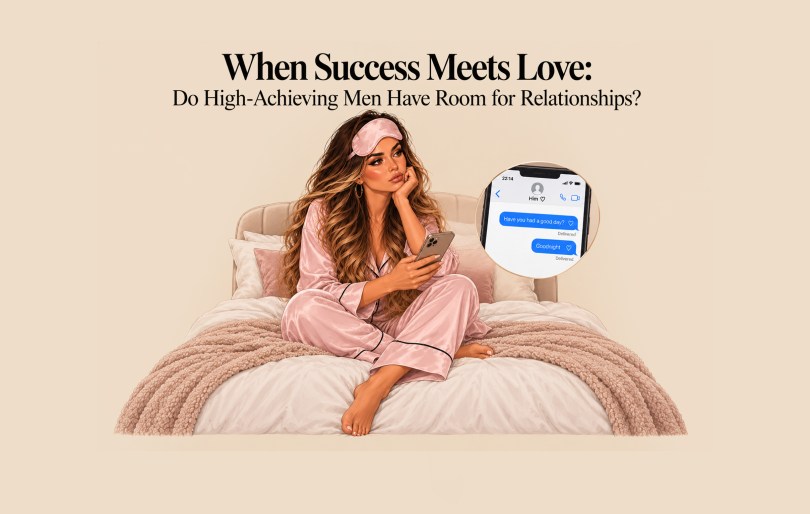
He works hard, he travels, he has a demanding career, he has meetings, dinners, networking events, friends, family, the gym, projects, responsibilities and a diary that appears to have been organised by someone with a personal vendetta against free time.

He is ambitious. Driven, Successful, Independent… and then there is you.

Waiting for the good morning text…Wondering why there wasn’t a goodnight message.

Looking at your phone and thinking:

He said he’d call. Then, at 10.47pm:

“Sorry, just got in. Crazy day.” And you think:

Is he genuinely that busy? Does he actually like me? Is this just what successful men are like? Am I expecting too much?

Or does he simply not have the capacity for a relationship?

This is where dating becomes less about reading messages and more about understanding behaviour, because being busy and being emotionally unavailable are not necessarily the same thing.

However sometimes, they can look remarkably similar…

High achievement does not automatically equal relationship capacity

We often make assumptions about successful people. If someone has built a successful company, developed an impressive career, accumulated wealth, travelled the world or reached a senior position, we can unconsciously assume they must also be highly emotionally intelligent and capable in relationships. However career competence and relationship competence are different skill sets.

Someone can be exceptional at business and struggle with intimacy. Someone can be brilliant at negotiation and terrible at expressing feelings. Someone can manage a team of hundreds of people and struggle to communicate consistently with one person they are dating. Someone can be incredibly disciplined professionally and chaotic romantically.

Achievement tells us something about what someone can accomplish.

It does not necessarily tell us how much emotional space they have available for another person.

And that distinction matters.

Is it a London thing?

Let’s get this out of the way.

It is not that London men are genetically incapable of sending a text.

Although sometimes, after dating for a while, you might reasonably begin to wonder. London has a particular rhythm.

Fast careers, Long working hours, Commuting, Client dinners, Networking, Travel, Property, Finance, Law, Entrepreneurship, Corporate life and Social commitments. There are people who genuinely work extraordinarily long hours, but there is another cultural element too.

Some highly successful people become exceptionally good at functional communication.

They can negotiate a multimillion pound deal.

They can manage a team.

They can organise a property development.

They can coordinate ten people across three countries.

But ask:

“How are you feeling about us?”

And suddenly the WiFi goes down.

Functional communication is easy.

“Meeting at seven.”

“I’m in Manchester.”

“Can’t do Thursday.”

“Call you tomorrow.”

Relational communication requires something different. It requires curiosity, vulnerability, consistency, emotional presence… And some people have simply never developed those muscles.

A high achieving man can still make room for connection

This is the bit I think women sometimes need reminding of.

A genuinely busy man can still send:

“Morning you. Crazy day today, but I’ll call you tonight.”

That takes seconds.

Or:

“Just got home and I’m absolutely shattered. Hope you’ve had a lovely day. Sleep well.”

Again, seconds.

Communication is not necessarily about having hours available.

It is about making room for connection within the time you actually have.A person does not need to be permanently attached to their phone to demonstrate interest, but they do need to demonstrate that the relationship exists somewhere within their priorities.

That is the difference…

There is a difference between being busy and being unavailable

A busy but emotionally available person might say:

“I’ve got a manic day today, but I’ll call you tonight.”

And then they call.

They might not message constantly, but they keep you informed.

They make plans.

They follow through.

They remember things you’ve told them.

They show curiosity about your life.

They don’t leave you perpetually guessing.

Someone with very little relationship capacity may look different.

They disappear for long periods.

Plans remain vague.

You initiate most of the contact.

They repeatedly cancel.

Communication happens when it suits them.

You receive affection in bursts rather than consistency… and you find yourself spending more time interpreting their behaviour than actually enjoying the relationship.

That’s exhausting.

The real issue may be consistency

We often ask:

“Does he like me?”

But perhaps the better question is:

“Is he consistent?”

Because someone can absolutely like you and still be a terrible communicator. Someone can be hugely attracted to you and still not have the emotional bandwidth to build a relationship. Someone can think you’re wonderful and still have a lifestyle that leaves no meaningful space for intimacy and someone can communicate brilliantly in the beginning because they are pursuing you, only to become inconsistent once the initial excitement settles.

So communication frequency is not necessarily the measure of interest.

Consistency, initiative and follow through are much more revealing.

A man does not have to text you every hour.

He does not need to report his movements.

He does not have to be permanently attached to his phone.

But you should be able to understand the rhythm of his communication.

You should not constantly be wondering where you stand.

Does he actually have relationship capacity?

This, for me, is the more interesting question.

We talk endlessly about whether somebody is attractive enough, successful enough, funny enough, wealthy enough, interesting enough or compatible enough.

But what about capacity?

Someone can have enormous financial capacity.

Career capacity.

Social capacity.

Sexual capacity.

And still have very little relationship capacity.

A person can be extraordinarily successful and genuinely have almost nothing left emotionally by the end of the day.

That does not make them a bad person, It does not mean they do not care. However it may mean they are not currently able to offer the kind of relationship another person needs. You cannot create emotional availability for somebody else. You cannot love someone into having more capacity. You cannot become sufficiently attractive, interesting or sexually compatible to manufacture time and emotional bandwidth that simply is not there.

And then there is the question we do not always want to ask

Is it because he does not like me enough?

Sometimes, yes.

But not always.

And I think this is where dating advice can become unnecessarily simplistic.

“If he wanted to, he would.”

It is catchy.

It is also not always true.

Adults have jobs.

Children.

Businesses.

Families.

Responsibilities.

Travel.

Stress.

Life.

People can care deeply about someone and still be inconsistent communicators, but the reverse is also true. Someone can tell you they are incredibly interested while giving you very little actual relationship behaviour. That is why words alone are not enough.

Look at the pattern.

Do not become a detective

This is perhaps one of the most emotionally draining parts of modern dating. You start analysing everything. He did not say good morning.

Why?

He normally calls at lunchtime.

He did not today.

Is he losing interest?

He said he was working late.

Was he really?

He has been online.

Why has he not replied?

He sent a heart yesterday and nothing today.

What does that mean?

Suddenly you are not dating anymore.

You are conducting an investigation.

And if you spend more time analysing someone’s communication than experiencing their companionship, something needs to change.

Not necessarily because they are doing something terrible.

But because the relationship is creating too much uncertainty.

Intermittent communication can become strangely powerful

There is another psychological reason inconsistent communication can feel so consuming. When attention and reassurance arrive unpredictably, they can become disproportionately attention grabbing.

One day there is affection, attention and connection.

Then silence.

Then a lovely message.

Then distance.

Then suddenly they are intensely interested again.

That unpredictability can make the connection feel more significant rather than less.

You start waiting for the next little hit of reassurance and that can create a cycle where you are constantly monitoring the relationship. This is why consistency matters so much.

Healthy connection does not need to be relentless.

It needs to be predictable enough that your nervous system is not constantly asking whether you are safe in the relationship.

What about the good morning and goodnight texts?

I love this conversation because people sometimes dismiss these things as needy.

They are not inherently needy.

They are preferences.

Some people genuinely enjoy little moments of contact throughout the day.

A good morning message.

A quick call.

A goodnight text.

A little:

“Thinking of you.”

Those things can create a feeling of continuity.

Other people do not naturally communicate that way.

Neither person is automatically wrong.

The question is whether their communication styles are compatible.

You do not need somebody who communicates exactly like you.

But you probably do need somebody whose communication style does not leave you chronically deprived.

High achievement can create a very autonomous lifestyle

There is something else worth considering. The more successful someone’s life becomes, the more independent it can become. They may be used to making their own decisions.

Controlling their diary.

Travelling when they want.

Working when they want.

Living where they want.

Spending their money how they want.

Managing their own environment.

That independence can be wonderful.

But relationships require something slightly different.

They require consideration.

Negotiation.

Compromise.

Flexibility.

Making decisions with another person’s needs in mind.

The question is not whether a successful man should give up his independence.

Of course he should not.

The question is whether he has learned how to integrate another person into an already highly autonomous life.

Because a relationship is not simply adding another person to your existing lifestyle. At some point, two lives have to begin making room for each other.

High achievement does not equal emotional maturity

This is another trap in dating. We can unconsciously assume that because someone is successful, intelligent, wealthy or highly accomplished, they must also be emotionally sophisticated.

Not necessarily.

Someone can run a successful business and struggle with intimacy.

Someone can be brilliant at negotiation and terrible at expressing feelings.

Someone can be highly disciplined professionally and chaotic romantically.

Someone can have enormous ambition and very little emotional availability.

Oh and sometimes, the very qualities that helped someone become successful can make relationships more challenging…

Drive can become workaholism.

Independence can become emotional distance.

Confidence can become an unwillingness to compromise.

A packed diary can become a life where nobody else really fits.

None of these things are inevitable.

But they are worth noticing.

If marriage and children are the goal, when do you make room for them?

There is another part of this conversation that we do not talk about enough.

What happens when a highly successful man reaches his 40s and says:

“I want to get married.”

“I want a wife.”

“I want children.”

Those are wonderful ambitions.

But if they are genuinely important, they cannot remain permanently in the category of “one day.”because relationships take time.

You do not simply meet someone on Tuesday, decide you want marriage on Wednesday and have a family by Friday.

You have to meet.

Date.

Get to know one another.

Work out whether your values align.

Discover whether you communicate well.

Establish sexual and emotional compatibility.

Navigate differences.

Build trust.

Develop commitment.

For couples who want children, there is another reality that needs to be acknowledged.

Fertility is not completely under our control.

Female fertility declines with age, particularly from the mid 30s onwards, and fertility difficulties become more common as women get older. That does not mean women in their 40s cannot have healthy pregnancies. They absolutely can. It does not mean every couple will experience fertility difficulties either.

But it does mean that fertility should not be treated as an unlimited resource that can simply be dealt with later.

This is where I think some high achieving men may need to have a more honest conversation with themselves. If you genuinely want marriage and children, when are you going to create the space for the relationship that could lead to them?

Because waiting until your mid 40s and then assuming:

“I’ll just find a younger woman.”

is not necessarily the straightforward solution people imagine.

Firstly, the woman has to want you.

Secondly, she has to want the same kind of relationship.

Thirdly, your values and lifestyles need to align.

Fourthly, she has to want children with you.

And fifthly, you still have to build an actual relationship.

Age does not magically manufacture compatibility.

A younger woman is not a fertility strategy. She is a person.

She has her own ambitions.

Her own timeline.

Her own relationship history.

Her own standards.

Her own hopes for marriage and family.

And she gets to decide whether the life someone is offering is one she wants.

This is not about blaming men for prioritising their careers

Ambition is not a problem, Success is not a problem. Wanting financial security before having children is not a problem. Building a career before settling down is not a problem.

The issue is whether the life you are building leaves room for the life you say you want.

If marriage and children are genuinely important, then partnership needs to become part of the architecture of your life rather than something you hope will somehow fit into the leftover space.

And there is an uncomfortable irony here.

Some highly successful men spend their 30s and early 40s building extraordinary careers, businesses, wealth and independence, while telling themselves that relationships and family can be prioritised later.

Then later arrives.

And suddenly they discover that dating is not an Amazon Prime catalogue where you simply select the age bracket you would like delivered to your door.

There are real human beings involved.

Women have their own ambitions.

Their own children or desire for children.

Their own fertility considerations.

Their own relationship histories.

Their own standards.

And they get to decide whether the life someone is offering is one they want.

And women have agency too

This conversation is not about telling women to wait patiently for a successful man to eventually decide he is ready.

We are allowed to ask questions.

What are you actually looking for?

Do you want marriage?

Do you want children?

What kind of timeline do you have in mind?

Do you actually have the capacity to build that relationship?

Those are not unreasonable questions when two adults are dating with serious intentions.

We do not have to be endlessly understanding of someone’s career while quietly putting our own needs on hold.

We do not have to become the easiest woman in the world to accommodate.

And we do not have to pretend that our time, our emotional energy and our hopes for the future are somehow less important because someone else’s career is impressive.

You cannot build a family with someone’s potential

This might be one of the most important lessons in the entire conversation. You cannot build a relationship with someone’s potential. You cannot build a marriage with what someone says they will eventually become. You cannot build a family with a future version of someone who might one day have more time.

You build it with the person who is actually showing up.

That does not mean someone needs to have everything figured out before they meet you…None of us do.

But there needs to be evidence that they are capable of creating space for the life they say they want.

So how do you know whether there is room for you?

Perhaps not by counting texts.

Perhaps not by analysing how quickly he responds.

Perhaps not by deciding that three hours without a reply means he has lost interest.

Look at the broader pattern.

Does he make plans?

Does he keep them?

Does he communicate when plans change?

Does he check in?

Does he remember?

Does he call when he says he will?

Does he ask questions?

Does he listen?

Does he show curiosity about your life?

Does he make space?

And perhaps most importantly:

Do you feel like a person he is building a life around, or an appointment he is fitting into one?There is a huge difference.

You do not need to win a place in someone’s diary

I think this is perhaps the biggest lesson. When we are attracted to someone who is highly successful, it can be easy to start treating their availability as a prize.

He gave me Thursday.

He called me.

He’s fitting me in.

He’s finally got some time.

But a relationship should not permanently feel like you are trying to secure an appointment.

You do not need to compete with someone’s career.

You do not need to become the easiest woman in the world to accommodate.

You do not need to suppress your needs so you do not look demanding.

You need to discover whether there is mutual room.

Because ultimately, relationships are not built from spare time.

They are built from intentional time.

And perhaps this is the real question

Not:

“Is he busy?”

Not:

“Does he like me?”

Not even:

“Why doesn’t he text more?”

But:

“Does this person have the capacity to build the kind of relationship I actually want?”

Because a man can be wonderful.

He can be successful, kind, attractive, funny, interesting, ambitious and driven.

He can genuinely like you…And still not have the capacity to give you the consistency and communication you need.

That does not necessarily make him wrong.. And girl, it does not make you needy.

It may simply mean your lives, expectations and emotional rhythms do not fit and that is something worth discovering early, because the goal of dating is not to convince somebody to make room for you.

It is to find out whether there is naturally enough room for both of you.

And sometimes, the most useful piece of information a person gives you is not what they say.

It is the pattern of what they repeatedly do.

Late Autism diagnosis in Women; Why Autistic women are so often misdiagnosed

I was speaking to a psychiatrist today, and it got me thinking about how many women reach their 30s and 40s before anyone realises they are autistic.

For decades, their difficulties may have been labelled as anxiety.

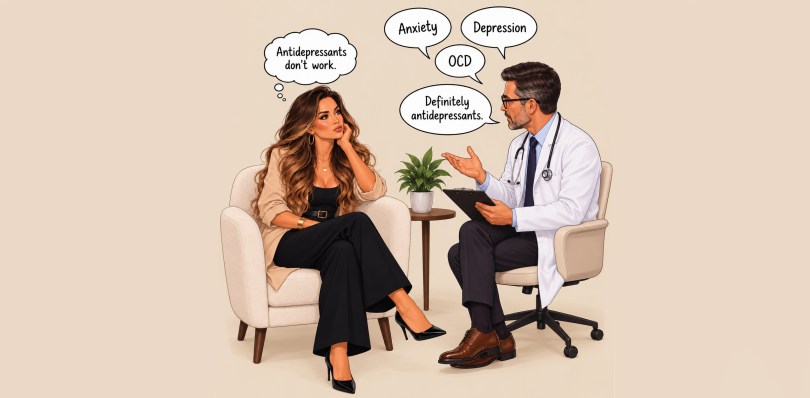
Depression, PTSD, being “too sensitive”, Being “overly emotional”, Being difficult, being unable to cope and sometimes, they are simply given antidepressants and sent on their way.

“Why is everything so overwhelming?”

Not just:

“Are you anxious?”

But:

“What has your relationship with the world, people and change always been like?”

Not just:

“Why can’t you move on from this relationship?”

But:

“What exactly is your brain trying to process about what happened?”

Because sometimes the woman who has spent her entire life wondering why she finds everything so much harder than everybody else isn’t broken.

She isn’t lazy, she isn’t dramatic, she isn’t anxious, she isn’t a recluse and She isn’t too sensitive.

She may simply have spent decades trying to navigate a world that wasn’t designed around the way her brain works and for some women, an autism diagnosis in their 30s or 40s isn’t discovering something new.

It’s finally being given an explanation for a lifetime of things that never quite made sense, and a final chance to understand their selves as a whole. 

For me personally, getting my own diagnosis was a long and difficult process. For a long time, I had essentially been written off as ADHD, but I always felt that there were parts of me that didn’t quite fit that explanation. I felt that so many of my traits were much more aligned with autism, but getting someone to actually look at the bigger picture wasn’t straightforward. 

There were several assessments, a lot of questioning and a lot of trying to make sense of things I’d experienced throughout my life. Then, finally, I got my autism diagnosis, and I cried, because these two Doctors understood everything and said what I was experiencing was just ‘My way’ and that I had been putting up a fight all my life, to conform to a Neurotypical world. 

What surprised me most wasn’t just receiving the diagnosis itself, but how much my understanding of autism changed afterwards. I had always associated the word “autism” with disability and, if I’m completely honest, I had my own stigma around it. It wasn’t until my son was diagnosed that I started looking at autism differently and becoming much more accepting of it. 

Then, when I began to understand my own autism, I started seeing the benefits too. I started understanding that my brain isn’t wrong , it simply works differently. It helped me look back at my life and understand why I’ve always been different, why I’ve always been quirky, why I’ve always had this intensity to me, why I experience emotions so deeply and why certain things that seem completely ordinary to other people can feel overwhelming to me. 

I realised why so many past lovers, had always said I become utterly fixated in the bedroom, ‘I apparently get a look in my eyes and I don’t focus on how I look, or bull shit, I’m just completely in the Sex Zone’, and this is actually down to Monotropism, where Autistic attention can become extremely  concentrated on one thing. In an intimate situation, that intense focus can mean you’re completely in the experience, rather than simultaneously thinking about how you’re appearing, what you should be doing next, or what your partner thing, and it’s one of the only times an autistic brain can be silenced, and become quiet because the intensity in sex in which you’re engaged in becomes the only thing your senses want. 

Now Monotropism doesn’t mean every Autistic woman is passionate or sexually responsive, but emotional responses, intense attraction, becoming absorbed, fixations and experiences sensory experiences different, is a high of intensity, and many of the Neurotypical people you’re Intimate with can be totally mind blown or on the other hand often intimidated.

So, whilst this doesn’t mean Autistic women can be better in bed, it just means, autistic women can experience intimacy, attraction and sensory experiences more intensely.

With my diagnosis, it even made me reconsider things people have said to me throughout my life. My child’s father, for example, would often tell me that I “lead with emotion and not logic.” Friends have said things to me that I don’t necessarily believe they intended to be hurtful, but I couldn’t understand why they were saying them because I genuinely assumed that people thought in the same way I did. I couldn’t comprehend why they couldn’t see things the way I could, just as they couldn’t comprehend why I saw things so differently. 

I think that’s one of the biggest misunderstandings between neurotypical and neurodivergent people: we can look at the same situation through completely different neurological lenses and assume the other person is simply being difficult, irrational, intense or weird. They’re not necessarily being any of those things. Their brain may simply be processing the world differently. My diagnosis has given me a completely different way of understanding myself. Instead of asking, “What’s wrong with me?” I’m learning to ask, “Why does my brain work this way?” And that shift has been enormous for me.

But what if we started looking at the whole picture?

What if we asked questions about how that woman has actually experienced life from childhood onwards?

Did she always prefer having one really close friend, rather than a big group?

Did having one person she trusted make friendships feel much easier?

Did she always prefer staying at home rather than going out?

Did social situations exhaust her, even when she seemed perfectly capable of handling them?

Did she become overwhelmed incredibly easily?

Did she struggle when plans changed?

Did she retreat from the world when everything became too much?

Did she spend enormous amounts of time thinking about decisions, analysing every possible outcome and then struggle to actually make the decision?

Did she have intense interests or become completely absorbed in particular subjects?

Did she repeatedly buy books, research things obsessively or become fixated on a new interest?

Did she experience a profound sense of injustice when something felt unfair?

And perhaps most interestingly…

Did she struggle to let go of people, situations or relationships that she felt had treated her unfairly? Because.. stop the press, this is something I think deserves far more understanding and discussing!!

There are women who become completely consumed by an ex-partner, a baby father, a friendship breakdown or a relationship that ended years ago, for what seems like most of their lives…

And their friends might say:

“Why are you still talking about him?”

“You need to let it go.”

“He’s moved on. Why haven’t you?”

But sometimes it isn’t simply that the woman is “hung up” on somebody.

There can also be a difference in how an autistic woman processes the ending of a relationship. If someone sits down with her, explains clearly that they don’t want to continue the relationship, gives her a reason and there is some sense of closure, she may actually be able to accept it, even if it hurts deeply. But when somebody suddenly disappears, ends things without explanation, changes their behaviour overnight, cheats or leaves her with unanswered questions, it can be much harder to process. The brain can get stuck on the why. What happened? What changed? What did I miss? Why wasn’t I told? Why wasn’t I given the opportunity to understand? And that unresolved sense of injustice or lack of closure can become something she keeps returning to. It isn’t necessarily that she wants the person back, it can be that she simply cannot make sense of what happened. 

For some autistic women, when something doesn’t have a logical ending, the mind can keep trying to solve it long after the relationship itself has ended. Sometimes there is a combination of fixation, emotional intensity, difficulty processing an unresolved situation and a powerful sense of injustice.

If something doesn’t make sense to her, if she believes she has been treated unfairly, or if there are unanswered questions, her brain may continue returning to it.

Not because she necessarily wants the person back. Not because she is deliberately dwelling on it, but because her brain hasn’t reached a sense of resolution and this is where autism can sometimes be misunderstood. 

That doesn’t mean every woman who struggles to move on from an ex is autistic. It doesn’t mean every woman with anxiety is autistic. It doesn’t mean every woman who stays at home, overthinks, feels overwhelmed or experiences relationship difficulties is autistic.

But there is a growing recognition that autistic women can present very differently from the stereotypical picture of autism , particularly women who have spent their lives masking, adapting and trying desperately to appear as though everything is fine.

They can become incredibly good at functioning.

Until they aren’t.

They can hold everything together until the demands of life become too much.

Then they may experience burnout, shutdown, anxiety, depression or what looks like an inability to cope.

And because the autism underneath it hasn’t been recognised, the treatment focuses on the symptoms rather than understanding the underlying reason for them. So, they get fed anti-depressants, higher dose, after higher dose, this tablet, that tablet, and still they feel the same… 

So perhaps we need to start asking different questions.

Not just:

“Are you depressed?”

But:

“Why is everything so overwhelming?”

Not just:

“Are you anxious?”

But:

“What has your relationship with the world, people and change always been like?”

Not just:

“Why can’t you move on from this relationship?”

But:

“What exactly is your brain trying to process about what happened?”

Because sometimes the woman who has spent her entire life wondering why she finds everything so much harder than everybody else isn’t broken.

She isn’t lazy.

She isn’t dramatic.

She isn’t too sensitive.

She may simply have spent decades trying to navigate a world that wasn’t designed around the way her brain works.

For some autistic women, social situations can involve a constant awareness of social conformity and how they are being perceived. A woman might be walking into the playground to pick up her child while her mind is already running through a hundred questions: 

Do I fit in here?

Does that mum like me?

Have I said something wrong?

Why aren’t they talking to me?

Do they think I’m strange? 

She might walk into a Pilates class and instinctively choose a place at the back, not because she doesn’t want to participate, but because she isn’t sure how she will be received or whether she might embarrass herself. This constant monitoring can make ordinary social situations exhausting. 

There can also be a tendency to analyse relationships and social dynamics very deeply, noticing changes in people’s tone, behaviour or body language and trying to work out what they mean. Forming friendships can also be different. Rather than wanting a large social circle, some autistic women may feel much more comfortable with one or two deep, trusted friendships where there is less need to constantly work out the rules of the group. Learning to step back from social conformity can sometimes help: instead of asking “Do these people like me?”, it can be more useful to ask “What do these people actually bring to my life, and how relevant are their opinions to me?” That shift doesn’t necessarily remove social awareness , autistic women can be extremely perceptive about other people, however it can help separate noticing someone’s reaction from feeling responsible for it. Someone else’s opinion doesn’t have to determine how a woman feels about herself, and she doesn’t have to change who she is simply to fit into a social environment. I learned long ago to look at people and think ‘What fucking joy do you bring to my lovely life’ – and most of the time it was Fuck all!! So what relevance do these people have, does it even matter if they like you or not, their judgement is on them, and not you. You be you, and realise you don’t need everyone to like you in this life, you are beautiful and just wired differently.

And for some women, an autism diagnosis in their 30s or 40s isn’t discovering something new.

It’s finally being given an explanation for a lifetime of things that never quite made sense.

Why Are Some Men Intimidated by Sexually Confident Women?

Through My Own Lens

Relationships, intimacy and confidence are deeply personal, and no two people experience them in exactly the same way. As I’ve grown older, I’ve found myself reflecting on how my own relationship with sex, confidence and femininity has evolved. Along the way, I’ve noticed certain patterns through my own experiences and through conversations with therapy clients. This isn’t about speaking for all men or all women. It’s simply an honest reflection of what I’ve observed, what I’ve lived, and the questions I’ve found myself asking.

Perhaps you’ll recognise some of it. Perhaps your experiences have been completely different. Either way, I hope it encourages a conversation about intimacy, confidence and the way we connect with one another.

For years I saw myself as quite submissive.

I like being feminine. I enjoy looking after myself, my child and my home. In a relationship I naturally fall into a softer role, and in the bedroom I always assumed I was more submissive too, it always felt natural.

But something has changed in that as I have got older.

Not because I became more dominant, god no, not because I suddenly became someone different. I think simply became more comfortable in my own skin.

The way I experience intimacy in my forties is completely different to how I experienced it in my twenties and thirties. Back then, like many women, there was always a little voice in my head.

Do I look okay?

Should I move like this?

Am I attractive enough?

Looking back, I wasn’t fully present. I think many women have sex while carrying insecurities into the room with them. Sometimes we’re performing without even realising it. We become so focused on pleasing someone else that we forget intimacy should also be something we experience for ourselves. As I’ve healed, grown, lost weight, become healthier and far more accepting of my own body, something shifted.

I don’t hide anymore, I don’t overthink, I feel completely at home in my own skin.

Ironically, that’s when I started noticing something unexpected.

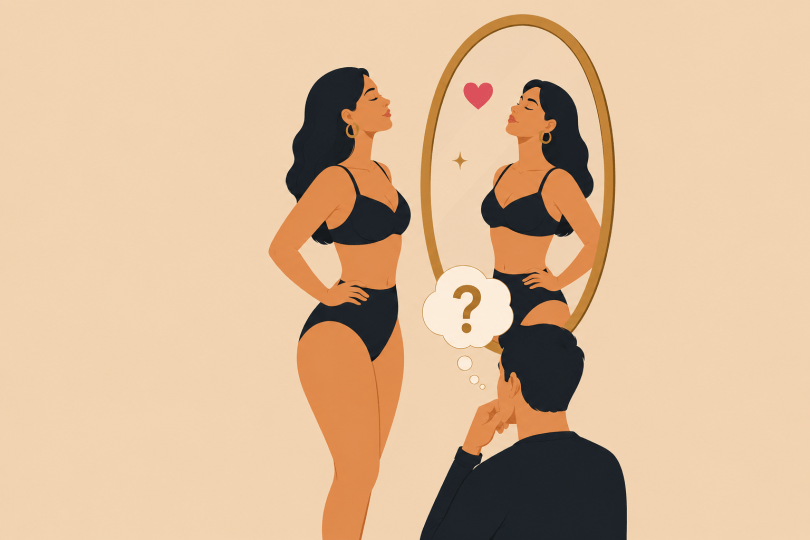
Some men seemed incredibly drawn to that confidence, Others seemed… intimidated by it.

Is Sexual Confidence Intimidating?

The answer isn’t yes or no.

It’s that confidence can expose insecurity.

Psychologists have long recognised that confidence in any area of life can sometimes trigger comparison in others. Rather than feeling inspired, some people feel inadequate. Intimacy is no different.

Sexual confidence isn’t about having countless partners.

It isn’t about being loud, outrageous or adventurous for the sake of it.

For me, it’s the opposite.

It’s about being emotionally present.

It’s about knowing what you enjoy, communicating honestly and allowing yourself to experience intimacy without shame.

Research consistently shows that women with greater body appreciation tend to report higher sexual satisfaction, greater communication with partners and lower levels of sexual anxiety. In other words, when we’re comfortable in ourselves, intimacy often becomes deeper rather than more performative.

“You’re Different”

One conversation has always stayed with me.

Last year I was in a committed relationship. Initially everything was wonderful. If I’m honest, it was probably the best sexual connection I’d ever experienced.

One evening we were lying in bed and he turned to me and said,

“You’re different to other women.”

I’ll admit, I braced myself for criticism, (he was the king of narcissism). 

Instead he said,

“I’ve been with a lot of women, but you’re different because you have sex for yourself as well as the other person. Most women don’t.”

That sentence has stayed with me ever since. At the time I didn’t fully understand what he meant. Looking back, I think he recognised something I’d never consciously thought about.

I wasn’t performing. I wasn’t worrying. I wasn’t trying to be someone.

I was simply present, Passionate, Connected.

To me, passion isn’t something reserved for the bedroom.

It’s how I approach life, I’m passionate about my work, About helping people, About healing, About relationships, About being alive.

Perhaps intimacy simply reflects that part of me. I think as with everything in life, I give it my all. 

Does Sexual Maturity Change as We Get Older?

One question I’ve found myself coming back to is whether women and men sometimes experience sexual maturity differently as they get older.

I can only speak from my own experience, but for me, confidence didn’t come from having more sex. It came from knowing myself better.

In my twenties and early thirties, I was far more aware of how I looked, whether I was “doing it right” and whether I was attractive enough. As I’ve got older, all of that has faded into the background. Today, intimacy feels less about performance and much more about presence. I know my body, I’m comfortable communicating, and I allow myself to enjoy the experience just as much as the person I’m with.

When I speak to other women, and to many of my coaching clients, I hear similar stories. Confidence often seems to grow as self-consciousness begins to fall away.

For many men, however, middle age can bring a different set of experiences. Careers become more demanding, family life becomes busier, stress increases, and for some, natural changes in sexual function can start to appear. UK research suggests that concerns about sexual health and performance become more common as men get older, even though many continue to value intimacy and want fulfilling sex lives.

I also can’t ignore something I’ve noticed through countless conversations with people over the years. I’ve spoken to middle-aged men who tell me they haven’t had sex with their partner for weeks, months or sometimes even longer. Equally, I’ve spoken to women who feel emotionally disconnected or who have simply stopped prioritising intimacy. It reminds me that this isn’t a “men’s issue” or a “women’s issue.” Long-term relationships can sometimes drift into companionship, routine and responsibility, leaving very little space for passion unless both people actively protect it.

That makes me wonder whether some couples can find themselves moving in opposite directions. Just as many women are becoming more accepting of themselves and more confident sexually, some men may be carrying pressures they’ve never had before. Not because they’ve become less masculine or less desirable, but because life changes us all.

Perhaps that’s why confidence can sometimes feel confronting.

Not because confident women are “too much”, but because genuine intimacy asks both people to be vulnerable.

I also find myself wondering whether this plays a small part in why some middle-aged men are drawn to younger women. Not because younger women are somehow better, and certainly not because all men seek younger partners, but because relationships where both people are still discovering themselves may sometimes feel less exposing than being with someone who already knows exactly who she is.

It’s simply a thought rather than a conclusion, but I think it’s an interesting question to ask.

Can Confidence Trigger Insecurity?

I’ve worked with enough people now to know I’m not alone in noticing this. Many women I’ve spoken to have shared similar experiences. Sometimes a sexually confident woman challenges expectations.

Some men have become used to being the one who leads, reassures or teaches. When they meet a woman who already knows herself and is comfortable expressing what she enjoys, it can shift the dynamic.

That doesn’t make those men weak. It simply means confidence requires confidence in return. Secure men often welcome openness because it creates honesty and better communication.

Less secure men may start questioning themselves.

Am I good enough? Has she experienced better? Can I satisfy her?

Those thoughts don’t always get spoken aloud, but they can quietly change the atmosphere within a relationship.

Sex Gets Better With Emotional Safety

One thing I’ve realised is that great sex isn’t really about technique. Anybody can have sex, come on you know how true that is… 

But genuine intimacy is different.

The best experiences happen when two people feel emotionally safe enough to stop performing altogether.

When there’s trust, laughter, curiosity, communication, acceptance, and when two people show the fuck up for each other.. they show each other, “I’m here, I’m yours, and I’m not going to fuck this up by playing games”!

That’s where connection lives.

Why I Don’t Date Casually

People are often surprised when I tell them that since the end of my long term relationship with my sons Dad,  I’ve only been sexually intimate in my personal life, with a couple of people over the last four years. Yes I have dated a few, but I have a way with men, where I don’t feel the need to show them who I am through sex. My personal world I guess can be so different, from perhaps any alter ego, I can play or come across as. 

For me, confidence hasn’t led to sleeping with more people. It’s actually had the opposite effect. I’ve become far more selective.

I don’t feel the need to give my body away simply because dating apps make casual intimacy feel normal, I mean what do I gain from that? Apart from making myself feel shit! Where is the reward for me? What a visit to the clinic, because men don’t want to wear protection? No THANKS!

I’ve reached a point where I value connection far more than attention.

Maybe that’s age, Maybe it’s healing, Maybe it’s simply knowing my own worth.

Either way, I no longer believe sex should be something we do because we’re lonely, bored or afraid someone else might come along. I’d rather wait for someone who genuinely values intimacy than collect experiences that leave me feeling empty.

It gives me such insight into the world, having this view, I know porn stars who have sex for money, but the sex they have on film, is not the sex they have with a partner. Many of them are choosing celibacy in their own life,  and you may sit there, not understanding that, but porn stars and sex workers, often become two people, and separate work and private life completely. The person they portray can be a million miles from the person they truly are. 

Are We Really Having Better Sex?

Dating apps have changed modern relationships. They’ve created endless choice, endless comparison and often a conveyor belt approach to dating.

But one question keeps coming back to me.

Are people actually having better sex because they have more opportunities? Or are they simply having more of it?

When I speak to people in long term relationships, it’s surprisingly common to hear things like, “We haven’t had sex for weeks”. Others describe intimacy that feels routine rather than exciting.

The statistics reflect this. Large surveys suggest that sexual frequency tends to decline in many long term relationships over time, and satisfaction depends far more on communication, emotional closeness and relationship quality than on how often couples have sex.

Perhaps the real issue isn’t how much sex we’re having.

It’s how connected we are while we’re having it.

Confidence Isn’t the Enemy

A sexually confident woman isn’t trying to compete.

She isn’t trying to dominate.

She isn’t trying to prove anything.

She’s simply comfortable enough to experience intimacy without apology.

The right man won’t feel threatened by that.

He’ll feel invited into something honest.

Because confidence isn’t about perfection.

It’s about authenticity.

And perhaps that’s the most attractive quality of all.

The Missing Ingredient: Are We So Busy Living That We’ve Forgotten to Love?

I feel like, in today’s day and age, we’re forgetting our age.

We’re forgetting how quickly time passes us by.

We’re spending so many years trying to cling on to our youth. Desperate to be seen. Desperate to be validated. Desperate to keep our options open. Desperate to have variety when it comes to sex. Desperate not to settle down too soon, commit too quickly, or somehow miss out on something better that might be waiting around the corner.

But in doing all of that, I wonder if we’re actually missing one of the most crucial ingredients of a genuinely happy life.

Love.

Meaningless hookups don’t make a happy life.

Yes, they might leave you feeling happy for a night. Maybe even for 24 hours. There’s excitement. There’s attraction. There’s validation. There’s that temporary high of being wanted.

But then what? 

Who do you call when something incredible happens?

Who hugs you when you’ve achieved something you’ve worked years for?

Who knows the tiny details of your life that wouldn’t mean anything to anybody else?

Who do you turn to and say, “Fuck it. Should we just go on holiday?”

Who do you build the memories with?

I seldom talk about myself personally in my blogs. As a coach and trainee therapist, I’m conscious of boundaries and how much of myself I bring into the work that I do, but on this occasion, I thought, why not… because recently I’ve started to realise something that actually brings me a great deal of sadness.

Some of the best years of my life, I’m spending alone.

We all look towards the future and think, I don’t want to grow old and be lonely.

But what if we’re looking too far ahead?

What if some of us are spending the best years of our lives alone right now?I’m in my 40s. I feel good in myself. I’ve done an enormous amount of healing, I’ve worked on myself, body and mind, I’ve built a life. I’m raising my child, I’m studying, I’m working,I’m travelling. I’m achieving things I’m proud of. Yet, sometimes, I look around at my friends who are in relationships.

They’re off to Italy. Mykonos. America. Australia.

They’re seeing the world. they’re going for date nights, they’re having weekends away. they’re building a collection of memories that belong to the two of them.

And then there’s me…. 

Going on my solo trips, Travelling with my child, waiting to see who can get childcare and plan that once a year night out…

And don’t misunderstand me, I absolutely love travelling with my child. Those memories are some of the most precious memories of my life. 

I have friends. I have family. I have a child I adore, I mean I’m not always sitting at home with nobody in my life… lol, But sometimes I sit there and think:

I’d love some romance in my life.

I’d love somebody to share all of this with.

I thought, last year, that maybe I’d found that.

It wasn’t meant to be.

If I’m completely honest, it felt like 50% of the relationship was love bombing and the final three months were spent with me acting as a personal therapist. The push pull dynamic, never knowing where you stand is Toxic, and not for my own attachment style at all..

Wrong person… Wrong relationship. 

Perhaps even the wrong relationships can teach us something about what we actually want. I remember being in Ibiza once and going on a date with a gorgeous Portuguese guy called Francisco. We had such a good date.He took me for a beautiful dinner. We went for drinks. We talked.

And at one point, he looked at me and said:

“Kerry, do you get lonely?” as we talked about what it’s like to be single..

And I said no.

Because I’m not lonely… Not in the traditional sense of the word, more so in an empty bed kind of way! As a mother, I have my child. I have friends. I have family. I have people I love and people who love me.

But there’s a particular kind of connection I miss.

I miss my person.

Recently, I completed another year of study. I got the message congratulating me on passing and in that moment, I missed having somebody there to congratulate me.

Someone to give me a hug.

Someone to ask how I felt.

Someone who understood how much work had gone into getting there.

And equally, I miss being that person for somebody else.

I miss praising someone.

I miss making somebody feel good.

I miss having someone walk through the door and being genuinely excited to hear about their day.

I miss having somebody say:

“Fuck it. Should we just go on holiday?”

Or:

“Should we go out tonight?”

I miss the spontaneity that comes from having somebody to do life with.

And recently I’ve realised something.

Life is just passing by.

We’re such slaves to work. Slaves to money. Slaves to our schedules. Slaves to this idea that we need to have everything sorted before we’re allowed to make room for love.

We tell ourselves:

I’m too busy.

I’ve got too much going on.

I haven’t got the capacity for a relationship.

Maybe when work calms down.

Maybe when the children are older.

Maybe when I’ve healed a little bit more.

Maybe when I’ve achieved this.

Maybe when I’ve sorted that.

But when exactly is life going to become completely uncomplicated?

Probably never.. and I think I’ve been guilty of this too.

Sometimes I push people away because I tell myself I’m not ready.

I tell myself I don’t have the time or capacity for a relationship because I’m so busy with work, but maybe they just haven’t been the right people.

Because there’s an important distinction here.

I don’t need anybody, but I would like somebody.

There’s a huge difference.

But I also wonder whether some of us have become a little too good at not needing anybody.

We celebrate independence. We celebrate the person who has been hurt, picked themselves back up, built their own life and learnt how to stand completely on their own two feet and rightly so.

However, psychologically, there’s something interesting that can happen when you’ve spent a long time having to rely on yourself. Independence can become more than a strength. It can become protection.

You become so accustomed to solving your own problems that asking for help feels uncomfortable. So used to carrying everything yourself that letting somebody carry something for you feels almost unnatural. So capable of regulating your own life that allowing another person into it starts to feel like a disruption rather than an addition and perhaps that’s where hyper-independence can creep in.

There’s a difference between I can do this alone and I must do this alone.

There’s a difference between choosing independence and being so afraid of depending on another human being that you never allow yourself to experience interdependence, the healthy middle ground where two capable people choose to lean on each other without losing themselves.

I think that’s something I’ve had to question within myself.

Am I genuinely too busy for a relationship?

Or have I become so accustomed to doing everything myself that I’ve convinced myself there simply isn’t room for another person?

Because maybe the goal was never to need nobody.

Maybe the goal was to know that I could survive alone, while still allowing myself to admit that life might be nicer shared.

I don’t want somebody because I can’t survive alone. I’ve already proved that I can. I don’t need someone to rescue me. I don’t need somebody to financially support me. I don’t need somebody to give me an identity.

I’ve built my own life.

But being capable of doing life alone doesn’t necessarily mean I want to do all of it alone. I want somebody who matches my energy.

I want somebody who asks me how I am in the morning.

“Good morning, baby. How did you sleep?”

Someone who checks in during the day.

“How’s your day going?”

Someone who says goodnight.

“Goodnight, darling.”

It doesn’t have to be constant communication. We’re adults. We’re busy. We have jobs. Children. Responsibilities.

However, I miss those little moments of knowing that somewhere in the world, somebody is thinking about you.

That ten-minute phone call at night:

“I just thought I’d ring you. I miss your voice.”

That’s what I miss.

That person checking in.

That person to share it all with.

Although, I have female best friends whom I’m incredibly grateful for, I miss having a best friend who is also my partner.

Someone who’s your lover, your teammate, your safe place and the person you laugh with over something nobody else would find remotely funny.

When I became single and left my child’s father, I left because I needed to find myself, I needed to find happiness, I needed to heal. I needed to grow and spread my wings like a butterfly.

I had been in an unhappy relationship, but I was also very unhealed and very unhappy within myself at the time.

So I left, I found myself, I built a different life and somewhere in the back of my mind, I think I always assumed I’d meet somebody.

When I met someone in 2025, I remember thinking:

Yeah. I’m ready for this.

Sadly, he wasn’t the right person.

I chose wrong.

However that doesn’t mean wanting the relationship was wrong.

Lately, I’ve had the strangest feeling, I can’t even properly comprehend it. I almost feel like maybe there’s a relationship around the corner. Of course I’ve chatted to people. I’ve been on a couple of dates over the past couple of years, but recently I’ve found myself looking at the people in my life and wondering:

Have I already met him?

Is it somebody I’ve never had a relationship with before?

Could it be somebody from my past?

For me, it’s rarely going to be somebody old because I don’t particularly like looking backwards, an ex is an ex for a reason….

Or is he somebody I haven’t met yet?

I genuinely don’t know.

I just have this weird gut feeling I’ve had for the last few weeks that maybe there is somebody out there for me.

Perhaps the bigger realisation is this:

Maybe I have to make myself available for him.

Not available in the sense of downloading every dating app and desperately searching for a relationship.

Emotionally available.

Making space.

Stop telling myself I’m too busy.

Stop telling myself I’ve got too much stress.

Stop telling myself I’ve got too much pressure.

Maybe if I let the right person in, some of that stress wouldn’t feel quite so heavy. Maybe life isn’t supposed to be something we carry entirely by ourselves.

So what are we doing as human beings?

Why do we push away good things because we tell ourselves we haven’t got time for them? the irony is we’re right.

We haven’t got time.

Just perhaps not in the way we think.

We haven’t got unlimited time.

We’re spending it every single day.

We’re just not always spending it on the things that will matter when we look back.

I look at my own life and think:

I’m always working.

I’m studying.

I’ve got my child.

Where exactly am I supposed to fit a relationship into all of this?

But then I think about last year, I had fewer staff, I was arguably even busier.

Yet somehow I fitted a relationship in perfectly.

It worked, It worked around childcare, It worked around work.

We gave each other time.

Sometimes it was simply a couple of nights a week being in his arms and it was nice.

Again, wrong person.

Perhaps that relationship taught me something important. When the cards are actually on the table and a relationship is genuinely on offer, I can make space for it.

Maybe I do want a relationship…. Actually, I know I do.

Because I don’t want to spend the best years of my life, in my prime, creating all these incredible memories and have nobody beside me who remembers them too.

I don’t want to meet somebody in my 50s and say:

“Do you remember when I did this?”

“Do you remember when I went there?”

And then realise: No. Of course they don’t.

Because they weren’t there.

Sometimes I look at older couples who’ve spent decades together. They’re old, they’re grey, life has slowed down, yet they have this enormous invisible library between them.

A lifetime of memories.

“Do you remember that holiday?”

“Do you remember when the children were little?”

“Do you remember that ridiculous restaurant?”

“Do you remember when we got completely lost?”

“Do you remember when we couldn’t stop laughing?”

Their bodies have aged, their lives have changed, but they have decades of remember whens. I’ve come to realise something I genuinely didn’t think I’d ever say.

I’m not just ready for love.

I’m ready for somebody to share my life with.

I’m ready to build memories with somebody.

I’m ready to grow alongside somebody.

I’m ready to create a family life together.

I’m ready for a partner.

..and believe me, I’m quite stubborn. It’s taken me a while to admit that.

Because our culture celebrates independence—and rightly so.

We tell people:

You don’t need anyone.

Learn to love yourself.

Be happy alone.

Don’t settle.

Know your worth.

And all of those things are important.

But I wonder whether somewhere along the way we’ve taken a healthy message and pushed it too far. We’ve started confusing independence with emotional isolation. We’ve started treating needing connection as weakness. We’ve become so frightened of appearing needy that sometimes we’re afraid to admit we have needs at all. We tell ourselves that the second somebody doesn’t meet every expectation, we should cut them off.

That there’s always another option.

Another swipe.

Another person.

Another date.

Another body.

We’ve created endless choice while somehow becoming increasingly disconnected and I wonder whether modern dating has inadvertently taught us to approach human beings like products.

We scroll. We swipe. We compare.

Too short.

Too tall.

Too available.

Not available enough.

Too keen.

Not keen enough.

Wrong job.

Wrong location.

Wrong shoes.

Next.

Of course, having standards is important. Boundaries are important. Compatibility matters enormously, but the paradox of having so much choice is that sometimes, instead of making us more certain, it can make us less satisfied with whatever we choose.

There’s always the lingering possibility that somebody better might be one swipe away and relationships don’t work particularly well when we’re constantly looking over somebody’s shoulder to see who else has just walked into the room.

I also wonder if we’ve created something of an avoidant dating culture.

Not because everyone is avoidantly attached, that would be far too simplistic, but because many of the behaviours modern dating normalises can look remarkably similar to emotional avoidance.

Keeping things casual, Keeping your options open, Not defining the relationship. Pulling away when things become emotionally intense. Ghosting rather than having an uncomfortable conversation.

Moving on to somebody new rather than working through vulnerability with the person standing in front of you.

We call it freedom.

Sometimes it is.

But sometimes, I wonder if what we’re actually doing is becoming incredibly skilled at avoiding attachment, because real intimacy isn’t found in endlessly meeting new people. It’s built when you stay long enough for somebody to actually know you. Not the version of you on the first date. Not your best photographs. Not your funny stories. Not the version who is effortlessly cool and definitely doesn’t care whether they text back.

You.

And perhaps that’s the uncomfortable thing about love. At some point, you have to stop browsing.

You have to choose.

And then you have to allow yourself to be chosen too.

Maybe that’s why some of us are still single.

Not because there’s nobody good enough out there, Not because we’re broken, Not because love isn’t meant for us, but because somewhere along the way, we became so good at protecting our peace that we forgot love requires us to open the door occasionally.

Of course, boundaries matter, Mine certainly do. If somebody consistently doesn’t give me attention, effort or emotional availability, I will walk away.

I don’t need to chase anybody.

There’s a difference between having boundaries and building walls. There’s a difference between recognising the wrong person and never giving the right person enough room to get close and perhaps that’s the question some of us need to ask ourselves:

Are we genuinely unavailable because life is too busy, or are we using busyness to protect ourselves from being vulnerable again?

Because love does require vulnerability. It requires making room. It requires allowing another human being to matter to you and yes, that means they could hurt you.

But they could also love you. They could also make an ordinary Tuesday feel like something worth remembering. They could be the person sitting beside you decades from now saying:

“Do you remember when…?”

So I asked myself a very simple question.

What do I actually want?

Do I want money? Not particularly.

As long as I have enough to pay my bills and live my life, I’m happy.

Do I want a healthy, happy child? More than anything in the world.

Do I want love? Yes.

Do I want happy memories? Yes.

Do I want a lifetime of togetherness? Yes.

I do.

Maybe that’s the ingredient we’re missing.

Not another achievement, Not another pay rise, Not another follower. Not another person finding us attractive. Not another meaningless hookup. Not another opportunity to prove we don’t need anybody.

Maybe it’s simply having somebody beside you who makes you feel glad you’re alive.

Someone to witness your life.

Someone whose life you get to witness too.

Someone to celebrate with.

Someone to comfort.

Someone to travel with.

Someone to laugh with.

Someone to come home to.

Someone who remembers.

Because one day, if we’re lucky, we’ll all grow old and perhaps the question isn’t only:

Who will be there when I’m old?

Maybe the question we should be asking ourselves now is:

Who do I want to build the memories with that we’ll talk about when we get there?

I don’t need somebody to complete my life.

My life is already full.

But I’ve finally realised… I’d quite like somebody to share it with.

Maybe I’ve spent long enough telling myself I’m too busy for love, because the truth is, life isn’t waiting for any of us to become less busy.

It’s happening now and I don’t want to miss it….

Everything Happens for a Reason – The American Dream

I flew 8,500 kilometres to follow my heart.

Not to chase anything, just to listen to that quiet inner pull that told me I needed to be here. I knew there was a risk. I knew the outcome might not be what I hoped for, and it wasn’t.

What I thought would happen didn’t happen.

But what did happen has changed my life.

Last year was one of the hardest years I’ve ever lived through. I’ve become very good at wearing a mask, hiding the sadness in my eyes, disguising the cracks in my confidence, especially in places where I once felt strong. I show up smiling, even when parts of me are still healing.

This trip stripped that mask away.

The first day here was filled with joy. The second day, it all disappeared. Everything I thought this journey was about was taken from me in an instant and instead of sitting in it, instead of becoming bitter, playing the victim, or feeling sorry for myself, I made a decision.

I chose kindness.

I chose to go out into the world and give what I still had left. Not because I expected anything back, but because being kind makes me feel whole. And if kindness returns, that’s beautiful, but it doesn’t need to.

So I complimented elderly women.

I bought an old man a mango tea.

I spoke to strangers.

I made friends.

I shared socials with photographers.

I laughed with people I’d never met before.

I had conversations with potential love matches that reminded me I’m still open, still hopeful.

And suddenly, this week became a week of discovery.

A week that felt… meant to be.

I’ve always felt drawn to America. No matter where I’ve lived, I’ve rarely felt truly at home, but every time I’m here, especially this time, there’s a deep, unexplainable sense of belonging. Not the kind you get when you’re on holiday and fantasise about a new life, but a quiet knowing. A feeling in my bones that says, this place matters.

I don’t know how that fits into my life yet, especially with a young child and a father who loves him deeply, but I trust that clarity will come when it’s meant to.

One thing that surprised me about LA is how obsessed the world thinks it is with perfection. Beautiful people, perfect faces, flawless bodies. You wonder how you could ever fit in.

And yet… everywhere I went this week, I was met with kindness and unexpected affirmation.

I went on a date with a truly lovely man, someone I’d known only as an Instagram connection for years. He drove an hour and a half just to spend the day with me, showed me the Hollywood sign, took me to dinner in Beverly Hills, and gave me his time and presence. There was no romantic compatibility, but he had one of the most beautiful souls I’ve encountered.

At one point he looked at me and said, “You’re the most American British woman I’ve ever met.”

As we walked around Beverley Hills, he told me to look, and he told me I stood out, He told me people noticed me, everyones heads turned…

And they did.

Women complimented my outfit.

Strangers asked if I worked in TV.

People asked if I modelled.

They told me my hair was fabulous, that I looked pretty, that I carried myself beautifully…

As a 42-year-old woman, that kind of attention can feel uncomfortable, even embarrassing. But this time, I let it in. I needed it. Not for my ego, but for my spirit. For the parts of me that had forgotten their worth.

This trip reminded me of something important:

There are two types of people in this world.

Those who say they are kind, and then hurt others without hesitation.

And those who show kindness through action, consistency, and integrity.

This week showed me exactly which one I am.

I don’t just call myself a Christian — I live it. I believe in the words from Matthew: “Treat others as you would like to be treated.” Being a Christian isn’t about what you say on Sundays; it’s about how you show up when it’s hard. When you’re hurting. When it would be easier to close your heart.

And I won’t close mine.

No matter how much pain I experience, I will never stop being kind.

I will never stop showing up.

I will never stop loving.

This journey, this unexpected, imperfect, emotional trip, has reminded me that everything truly does happen for a reason. I was pulled here for a reason, even if I don’t fully understand it yet.

The Signs I Couldn’t Ignore

As this week comes to an end, I’ve realised it wasn’t just the experiences that changed me, it was the signs, Quiet ones, Gentle ones, The kind you don’t notice unless you’re finally still enough to listen.

Yesterday I sat alone on the beach, the ocean stretched out in front of me, my heart heavy from the emotional rollercoaster of the week. I had a tear in my eye when someone came and sat a few metres away, music blaring from their speaker…. and then it played , Red Red Wine by UB40. You never hear that song anymore, But there it was and I won’t explain why it matters to me only that it does. Deeply. In that moment, looking out across a California beach with that song playing, I knew. I knew why I was here.

Every time sadness crept in this week, I walked, and every time I walked, I was reminded of something familiar, something grounding. One day, while quietly sharing my sadness, Dexys Midnight Runners came on, my life anthem. The song that has carried me through more than anyone knows. Hearing it felt like a nudge: Back in the room, Kerry. You’re okay.

And then there was the word Joe.

Everywhere I looked, it appeared. Cafes, Fridge magnets, Sign, Small ordinary places, to me, it wasn’t ordinary. It reminded me of my son, It reminded me of my Grandad. It gave me strength when I needed it most. Too many times to be coincidence, this week.

There is a reason I’m here. I don’t know what it is yet, and I wish I had the answers now. I trust that one day I will. Whether the reason is joyful or painful, big or subtle, it matters, America has always felt like this to me, I never feel home anywhere, but here.. yes my God, I feel home. There is a pull here, the strongest pull I’ve ever felt.

And no, it has nothing to do with the original reason I came. That chapter ended, not by my choice, but by having my vulnerability met with unkindness, by being left in shock when all I needed was compassion. But instead of letting that define this journey, I chose goodness.

I rode the buses, trams, bikes even though everyone told me not to use public transport, I am no snob and I wanted to feel part of something, To see everything, To experience the city as it really is. I ended up on the weirdest, most wonderful bus journeys through LA’s rougher parts, and then somehow found myself walking through Rodeo Drive, feeling like I’d stepped into a Pretty Woman dream.

And that’s when it hit me.

Life really is special.

Even in pain.

Even in disappointment.

Even when plans fall apart.

Especially then.

This week reminded me that meaning doesn’t always arrive the way we expect, but it always arrives when we’re open enough to receive it, and for that, I am endlessly grateful, and as I conclude this, just finishing a call with my son and his father, I’ve just been told, my ex would move here in a flash, and has offices all over here.. maybe the dream isn’t too far away…

I can’t wait to bring Joe back … Is this home? Let’s see…

The Men of 2025: How my year of Dating Hell, and Hard-Learnt Lessons, can help you spot Red Flags!

What the hell happened!!??

Sex, fantasy, consistency — and why modern dating keeps breaking women

After a long period of celibacy, I met my ex-boyfriend — let’s call him The Lion. We don’t need his real name.

The Lion, The narcissist.

In fact The grandiose narcissist.

He was very handsome, Beautiful, actually. Perfect white teeth. A full head of hair, (two hair transplants because one wasn’t enough). He was sexy, but not my usual type. I normally go for taller, lean, athletic men with no tattoos. He was huge. Six foot tall, probably six foot wide. Muscly. Strong. Dominant.

He wasn’t my type — and yet something about him completely undid me.

I found him intensely attractive, in a way I hadn’t experienced before. Maybe because he wasn’t my normal type. Who knows. But the sex between us was off the scale. Raw. Animalistic. Lust-driven. Some of the best sex I’ve ever had.

We couldn’t get enough of each other. Sexy weekends away. Him telling me how to dress. The gifts, ( And for anyone who knows me, Im not normally into this) The energy. The chemistry. The obsession.

I almost felt like his doll — something he couldn’t put down, and that, I think, is where most of the attraction came from.

And that’s all it was.

Sex.

There was no substance. No emotional safety. No real love. Just intensity masquerading as connection. My therapist later told me clearly: the “connection” existed because I had been celibate, and my body and mind craved attention.

The first three or four months felt incredible.

Then everything shifted.

The final two months were hell.

I dropped from 9st 4 to 7st 10, living in pure survival mode.

He became verbally abusive — at first subtly, then relentlessly. Comments about my body. My teeth. My weight. My scars. Criticism disguised as jokes or “help.” Tiny cuts, over and over again.

This was a man who knew my history with an eating disorder and body dysmorphia. All the “I want to know everything about you” had been a ploy — to gather ammunition.

I treated him like a king.

He treated me like something and someone he owned…

He’d say things like, “Why do you have this effect on me? I just can’t give you up.”

As if I was the problem. As if I was doing something to him.

Once, sitting in my car, he pulled me onto his lap and said,

“Kerry, you do this to me. I’m not sure I want this, but you have this way of winning me back.”

I hadn’t done anything wrong.

Then he hugged me and said,

“I’m scared I could become abusive towards you — you’re too soft and nurturing.”

Let that sink in.

I’ve been told before that I have a presence, that I make people feel seen. With him, that became a weapon. He leaned into my kindness while resenting me for it.

The worst moment came on a drug-fuelled Ibiza trip. Pink cocaine from 7am to midnight. Then the comedown.

For twelve hours — hotel, airport, plane — he broke me down.

Told me I was a bad person. Needed therapy. Needed to change my career. Needed to look different. This was Loudly, Publicly, to the point people noticed.

Every time I looked away, he physically lifted my chin and told me I wasn’t listening.

I hadn’t done a single thing wrong.

At one point a stranger followed me into an airport toilet and said,

“This is not okay. I’m worried about you, as this is dangerous’

And I still made excuses for him.

That’s how deep it was, and I knew I was hours away from the safety of my own home..

After that, he love-bombed me, Promises. Romance. Safety. Then after one trip, I fell seriously unwell, to the point I was hospitalised for 8 days — He then broke off with me saying ‘I didn’t sign up for this’ – Meaning his Girl in hospital and being super unwell, then nothing. Coldness. Disinterest. Silence.

And that’s when I finally saw it.

This was just sex.

And no sex — no matter how good — is worth fear.

He did wonders to my body sexually I thought at the time, and then I realised, No, I made that happen, I had gone so long without sex that I think anyone could of made that happen.

What he did to my head nearly destroyed me.

He tried to break me.

And I very nearly let him.

Reflection: The Narcissist

This wasn’t love. It was trauma bonding. Intensity without safety. Power without care. He fed on devotion, then punished me for giving it.

Narcissists don’t want partners — they want mirrors, supply, and control.

Lessons Learned: If You Meet a Narcissist

  • Intensity is not intimacy
  • Amazing sex does not cancel abuse
  • If he uses your vulnerabilities against you, leave
  • If your body is deteriorating, your nervous system is screaming
  • Love never requires survival mode

Airport Guy: When Kindness Still Isn’t Compatibility

A few days after splitting with my Ex, I flew abroad with my little boy.

I was still fragile. Still healing. Still very much in recovery mode — physically and emotionally.

At the airport, a man stared at me so intensely it actually made me blush — and I am not easily flustered. I mean, his neck nearly broke turning to look back at me. Later, delayed on my flight, I opened a dating app.

And there he was.

We matched. Of course we did.

Airport Guy.

He was kind, sweet, down to earth, handsome — and back to my usual type: dark, tall, athletic. After everything I’d been through, he felt… safe. Gentle. Normal.

We talked for weeks. He was attentive and consistent with messaging. There was warmth there, ease, laughter. But as time went on, I realised something was missing. There was no real depth. No emotional intelligence. No stimulation that made me feel mentally alive.

Still, I agreed to a date.

And actually, we had a ball.

It was last minute, impulsive, a “fuck it” moment. The evening was easy and fun, and before it ended, we’d already agreed to a second date.

On the second date, he went all out. He booked Louie’s in Manchester and really made an effort. That night, he stayed over. We cuddled, talked, laughed, but lying there, I found myself thinking something that surprised me.

I really fancied him – but I didn’t want sex with him.

Not in that way.

There was attraction, but no pull. No hunger. No emotional spark that made me want to cross that line. And I can’t fake that, nor should I.

We ended up seeing each other six times over several weeks. I kept hoping something would ignite. I wanted it to. He was good company, however instead of things deepening, cracks started to show.

He moaned constantly about the two-hour distance.

He lacked curiosity and depth.

When life got hard, he disappeared into drug-fuelled benders.

One night, he rang me 37 times, completely off his head, telling me he’d fallen for me — but his mind was a mess, I was too far away, and I was “too good for him.”

That sentence told me everything I needed to know.

I don’t do drugs. I won’t tolerate them in a partner, especially after what I’d just survived and while he was genuinely lovely, he was also lost, unhealed, and not self-aware enough to know it — without playing the victim role.

I wasn’t the woman who could save him.

And in truth, I also wasn’t ready to progress intimacy with anyone. You can’t force a spark. It’s either there or it isn’t. And without it, nothing meaningful grows.

So I ended it.

Not because he was bad — but because nice isn’t enough.

Reflection: The “Good on Paper” Man

Airport Guy represents a difficult truth: not every connection that feels safe is right. After abuse, kindness can feel like chemistry — but they are not the same thing.

He wasn’t cruel. He wasn’t manipulative. He was simply unhealed. And unhealed people often look for partners to steady them, soothe them, or anchor them through chaos.

That isn’t partnership — it’s emotional dependency in waiting.

Lessons Learned: When the Man Is Kind but Not Ready

  • Safety alone does not equal compatibility
  • Attraction without depth leads nowhere
  • You cannot build intimacy with someone who avoids their own pain
  • Substance abuse is not a “phase” — it’s a coping mechanism
  • It’s okay to walk away from someone good because you need something right

Choosing yourself doesn’t always mean leaving bad men.

Sometimes it means leaving good men who aren’t capable of meeting you where you are.

The Mistake Guy: When Your Body Knows Before You Do

Then came The Mistake.

We matched on Hinge — and as anyone who’s been on dating apps knows, even getting off them and exchanging numbers takes effort. This man had recently moved back to the UK from Dubai, Ex-soldier. Worked on high-end military contracts, Father of three.

On paper, he sounded solid.

He was intelligent, direct, keen to align. We shared beliefs around supporting the military — but beyond that, there wasn’t much emotional alignment. I felt he tried to force more alignments than there were, and I wasn’t sure if I was attracted to him, beyond recognising that he was tall, dark, and handsome.

Still, as always, he was the only person I was speaking to.

He was persistent, offered date after date and even though he lived four hours away, he kept pushing to see me.

At the time, I’d been off work and unwell so on week three of chatting, he badgered me for a date and offered to drive to my city. With hesitation — and, if I’m honest, feeling a little guilt-tripped — I agreed.

On one condition: I would drive myself.

Within minutes of me saying yes, he told me he’d booked a hotel (for himself), chosen the restaurant, and planned the evening. Later, I discovered he’d lied about part of this, but at the time, I put it down to enthusiasm.

When we met, I was late and had misunderstood the bar he’d suggested, so I went straight to the restaurant. Standing at the bar waiting, I suddenly felt someone come up behind me and pick me up and squeeze me.

Anyone who knows me knows I have strong boundaries — and I hate being picked up unexpectedly.

I froze.

I told myself to calm down. He’s just excited to see you.

At dinner, he commented that he didn’t like sitting opposite me. I replied that I was comfortable where I was. When I went to the bathroom and came back, he’d moved to my side of the booth. I felt cornered. I slid back into my seat, forcing him to stand up, and angled my body so I wasn’t fully facing him.

He put his arm around me and went in to kiss me.

I pecked him — more out of politeness and shock than desire.

I think he felt my energy change, because suddenly he pulled back and shifted tone. For the next few hours, he was a perfect gentleman. I relaxed. I enjoyed the date.

And that’s where I made the mistake.

I ignored my intuition — the tight chest, the internal warning — because nothing “bad” had happened yet, and I put it down to my own over-thinking.

What followed was something I won’t detail publicly, but it was enough to teach me a lesson I will never forget.

He is well and truly blocked and I hope our paths never cross again.

Reflection: This Is What Happens When You Override Your Gut

Nothing dramatic has to happen for something to be wrong. Women are taught to override discomfort to avoid appearing rude, dramatic, or ungrateful.

Predatory or unsafe men rely on that conditioning.

Your body recognised danger long before your mind caught up.

Lessons Learned: What Women Need to Hear About “The Mistake”

  • Discomfort is information, not anxiety
  • You don’t need proof to leave a situation
  • Being polite has put women in danger for generations
  • A man who ignores physical boundaries early will ignore bigger ones later
  • If your intuition whispers, listen — if it screams, run

Ignoring your gut doesn’t make you open-minded.

It makes you vulnerable.

Mr Avoidant: The Fantasist Who Never Intended to Stay

Then there was Mr Avoidant — someone I’d known briefly before, who had actually helped and advised me after The Mistake.

At first, he seemed different.

Attentive, Caring. Emotionally available. He listened. Asked questions. Showed understanding. I told him early on that I’d sworn to celibacy — that my body needed to belong to me again.

He said he respected it.

He talked about the future, About long-term plans, About a relationship. Even about going to Auschwitz together — somewhere I’ve always wanted to go but this was from the off and straight away I recognised the feeling immediately: love bombing.

I’ve learned something important about myself — I attract fantasists. Men who talk. Men who imagine. Men who build futures with words rather than actions.

Men who want the idea of me.

One night, we kissed. Just a kiss. A cuddle. No intimacy. During that moment, he said, “You’re dangerous.” I asked what he meant. He brushed it off — but I knew exactly what he meant.

After that night, the shift was immediate.

Avoidance. Excuses. Distance. Mixed signals.

Too ill to see me with a supposed chest infection — yet somehow well enough to win a padel tournament. Constant viewing of my Instagram stories within minutes of posting. Suddenly posting stories himself, despite never doing so before.

WhatsApp messages sent — then deleted before I could read them.

It felt unhinged.

I don’t do games.

There is a short window with me. Once I feel self-protection kick in, the switch goes off — and that’s not self-sabotage. That’s self-preservation.

The following week, I went back on dating apps.

And there he was, Back on them too.

You don’t get access to me while shopping for someone else. You don’t get my emotional energy while keeping your options open.

Reflection: Fantasists Want Access, Not Responsibility

Avoidant men love connection — until it requires consistency. They crave intimacy but panic when it becomes real.

They want you close enough to soothe them, but far enough that they don’t have to commit.

Lessons Learned: How to Spot an Avoidant Early

  • Words without follow-through are a red flag
  • If he’s still on dating apps, you’re not chosen
  • Mixed signals are the signal
  • Consistency is emotional maturity
  • If he disappears after intimacy (even emotional), believe the pattern

A man who wants you doesn’t confuse you.

He makes space. He makes plans. He shows up.

The Red Flags I Will Never Ignore Again

(And Neither Should You)

These aren’t dramatic.

They aren’t always obvious.

Most of them appear early — and we talk ourselves out of them.

Early Behavioural Red Flags

  • Intensity too soon — fair enough if its a month in, but i’m talking week 1 week 2.
  • Boundary testing on first or early dates (touching, closeness, pressure)
  • Discomfort in your body that you rationalise away
  • Inconsistent communication disguised as “busy” or “overwhelmed”
  • Charm paired with entitlement

Emotional & Psychological Red Flags

  • Making their feelings your responsibility
  • Subtle criticism framed as jokes, concern, or “help”
  • Playing victim while avoiding accountability
  • Blaming stress, substances, or mental health for harmful behaviour
  • Turning your empathy into a weapon

Consistency & Availability Red Flags

  • Talking about commitment without backing it up with action
  • Keeping you in conversation but vague about seeing you
  • Still active on dating apps while claiming interest
  • Hot–cold behaviour after intimacy (even emotional intimacy)
  • Making you feel anxious instead of grounded

Lifestyle & Coping Red Flags

  • Using drugs or alcohol to escape discomfort
  • Chaotic lives with no evidence of self-work
  • Expecting you to stabilise or rescue them
  • Treating therapy, growth, or accountability as optional

The Biggest Red Flag of All

  • You feel smaller, quieter, or less yourself around him
  • You start editing your needs to keep the peace
  • Your nervous system is on edge more than it’s at rest

Love does not feel like walking on eggshells.

Connection does not cost your health.

Desire does not require self-betrayal.

What 2025 Really Taught Me

It would be easy to frame 2025 as a year where I simply met the wrong men.

But that would let me off too lightly.

The truth is, I chose them.

Not consciously. Not maliciously. But through patterns I hadn’t fully interrupted yet.

The narcissist wanted power.

Airport Guy wanted comfort.

The Mistake wanted access.

The Avoidant wanted fantasy.

Different men — same outcome.

And while each of them was responsible for their behaviour, I have to be honest about my part in letting them close.

My Accountability

I didn’t attract these men because I’m weak.

I attracted them because I am open, emotionally literate, warm, and capable of holding space. I listen deeply. I give generously. I see people for who they could be — not just who they are in front of me.

That’s not a flaw.

But here’s where my responsibility lies:

I stayed too long in potential.

I rationalised early discomfort.

I confused intensity, kindness, or familiarity with readiness.

I allowed words to carry more weight than actions.

I also entered dating while still healing — believing I was strong enough to spot danger, without fully respecting how vulnerable that season made me.

That vulnerability didn’t make me stupid.

But it did lower my tolerance for red flags.

The Pattern I Finally Saw

Each of these men was offering something that looked like connection — but none of them were offering consistency.

And consistency is the only thing that makes love safe.

They talked.

They imagined.

They promised.

They performed.

But when it came to showing up — emotionally, practically, predictably — they disappeared, destabilised, or turned harmful.

What I learned is this:

If a man cannot meet you in reality, he will meet you in fantasy — and fantasy always collapses, its unsustainable!

We need to spot Green Flags!

The Green Flags of Real Love

(The Signs You Can Trust and Build With)

These are the behaviours and qualities that signal safety, consistency, and emotional availability. They’re not flashy or dramatic, they’re grounded in reality.

Early Behavioural Green Flags

  • Respects your boundaries — physical, emotional, and temporal
  • Doesn’t rush intimacy — values connection over convenience
  • Takes your discomfort seriously — validates it instead of brushing it off
  • Consistent communication — not overbearing, not disappearing

Emotional & Psychological Green Flags

  • Owns their emotions and mistakes — doesn’t blame you for their problems
  • Shows empathy without expectation — can see your perspective without needing to fix it
  • Encourages your growth — celebrates your strengths and supports your goals
  • Balances give-and-take — emotional labor isn’t one-sided

Consistency & Availability Green Flags

  • Follows through on plans — action matches words
  • Prioritizes quality time with you — without making excuses or distractions
  • Shows a genuine interest in getting to know you as a person
  • Keeps commitments — from simple promises to long-term discussions

Lifestyle & Coping Green Flags

  • Manages stress in healthy ways — doesn’t turn to substances to escape reality
  • Engages in self-work — therapy, reflection, or intentional growth
  • Seeks partnership, not rescue — wants a relationship of equals, not a project
  • Communicates openly — expresses needs and feelings honestly

The Biggest Green Flag of All

  • You feel fully yourself — at ease, grounded, excited, and safe
  • You can voice your needs without fear
  • You don’t feel anxious just being near him
  • You see a future and it feels like a shared love story…but you can still keep each other grounded without fear of love bombing.

Love should feel like a homecoming, not a battle.

Safety, respect, a man who is self aware and consistency are far sexier than drama, intensity, or unpredictability.

What I Want Other Women to Take From This

This isn’t about becoming colder, harder, or closed.

It’s about becoming clear.

  • Attraction without safety is not chemistry — it’s your nervous system reacting
  • Kindness without emotional capacity is not partnership
  • Words without follow-through are not hope — they are placeholders
  • If your body is in distress, your intuition already knows the truth

And most importantly:

You are not “too much” for wanting consistency.

You are not demanding for wanting clarity.

You are not difficult for expecting follow-through.

Those are the bare minimum requirements for love.

Where I Am Now

I no longer chase intensity, reassurance, or potential.

I look for:

  • Actions
  • Effort
  • Emotional regulation
  • Consistency over time

And if those things aren’t present, I don’t negotiate with myself anymore.

This isn’t bitterness.

It’s self-respect.

2025 didn’t break me.

It taught me how to stop abandoning myself.

And that lesson will change everything that comes next.

To the Man Turning 40: This Isn’t a Crisis — It’s a Reckoning

(A Coach/therapist’s letter to men who feel restless, disconnected, and quietly unfulfilled)

If you’re a man approaching 40, or already there climbing up the big steep hill to the next milestone, and you feel unsettled in a way you can’t quite explain — this is for you.

Not because something has gone “wrong”, but because something has finally become clear.

Most men don’t wake up at 40 and announce, “I’m having a midlife crisis.”

What actually happens is far quieter.

You start feeling bored by things that used to distract you.

You feel irritated by routines you once accepted.

You look at your relationship, your job, your social life — and can start to feel strangely disconnected from all of it.

And the most confusing part? Nothing is obviously broken….

Why This Age Hits Men So Hard – The Biological Facts!

As a coach and trainee therapist, I sit with men every week who say some version of:

“I don’t know what’s wrong. I should be happy, but I’m not.”

At 40, men reach a point where autopilot stops working.

Let’s pause and talk about something many guys never learn in school: your hormones are not static. They change over time, and that matters deeply for your energy, mood, desire, and how you experience life and relationships.

Around the age of 40, many men begin to feel changes that don’t feel random and that’s because they’re linked to very real shifts in hormone biology.

Testosterone Doesn’t Fall Off a Cliff – It Declines Gradually

Unlike what you might hear in the media, men don’t go through a sudden “male menopause” like women do. Instead, testosterone, the hormone most closely associated with male biological identity, begins to decline slowly and steadily from around your 30s onward. Research shows this decline is roughly about 1 % per year after age 30. 

To put that in perspective:

  • At 30, your testosterone is near its adult peak.
  • By 40, you’ve already experienced years of gradual decline.
  • By 50–60, the difference is more noticeable both physically and emotionally.  

This slow hormonal change is often referred to in medical literature as part of andropause or late-onset hypogonadism, though those terms can sometimes be misleading because the shift is gradual, not abrupt, and affects each man differently. 

What Testosterone Actually Does

Testosterone plays many roles in your body — far beyond libido:

  • It helps maintain muscle mass and strength.
  • It supports bone density and skeletal health.
  • It influences red blood cell production and overall energy.
  • It plays a part in mood, motivation, and emotional regulation.
  • It stimulates sexual desire and reproductive function.  

So when testosterone dips – even just a bit — it can show up in ways that feel psychological, emotional, and physical all at once.

Why You Might Not Notice at First

Because the decline is gradual, most men don’t feel a “switch flip.” Instead, you start noticing:

  • Less energy, even after decent sleep
  • Motivation that once came easily now requires effort
  • Lower drive and desire in sex and life
  • Mood shifts, more irritation, less patience
  • Reduced confidence or feeling “not quite myself”
  • Changes in body composition a bit more fat, a bit less muscle
  • A creeping sense that things aren’t as fun anymore  

These aren’t dramatic changes one day, they’re the subtle results of years of small hormonal shifts and because testosterone influences mood and motivation, these shifts can feel emotional before they feel biological.

It’s Not Just Testosterone — The Whole System Changes

The production of testosterone is governed by a feedback loop between your brain and your testes. With age, this loop becomes less efficient, meaning your body produces slightly less hormone and responds slightly differently to what it does produce. 

Plus, other hormones like growth hormone and adrenal androgens (which also affect vitality and stress response) decline over time too, so the whole hormonal landscape shifts. 

Why This Matters at 40

At 40, these hormonal shifts often intersect with life reality checks, relationship strains, career plateau, unmet goals, changing bodies, and the first real awareness of time passing.

That’s why what feels like a “crisis” often feels like:

  • low energy
  • lack of motivation
  • creeping dissatisfaction
  • longing for something more

Not because you’re weak —

but because your internal chemistry has changed, and your brain is suddenly comparing your inner experience to your outer life expectations and when your internal validation sources aren’t as strong as they once were, your brain starts searching externally, in relationships, sex, novelty, validation from others, and fantasies that feel exciting precisely because they promise a rush of feeling alive again.

Biologically, testosterone begins to fluctuate and slowly decline. This doesn’t just affect libido, it affects drive, confidence, tolerance, and motivation. What you once pushed down or ignored suddenly demands attention.

Psychologically, your brain shifts from building mode to meaning mode. You start asking:

  • Is this the life I actually chose?
  • Have I lived for myself, or for everyone else?
  • Who am I?
  • If nothing changes, is this really how I want the next 40 years to look?

This is not weakness. This is self-awareness arriving late, because no one taught you how to access it earlier.

The Life of Convenience (And Why It Feels Like a Trap)

Many men arrive at 40 realising they didn’t consciously design their life – they slid into it.

The relationship made sense.

The job was stable.

The family structure worked.

The expectations were met.

But alignment and convenience are not the same thing.

A lot of men are not unhappy because their partner is “wrong” – they’re unhappy because they were never honest about who they were or what they needed, and do start to feel everything became about convenience, and now that’s not enough..

So now you feel:

  • tied down
  • under pressure
  • emotionally muted
  • resentful without knowing why

Not because someone is controlling you, but because you’ve been people-pleasing your way through adulthood.

You learned early that being a “good man” meant not rocking the boat. Now you’re suffocating in the boat you never questioned getting into.

Validation: The Missing Piece No One Talks About

Let’s talk about validation, because this is at the core of so much male behaviour at this age. Men are rarely taught how to validate themselves.

Your worth has likely been measured by:

  • productivity
  • providing
  • being wanted
  • being chosen
  • being a team player
  • being useful
  • being successful in sports and work

By 40, many men feel invisible. At work, you’re replaceable. At home, you’re functional. In your relationship, you’re familiar.

So your nervous system starts searching for external confirmation that you still matter.

This is where validation-seeking behaviours appear.

Let’s Talk About the Relationship You’re In

If you’re around 40, there’s a good chance the relationship you’re in wasn’t chosen with full awareness, because you weren’t the man you are now when you entered it.

You might be with your first love, the person you grew up with, changed with, adapted to, without ever stopping to ask whether you still fit each other.

You might be with your second or third serious partner, a relationship formed after heartbreak, loneliness, or the fear of starting again Or you might be in a relationship that simply worked at the time, it felt safe, sensible, and stable and now feels flat, distant, or restrictive.

None of this makes you a bad man. It makes you human – and honest enough to notice change.

Why You’re Still There, Even If You’re Unhappy

Let me say this clearly, because men rarely hear it said plainly.

You’re probably not staying because you’re happy.

You’re staying because you’re afraid.

Afraid of hurting someone you care about.

Afraid of being judged.

Afraid of losing access to your children.

Afraid of starting again at 40.

Afraid that you won’t be chosen again.

But underneath all of that is a quieter fear, one most men don’t name:

The fear of being alone with yourself.

If you’ve moved from one relationship to another, or if you’ve never truly been single as an adult, the idea of being alone can feel confronting rather than freeing, and it’s not what your ‘mates’ are doing –

This relationship may be doing more than offering companionship. It may be protecting you from having to face yourself, and providing that comforting feeling of conforming.

Be Honest: Did You Choose This, or Did You Settle?

I’m not asking this to shame you.

I’m asking because clarity matters.

Settling sounds like:

  • It’s not perfect, but nothing is.
  • I should be grateful.
  • It’s easier to stay.
  • I’ve already invested so much.
  • I do love her but…
  • I often think of someone else, but I couldn’t her
  • It just works.. I guess
  • Everyone else is married off..

Choosing sounds different:

  • I can be myself here, everything aligns perfect
  • I feel emotionally and physically connected.
  • I don’t have to shrink or perform.
  • This relationship supports the man I’m becoming.

If you’re honest, you already know which one you’re doing.

Why the Thought of Being Single Feels So Heavy

Being single at 40 can feel like failure, especially in a culture that measures men by stability and continuity. However the real weight isn’t social, It’s emotional.

Being single means:

  • no distraction
  • no automatic validation
  • no role to hide behind

It forces you to ask: Who am I without this relationship?

If you’ve never learned how to self-validate, self-soothe, or sit with your own emotions, that question can feel overwhelming.

So staying feels safer than facing it.

Here’s the Truth Most Men Avoid

If you can’t imagine being single, that doesn’t mean you should stay.

It means you haven’t yet built a relationship with yourself.

Being single at 40 isn’t a failure.

For many men, it’s a developmental stage you were never encouraged to enter earlier.

It’s where you:

  • stop performing
  • rebuild self-trust
  • learn what you actually want
  • choose a partner rather than needing one

Men who never allow themselves this phase often repeat the same relationship – different person, same dynamic, because there hasn’t been growth, maybe healing, but not growth! Are you back on the couch each night? Are you secretly thinking about someone else?

Staying Isn’t Always the Noble Choice

Staying in the wrong relationship doesn’t protect anyone in the long run.

It creates:

  • quiet resentment
  • emotional withdrawal
  • sexual disconnection
  • fantasy lives outside the relationship
  • a slow erosion of self-respect

Leaving doesn’t make you selfish. Staying disconnected doesn’t make you loyal.

The real issue isn’t leaving or staying – it’s living unconsciously.

What I’d Ask You as Your Therapist

Before you ask yourself,

“Should I leave or stay?”

Ask yourself:

  • Am I here out of love, or out of fear?
  • Can I be fully honest in this relationship?
  • Do I feel more myself, or less, when I’m in it?
  • If nothing changed, could I accept this life forever?
  • Is she the one who blows my mind, and am I happy sleeping with her for the rest of my life?

You don’t need immediate answers. You do need the courage to stop avoiding the questions.

Because the most painful thing I see men do at this age

isn’t leaving a relationship – it’s staying silent and slowly disappearing inside it.

Men block away the questions, block away the doubt and try and plod on, and what the fuck for? To live a life you’ve never really wanted? To make do?? Is this all life means to you?

This is the problem – Because this is where the need for validation, can take strong hold, this is where affairs can creep in.. and suddenly your mind starts to wander..

Seeking out the answers..

Why Younger Women Suddenly start to stand out..

When a younger woman shows interest, it doesn’t just feel flattering – it feels restorative.

It says:

  • You’re still attractive.
  • You still have power.
  • You still have options.
  • You’re not past it.

This isn’t always about sex.

It’s about identity repair.

Dating apps amplify this. You lower your age. You lower the age you’re searching for. You chase the dopamine hit of being wanted rather than asking yourself what you actually want.

But here’s the part I challenge men on in coaching therapy:

If you don’t want more children, repeatedly choosing women without children, or significantly younger women, is not accidental.

It’s avoidance.

You’re outsourcing clarity to the future and hoping it won’t cost anyone.

That’s not malicious – but it is your responsibility.

You look at women, and think – “will my friends be impressed by her”, “Will she fit into my social circle”, “Will she make me feel younger” , I mean yes, yes and yes, but after the first year or two, you will realise, this isn’t enough. When your baby raising days are over, you’re sat now with a childless younger woman, and the question of “Do I really want to become a father again?” – Now do you people-please, or take the reigns and seek what you truly want.

Sex, Threesomes, and the Search for Validation

Around this age, many men suddenly start thinking about sexual exploration – threesomes, older women, young women, experimentation, novelty, fantasies they ignored earlier in life.

Let me be very clear:

This is not about being perverted, broken, or immature.

It’s about validation multiplied.

Being desired by one woman reassures you. Being desired by two feels like confirmation of masculinity, relevance, and power.

It can feel like stepping into a “boss era” — admired, wanted, envied.

But here’s the question I ask men:

“What do you think this experience would finally prove about you?”

Because sexual novelty often isn’t about pleasure – it’s about self-worth.

There is nothing wrong with curiosity. There is a risk when curiosity becomes a way to avoid looking at deeper dissatisfaction.

If your life feels flat, sex becomes the fantasy of aliveness. If your identity feels lost, desire becomes proof you still exist, so multiplying that in a ménage a trois.

Children, Regret, and the Illusion of Starting Over

Many men at 40 already have children – and for the first time in years, life is easing.

Your kids are more independent. You’re getting space back.

You can breathe.

This is why the idea of another baby creates such conflict.

A new child can symbolise youth, purpose, and renewal, that fresh feeling of a new little love in your life, but it also means losing autonomy again, and as stats prove, children 2nd time around can cause much more conflict. The woman you chose second time around, who made you feel young, alive again, suddenly becomes mum, and the circle that trapped you in the first cycle, starts all over again.

I work with men who agree to another child not because they want one, but because they don’t want to disappoint their partner or face difficult conversations – again people-pleasing!!

That isn’t selflessness.

That’s fear and fear-based choices are where resentment is born.

Men’s Mental Health at 40: What I See in the coaching Room

Men don’t usually talk about this stage — they act it out.

They:

  • withdraw emotionally
  • fantasise about escape
  • chase validation
  • avoid honesty
  • live parallel lives

Not because they’re selfish – but because no one taught them how to process change without running from it.

If you recognise yourself here, I want you to hear this:

You are not broken.

You are not failing.

You are waking up.

My Advice…

Before you change your relationship, your partner, your sex life, or your future – pause.

Ask yourself:

  • Where am I seeking validation instead of self-acceptance?
  • What have I never allowed myself to say out loud?
  • Am I avoiding discomfort, or avoiding truth?
  • If I keep living this way, who do I become?

You don’t need to implode your life.

You do need to stop abandoning yourself.

Sometimes staying and rebuilding is the bravest thing. Sometimes leaving honestly is the healthiest thing.

What matters is that you choose, consciously – instead of drifting.

What do you really want? Who do you really want? Are you happy to conform? Are you happy with you? What is missing? What brought you here…

To the Man Reading This

You’re allowed to want more than convenience.

You’re allowed to evolve.

You’re allowed to change your mind.

You’re allowed to prioritise authenticity over approval.

Turning 40 isn’t about getting your youth back.

It’s about finally becoming the man you never had space to be.

And that journey doesn’t start with validation from women, sex, or novelty — it starts with honesty.

With yourself..

(Contact me for Coaching – transformwithkerry@gmail.com)