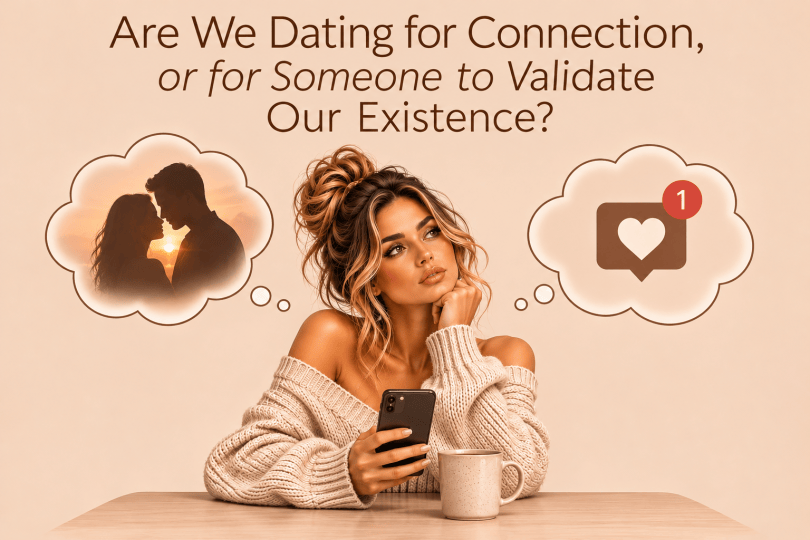
Are We Dating for Connection, or Are We Waiting for Someone to Validate Our Existence?

Have we outsourced our self-worth to people who can’t even manage to reply to a WhatsApp message?

Let’s talk about modern dating. Not the usual conversations about red flags, situationships, attachment styles or whether someone who takes six hours to reply is genuinely busy or simply not that interested.

I want to talk about something a little deeper.

Something that might explain why so many of us seem to be emotionally exhausted by dating before we’ve even established whether we actually like the person we’re dating.

Are we becoming so dependent on external validation that we’ve forgotten how to evaluate ourselves?

More importantly, are we allowing other people’s opinions, behaviour and attention to determine how we feel about our own worth? Because if we’re honest, there’s something quite extraordinary about the amount of emotional power we can hand over to someone we’ve known for approximately three weeks.

One minute we’re perfectly happy, getting on with our lives, feeling reasonably confident. The next, somebody hasn’t replied to a message, and suddenly we’re conducting a full forensic investigation into our personality.

Did I say something wrong? Was I too keen? Was I not keen enough? Did I come across as desperate? Was that joke a bit much? Was I not good looking enough?

And before we know it, we’re analysing a conversation that lasted eleven minutes as though we’re preparing evidence for the Crown Court.

But perhaps the problem isn’t always the person who hasn’t texted back.

Perhaps it’s what their silence has come to mean to us.

Enter Carl Rogers: Conditions of Worth

In person-centred psychology, Carl Rogers introduced the concept of conditions of worth.

The basic idea is that we develop an understanding of our own value through the conditions we believe we must meet to receive acceptance, affection and approval from others.

In an ideal world, we’re raised experiencing unconditional positive regard. We’re accepted as individuals, rather than feeling that love and approval must be earned through our behaviour, achievements or ability to meet somebody else’s expectations.

Unfortunately, real life isn’t always quite so straightforward. We can grow up learning, consciously or unconsciously, that we’re more lovable when we’re agreeable, more acceptable when we’re successful, more deserving of affection when we’re attractive, helpful, accommodating or easy to be around.

Eventually, these external expectations can become internalised.

We begin to believe that our worth is conditional.

We might not consciously think, “I’m only worthy if somebody chooses me,” but our behaviour can suggest otherwise and this is where modern dating becomes particularly interesting. Because how many of us have found ourselves measuring our attractiveness, desirability or even our basic worth against whether another person wants us?

We say we want a relationship, but sometimes what we’re desperately seeking is confirmation that we’re wanted.

There’s a difference.

One is about connection. The other is about validation.

And confusing the two can get us into a whole world of trouble.

The Locus of Evaluation: Who Gets to Decide Your Worth?

Another important concept in Rogers’ theory is the locus of evaluation.

Put simply, this concerns where we look when evaluating ourselves and deciding what we think, feel and believe about our experiences.

An internal locus of evaluation means we’re increasingly able to assess ourselves using our own values, experiences and feelings.

We can listen to other people’s opinions without allowing those opinions to become the final verdict on who we are.

An external locus of evaluation, on the other hand, means we’re placing greater emphasis on other people’s judgements, expectations and approval when deciding how to feel about ourselves.

Now, let’s apply that to dating.

Imagine you’ve been on a date. You’ve had a lovely evening, enjoyed the conversation, laughed, felt comfortable and thought there was a genuine connection.

You get home feeling quite positive.

Then you don’t hear from them the following day…. Your stomach ends up in knots, you suddenly feel anxious..

Suddenly, your evaluation of the entire evening changes.

Was it actually that good? Did they find me attractive? Did I talk too much? Perhaps I wasn’t their type after all. Did they lie about the chemistry?

Notice what has happened.

Your original experience was positive. You enjoyed yourself. You felt comfortable. But somebody else’s subsequent behaviour has suddenly become more important than your own experience.

You’ve effectively handed them the authority to rewrite your evening.

And this is the bit I find fascinating…. Because we’re all caught in this fucked up washing machine cycle, of analysing everything!


I can actually relate to this from personal experience. Last year, I was in a relationship with somebody who I would describe as having strong narcissistic traits, well actually I’m being kind there, he was a full on Narcissist! When I initially entered that relationship, I was confident in myself. I knew who I was, I was comfortable in my own skin and I didn’t particularly need anybody else’s approval to validate me. But as the relationship progressed, something started to change. I gradually found myself questioning myself, feeling as though I wasn’t good enough and becoming increasingly conscious of whether I was meeting his expectations. Almost everything I did felt as though it needed his approval or validation. I found myself looking externally for reassurance that I had previously been able to find within myself.

Looking back, what I find particularly interesting is that I hadn’t necessarily entered the relationship with those insecurities. They developed within the dynamic of the relationship itself. It was almost as though my internal locus of evaluation had gradually shifted towards an external one. His opinions, reactions and approval began to carry more weight than my own feelings and judgement and I think that’s something worth recognising: sometimes we don’t realise how much of our self-concept has become influenced by another person until we step outside the relationship and begin to find ourselves again.

Why does somebody else’s lack of interest suddenly make us question our own value?

They might not be compatible with us. They might not be emotionally available. They might have different priorities, preferences or expectations.

Or perhaps they simply didn’t fancy us…. That’s allowed. We’re not everybody’s cup of tea.

But why does their preference become a judgement about our worth?

Somewhere along the way, we’ve confused being chosen with being valuable and those two things are not remotely interchangeable.

The WhatsApp Waiting Room: When Someone Else Controls Your Mood

Let’s talk about the modern dating ritual that deserves its own psychological diagnosis.

Waiting for a text.

You send a message. Nothing…

You put your phone down. Pick it up again. Check whether they’re online. Notice they’ve viewed your story. Wonder why they can apparently operate Instagram but cannot locate the WhatsApp application.

You check the last-seen status.

You analyse the punctuation in their previous message.

You consider whether the full stop was passive-aggressive.

God forbid they were previously sending good morning messages with kisses and have suddenly reduced their communication to “Morning”… or Nothing!

What the actual fuck happened???

But underneath the humour is something worth examining.

When we’re waiting for a message to determine how we feel, we’re potentially placing our emotional wellbeing in somebody else’s hands.

Their attention provides reassurance. Their enthusiasm provides a temporary boost. Their silence creates uncertainty and we can become increasingly preoccupied with obtaining the next little piece of reassurance.

It’s worth distinguishing between the psychological theories here. Rogers’ locus of evaluation helps us understand why we might rely on somebody else’s response to judge ourselves. Behavioural psychology also offers useful ways of understanding how unpredictable rewards can reinforce checking behaviours.

When attention arrives inconsistently, we can become particularly focused on when it might arrive again. We don’t know whether we’ll receive affection, enthusiasm or silence.

So we check.

And check again.

And again… FUCK ME! You want to stop checking your phone but cant!

We’re not necessarily waiting for a meaningful conversation anymore. Sometimes we’re waiting for the emotional relief that comes with knowing we’re still wanted.

That’s quite a distinction.

And perhaps the most uncomfortable question is this:

If that person never messaged again, would we miss them, or would we miss how they made us feel about ourselves?

Because those are two very different experiences.

Self-Concept: Are We Seeing Ourselves Clearly?

Rogers also placed considerable importance on self-concept: the collection of beliefs and perceptions we hold about ourselves.

This includes our self-image, the person we believe we are, and our ideal self, the person we would like to become.

He also explored the relationship between our self-concept and our experiences. When there’s a significant gap between how we experience ourselves and how we believe we should be, psychological tension can develop.

Dating can expose this gap rather dramatically.

We might see ourselves as independent, confident, emotionally intelligent people who know exactly what we want. Yet, when somebody we’re attracted to becomes distant, we find ourselves abandoning our usual boundaries.

We might tolerate behaviour we wouldn’t normally accept, make excuses for inconsistency or become preoccupied with winning back somebody’s attention.

Suddenly, the person who was quite happy being single is wondering whether they should send another message. The person who said they wanted emotional availability is making allowances for somebody who communicates like a faulty satellite.

The person who knows their worth is trying to negotiate a better price for it and perhaps that’s where we need to examine the difference between what we say we value and what we actually demonstrate through our behaviour.

Because self-worth isn’t simply about telling ourselves we’re wonderful.

It’s about whether we can maintain our sense of self when somebody else doesn’t see us in the way we’d hoped.

Are We Making Decisions Based on Someone Else’s Verdict?

Here’s another question.

How often do we actually stop and ask ourselves whether we like the person we’re dating?

Not whether they like us, Not whether they fancy us, Not whether they’re going to ask us out again.

But whether we genuinely like them.

Are they kind? Are they emotionally available? Do we enjoy their company? Do our values align? Do we feel comfortable being ourselves around them?

Or have we become so preoccupied with being selected that we’ve forgotten we’re supposed to be selecting too? I mean, has it just become one shitty game, we’re all addicted to.

I think this is one of the biggest traps in modern dating.

We can become so focused on securing somebody else’s approval that we stop evaluating whether they’re suitable for us.

We start auditioning.

We become more conscious of how we’re presenting ourselves, whether we’re saying the right things, whether we’re being too available, too enthusiastic, too independent or too much of anything and dating starts to resemble a job interview where both candidates are pretending not to care whether they get the position.

Meanwhile, neither of them has actually checked whether the job comes with decent working conditions.

Perhaps we’re not always looking for compatibility.

Perhaps sometimes we’re looking for confirmation.

Confirmation that we’re attractive. Desirable. Interesting. Worth pursuing.

And when somebody doesn’t provide that confirmation, we experience it as rejection, even when we might not have been particularly interested in them ourselves.

The Gender Question: Are Men and Women Playing Different Versions of the Same Game?

It’s tempting to think this is predominantly a female issue, particularly when we consider the pressures women experience around appearance, desirability, ageing and being chosen.

Women can find themselves measuring their value against whether they’re considered attractive enough, young enough, feminine enough or desirable enough.

Social media hasn’t exactly helped.

We’re constantly exposed to carefully curated versions of other people’s relationships, appearances and lifestyles and dating apps can make romantic attention feel measurable.

Matches, likes, messages, dates and followers become little indicators of perceived desirability.

However men aren’t necessarily immune to the same psychological process.

Men can experience conditions of worth around success, financial security, status, physical attractiveness, sexual performance and being perceived as desirable. Some may feel their value is tied to being wanted, admired, successful or sexually validated.

Others may seek reassurance through romantic or sexual attention without necessarily being comfortable with emotional vulnerability.

Of course, these aren’t universal male or female characteristics. People experience validation differently, and social expectations can influence how they express it.

But perhaps both sexes are participating in a similar psychological dance.

One person is waiting to feel chosen.

The other is waiting to feel desired.

Both are potentially looking outside themselves for reassurance.

And neither necessarily feels particularly secure.

The Disaster of Conditional Dating

Here’s where I think things can become particularly problematic.

If our self-worth is heavily dependent on external approval, dating can become less about finding a compatible partner and more about managing our own insecurities.

We might pursue people who are emotionally unavailable because their approval feels particularly rewarding. We might become more interested when somebody withdraws their attention. We might interpret inconsistency as a challenge rather than information. We might overlook incompatibility because we’re too invested in being chosen.

And we might confuse the intensity of our emotional response with the depth of our connection…

Sometimes, the person we’re most preoccupied with isn’t necessarily the person who makes us happiest.

They’re simply the person whose approval we haven’t secured, and we like to chase.

That uncertainty can keep us emotionally invested long after the relationship has stopped offering anything particularly meaningful and that’s a dangerous place to find ourselves.

Because when somebody else’s behaviour determines our emotional state, we’re no longer making decisions entirely from our own values.

We’re reacting to their behaviour. We’re adjusting ourselves around their availability. We’re waiting for their approval before allowing ourselves to feel okay again and eventually, we can lose sight of what we actually wanted in the first place.

So, How Do We Get Our Internal Locus of Evaluation Back?

Perhaps the answer isn’t to stop caring what other people think.

We’re human. We want connection, affection, acceptance and intimacy. There’s absolutely nothing wrong with wanting to be loved or wanted. Nor does having an internal locus of evaluation mean ignoring feedback or refusing to acknowledge when we’ve made mistakes.

It’s about developing the ability to consider other people’s opinions without automatically treating them as the truth.

It’s about being able to say: I enjoyed that date, regardless of whether they enjoyed it.

I found that person attractive, but that doesn’t mean they’re right for me.

I’d like them to message, but my evening doesn’t need to revolve around whether they do.

I’m disappointed that they aren’t interested, but their lack of interest doesn’t diminish my value and perhaps most importantly:

I don’t need somebody else to choose me before I decide that I’m worth choosing.

That last one is worth sitting with.

Because when we begin to develop a more internal sense of evaluation, something changes. We stop treating every interaction as a referendum on our desirability. We become more interested in how people make us feel rather than how we make them feel. We become better at recognising incompatibility without interpreting it as personal failure and we become less willing to abandon ourselves in exchange for somebody else’s attention.

Final Thoughts: Perhaps We Need to Stop Auditioning

I think modern dating has created an environment where external validation is incredibly accessible, but genuine emotional security can feel increasingly elusive.

We can receive hundreds of likes, matches and messages and still question whether we’re desirable. We can have somebody tell us we’re beautiful and still need them to tell us again tomorrow. We can receive attention from multiple people and still become fixated on the one person who isn’t giving us any and perhaps that’s because validation and self-worth are not the same thing.

External validation can make us feel good. It can reassure us, excite us and make us feel desirable.

But it cannot permanently resolve an underlying belief that we’re somehow not enough.

That work has to happen internally.

Perhaps the real question we should be asking ourselves when dating isn’t simply, “Do they like me?”

It’s:

“Do I like them?”

“Do I feel comfortable being myself?”

“Am I enjoying this experience?”

“Am I acting in accordance with my own values?”

And, most importantly:

“Would I still feel good about myself if this person decided they weren’t interested?”

Because we cannot spend our lives waiting for other people to issue us with a certificate confirming that we’re attractive, lovable and worthy of affection and if somebody’s inability to send a text message can dismantle your entire sense of self, perhaps it’s time to take a little of that power back.

Stop waiting for somebody else’s verdict. You’re not applying for the position of being worthy.

And for fuck’s sake, put your phone down.

You’ve got a life to live.

The Context we Meet in: Why we judge women by circumstance instead of Character

There is a scene in Pretty Woman that has stayed with me for years.

Edward, played by Richard Gere, looks at Vivian and says, “I’ve never treated you like a prostitute.”

Her response is immediate.

“You just did.”

For a long time, I watched that scene and thought it was simply about a man saying the wrong thing. As I have grown older, spent more time listening to people’s stories and worked with women from all walks of life, I have come to realise that the scene is about something much bigger than a wealthy businessman falling in love with an escort. It is about judgement. It is about the labels we place on people. Most importantly, it is about how often women are judged by the circumstances in which they are found rather than the character they possess.

What strikes me most about that exchange is that Vivian never asks the obvious question. Why is she carrying the burden of judgement when Edward was equally involved? He may have been the wealthy businessman and she may have been the escort, but both of them participated in the same encounter. Without Edward, there is no transaction. Without his choices, there is no story. Yet somehow society finds it easier to judge Vivian than it does Edward. He is seen as successful. She is seen as shameful. He is allowed complexity. She is reduced to a label, she could be incredibly successful in her own right, but it’s always the man casting judgement, without the understanding.

That scene has always felt like a reflection of something much bigger that still exists today. Women continue to be judged differently for the very same situations that men willingly participate in. The details may have changed. Dating apps have replaced chance meetings in bars. Social media has transformed how people connect. Entire industries have emerged that did not exist twenty years ago. Yet the underlying double standard remains surprisingly familiar.

A woman can meet a man on Tinder, spend an evening talking, laughing and building what she believes is a genuine connection, sleep with him, and then discover she has been quietly disqualified from relationship status because she slept with him too quickly. The irony is extraordinary. He was there too. He made the same decision. He participated in exactly the same experience. Yet somehow he walks away feeling entitled to judge her for behaviour he willingly took part in himself.

What fascinates me is that many women do not think this way. They are often looking at the bigger picture. They are wondering whether there is chemistry, whether there is potential, whether this person could become a meaningful part of their life. Of course there are exceptions. Both men and women can be manipulative. Both men and women can seek validation. Both men and women can be dishonest. This is not about pretending one gender is innocent and the other is guilty. Human beings are complicated. What interests me is the imbalance in how judgement is applied. Society still seems far more comfortable attaching shame to women than it does to men.

One of the most interesting questions in modern dating is why some men automatically assume that a woman on Hinge is more suitable for a relationship than a woman they meet in a lap dancing club or who perhaps has worked as an escort. Why? What evidence do they actually have? Have they spent time understanding her values? Do they know how she treats people? Do they know whether she is loyal, emotionally available, trustworthy or kind? Usually the answer is no. What they are really judging is not the woman herself. They are judging the story attached to her, and the crazy thing is from my day to day life, I actually hear that ‘BodyCount’ can often reign higher in the women they perceive as ‘Marriage material’.

The woman on Hinge is viewed as someone searching for love. The woman in the club is viewed as someone selling fantasy. One is placed into a socially approved category. The other is placed into a socially disapproved category. Yet neither label tells us very much. The woman in the club may have stronger boundaries than anyone the man has ever met. She may have spent years single because she refuses to settle for relationships that do not meet her standards. She may be fiercely loyal once she commits to someone. She may have had fewer sexual partners than many of the women being praised as relationship material. Meanwhile, the woman on Hinge may be dating multiple people, have no interest in commitment and be seeking validation rather than connection. Or the opposite may be true. The point is that nobody knows.

Character cannot be determined by profession. It cannot be determined by appearance. It cannot be determined by where somebody happened to meet you. Yet people continue to make assumptions every single day based on these things. They judge a book by its cover and then convince themselves they know the entire story.

What I have learned over the years is that public image and private reality are often worlds apart. We live in a culture where people carefully curate how they are perceived. Dating profiles are curated. Social media accounts are curated. Influencer brands are curated. Even ordinary people curate versions of themselves for public consumption. We look at photographs, captions and carefully selected moments and convince ourselves we know somebody. The truth is that we rarely do.

There are women with enormous social media followings who are admired by millions. There are reality television personalities, influencers and public figures who have built highly successful brands around their image. Some have found ways to monetise their beauty, fame and desirability in ways previous generations could never have imagined, and behind closed doors are being sent out on secret Whatssap groups for £10k for the night. Personally, I do not see anything wrong with that. If somebody has built an audience, worked hard to create opportunities and found a way to capitalise on their success, then fair play to them. What interests me is not what they do. What interests me is how society responds to them depending on what information is publicly available.

The same man who judges a woman working openly within the adult industry may spend years admiring, following and fantasising about a public figure whose private life he knows nothing about. The difference is not necessarily morality. The difference is visibility. One woman is judged because people know. The other escapes judgement because people do not. Yet both may be making similar choices in private. This is why assumptions are so dangerous. They are built on incomplete information and presented as certainty.

Another aspect of this conversation that deserves far more compassion is the reality that some women carry experiences most people know nothing about. Some women working within parts of the adult industry have histories of childhood sexual abuse, rape, domestic violence, coercive relationships or profound emotional neglect. Of course this is not true of everyone and it would be wrong to make assumptions. Every woman’s story is different. Yet it is important to recognise that for some women, their relationship with their body, sexuality and sense of control has been shaped by experiences that occurred long before anyone met them. I work with one lady in the industry, who was date raped, and is simply too scared to date, and maybe she’s lost her way a little, but who are we to sit and judge.

What often frustrates me is how quickly people jump to judgement without any curiosity about what might have brought someone to where they are today. We see a profession and assume we understand a person. We see a choice and assume we know the story behind it. Yet human beings are rarely that simple. For some women, stepping into a space where they choose the terms, set the boundaries and decide what access people have to them can feel very different from experiences where control was taken away. What outsiders may perceive as exploitation, another person may experience as autonomy. Whether people agree with those choices or not is almost irrelevant. The point is that we cannot understand someone’s life by reducing them to a label.

Perhaps that is another reason I find judgement so problematic. It leaves no room for complexity. It leaves no room for empathy. It leaves no room for the possibility that the person standing in front of us has survived things we cannot imagine. We do not know their history. We do not know their struggles. We do not know what they have overcome to become the person they are today. Yet society is often quick to condemn women for the choices they make while showing very little interest in understanding the experiences that shaped those choices in the first place.

As the film draws to a close, something interesting happens. Edward finally understands what he could not see at the beginning. The issue was never Vivian’s profession. It was never the circumstances in which they met. It was never the label he had attached to her. The real obstacle was his inability to look beyond those things. Only when he lets go of his assumptions is he able to see the woman standing in front of him.

If we return back to the film ‘Pretty woman’ in one of the most iconic scenes in the film, Edward arrives with flowers and climbs the fire escape despite his fear of heights. He becomes the knight in shining armour Vivian once dreamed about as a little girl. Of course, we live in a different world now. Most women are not waiting to be rescued. Women build careers, raise families, buy their own flowers and save themselves every single day. The fantasy was never really about being rescued anyway. The fantasy was about being chosen. Being valued. Being seen… finally the little girl who had led such a traumatic and sad life, was seen.

Perhaps that is what so many people are searching for beneath all the noise of modern dating. Not perfection, Not status, Not somebody who ticks every box on paper. Just somebody willing to look beyond the stereotypes, beyond the assumptions and beyond the story attached to how they met.

Because love does not arrive wrapped in social approval. It does not ask whether someone was met through friends, on a dating app, in a club, at work or during the most unexpected chapter of their life. Love only asks whether two people are willing to know each other honestly.

And perhaps that is the real lesson hidden inside Pretty Woman. The greatest relationships are not built by people who meet in the perfect circumstances…. They are built by people brave enough to see beyond them….

Maybe the real question is not where are the women worth loving. Maybe the real question is where are the men willing to put down their judgement long enough to recognise them.

Because the most beautiful love stories have never been about how two people met.

They have always been about what happened when they decided to truly see one another.

2026 – The year Choosing Me: The Moment I Stopped Waiting to Be Chosen

There’s a truth I’ve had to learn the long way round:

Sometimes you have to experience the wrong people to finally understand your worth.

Not in a cliché way and not in a “everything happens for a reason” way, but in a very real, very lived way, where each connection leaves a mark, teaches you something, and slowly pulls you back to yourself.

I’ve loved different kinds of men.

Last year I met the one who felt electric at the start, passionate, intense, everything turned up to 100. The sex was something else, I mean girls, there is good and then there is WILD! Insane until it wasn’t. Until the warmth turned into walking on eggshells. The subtle put-downs. The control disguised as care. The disappearing acts followed by apologies that reset everything… until the cycle began again and I lost myself in that, not just emotionally, but physically too. So swept up in the sex, attention, gifts and love-bombing, I suddenly realised after watch him down pink cocaine for two weeks, that this was not the kind of man who should be in mine or my Childs life.

Then came along a good man, Kind-hearted, Safe, I thought. Someone I let myself open up to in a way I hadn’t in a good few years. We built something slowly, calls, messages, shared moments across distance, it felt so familiar… And then… he shut down.

No warning. No gradual fade. Just a switch.

One minute, he was planning a weekend with me, so excited I was in his country. The next, it was “this feels like pressure, I should respect my boundary, I can’t do long distance”, That kind of emotional whiplash does something to you. It doesn’t just hurt, it changes how you see people. How you trust. How you show up. I’m so glad I didn’t have sex with him, because in all honesty seeing his insecurities at play with avoidance, makes me feel there would have been disappointment. I think it felt familiar, because it threw me back into the summer of 2023, another situation, the calls, messages, consistency, deep intimacy on all levels except sex.

and somewhere underneath all of that, there’s been another truth sitting quietly in my life:

There is someone I love… who didn’t choose me, and it was after the experience with my Californian guy, I realised, it simply reminded me of that! The heartbreak of 2023, where I wasn’t chosen, but had fallen anyway..

For a long time, I told myself it was limerence, Infatuation. Something I’d grow out of, however time has a way of clarifying things, not erasing them and the truth is some feelings don’t fade just because they’re inconvenient, they simply get avoided.

But here’s what I’ve realised:

Someone not choosing you doesn’t make them “the one.” It makes them unavailable.

The Pattern I Couldn’t Ignore

There’s something else I started to notice.

Men would leave… choose someone else… build lives with other women.

Then years later, they’d come back, Telling me I was always the one, That they see me now, That they made the wrong choice. It happened last summer. I had a call, with an ex asking to meet me, I was seeing the narcissist at the time, and I declined, but he pushed and pushed, so I agreed ten mins in a public place only. I showed up, and was met with, basically I was the one perfect for them, I was the one they loved, I was the one aligned, I was so shocked, but its not the first time this has happened.

But by then, it’s too late, Because love isn’t just about recognition, It’s about timing. It’s about courage. It’s about choosing.

And I deserve to be chosen in real time, not in hindsight.

I appreciate if things don’t work out with someone else they chose, and then try and rekindle, but I will never be the other woman, whilst you keep someone there incase I say NO, and I did say NO!

The Misunderstanding of Who I Am

I think part of my story is this:

People think they know me when they first meet me, I get judged all the time. They see confidence, Strength, Independence.
They assume I’m “a lot.”, That I’ll be hard to handle. People see the Kerry now before them, not the Kerry I was for all of my life, they see the girl with the lips, the tan, the hair, taking images and posing, and they see me in a certain way, because that’s what their ind interprets.

But the truth?

In a relationship, I’m soft, I’m calm, I’m loyal, I’m simple in what I want.

A quiet life.
A genuine connection.
A partner to build with, not perform for.

And it’s only later, when they’ve already chosen someone else, that they realise actually she’s the opposite to who she comes across as, But I’m not waiting around to be understood after the fact anymore. Judgement is on them, Darlings, not me!

What I See Clearly Now

I see the half-effort.

The “let’s plan something” followed by inconsistency.
The words that don’t match actions.
The low-level energy that expects access to me.

And I’m done with it, yep over it! You will remain in the archived, because quite frankly, I cannot be arsed seeing your face!

Because here’s the truth:

There is no attraction without consistency.
There is no connection without effort.
And there is no future where I am not fully chosen.

What I Actually Want

It’s not complicated.

I want someone grounded, Calm, Emotionally available.
Someone who values routine, health, stability. Someone who has kids already, maybe similar age to my child, so we can just enjoy watching the kids grow, rather than the stress and worry of having another! I love my life now to start all over again with a new baby. Someone who wants to build a life, not escape into one.

A home.
A partnership.
A quiet, real kind of love, that will last

Not the loud, chaotic kind that burns fast and leaves damage behind.

Just… a good man…

Here’s Where Everything Changed

At some point over the last 8-9 months, something shifted in me. In that time, I dated a narcissist, was sexually assaulted by someone I went on a date with, and then I met the ultimate avoidant. This was all meant to happen, and I don’t say that to minimise it, I say it not through bitterness or coldness, but

Clarity.

I realised I’ve spent so much time pouring into other people, trying to understand them, support them, love them, hold space for them…And not enough time choosing myself. Too much time not filling up my own cup.

So now?

I’m not chasing.
I’m not convincing.
I’m not waiting to be picked.

You either show me, consistently, clearly, and show that you choose me…
or you don’t get access to me at all.
..

There is no in-between anymore my body, my mind, my heart. No, you are not welcome!

It’s taken 42 years to reach this point, and I realise, I’m worth something, and it’s a deep routed find, and wow, my eyes are open.

For Any Woman Reading This

If you’ve ever felt like the one they come back to… but never the one they choose first…

If you’ve ever been “almost” loved properly…

If you’ve ever questioned your worth because someone couldn’t meet you where you are…

This is your reminder:

You are not too much.
You are not misunderstood.
You are not “almost.”

You are just no longer available for half-hearted love, and please hold your value high, hold it for someone who offers consistency, but offers to show up to! Not just a lunchtime meet in costa! Because the coffee dates are devaluing romance!!

However the true message stands, the moment you truly choose yourself, set your boundaries and recognise your value matters, is the moment the shift will happen!

When Love Has Nowhere to Go. What happens when you fall for an Avoidant

There is a particular kind of heartbreak that doesn’t explode, it dissolves.

No dramatic betrayal, no obvious cruelty. no moment you can point to and say, “That’s when everything broke.”

Just love, slowly, quietly, with nowhere to land.

Loving someone with an avoidant attachment style often feels like pouring warmth into a room with no walls. Nothing visibly rejects you, nothing violently pushes you away and yet, somehow, everything disappears.

Not because the love wasn’t real.

Simply because it could not be received.

When Everything Feels Aligned

It often begins with something that feels rare, connection that feels effortless, conversations that stretch late into the night, laughter that feels easy, natural, unforced. Moments of closeness that feel deeply mutual. There is chemistry, there is emotional resonance. There is, at least for a time, a sense of alignment, the most beautiful alignment.

You don’t feel like you’re forcing something.

You don’t feel like you’re chasing.

It feels like something unfolding, a beautiful foundation being built with two human beings falling for each other.. and this is what makes it so confusing later, because nothing about the beginning feels incompatible. In fact, it often feels unusually right, perfectly right, and most of the time it is right…or at least could of been..

However, attachment dynamics don’t always reveal themselves at the start, because avoidant individuals can connect, in the beginning.

They can feel deeply.

They can even fall in love.

What they struggle with is not feeling, but staying.

Love vs. Fear: A Different Internal Reality

For the person who loves, closeness feels like safety, yet for the avoidant, closeness often feels like danger.

This isn’t a metaphor. It’s neurological. It’s sadly fact, and a fact even the avoidant themselves isn’t aware of.

Research in attachment theory shows that individuals with avoidant attachment styles frequently experience intimacy as a threat to autonomy. Emotional closeness activates the same stress responses that others might associate with loss of control, engulfment, or vulnerability.

Where one person feels warmth, the other may feel:

  • Pressure
  • Anxiety
  • A loss of space
  • A subtle sense of being trapped
  • A rising need to pull away
  • A feeling that the situation, relationship or partner isn’t right for them.

Nothing externally catastrophic needs to happen, no huge row… simply their body and mind, starts to reek havoc, slowly but surely, and they start to believe that they’re feeling this because the relationship or partner is wrong, they physically feel a build of anxiety, which leads to rumination, over thinking and panic, and the feeling of feeling overwhelmed, must be somebody else’s fault, because they don’t understand this is their own mental health, and any level of accountability means, it’s their fault, this over riding sense of anxiety, sickness, sleepless nights, lead to them saying ‘this isn’t right’… but please note, you could be a 10/10partner, but their mind will convince them you’re not right, and this is their own fear.

The relationship itself becomes the trigger, not because the love is wrong, but because the deeper the love and intimacy activates deeply wired protective strategies formed long before the relationship began. This is why most avoidants can only survive in relationships that are surface or fantasy based only.

The Tragedy of Misaligned Meanings

This is where the quiet sadness lives.

Two people experiencing the same relationship, but inhabiting entirely different emotional realities.

The loving partner experiences:

  • Growing closeness
  • Deepening attachment
  • Emotional investment
  • Hope
  • A desire for more connection
  • Love
  • Safety

The avoidant partner experiences:

  • Increasing discomfort because the feeling of love = anxiety
  • A need for distance to avoid accountability, and to feel safe
  • Emotional overwhelm, to the point it leads to both mental and physiological break down
  • A sense of losing independence, not being heard
  • Fear disguised as detachment

The same moments that feel like bonding to one person who has emotional capacity and maturity, but may feel like suffocation to the other.

No one is intentionally cruel, no one is consciously sabotaging.

And yet, damage happens anyway, because one of the parties didn’t realise what they we’re feeling was love…

When Love Becomes Something to Escape

As intimacy deepens, the avoidant nervous system often shifts into protection mode.

Common patterns begin to appear:

  • Emotional withdrawal
  • Subtle distancing
  • Reduced communication
  • Increased focus on flaws
  • Sudden doubts about compatibility
  • A vague sense that “something feels off”

Psychologists sometimes call this deactivation, the unconscious process by which avoidant individuals reduce attachment intensity when closeness becomes uncomfortable.

Love doesn’t disappear, access to it does.

To the loving partner, it feels like confusion:

“We were so close — what changed?”

To the avoidant partner, it feels like necessity:

“I just need space.”

The Ache of Unspent Love

For the one who loves, this is where grief becomes complicated, Because the love is still there, still alive, still willing. still reaching.

But with nowhere to go.

Love needs reception, Love needs reciprocity, Love needs emotional availability.

Without those, love doesn’t vanish, it lingers.

As longing, as rumination, as the painful question: “If it felt so real, why couldn’t it survive?”. There is a particular sorrow in loving someone who could not fully accept what you offered. Not because you were too much, but because they could not stay open.

The Avoidant’s Invisible Sadness

Yet there is another side to this story that often goes unseen, Avoidant individuals are not emotionless. They are not incapable of love. They are not immune to loss. Their pain simply looks different.

Avoidant attachment is rooted in early experiences where emotional needs were discouraged, ignored, or inconsistently met. Over time, self-reliance becomes safety, Vulnerability becomes risk, Distance becomes regulation.

Many avoidant individuals genuinely care, but experience closeness as dys-regulating. The push-pull dynamic is not calculated; it is protective.

And after withdrawal, they often feel:

  • Relief mixed with guilt
  • Confusion about their own reactions
  • Lingering affection they struggle to express
  • A familiar return to emotional isolation

The tragedy is not that they do not feel, The tragedy is that their fear consistently outruns their capacity for connection. The sad tragedy lies in, this will be their life, unless they learn, invest in therapy, and start to realise, kindness and empathy for others they cause paid to is key… a simple Sorry…

Why the Pattern Repeats

One of the most painful realisations for the loving partner is this:

Love alone cannot heal attachment wounds. Avoidant patterns are not situational quirks. They are deeply ingrained strategies for emotional survival.

Without conscious self-awareness and intentional work, the cycle often repeats:

  1. Connection
  2. Growing closeness
  3. Rising discomfort
  4. Withdrawal
  5. Distance
  6. Reset
  7. Repeat

Not because the partners are wrong, but because the underlying system remains unchanged.

The Cruel Irony of Compatibility

Perhaps the saddest truth of all, You can be deeply compatible with someone, and still be unable to build a stable relationship.

Shared values, Shared humour, Shared affection, Shared dreams, shared chemistry, intense attraction….

All of it can exist.

But if one nervous system experiences love as safety, and the other experiences love as threat, alignment at the surface cannot overcome misalignment at the core, until the avoidant does the serious work needed on themselves.

When Love Isn’t Wasted – Just Unreceived

It is tempting to call this wasted love, but love is never truly wasted.

Love given sincerely is evidence of capacity, not failure.

The ability to love deeply, openly, vulnerably is not something that diminishes because it was not reciprocated. It remains a reflection of emotional strength, a person with emotional maturity but mostly, capacity, you understand the real meaning of love…

The heartbreak lies not in loving the wrong person, but in loving someone who could not remain present inside the love you shared.

A Sadness Without Villains

This kind of story rarely has villains.

Just two people:

One reaching for closeness.

One retreating toward safety.

Both shaped by histories they did not choose.

Both experiencing pain in ways the other struggles to understand.

And love…..caught between longing and fear… it’s there.. it exists…

With nowhere to go.

Survival Mode in Relationships: When Emotional Abandonment Pushes the Body Into Crisis

How avoidant and narcissistic relationship patterns trigger fight-or-flight, hormonal disruption, and physical collapse, especially in women

There is a kind of stress that doesn’t stay in the mind.

It moves into the body.

It shuts down appetite.

It steals sleep.

It disrupts hormones.

It turns love into a medical emergency.

For me, stress from romantic relationships affects my body more than anything else in my life, Not work, Not money, Not external pressure. Love, or more accurately, emotional instability disguised as love, is what pushes my body into survival mode.

And once I’m there, I can’t simply “calm down.”

My body is panicking.

What Survival Mode Really Is (Fight, Flight, and Freeze)

Survival mode is not a metaphor. It is a physiological nervous system response that occurs when safety is threatened.

In relationships with avoidant partners or narcissistic partners, the body does not experience emotional inconsistency as inconvenience, it experiences it as danger.

Hot-and-cold behaviour.

Sudden withdrawal.

Love-bombing followed by emotional abandonment.

Connection offered, then removed.

The nervous system responds by activating the sympathetic response, fight, flight, or freeze. This response is meant for short-term danger. In emotionally unstable relationships, the threat is ongoing.

So the body stays switched on.

The Avoidant Attachment Cycle — Step by Step in the Body

Avoidant attachment is often unconscious. But its impact on the other person’s nervous system is very real.

1. Connection Phase: “This Feels Safe”

What the avoidant does

  • Emotional intimacy
  • Deep conversations
  • Strong sense of alignment
  • Feeling chosen and secure
  • A perfect mirror to you, which helps secure a sense of bond

What happens in your body

  • Oxytocin increases (bonding hormone)
  • Dopamine rises (hope and reward)
  • Nervous system softens
  • Appetite and sleep may stabilise

Your body begins to wire this person as safety.

2. Deactivation Phase: Emotional Withdrawal

What the avoidant does

  • Becomes distant
  • Reduces communication
  • Feels “overwhelmed”
  • Shuts down emotionally

What you begin to feel

  • Unease
  • Tight chest
  • Anxiety
  • A sense that something is wrong

Physiological response

  • Cortisol begins to rise
  • Vagus nerve regulation drops
  • Fight-or-flight activates

Your body senses danger before your mind understands it.

3. Push–Pull Dynamics and Intermittent Reinforcement

What the avoidant does- Sometimes , may I add, however most are too weak to return and do not have the emotional bandwidth

  • Returns briefly
  • Reassures you
  • Withdraws again

What you feel

  • Relief followed by panic
  • Hypervigilance
  • Emotional preoccupation

What happens in the body

  • Cortisol remains elevated
  • Adrenal system overstimulated
  • Digestion suppressed → appetite loss
  • Sleep disrupted

This is where survival mode becomes chronic.

4. Sudden Breakup or Emotional Disappearance

What the avoidant does

  • Ends the relationship abruptly
  • Avoids closure
  • Emotionally shuts the door
  • Blocks you everywhere

What happens to you

  • Shock
  • Disbelief
  • Inability to eat
  • Inability to sleep
  • Inability to just function with day to day life

Physiology

  • Cortisol spikes
  • Melatonin suppressed
  • Blood pressure may drop
  • Immune system weakens

This is often the point people say:

“I don’t recognise myself anymore.”

The Narcissistic Relationship Cycle — And Why It Damages the Body

Narcissistic relationship patterns are different because the instability is often manipulative rather than avoidant.

1. Love-Bombing and Idealisation

What they do

  • Intense attention
  • Excessive affection
  • Fast emotional bonding

Body response

  • Dopamine surge
  • Oxytocin surge
  • Rapid attachment

The body bonds before trust has time to develop.

2. Devaluation and Emotional Withholding

What they do

  • Withdraw affection
  • Criticise or invalidate
  • Create emotional insecurity

What you feel

  • Anxiety
  • Self-doubt
  • Trying harder to regain safety

Physical impact

  • Cortisol rises
  • Appetite shuts down
  • Gut function slows
  • Weight loss begins

3. Discard, Return, Repeat

What they do

  • End the relationship
  • Return
  • End it again

Each cycle re-activates the trauma response.

The body never fully resets.

During one such relationship, my weight fell from nine stone (around 57 kg) to seven stone ten (around 49–50 kg). I couldn’t eat. I couldn’t sleep. My periods became severe and prolonged, leading to hospitalisation.

This was not just emotional distress. It was physiological breakdown caused by chronic stress.

Blocking: The Nervous System Impact of Sudden Disappearance

Blocking is not neutral.

Blocking is digital abandonment.

Psychological and Neurological Impact

Research shows that social rejection activates the same brain regions as physical pain. Blocking removes:

  • Access
  • Repair
  • Explanation

The brain interprets this as:

“You no longer exist.”

What Blocking Does to the Body

  • Sudden cortisol spike
  • Panic response
  • Obsessive thinking
  • Appetite shutdown
  • Severe insomnia

For bonded individuals, blocking can:

  • Disrupt menstrual cycles
  • Lower blood pressure
  • Trigger medical symptoms
  • Psychologically impact their whole future

There is no nervous system regulation without closure.

Why Emotional Stress Affects Women’s Bodies So Deeply

Chronic relational stress disrupts the HPA axis (hypothalamic-pituitary-adrenal axis), which governs stress hormones.

This impacts:

  • Cortisol regulation
  • Progesterone production
  • Oestrogen balance
  • Ovulation and menstrual cycles

This is why emotional stress can cause:

  • Heavy or prolonged periods
  • Hormonal imbalance
  • Faintness or low blood pressure
  • Hospital admissions

Women don’t just experience stress psychologically.

We carry it physically.

The Core Truth About Survival Mode in Love

Avoidant partners regulate by leaving, a selfish act for their own self preservation and to maintain their narrative ‘As the good guy’ – Which sadly to you and to an outsider not in their orbit, is actually anything but.

Narcissistic partners regulate by controlling, they can’t control someone who starts to remember their own self worth, and who starts to call them out…

The person left behind regulates by breaking down internally.

They close the door, and your body absorbs the impact.

Grounding: Gently Returning the Body to Safety

If you are in survival mode, your body is not betraying you.

It is protecting you.

Healing does not come from forcing yourself to move on. It comes from restoring safety slowly:

  • Eating what you can, when you can
  • Sleeping without self-judgment
  • Reducing exposure to emotional chaos
  • Choosing calm over intensity

Your nervous system does not need answers.

It needs consistency, gentleness, and time.

My little tip…

This blog is written from my own lived experience.

I share my story, including weight loss, hormonal disruption, hospital admissions, and the physical effects of emotional abandonment, not for sympathy, but for validation. To them you may not matter, but the key thing is, you should matter to you. They tried to rob you of dignity, clarity, and validation… but you have to remember, stop investing all that into them, and protect yourself… I mean we literally have no hope right now when it comes to dating, do we girls? Because everyone left who isn’t taken has that much trauma they become Avoidants or Narcissists, however remember, our own trauma can simply be making us anxious attachments… we need to stop the cycle!

Too many women are told they are “too sensitive” when their bodies react to relational stress. In reality, these reactions are often normal nervous system responses to instability and loss of safety.

If this resonates with you, please know:

You are not broken.

Your body has been fighting for you.

What Would Happen If We Walked Away From Dating Apps in 2026?

Dating apps promised connection. Instead, they’ve left many of us anxious, disposable, and lonelier than ever.

My mum doesn’t believe me when I tell her that the only real way people meet these days is through dating apps. She’s from a different generation, one where people met through friends, work, chance encounters, or simple introductions. You met someone, you liked them, and you tried to make it work.

Today, dating feels nothing like that… it’s even hard to imagine, life was that simple, once!!

In 2026, dating apps dominate modern romance, yet, more people than ever feel emotionally burnt out, disconnected, and deeply unsure about love. So I keep asking myself the same question:

What would actually happen if we all made a conscious decision to walk away from dating apps?

Dating Apps and the Rise of Modern Dating Anxiety

There’s no denying it, dating apps have rewired how we connect.

Psychologically, they operate on the same reward systems as gambling: dopamine hits, intermittent validation, endless novelty. You swipe, you match, you wait. You check notifications. You compare. You question your worth.

Research over the last few years has consistently linked dating apps to:

  • Increased anxiety and stress
  • Lower self-esteem
  • Addictive usage patterns
  • Emotional burnout

So much so that users have attempted to sue dating apps, claiming the platforms are deliberately designed to encourage compulsive behaviour, emotional dependence, and prolonged singlehood rather than healthy relationships.

And honestly? I believe it, I have seen it with my own eyes, and my eyes are so tired of it..

Recently, I deleted Tinder and Bumble completely, I barely used Raya and have now set it to friends only. I thought everything was gone — until I realised I still had Hinge on my work phone. I hadn’t checked it in weeks.

There were 236 notifications.

And I didn’t feel excited. I didn’t feel curious.

I felt sick.

I didn’t even want to open it. I just wanted my pictures offline. I didn’t want to exist digitally anymore. That, in itself, says everything about what dating apps do to us. As soon as I clicked onto it, to delete, the universe spoke, on a dark reminder of why I want to be offline, lay before me on my screen, It was like I was being told… yes delete, delete, delete, because bad people lurk here…

The Illusion of Endless Choice

Dating apps sell the idea that more choice equals better outcomes, however psychologically, the opposite is often true.

Too much choice leads to:

  • Paralysis
  • Dissatisfaction
  • Constant comparison
  • A belief that something “better” is always out there

We find a diamond and still keep fucking digging anyway… why???

People become disposable, A face, A profile, A moment of interest, then… replaced. Not because something is wrong — but because the swipe never ends. It’s so cruel, not just to others but to ourselves..

We’ve become fickle and the apps reward it.

The Scariest Part of Online Dating: The 3–4 Week Pattern

This is the part nobody wants to admit — because once you see it, you can’t unsee it.

You meet someone, You talk every day, The connection feels consistent, Warm and Promising.

Then you hit week three or week four.

And something changes.

Replies slow down, Effort drops, the tone shifts. Suddenly they’re busy. Work is stressful. Life is overwhelming. They’ve got so much on.

The good mornings , the good nights disappear. The curiosity fades.

And you’re left asking:

Why does it always seem to end here? Why do people stop trying at the exact same point?

Dating apps encourage people to fantasise rather than commit, its all words and no action, To chase excitement without responsibility. To invest emotionally just enough, until someone else catches their eye.

Because someone always does.

A girl drops into their DMs. A new face swipes right. And before you know it, the excuses begin:

“I didn’t get a chance to reply.”

“I’ve been exhausted.”

“I’ve just been really busy.”

It’s not that they suddenly became busy.

It’s that their attention moved elsewhere… and it hurts…

When You Have a Good Heart, This Hurts More

This pattern cuts deeper when you’re someone who leads with sincerity, when your heart is pure, and you just simply hope for a glimmer of happiness in love…

When you like someone, you focus. You don’t browse. You don’t keep your options open “just in case.” Once you’ve met someone, you don’t feel the need to even look at an app.

So when things fade — again — it makes you question everything:

Who do I get close to?

Who do I trust?

When is it safe to let my barriers down?

As a woman, I sometimes wish I could be colder, more guarded, less emotionally available. Like friends of mine who can detach easily and give nothing away, and play the complete bitch, and they get treated like absolute royalty..

But I can’t help who I am.

And that softness — in a swipe culture — feels like a liability…

The Emotional Cost of Subtle Withdrawal

What makes this even harder is how quiet the withdrawal is.

If you’re intuitive, you feel it instantly. You notice the shift before it’s acknowledged. The delayed replies. The lack of effort. The energy change.

So when it happens again, it’s not just disappointment — it’s exhaustion.

It makes you not want to date at all. Not because you don’t want love, but because you’re tired of walking the same emotional loop with different faces.

Sometimes, you wish the internet didn’t exist, because people used to learn how to love. They worked through boredom. They chose each other. They didn’t disappear when novelty wore off.

Now, instead of asking “Can I grow with this person?”

People ask “Who else is out there?”

And that question alone destroys connection.

This is why celibacy is so key, because we can give part of our souls, but at least our body can remain untouched and we can hold onto some dignity. The real sadness these days, is how a lot of women, do give their bodies up too early, too freely, and the men take take take.. so you’ve given everything and feel left with nothing, and it hits you twice as hard.

Are Dating Apps Really How Most People Meet?

Despite how dominant apps feel, the data tells a different story.

While dating app usage has skyrocketed over the last decade, most long-term relationships still don’t start online. Even now, the majority of couples meet through:

  • Friends
  • Work
  • Social circles
  • Shared interests
  • Real-world environments

Apps feel unavoidable, but they aren’t the only way. They’ve just become the loudest.

What If We Walked Away From Dating Apps in 2026?

If we collectively stepped back, even temporarily, something interesting might happen.

  • Effort would return — because access wouldn’t be endless
  • Presence would matter more than performance
  • People would have to communicate instead of disappearing
  • Traditions would slowly reinstall themselves

When temptation isn’t constantly in your pocket, you’re more likely to lean into what’s in front of you.

And maybe — just maybe — if we stepped away from apps once we met someone, we’d actually try. We’d communicate. We’d work through discomfort instead of escaping it.

Choosing Depth in a World Addicted to Dopamine

As I step into 2026, I don’t have all the answers when it comes to love. I don’t know where life will take me romantically. What I do know is that I’m no longer willing to participate in something that leaves me feeling anxious, disposable, or disconnected from myself. I have hopes, I have dreams, I have affection, right now even desire, and I know where my heart points… but still trying to remain the ever optimist, and hope somewhere in this big wide world, a good man who aligns still exists.. somewhere.. maybe an ocean away… but there will be that man in the world, who brings calm, brings smiles, and brings a genuine love…

Right now, I’m single and you know what I’m okay with that… because I know my worth and what I deserve… and what’s more so If I feel the tone change, trust me, I will switch off quicker than any guy saying ‘Sorry Ive had a busy day’ – FU and FU …

So until a man asks me to be his girlfriend, his girl, until there is clarity, intention, and consistency — I choose to remain exactly where I am. Open-hearted, hopeful, but no longer available for half-effort, fantasy, or emotional breadcrumbs, darling, you we’re great for the 3 week Disney story, now I have shit to do, but yes, I use the word hopeful… you just never know, what’s around the corner!

Sadly Dating apps have trained us to believe that being alone is something to fix quickly, rather than something to sit with consciously. They’ve taught us that love is abundant but shallow, that connection is instant but disposable, and that if something feels hard, there’s always another option waiting.

But real love has never worked like that.

Love requires patience. It requires discomfort. It requires staying, even when the novelty fades and perhaps that’s why so many people feel lost now: not because love no longer exists, but because we’ve forgotten how to nurture it.

We’re living in a time where people want the feeling of connection without the responsibility of maintaining it. Where intimacy is mistaken for attention. Where consistency feels rare, and emotional safety feels almost radical.

And yet — despite all of this — I don’t believe love is gone.

I believe it’s quieter now. Slower. Less performative. I believe it exists in real conversations, in shared experiences, in moments that aren’t filtered or curated for an audience. I believe it grows when temptation isn’t constantly whispering in your pocket, telling you someone else might be better.

Maybe walking away from dating apps isn’t about rejecting modern dating entirely. Maybe it’s about reclaiming our nervous systems. Relearning how to be present. Choosing depth over dopamine.

Because when you remove endless choice, what’s left is intention.

When you remove constant comparison, what’s left is appreciation.

And when you remove distraction, what’s left is the possibility of something real.

So perhaps the question isn’t “How do we find love in 2026?”

But rather:

“How do we protect it when it shows up?”

And maybe — just maybe — the answer starts with putting the phone down, stepping back into the world, and allowing connection to unfold the way it always did… slowly, imperfectly, and humanly. Maybe the olden day love is still out there, maybe we just need to allow our eyes to glance further than our phone screens, and maybe we should just cherish the connections we do make.. making our own Hollywood ending…

You never know, maybe love is already in your life.. and you’ll find it when the distractions cease…

When ADHD and Narcissists date!

The story of the Lion & The Giraffe….

Can those with ADHD really date a true narcissist successfully? I mean I say true narcissist because 2025 sees us using that word so freely. However imagine a true Narcissist, one that ticks every single box, a true narcissist combines ASPD, formally known as the term we coined ‘Sociopath’ – and imagine this person, who never believes they’re in the wrong, never feels or truly sees anyone else but theirselves , lies solum and waiting on their prey, waiting for their next supply, and who lives in a fake reality because anything that doesn’t feel like a high is surplus to them.

So lets look at the person with ADHD, the childlike, the fun, the passion filled, the excitable, the one who wants to fix everyone, and mend everything, the ultimate people pleaser. The kind warm loving ADHD’er the one who chooses to ignore red flags because they can see every negative in the world, and thinks they have the remedy and know how, on how to right wrongs, not even their own, but those of others. The type of people pleaser that will shower someone with so much love and affection….

The ultimate supply..

or

The perfect prey..

People with ADHD are often naturally drawn to narcissistic individuals in romantic relationships.This is because both personality disorders share many traits however take one as the angel and one as the devilish version… Impulsiveness, thrill seeking and competitiveness, and the ADHD’er able to understand more than most the narcissists full lack of empathy. ADHD’ers can struggle with empathy theirselves, because of the difficulties with their executive functioning, they have trouble recognising and regulating their emotions, which can take away their efforts and understanding, on the emotions of others. Quite often an ADHD can be straight to the point, almost rude, they don’t realise they do it, but when the words leave their mouth, it can cause panic when they realise what they say, albeit innocently. So as you can imagine, when someone with ADHD sees a narcissist, they often feel a strange common ground, and often wonder If the narcissist is ADHD to, as they recognise behaviour patterns, but lets face it, Narcissism is the evil big brother, the steroid version, of the very innocent ADHD traits, so of course the ADHD’er will feel there is common ground, not realising the danger that lies ahead with their innocent outlook on the situation.

ADHD is a neurological developmental disorder that affects self regulation and attention. Impulsive easily distracted and hard to stay focused, often with a need for speed and things to happen there and then. However all this is innocent, 99% wrapped in a loveable person, who wants to people please. Narcissists on the other hand, may have steroid version similar traits, however these are characterised by their grandiose self of self importance and constant need to be seen in that light and admired by all, they need validating by those lower than them, (In their eyes only) and they have zero empathy, because they don’t need to think about anyone but theirselves. They are controlling, manipulative and they use their minds wisely and their charm, to lure in the soft and the pure, into their orbit. Narcissism isn’t neuro-diversity, its a complex and dangerous personality disorder, which impacts every individual that surrounds them, from parents, to partners to their children. Narcissists can be hard to spot, and as mentioned many with ADHD will almost feel the Narc has ADHD. However common traits of a narcissist include:

A constant pre-occupation of visions and day dreams, of wealth, success, power and a family life where they hold the remote control.

A true belief they are special and unique and should only mix with people on their level, a constant need for hierarchy. Many Narcissists feel they are children of god, the feeling of special, can go off the scale.

A strong need for admiration and attention, a strong need for people to see them in a high position of authority and power.

An expectance of automatic control over other, and an expectance of others to obey and comply, and an expectancy of people to treat them ‘Special’.

An inner anger to be envious of others, and a constant feeling that others are envious of them.

A constant behaviour trait of exploiting others and manipulating others for their own gain, requirements and supply.

A split personality to the outsider, leading to outsiders never being able to settle and feel emotionally in control, as the narcissist can appear fickle and flippant, in what they want, who they are, and who they want to be with.

Narcissists can be both female and male, males tend to lead to more sociopath traits, and can often get involved in criminal activities, whilst females often get drawn into emotional and sexual manipulation of others.

The ADHD partner is the innocent Giraffe, head in the clouds, wondering the Serengeti, and the perfect prey for the Lion to take down, bit by bit, inch by inch, insult by insult… until eventually the giraffe is so damaged, its impossible to ever be able to walk on those long legs again, or dead… left as a carcus with no meat left, and surplus to the lions needs. The giraffe life changed forever, meanwhile the lion without empathy and with the notion of ‘I just needed my feed, its the circle of life’, moves on in the long grass ready for its next prey, feeding of snippets here and there, until they meet their next Giraffe.

The relationship between both disorders, starts off in a term ‘Euphoric’ for both parties, The ADHD’er has every single supply the Narc needs, and the Narc provides the perfect ingredients of love bombing, that gets the ADHD’er hooked. In fact, let’s scrap ADHD/NARC, let’s simply use LION for the Narc and GIRAFFE for the ADHD’er. Its so much easier, and we hate titles!! The chemistry between the two is mind blowing, for both, out of this world, the Lion gets the Giraffes needs perfect, and the Giraffe gets the Lion more than anyone ever has.. Its a sexual match made in heaven! For people with ADHD, narcissists can provide excitement and stimulation, which can counteract their boredom levels, because lets face it ADHD’ers hate being bored and often get frustrated. ADHD’ers are drawn to the attention and grandiose of the narcissist and pop them up on the peddle stool, exactly what the narcissist needs.

Giraffes struggle In life with various elements for instance spotting red flags, this makes them susceptible to the Lions manipulation. Lions exploit the emotional dysregulation that giraffes can often struggle with, leading to a pattern that is beyond dangerous, and will leave the giraffe walking on egg shells, and feeling beyond anxious, and scared, of the Lions mood, the lions feelings and never knowing what side of the bed the Lion is going to wake up on. The poor Giraffe will feel like they are sinking, unable to think of anything, through pure anxiety and fear, of the unexpected, and anyone knows those with ADHD struggle with the fear of the unknown. The emotional abuse and exploitation that can exacerbate already present difficulties, can lead to the most incredible sense of anxiety and depression, that the ADHD’er may have never felt before, so it can bring immense confusion and sadness to the positive ADHD’er.

Giraffes often have problems asserting theirselves, and this can be part of their softness, however this is putty in hands to the Lion, as they can push boundaries beyond the normal levels, and to the point the giraffe doesn’t have any because they are so worn down, with trying to set boundaries, but never being heard by the Lion. They will start off really trying to firm up their boundaries, yet the more and more the lion doesn’t listen, they feel backed into a corner and think, why bother?

Giraffes as we know have difficulties maintaining attention and can often have memory problems, especially short term memory. This is a key tool for the narcissist to who play on these memory problems to exploit the ADHD’er and they will take advantage by gaslighting to the full max of this situation, and psychologically manipulate the ADHD’er to make them question their own memory, perception and sanity. For instance and I have seen this myself the narcissist will deny conversations that occurred, and twist the truth to suit their narrative. For instance, a conversation factually for me, I was told, “Oh yes I rescued my friend from a brothel, and paid for the lads to go to the brothel”, so when I asked ‘Have you ever slept with a prostitute?’ I was told.. NO! Fact! Fast forward 3 months later a conversation that was completely normalised, became ‘Yeah of course I’ve slept with prostitutes, I told you this’ – I tried to argue I hadn’t been told, and was told ‘You don’t listen, I told you’ … leading me to rewind and rewind and rewind, over the initial conversation, and NO, it was not my fucking memory! However just being told that left me anxious, disorientated and almost feeling I needed to write down and document everything, as my self defence. To be honest I could of recorded the initial conversation, and he would of still tried to convince me, I was wrong and he was right.

Giraffes will love their lion at their worst, at their lowest, at their angriest, the giraffe can witness their lion eating another giraffe and still the giraffe will remain, because their love for their lion is so true, so pure and so real. However the Lion will not ever see this, because as all narcissists do, they only ever measure their own feelings, and do not have the capacity to feel, recognise, or appreciate others love. The giraffe will not care for what the Lion used to have, what prestige or title they have or had, the giraffe will fall in love with the heart of the lion, and this again another danger, because the Lion in their grandiose doesn’t want to be seen let alone loved at this low level, they aren’t accustomed to, the lion only wants the rest of the Serengeti to see them on pride rock, at the top of their game, at the top of the hiecharchy, so knowing the giraffe sees them at their most vulnerable, at the start the Lion will appreciate that, when they have a sense of fake reality, the sense that they don’t need to be up on pride rock showing off, however when pride takes over and they need to be seen, valued, little giraffe, how could they love that pathetic wonderer who isn’t up on their rock, giraffes should love their Lions when they’re up on their pride rock, where they want and need to be, and where everyone looks up to them, even giraffe. You see there will never be an equal part in their relationship, the Lion will always only ever go as low as 51/49, because their sense of needing to be seen in their hierarchy and at the top of the board, will always come first. Narcissists needs to feel above everyone else, even the ones who love them the most.

ADHD’ers, it’s a known fact, can often posses a level of low self esteem, which more than often stems from past traumas, and the sad fact of this, is they are far more tolerable of abusive behaviours the narcissist will put their way. The Narcissist will start with, hmm lets call them baby insults, the softened blow such as ‘I say it with love, however you have such a pretty face, but if you had your teeth done baby it will change your whole face and make you prettier’ – See anyone reading that, (bar for the narc theirselves) can see its a vile and hurtful insult, but in the moment, the ADHD partner won’t see that, it will stimulate their people pleasing notion, and they will start to think without realising ‘Maybe I do need my teeth doing’. This is how it starts, the undoing of the ADHD’er the Narc gaining control. In my own personal case it was followed with, I can’t deal with your job it reminds me of this, it triggers this, I need you to give it up. Followed by, awww baby, you tummy tuck scar, is so bad, why is it like this. In my head I was like “Its actually a brilliant scar only 14 months old so not faded white yet’ – The next about my boobs, so I went for a consultation, and the insult following that was ‘If you tie a brick to this one, and tie a brick to that one, then throw the brick over your shoulder, it will pull them up?? Ok… I mean here is a few sentences of a personal snap shot. However a true Narc cannot even see the wrong in what they say, and if you dare confront them… ‘You’re hard work’ , ‘You’re combative’ – even though just as any human being, you are simply doing the very basics of defending yourself.

ADHD’ers are the type of individuals who simply make it their quest to help, to help support and to think they can help others, to anyone in the world the ADHD’er will have a heart of gold, may be annoying, however they’re good people, its within them to want to help. However to a sociopath or narcissist, their goodness is massively undervalued, and they can irritate the Narc immensely, and unless the Narc goes away and deals with their inner anger and issues and pick up some serious CBT skills, the whole combination is beyond dangerous for the ADHD’er , because as we have covered already, the Lion will simply drag the giraffe down, slowly, painfully, until the ADHD’er and everything that once shone for them, is beyond damaged.

At the end of it all, it is possible for the two of them to work, and potentially have something Euphoric for life, but it’s crucial the ADHD’er is wide awake, and crucially, aware of the risks the ultimate predator possess. The euphoria will only truly work, when the narcissist knows their behaviour is abusive, and pushes and known they need to correct their behaviours, and also when the narc knows, that true love is about choosing someone other than theirselves, and showing up. Sadly the ironic thing about researching this is that the giraffe will always find happiness, yet the Lion often dies lonely… surrounded by superficial, and never truly being happy inside, happy who they’re with, and happy with their lives. They truly struggle more than any disorder out there to truly love others, and when they feel true love, it’s not as exciting as the honeymoon ‘being in love’ , so it fails to impress them, it fails to mean anything to them, and rather than choose that person, like we all do in the second phase of love, they dispose of them, or cheat on them and leave them sat at home disrespected and hurt.

The relationship of the Giraffe and Lion, could be totally described by both as a meeting of souls, a true soulmate, however it takes two of them working hard and showing up, and most often the Lion disposes yet later in life will regret letting go of their ‘Soulmate’ in the giraffe, but what goes around.. comes around, and karma always follows through..