Through My Own Lens
Relationships, intimacy and confidence are deeply personal, and no two people experience them in exactly the same way. As I’ve grown older, I’ve found myself reflecting on how my own relationship with sex, confidence and femininity has evolved. Along the way, I’ve noticed certain patterns through my own experiences and through conversations with therapy clients. This isn’t about speaking for all men or all women. It’s simply an honest reflection of what I’ve observed, what I’ve lived, and the questions I’ve found myself asking.
Perhaps you’ll recognise some of it. Perhaps your experiences have been completely different. Either way, I hope it encourages a conversation about intimacy, confidence and the way we connect with one another.
For years I saw myself as quite submissive.
I like being feminine. I enjoy looking after myself, my child and my home. In a relationship I naturally fall into a softer role, and in the bedroom I always assumed I was more submissive too, it always felt natural.
But something has changed in that as I have got older.
Not because I became more dominant, god no, not because I suddenly became someone different. I think simply became more comfortable in my own skin.
The way I experience intimacy in my forties is completely different to how I experienced it in my twenties and thirties. Back then, like many women, there was always a little voice in my head.
Do I look okay?
Should I move like this?
Am I attractive enough?
Looking back, I wasn’t fully present. I think many women have sex while carrying insecurities into the room with them. Sometimes we’re performing without even realising it. We become so focused on pleasing someone else that we forget intimacy should also be something we experience for ourselves. As I’ve healed, grown, lost weight, become healthier and far more accepting of my own body, something shifted.
I don’t hide anymore, I don’t overthink, I feel completely at home in my own skin.
Ironically, that’s when I started noticing something unexpected.
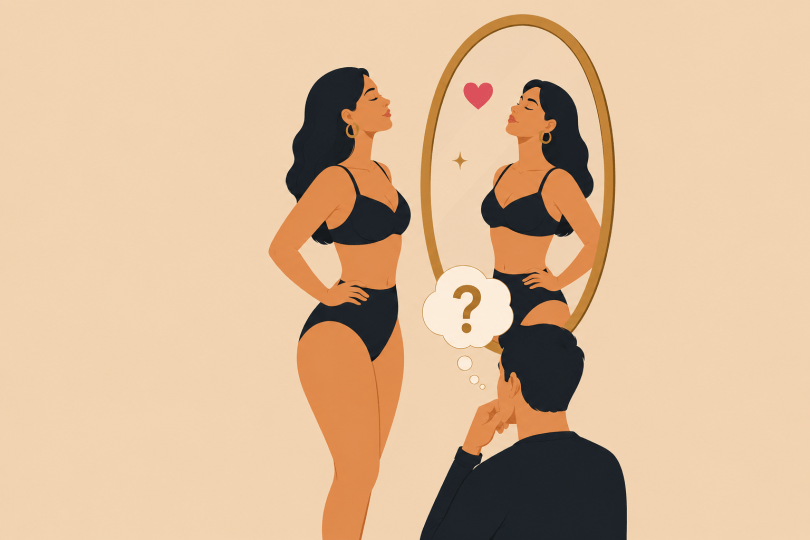
Some men seemed incredibly drawn to that confidence, Others seemed… intimidated by it.
Is Sexual Confidence Intimidating?
The answer isn’t yes or no.
It’s that confidence can expose insecurity.
Psychologists have long recognised that confidence in any area of life can sometimes trigger comparison in others. Rather than feeling inspired, some people feel inadequate. Intimacy is no different.
Sexual confidence isn’t about having countless partners.
It isn’t about being loud, outrageous or adventurous for the sake of it.
For me, it’s the opposite.
It’s about being emotionally present.
It’s about knowing what you enjoy, communicating honestly and allowing yourself to experience intimacy without shame.
Research consistently shows that women with greater body appreciation tend to report higher sexual satisfaction, greater communication with partners and lower levels of sexual anxiety. In other words, when we’re comfortable in ourselves, intimacy often becomes deeper rather than more performative.
“You’re Different”
One conversation has always stayed with me.
Last year I was in a committed relationship. Initially everything was wonderful. If I’m honest, it was probably the best sexual connection I’d ever experienced.
One evening we were lying in bed and he turned to me and said,
“You’re different to other women.”
I’ll admit, I braced myself for criticism, (he was the king of narcissism).
Instead he said,
“I’ve been with a lot of women, but you’re different because you have sex for yourself as well as the other person. Most women don’t.”
That sentence has stayed with me ever since. At the time I didn’t fully understand what he meant. Looking back, I think he recognised something I’d never consciously thought about.
I wasn’t performing. I wasn’t worrying. I wasn’t trying to be someone.
I was simply present, Passionate, Connected.
To me, passion isn’t something reserved for the bedroom.
It’s how I approach life, I’m passionate about my work, About helping people, About healing, About relationships, About being alive.
Perhaps intimacy simply reflects that part of me. I think as with everything in life, I give it my all.
Does Sexual Maturity Change as We Get Older?
One question I’ve found myself coming back to is whether women and men sometimes experience sexual maturity differently as they get older.
I can only speak from my own experience, but for me, confidence didn’t come from having more sex. It came from knowing myself better.
In my twenties and early thirties, I was far more aware of how I looked, whether I was “doing it right” and whether I was attractive enough. As I’ve got older, all of that has faded into the background. Today, intimacy feels less about performance and much more about presence. I know my body, I’m comfortable communicating, and I allow myself to enjoy the experience just as much as the person I’m with.
When I speak to other women, and to many of my coaching clients, I hear similar stories. Confidence often seems to grow as self-consciousness begins to fall away.
For many men, however, middle age can bring a different set of experiences. Careers become more demanding, family life becomes busier, stress increases, and for some, natural changes in sexual function can start to appear. UK research suggests that concerns about sexual health and performance become more common as men get older, even though many continue to value intimacy and want fulfilling sex lives.
I also can’t ignore something I’ve noticed through countless conversations with people over the years. I’ve spoken to middle-aged men who tell me they haven’t had sex with their partner for weeks, months or sometimes even longer. Equally, I’ve spoken to women who feel emotionally disconnected or who have simply stopped prioritising intimacy. It reminds me that this isn’t a “men’s issue” or a “women’s issue.” Long-term relationships can sometimes drift into companionship, routine and responsibility, leaving very little space for passion unless both people actively protect it.
That makes me wonder whether some couples can find themselves moving in opposite directions. Just as many women are becoming more accepting of themselves and more confident sexually, some men may be carrying pressures they’ve never had before. Not because they’ve become less masculine or less desirable, but because life changes us all.
Perhaps that’s why confidence can sometimes feel confronting.
Not because confident women are “too much”, but because genuine intimacy asks both people to be vulnerable.
I also find myself wondering whether this plays a small part in why some middle-aged men are drawn to younger women. Not because younger women are somehow better, and certainly not because all men seek younger partners, but because relationships where both people are still discovering themselves may sometimes feel less exposing than being with someone who already knows exactly who she is.
It’s simply a thought rather than a conclusion, but I think it’s an interesting question to ask.
Can Confidence Trigger Insecurity?
I’ve worked with enough people now to know I’m not alone in noticing this. Many women I’ve spoken to have shared similar experiences. Sometimes a sexually confident woman challenges expectations.
Some men have become used to being the one who leads, reassures or teaches. When they meet a woman who already knows herself and is comfortable expressing what she enjoys, it can shift the dynamic.
That doesn’t make those men weak. It simply means confidence requires confidence in return. Secure men often welcome openness because it creates honesty and better communication.
Less secure men may start questioning themselves.
Am I good enough? Has she experienced better? Can I satisfy her?
Those thoughts don’t always get spoken aloud, but they can quietly change the atmosphere within a relationship.
Sex Gets Better With Emotional Safety
One thing I’ve realised is that great sex isn’t really about technique. Anybody can have sex, come on you know how true that is…
But genuine intimacy is different.
The best experiences happen when two people feel emotionally safe enough to stop performing altogether.
When there’s trust, laughter, curiosity, communication, acceptance, and when two people show the fuck up for each other.. they show each other, “I’m here, I’m yours, and I’m not going to fuck this up by playing games”!
That’s where connection lives.
Why I Don’t Date Casually
People are often surprised when I tell them that since the end of my long term relationship with my sons Dad, I’ve only been sexually intimate in my personal life, with a couple of people over the last four years. Yes I have dated a few, but I have a way with men, where I don’t feel the need to show them who I am through sex. My personal world I guess can be so different, from perhaps any alter ego, I can play or come across as.
For me, confidence hasn’t led to sleeping with more people. It’s actually had the opposite effect. I’ve become far more selective.
I don’t feel the need to give my body away simply because dating apps make casual intimacy feel normal, I mean what do I gain from that? Apart from making myself feel shit! Where is the reward for me? What a visit to the clinic, because men don’t want to wear protection? No THANKS!
I’ve reached a point where I value connection far more than attention.
Maybe that’s age, Maybe it’s healing, Maybe it’s simply knowing my own worth.
Either way, I no longer believe sex should be something we do because we’re lonely, bored or afraid someone else might come along. I’d rather wait for someone who genuinely values intimacy than collect experiences that leave me feeling empty.
It gives me such insight into the world, having this view, I know porn stars who have sex for money, but the sex they have on film, is not the sex they have with a partner. Many of them are choosing celibacy in their own life, and you may sit there, not understanding that, but porn stars and sex workers, often become two people, and separate work and private life completely. The person they portray can be a million miles from the person they truly are.
Are We Really Having Better Sex?
Dating apps have changed modern relationships. They’ve created endless choice, endless comparison and often a conveyor belt approach to dating.
But one question keeps coming back to me.
Are people actually having better sex because they have more opportunities? Or are they simply having more of it?
When I speak to people in long term relationships, it’s surprisingly common to hear things like, “We haven’t had sex for weeks”. Others describe intimacy that feels routine rather than exciting.
The statistics reflect this. Large surveys suggest that sexual frequency tends to decline in many long term relationships over time, and satisfaction depends far more on communication, emotional closeness and relationship quality than on how often couples have sex.
Perhaps the real issue isn’t how much sex we’re having.
It’s how connected we are while we’re having it.
Confidence Isn’t the Enemy
A sexually confident woman isn’t trying to compete.
She isn’t trying to dominate.
She isn’t trying to prove anything.
She’s simply comfortable enough to experience intimacy without apology.
The right man won’t feel threatened by that.
He’ll feel invited into something honest.
Because confidence isn’t about perfection.
It’s about authenticity.
And perhaps that’s the most attractive quality of all.

 The Girl Who