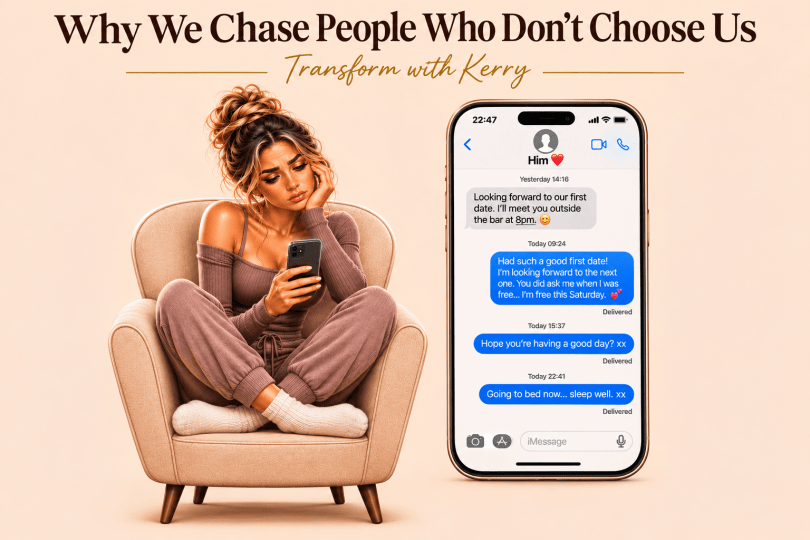
Why We Chase People Who Don’t Choose Us – The Psychology of Rejection sensitivity, Validation and Self-respect

An honest look at modern dating, emotional attachment, the grief of potential and why we sometimes abandon ourselves in the pursuit of being wanted.

Why do we chase?

Have you ever found yourself becoming more emotionally invested in someone precisely when they seem to be becoming less available? Have you found yourself analysing messages, checking whether someone has viewed your stories, questioning a change in their tone or wondering what you did wrong when their attention suddenly shifts?

Perhaps you’ve told yourself you’re not going to message again, only to find yourself looking for another reason to make contact. I remember being there at the start of 2026, and now I look back and like ‘WTF Kerry’ !! Perhaps you’ve replayed a date in your head, searching for clues that might explain why somebody who appeared so bloody interested has suddenly become distant and perhaps the most difficult part is that you recognise what’s happening.

You know you’re overthinking. You know you’re giving somebody more headspace than they have earned, I mean have they even earned a fraction.. Yet somehow, knowing that doesn’t immediately make the feelings disappear.

Why do we do this? Why can another person’s attention, or lack of it, have such a powerful effect on how we feel about ourselves? And why, sometimes, do we find ourselves chasing reassurance from the very situation that is making us feel insecure?

I think these are important questions, particularly in a dating culture where communication is constant, connections can begin and end within days, and social media gives us endless opportunities to monitor somebody else’s attention.

One concept that helps us explore this is rejection sensitivity. It can influence how we interpret other people’s behaviour, how quickly we become emotionally invested and how we respond when we sense that somebody might not want us in the way we want them.

But there is another part of this conversation that I think deserves just as much attention: the grief of potential. Sometimes we aren’t grieving a relationship that we’ve actually had. We’re grieving the relationship we imagined might happen and somewhere between wanting to be chosen and hoping something will develop, we can lose sight of the one person whose feelings and needs we should never be prepared to abandon: ourselves.

Understanding rejection sensitivity

Rejection sensitivity is the tendency to anxiously expect, readily perceive and react strongly to the possibility of rejection. It doesn’t necessarily mean somebody has actually rejected us. Sometimes the emotional response begins before we know what is happening.

A delayed reply, a change in someone’s communication, a cancelled plan or a perceived lack of enthusiasm can become loaded with meaning. We might interpret uncertainty as rejection, distance as disinterest or a change in behaviour as evidence that we are no longer wanted.

The emotional reaction can feel much bigger than the situation itself. We may experience anxiety, sadness, frustration, embarrassment or an overwhelming need to find out where we stand.

It’s important to understand that rejection sensitivity isn’t exclusive to any particular group of people. Most of us will experience some degree of sensitivity to rejection at different points in our lives. For some, however, the experience is much more intense and can have a significant impact on relationships, confidence and emotional wellbeing.

The term rejection sensitive dysphoria, often shortened to RSD, is frequently used in discussions about ADHD and emotional sensitivity. However, it isn’t a formal standalone clinical diagnosis, and we should be careful not to treat every experience of rejection as a medical condition.

What matters is understanding the experience itself: why certain situations affect us so deeply, what they bring to the surface and how we can respond without allowing the emotion to take control of our behaviour.

Where does rejection sensitivity come from?

There isn’t one universal explanation. Rejection sensitivity can develop through a combination of experiences, relationships, temperament and the way we learn to understand ourselves and other people.

For some people, childhood experiences may play an important role. Growing up with emotional neglect, inconsistent affection, criticism, abandonment or a lack of reassurance can influence how safe we feel in relationships later in life.

When a child experiences inconsistent care or doesn’t feel emotionally secure, they may become particularly alert to changes in other people’s behaviour. They might learn to monitor moods, anticipate disappointment or work hard to maintain connection because, at some point, connection hasn’t felt reliable.

These experiences don’t automatically mean someone will develop rejection sensitivity. Nor does experiencing rejection sensitivity mean somebody must have experienced childhood trauma. Human development is much more complicated than that.

However, it is worth considering whether some of our adult reactions are connected to feelings that began much earlier in life.

Sometimes the person in front of us isn’t the whole reason we’re hurting. Their behaviour may be touching an older feeling: not being wanted, not being important, not being enough or not being chosen and when that happens, the emotional response can feel disproportionate because we’re not necessarily responding to just one moment. We’re responding to what that moment represents to us.

The impact of ADHD and autism

Although rejection sensitivity can affect anybody, neurodivergence can add another layer of complexity for some people.

ADHD is associated with difficulties with emotional regulation for some individuals. Emotions can feel particularly intense, and it may take longer to settle after something upsetting. Uncertainty, perceived criticism and changes in interpersonal relationships can therefore become difficult to navigate.

Autistic people may also experience particular challenges around social uncertainty, interpreting ambiguous communication or making sense of changes in another person’s behaviour. This varies enormously between individuals, and it would be wrong to assume that every autistic person experiences rejection in the same way.

I think it’s important to make this distinction because rejection sensitivity is not an ADHD or autism issue alone. It is a human experience, although neurodivergence, childhood experiences and other individual circumstances can influence how it presents.

The more we understand the different factors involved, the less likely we are to judge ourselves for having an emotional response that we don’t yet fully understand.

My own experience: learning to understand rejection sensitivity

This is something I’ve had to explore personally, and I will be honest: it wasn’t something I initially understood particularly well.

Even through my own personal development and therapist-related learning, I found that I had to go away and investigate it further. I wanted to understand what rejection sensitivity actually meant, where it could come from, why it could feel so intense and, perhaps most importantly, why certain situations seemed to affect me more than others.

As somebody who has experienced childhood trauma, neglect and the absence of a father figure, I’ve had to reflect on how those early experiences may have influenced the way I experience emotional connection, distance and rejection as an adult.

I can’t say that one experience explains everything, and I don’t think we should reduce our entire emotional world to our childhood. But I do think there is value in asking ourselves whether some of the things that hurt us today connect with feelings we experienced much earlier in life.

As a neuro-divergent woman with autism and ADHD, I’ve also had to consider how my own way of processing emotions, uncertainty and relationships can add another layer to the experience.

There have been a couple of occasions in my adult life when I’ve experienced rejection sensitivity particularly intensely. What I found interesting was how much emotional energy I could give to a situation, sometimes far more than the actual relationship or circumstances warranted.

I had to start looking at the underlying reasons rather than simply criticising myself for how I felt. I wanted to understand the triggers, recognise the patterns and learn how to respond differently and I think that is where real personal growth begins. Not in pretending we don’t care, not in becoming emotionally unavailable and certainly not in convincing ourselves that we should never feel hurt. It begins with developing enough self-awareness to recognise what is happening inside us and choosing not to let every emotion dictate our next move.

The validation loop: when we start chasing reassurance

One of the most difficult patterns associated with rejection sensitivity is the need for reassurance.

Imagine meeting somebody and having a genuinely lovely experience. There’s chemistry, conversation, attraction and the feeling that something could develop. You come away feeling positive, perhaps even excited about the possibility of seeing them again.

Then something changes. Their messages become less frequent. The enthusiasm seems to dip. They don’t initiate conversation in the same way, or perhaps they are still watching your social media stories but aren’t making any real effort to communicate.

Suddenly, your attention shifts.

Instead of enjoying the possibility of getting to know someone, you’re trying to work out whether they still like you. You’re analysing the timing of messages, reading between the lines, checking online activity and looking for reassurance that the connection hasn’t disappeared.

You might find yourself wanting to contact them, not necessarily because you have something meaningful to say, but because you want to relieve the discomfort of not knowing.. and this is where we can become caught in a cycle.

We feel uncertain, so we seek reassurance. We receive a little reassurance and feel better temporarily. But if the underlying situation remains inconsistent, the uncertainty returns. We then find ourselves looking for reassurance again.

The problem is that we can become dependent on the very person whose inconsistency is triggering the insecurity.

I sometimes think of this as a form of emotional self-sabotage. We repeatedly expose ourselves to a situation that makes us feel unsettled, hoping that the next interaction will finally give us the reassurance we need, but how much of our emotional energy are we willing to spend trying to obtain certainty from somebody who isn’t offering it naturally?

And at what point do we stop asking what they think of us and start asking what their behaviour is telling us?

The grief of potential: are we attached to the person or the possibility?

This is one of the most interesting parts of modern dating, and I think it is something many people will recognise.

Sometimes we become attached to what a person represents rather than what we actually know about them.

We have a wonderful first date. We experience chemistry, laughter, affection and a sense of connection. We start imagining what might happen next. We picture future dates, weekends away, conversations and the possibility of something meaningful.

Our minds begin building a future around a person we may have only met once or twice. Then, when the connection doesn’t develop, we experience disappointment that can feel surprisingly intense.

But what exactly are we grieving?

Are we grieving the person, or are we grieving the possibility of what we thought could happen?There is a difference between losing an established relationship and losing an imagined future. Both can hurt, but they are not the same experience.

When we become emotionally invested in potential, we can end up mourning something that never really existed outside our imagination. We may miss the excitement, the anticipation, the feeling of being wanted and the future we had quietly started to picture.

This doesn’t make the feelings silly or invalid. Hope is a natural part of getting to know somebody. It’s lovely to feel excited about a new connection.

But we need to be careful not to confuse the promise of something with the reality of what is being offered.

Chemistry isn’t compatibility. Attraction isn’t emotional availability. A wonderful first date isn’t a guarantee of a relationship. And somebody’s potential isn’t the same as their willingness to build something with us.

We need to give people the time and space to show us who they are through consistent behaviour, rather than filling in the gaps with what we hope they might become.

When rejection sensitivity meets modern dating

I think modern dating has created an environment where rejection sensitivity can be particularly difficult to navigate.

Dating apps have made it easier than ever to meet people, but they have also changed the way many of us experience connection. We can move from one conversation to another, meet several people in a short period of time and feel as though there is always somebody else just a swipe away.

Social media adds another dimension. We can see when someone is online, whether they have viewed our stories and sometimes what they are doing, without having any meaningful communication with them.

This can create a strange situation where we have more access to information about somebody’s activity but not necessarily more understanding of their intentions.

A person can watch every story and still make no effort to arrange a date. They can send a message one evening and disappear for several days. They can show enthusiasm in person but struggle to communicate consistently afterwards and because so much of modern dating takes place through a screen, we can find ourselves trying to interpret tiny pieces of information that may not tell us very much at all.

A viewed story isn’t a declaration of interest. An online status isn’t an invitation. A delayed reply doesn’t automatically mean rejection.

But when we’re already feeling emotionally vulnerable, these small details can become the focus of an enormous amount of mental energy.

I don’t think dating apps are inherently bad, nor do I think everyone who communicates inconsistently is deliberately trying to hurt somebody. People have different expectations, circumstances and levels of emotional availability.

However, I do think we need to recognise how an environment of constant access, ambiguity and perceived choice can make it harder to feel secure when we’re getting to know someone.

We can become so busy trying to work out where we stand with another person that we forget to ask whether we actually like how the situation is making us feel.

Why are we in such a rush?

I think this is a question worth asking.

Why do we feel the need to establish where something is going almost immediately? Why do we sometimes become so invested in a connection before we’ve had enough time to understand whether the other person is right for us?

There is nothing wrong with wanting a relationship. There is nothing wrong with being intentional about dating or knowing what you want, But there is a difference between being open to a relationship and trying to force one to develop before it has had the opportunity to grow naturally.

When we rush emotionally, we can become attached to an outcome rather than paying attention to the experience itself.

We start looking for signs that somebody likes us instead of asking whether their behaviour demonstrates the qualities we want in a partner. We focus on whether we’re being chosen rather than considering whether we would actually choose them and perhaps this is where we need to change our perspective.

If somebody wants to speak to you, allow them the opportunity to speak to you. If they want to arrange another date, let them show that through their actions. If they want you to be part of their life, there should be some natural movement towards that.

This isn’t about playing games, withholding affection or pretending to be less interested than we are. It’s about allowing a connection to be mutual.

You don’t need to carry the entire conversation, organise every meeting, initiate every interaction or continually remind somebody that you exist.

Let people meet you halfway.

And if they don’t, you have information that can help you decide whether this is something you want to continue investing in.

Self-respect: Stop abandoning yourself to be chosen

This is probably the most important part of the whole conversation for me.

Self-respect isn’t about being cold, arrogant or emotionally unavailable. It doesn’t mean pretending you don’t care when you do. It doesn’t mean refusing to message first or turning dating into a competition about who can appear least interested.

It means understanding that your worth doesn’t increase when somebody wants you, and it doesn’t decrease when somebody doesn’t.

It means being able to enjoy another person’s company without making their attention the measure of your happiness.

It means recognising when you’re starting to compromise your own emotional wellbeing in order to keep a connection alive.

It means being prepared to walk away from something that isn’t meeting your needs, even when you had hoped it might become something special.

I think many of us have, at some point, found ourselves trying to become more appealing, more accommodating or more available because we are worried that somebody might lose interest.

We might overlook behaviour that makes us uncomfortable, minimise our own expectations or convince ourselves that if we are just patient enough, understanding enough or attractive enough, things will eventually change.

But a healthy connection shouldn’t require us to continually negotiate our own worth.

We can be understanding of somebody else’s circumstances without making ourselves responsible for their emotional availability. We can recognise that somebody may be busy, healing or working through their own experiences without waiting indefinitely for them to decide whether they want us and we can be disappointed when something doesn’t work out without turning that disappointment into a judgement about ourselves.

How do we begin to break the cycle?

The first step is awareness. We cannot change a pattern we haven’t recognised, and we cannot make healthier decisions if we don’t understand what is driving our behaviour.

When you notice yourself becoming preoccupied with somebody’s attention, try to pause before reacting. Ask yourself whether you’re responding to something that has actually happened or to something you’re afraid might happen.

There is a difference between facts and interpretations. The fact might be that somebody hasn’t replied today. The interpretation might be that they’ve lost interest, met somebody else or decided you’re not good enough. Those interpretations may feel convincing, but they are not necessarily true.

Give yourself permission to sit with uncertainty rather than immediately trying to eliminate it.

Try to maintain your own life while getting to know somebody. Keep seeing your friends, pursuing your interests, working towards your goals and enjoying the things that make you feel like yourself. A new connection should add something to your life, not become the entire focus of it.

Be mindful of repeatedly checking social media, monitoring online activity or seeking reassurance when you feel anxious. These behaviours may offer temporary relief, but they can also keep your attention fixed on the uncertainty.

Most importantly, pay attention to how somebody behaves over time. Look for consistency, communication, respect and genuine effort. You don’t need to make excuses for someone, but you also don’t need to jump to conclusions based on one delayed message and if rejection sensitivity is causing significant distress or affecting your relationships and everyday life, speaking to a suitably qualified mental health professional can help you explore the underlying patterns and develop strategies that work for you.

The aim isn’t to stop caring. It’s to learn how to care without losing yourself.

Learning not to let feelings dictate behaviour

One of the biggest changes I’ve noticed in my own thinking is that I no longer believe every feeling needs an immediate response.

I can meet somebody, enjoy their company, feel attracted to them and genuinely hope that something develops. I can be excited about the possibility of seeing them again.

However, I can also recognise that if they don’t want the same thing, that is okay. It doesn’t mean I wasn’t interesting enough, attractive enough or good enough. It doesn’t mean I’ve missed my only opportunity for happiness. It simply means that this particular connection may not be right, mutual or available.

Of course, that doesn’t mean rejection never hurts. I’m human. I can still feel disappointed, and I can still have moments when I wish something had worked out differently. The difference is that I don’t have to allow those feelings to dictate my behaviour.

I don’t have to chase somebody to prove that I’m worth choosing. I don’t have to keep looking for reassurance from someone who isn’t offering it. And I don’t have to turn somebody else’s lack of interest into a personal failure.

There will always be other people to meet, other experiences to have and other opportunities for connection.

That isn’t arrogance. It isn’t pretending that people are disposable. It’s understanding that one person’s decision doesn’t define my value.

And I think there is a real freedom in reaching that point.

Stop grieving the future and start looking at the present

Perhaps one of the most important things we can learn in dating is to stop falling in love with what something could become before we’ve had the chance to understand what it actually is.

We need to give people the opportunity to show us who they are, rather than becoming attached to the version of them we’ve created in our minds.

We need to recognise that attraction is only one part of compatibility, that chemistry doesn’t guarantee emotional availability and that potential means very little without consistent action.

We also need to be kinder to ourselves. If rejection affects us deeply, there is usually something worth understanding beneath that feeling. We don’t need to shame ourselves for being sensitive, wanting connection or hoping to be loved.

However, we do need to take responsibility for how we respond.

We can acknowledge our past without allowing it to determine our future. We can recognise our triggers without allowing them to control our decisions. We can want somebody without needing them to want us back in order to feel whole.

And perhaps the question we should ask ourselves when we find ourselves chasing somebody’s attention isn’t simply, “Do they like me?”

Perhaps it’s:

“Why am I chasing something that doesn’t appear to be choosing me?”

Because the goal isn’t to become somebody who never feels rejection. It’s to become somebody who understands that rejection is not a measure of their worth.

You can be open-hearted without being endlessly available. You can be interested without becoming invested too quickly. You can hope for something beautiful without abandoning yourself in the process.

And you can walk away from a connection you wanted, knowing that you are still worthy of the connection you deserve. I learned a hard lesson in January 2026, and its one that’s helped me evolve so deeply and emotionally, take every situation you face as growth..

Don’t lose yourself trying to be chosen by somebody else. Choose yourself first.

Are We Dating to Find Love, or Addicted to the Search?

The psychology of dating apps, the business of loneliness and why modern romance might be in trouble.

When did finding love become an endless shopping experience?

We live in a time when we have more opportunities than ever to meet people. With a few taps on a phone, we can access hundreds, sometimes thousands, of potential romantic partners. We can browse profiles, swipe through photographs, exchange messages and arrange dates without ever having to leave the comfort of our homes.

On paper, this should be the golden age of romance. Yet something rather peculiar seems to be happening.

People are increasingly talking about dating fatigue, emotional exhaustion, ghosting, situationships and the difficulty of finding someone who genuinely wants a relationship. We have an extraordinary amount of choice, but are we actually becoming any better at choosing?

And perhaps a more uncomfortable question: Are dating apps designed to help us find love, or have we become the product of an industry that makes money from our continued search for it?

The business model behind looking for love

I recently had a conversation with somebody who works in analytics and algorithms. They raised an interesting point about the economics of dating platforms. Their argument was that a relatively small proportion of men receive a disproportionate amount of attention, while a much larger proportion experience considerably less success. Those who receive fewer matches may consequently spend more time on the platforms, purchase subscriptions, pay for boosts and invest money in trying to improve their visibility.

It got me thinking.

There is a popular theory circulating online known as the 80/20 rule of dating apps. It suggests that a small proportion of men receive the majority of female attention.

You will also hear variations of this as the 90/10 rule.

However, it is important to distinguish internet theories from established research. There is no reliable universal statistic proving that 10% of men receive 90% of all matches across dating apps.

What we do have is some interesting evidence.

A 2016 academic study, A First Look at User Activity on Tinder, conducted by researchers including Gareth Tyson at Queen Mary University of London, examined almost half a million Tinder users using a combination of controlled profiles and survey research.

The researchers identified significant differences in how men and women interacted with the platform. Women tended to be more selective, while men tended to swipe right on a much larger proportion of profiles.

This created what the researchers described as a feedback loop: men became less selective in the hope of securing matches, while women became increasingly selective because their likes were more likely to result in matches.

The result was an unequal experience of the same platform.

This doesn’t prove that a fixed percentage of men monopolise all the attention. But it does demonstrate that dating apps can create very different experiences for different groups of users.

Oh and the commercial implications are interesting.

If somebody is repeatedly unsuccessful, they may be more inclined to keep trying. They might purchase premium membership, pay to see who has liked them, increase their profile visibility or buy additional features.

Meanwhile, somebody receiving hundreds of likes may find themselves overwhelmed by choice and struggle to establish meaningful connections. Two very different experiences. Potentially the same commercial outcome: continued engagement, addiction and lack of love.

The psychology of the swipe

So why are these apps so difficult to put down? Part of the answer lies in behavioural psychology.

Dating apps use a mechanism that has a lot in common with variable reward systems.

Think about a slot machine. You don’t know when the next reward is coming. Sometimes you get nothing. Sometimes you get a small reward. Occasionally, you get something that feels particularly exciting.

The uncertainty is part of what makes the experience compelling. A dating app can operate in a similar psychological environment.

You swipe through several profiles. Nothing particularly interesting happens. Then suddenly, a match appears.

Someone attractive. Someone interesting. Someone who looks as though they might tick every box.

There is a little rush of excitement. Perhaps a notification, a message or a compliment.

You begin imagining the possibilities, but then the interaction might fade, the person might stop replying, or the date might never materialise.

And so you return to the app….Perhaps the next swipe will be different.

This is not to say that every dating app user is addicted or that every notification produces a predictable dopamine response. Human behaviour is much more complicated than that.

But intermittent rewards, anticipation, novelty and uncertainty are well-established psychological mechanisms that can reinforce repeated behaviour.

The interesting thing is that the reward isn’t necessarily the relationship itself.

Sometimes, it is simply the possibility of one.

The addiction to the new crush

I think this is one of the most fascinating aspects of modern dating.

Why do we become so excited about somebody we barely know?

A new match can generate an extraordinary amount of anticipation. You exchange messages, learn little details about each other, start imagining what meeting might be like and perhaps begin to picture a future.

There is an element of fantasy involved.

Because when we first meet somebody, we don’t know them particularly well. We are often responding to the potential of who they might be, rather than the reality of who they are.

The early stages of attraction are exciting precisely because there is so much we don’t know. Every message can feel significant. Every compliment can reinforce our interest. Every little sign of attention can make us want more.

Psychologically, anticipation can sometimes be more exciting than the eventual reward and this creates an interesting problem.

Once we have actually met somebody, the mystery begins to disappear. We move from imagining a person to getting to know an actual human being.

Real relationships require patience, communication, compromise and consistency. They also involve ordinary moments that aren’t particularly exciting, but if we become accustomed to the constant stimulation of new profiles, new matches and new conversations, could the ordinary process of getting to know somebody start to feel less exciting by comparison?

Are we becoming better at starting connections but worse at allowing them to develop?

Why are we still swiping after a brilliant date?

Imagine this.

You meet somebody. The date is wonderful. You laugh, there’s chemistry, the conversation flows and you feel genuinely attracted to each other.

You go home feeling happy.

There is every possibility that this could develop into something meaningful… maybe?

Yet the following morning, while lying in bed, you open your dating app again.

Why?

Perhaps you’re not entirely convinced that the person is right for you.

Perhaps you’re worried about becoming too invested too quickly.

Perhaps you simply want to know that other options are still available.

Or perhaps the app has conditioned you to believe that there is always somebody else around the corner.

This is where the psychology of choice becomes particularly interesting.

When we believe there are endless alternatives available, committing to one possibility can feel like closing the door on hundreds of others.

What if the next person is more attractive? More successful? Funnier? More compatible? What if somebody even better is only three swipes away?

This is sometimes referred to as the paradox of choice.

More options can create more opportunities, but they can also make decisions harder and increase the fear of missing out.

Research published in 2025 by Marina Thomas, Alice Binder and Jörg Matthes examined how the number of profiles people evaluate affects their decision-making. Their experiment involved 401 participants.

Those who evaluated more profiles were less likely to accept a potential partner than those presented with fewer profiles. Greater numbers of profiles also increased feelings of choice overload.

The study also found that the way people made decisions mattered. More intuitive, rapid decision-making was associated with less favourable self-evaluations.

Think about what that means.

The more people we browse, the more difficult it may become to feel satisfied with any individual choice.

Perhaps the problem isn’t that we haven’t found somebody good enough.

Perhaps we’ve become accustomed to looking for somebody better.

The evidence: Are dating apps making us unhappy?

There is growing academic interest in the psychological effects of dating app use.

A 2023 research paper published in Telematics and Informatics, titled 99+ Matches but a Spark Ain’t One, examined the adverse psychological effects associated with excessive swiping.

The researchers identified links between excessive swiping and:

  • Upward social comparison.
  • Fear of being single.
  • Partner choice overload.

The study also found that excessive swiping helped explain the relationship between frequent dating app use and these negative psychological experiences.

In other words, simply having access to dating apps isn’t necessarily the whole issue. How much we use them, and how we interact with them, matters.

A further systematic review and meta-analysis published in Communications Psychology in 2026 examined 27 studies involving 21,263 participants.

It found small-to-moderate associations between dating app use and emotional distress, appearance concerns, body image disturbance, behavioural dysregulation and interpersonal sensitivity. The strongest associations were found in behavioural dysregulation and body-related outcomes.

Importantly, the researchers also highlighted that these findings do not establish that dating apps cause these problems. Individual circumstances, pre-existing vulnerabilities and social context all matter.

Nevertheless, it raises an important question about the psychological environment in which modern dating now takes place.

When your romantic prospects are presented as a continuous stream of photographs, profiles and first impressions, it is easy to start evaluating yourself in the same way.

Am I attractive enough? Am I getting enough matches? Why hasn’t that person replied? Why have they viewed my profile but not messaged?

Something that began as an attempt to find companionship can gradually become another source of comparison and self-doubt.

The legal challenges: Are dating apps being held accountable?

Interestingly, concerns about the business practices and psychological effects of dating platforms have moved beyond online discussions.

There have been actual legal challenges.

1. The Match Group addiction lawsuit – 2024

In February 2024, nine users filed a proposed class action in the United States against Match Group, the company behind Tinder, Hinge and The League.

The plaintiffs alleged that the platforms were deliberately designed to encourage compulsive use, using features that kept users engaged and encouraged them to purchase increasingly expensive subscriptions.

Their argument was that the companies’ commercial interests were in conflict with users’ stated objective of finding lasting relationships.

In December 2024, a federal judge ruled that the claims had to proceed through individual arbitration rather than as a federal class action, relying on arbitration provisions in the companies’ user agreements.

This was a procedural decision. It was not a finding that the addiction allegations were proven.

Match Group disputed the allegations.

Nevertheless, the case brought an important question into the legal arena: should technology companies be held accountable if the design of their products encourages patterns of behaviour that users struggle to control?

2. The Federal Trade Commission versus Match Group

Another significant case involved the United States Federal Trade Commission.

In 2019, the FTC sued Match Group over allegations concerning deceptive advertising, billing and subscription practices on Match.com.

Among the allegations was that the platform used potentially fraudulent or fake romantic interest notifications to encourage non-paying users to subscribe.

In September 2025, Match Group agreed to pay $14 million to resolve the FTC’s charges.

The agreement also required changes to its advertising representations, account practices and cancellation processes.

This case was not a court finding that the company had deliberately engineered romantic addiction. It was a consumer protection case concerning commercial practices.

But it does demonstrate that the way dating platforms make money, market their services and treat paying customers is a legitimate area of regulatory scrutiny.

3. The wider question of accountability

These cases raise a much bigger issue.

Social media platforms have faced increasing scrutiny over engagement-driven design, and dating apps are beginning to attract similar questions.

Should a company whose customers are seeking romantic relationships be judged purely on how many people use its platform, how long they stay or how much they spend?

Or should we also be asking whether its business model genuinely supports the outcome those customers are paying for?

There is a fundamental difference between a business that helps you find something and one that makes money from you continuing to look for it.

That distinction deserves closer examination.

The numbers behind modern dating

Let’s look at the UK picture.

According to Ofcom’s 2024 Online Nation research, approximately 4.9 million UK adults used an online dating service during the year.

In May 2024:

  • Tinder reached approximately 1.9 million UK adults.
  • Hinge reached approximately 1.4 million.
  • Bumble reached approximately 1.1 million.
  • Men accounted for 65% of adult visitors to online dating services overall.
  • Women accounted for 35%.

Interestingly, Hinge was the only one of the top ten services where women outnumbered men, accounting for 53% of its adult visitors.

Ofcom also reported that nearly two million adults visited dating services on Valentine’s Day 2024, spending an average of 19 minutes looking for love online that day.

These figures tell us something important.

Dating apps are not a small niche industry. They have become a substantial part of how people meet, interact and pursue relationships.

And yet, more access to potential partners doesn’t automatically translate into more meaningful relationships.

Are we creating a culture of disposable relationships?

Perhaps one of the biggest cultural changes is the way we perceive potential partners. When we meet someone in everyday life, we tend to encounter them as a whole person. We might meet through friends, work, church, social activities or a shared interest.

Attraction develops through conversation, familiarity, humour, shared experiences and the little things that make somebody interesting.

Dating apps change that starting point.

We are presented with a profile. A photograph. An age. A location. A short description. Before we’ve even spoken, we have often made a decision about whether somebody is worth our time and if we don’t immediately feel excited, we can simply move on.

There is always another profile waiting.

Could this be encouraging a more disposable attitude towards people?

Are we becoming less tolerant of imperfections because we believe there is an endless supply of alternatives?

Do we abandon connections at the first sign of uncertainty because we have become accustomed to instant gratification?

And what happens when two people who might actually be compatible never give themselves the opportunity to find out?

Of course, not every relationship deserves a second chance. Nobody should feel obliged to pursue someone they aren’t interested in.

But there is a difference between recognising genuine incompatibility and constantly searching for an imaginary perfect person.

Real people are not profiles. They have difficult days, insecurities, responsibilities, histories and imperfections.

The challenge of a relationship is learning whether two real people can build something together.

That requires a little more than a swipe.

Are we heading towards a lonelier society?

It would be unfair to blame dating apps for loneliness.

Loneliness is influenced by many factors, including social isolation, changing family structures, work patterns, financial pressures and the decline of some traditional community connections.

But it is worth looking at the wider picture.

The UK Government’s Community Life Survey for 2024/25 reported that approximately 6.6% of adults in England felt lonely often or always.

Among adults aged 16–24, that figure was 9%.

For those aged 25–34, it was 8%.

These statistics don’t tell us that dating apps are responsible. They do, however, remind us that loneliness remains a significant social issue and there is an interesting contradiction here.

We can have hundreds of conversations in our phones and still feel disconnected.

We can receive constant notifications and still feel unwanted.

We can have multiple matches and still struggle to find somebody who genuinely wants to spend time with us.

Digital access to people is not the same thing as emotional intimacy.

Perhaps we have become very good at making contact but less confident about building connection.

So how do we change the way we date?

I don’t believe the answer is necessarily to delete every dating app or return to a world where people can only meet through friends.

Dating apps can be wonderful. They have introduced people who might otherwise never have crossed paths. They can be particularly valuable for people with busy lives, those who have moved to new areas and those who find approaching strangers difficult.

There is absolutely nothing wrong with using technology to meet someone.

The question is whether we are using it intentionally. Perhaps we need to rethink some of our habits.

What if, after a genuinely enjoyable date, we allowed ourselves to enjoy the experience rather than immediately returning to the search?

What if we gave somebody the opportunity to show us who they are over a few meetings, rather than deciding whether they are our future partner after two hours?

What if we stopped treating every interaction as an opportunity to assess whether somebody is better than the last person? And what if we became a little more comfortable with the idea that choosing one person means temporarily putting other possibilities aside?

That isn’t settling. It’s recognising that meaningful relationships are built through attention, consistency and time.

You cannot cultivate something while constantly digging it up to see whether something better might be growing elsewhere.

The question we should all be asking

Perhaps the most important question isn’t whether dating apps are ruining relationships.

It’s whether we have allowed the culture of endless choice to change what we expect from relationships in the first place.

We want excitement, but also stability.

We want somebody emotionally available, but sometimes struggle to make ourselves available.

We want to be someone’s first choice, while keeping our own options open.

We want meaningful connection, but can become impatient with the ordinary process of getting to know another human being and perhaps the biggest irony of all is that the very technology designed to bring us closer together can sometimes leave us feeling that nobody is quite enough.

There is a difference between being open to meeting somebody and being permanently available to the possibility of somebody better.

Maybe we need to rediscover the ability to pause…

To enjoy a date.

To be curious about a person rather than their next potential replacement.

To recognise that chemistry is a beginning, not a finished relationship, and that something meaningful needs room to grow… or at least enjoy…

Because if we spend all our time searching for the next exciting possibility, we might eventually overlook the person sitting right in front of us.

Perhaps we don’t have a shortage of potential partners. Perhaps we have a shortage of people willing to put down their phones long enough to discover one another… rather than seeking constant validation.

And that is a much bigger problem than dating apps alone

Christianity and Sex: What does the Bible really say about Premarital Sex?

The Christian Sex Debate Nobody Wants to Have

From premarital sex and sexual compatibility to fantasies, fidelity, and whether God really cares what happens in the bedroom.

Try Before You Buy? Does Christian sexual morality still make sense in 2026?

Let’s talk about sex.

More specifically, let’s talk about Christianity and sex.

Because there is something rather fascinating about the relationship between the two.

Christianity has a lot to say about love, marriage, fidelity, temptation, desire, self-control and sexual morality. And yet, for something that is such a fundamental part of being human, sex can still be one of those subjects that Christians find incredibly difficult to talk about openly.

And perhaps that is why I wanted to write this.

Not to attack Christianity, not to tell Christians what they should or shouldn’t believe and certainly not to suggest that there is only one way to be a Christian.

I am a Christian woman myself.

I have been married. I have been divorced. I have experienced love, heartbreak, intimacy and betrayal and as someone who has studied therapy and the psychosexual side of relationships, I have spent a lot of time thinking about what actually makes relationships work.

My own beliefs around sex are fairly simple.

I believe intimacy should mean something, I believe commitment matters, I believe trust matters, I believe kindness matters, I believe consent matters and I believe that when you become intimate with somebody, you are stepping into something that can be incredibly vulnerable for both people.

However, does that necessarily mean we have to wait until a wedding ceremony before we can discover whether we are sexually compatible?

Well, that’s where things get interesting.

Does the Bible actually say you can’t have sex before marriage?

The traditional Christian answer is essentially yes.

Catholic teaching is very clear that sexual intercourse belongs within marriage and that unmarried couples are called to live chastely rather than engaging in sexual relations. The Catechism describes marriage as a complete and lifelong mutual gift and says that sexual intimacy becomes part of that marital commitment. (Vatican⁠)

Many conservative Protestant and evangelical churches hold a similar position, interpreting biblical passages concerning sexual immorality, marriage and the “one flesh” relationship as teaching that sex belongs within marriage.

But there is an important distinction. The Bible doesn’t actually contain a simple sentence saying:

“Thou shalt not have sex before marriage.”

The traditional Christian position is an interpretation drawn from a collection of passages and theological principles. The traditional Christian teaching that sex belongs within marriage come from how a number of biblical passages about sexual immorality, marriage and sexual desire and the ‘One flesh’ relationship have been interpreted together, the traditional conclusion is simply very well established. If we look at examples to help us look deeper..

1. 1 Corinthians 6:18–20 – “Flee from sexual immorality”

This is probably one of the strongest passages for the traditional argument.

Paul says:

“Flee from sexual immorality… honour God with your bodies.”

He then connects sexual union with the “one flesh” language from Genesis 2:24. 

The traditional interpretation is essentially:

Sexual union is not morally neutral. Your body belongs to God, and sexual intimacy creates a profound bodily union, so Christians are called to avoid sexual relationships outside God’s intended framework.

The interesting bit is that Paul doesn’t spell out every prohibited scenario. He uses the broad category sexual immorality, which Christians have subsequently interpreted in different ways.

2. 1 Corinthians 7:2 – marriage as the answer to sexual desire

Paul writes:

“Since sexual immorality is occurring, each man should have sexual relations with his own wife, and each woman with her own husband.”

He then discusses mutual sexual responsibilities within marriage. 

The traditional interpretation is fairly obvious:

If sexual desire is difficult to control, marriage provides the appropriate context for sexual intimacy.

That’s one of the passages behind the historic Christian teaching that sex belongs within marriage.

But notice something important for your article: Paul is not writing a modern sex-Ed manual. He’s addressing a particular Christian community with particular questions about sexual behaviour, marriage and celibacy.

So we shouldn’t pretend the verse is more explicit than it actually is.

3. 1 Thessalonians 4:3–7 – “avoid sexual immorality”

This is another major passage.

Paul says:

“It is God’s will that you should be sanctified: that you should avoid sexual immorality…”

He goes on to talk about controlling one’s body “in a way that is holy and honorable” and not wronging or taking advantage of another person. 

Don’t exploit another person.

That fits beautifully with what you’ve been saying about kindness.

The traditional Christian sexual ethic isn’t only about “Don’t have sex.”

It is also about:

self-control + holiness + honour + not taking advantage of another person.

4. Hebrews 13:4 – “the marriage bed”

This is probably one of the most direct verses for the traditional position.

Hebrews says:

“Marriage should be honoured by all, and the marriage bed kept pure…”

and then contrasts the marriage bed with adultery and sexual immorality. 

Traditional Christians have understandably read this as supporting the idea that sexual intimacy has a particular place within marriage.

Again, though, it doesn’t literally say:

“Unmarried people must never have sex.”

It establishes a strong connection between marriage, sexual purity and the marriage bed.

5. Genesis 2:24 – “the two will become one flesh”

This one is incredibly important because it becomes a foundation for later Christian teaching.

Genesis describes marriage:

“A man leaves his father and mother and is united to his wife, and they become one flesh.”

Then Jesus repeats this teaching in Matthew 19:4–6, and Paul uses it again in 1 Corinthians 6:16 when discussing sexual union. 

This is where the traditional Christian concept becomes really interesting.

Sex isn’t regarded simply as:

two people doing a physical activity.

It is associated with becoming “one flesh.”

So the theological argument becomes:

If sexual union creates a “one flesh” relationship, shouldn’t that union belong within the covenant of marriage?

That’s a theological inference rather than a direct prohibition, but you can see exactly how Christians got there.

6. Matthew 19:4–6 – Jesus connects sex, marriage and “one flesh”

Jesus quotes Genesis when discussing marriage and divorce.

He says:

“The two will become one flesh.”

And then:

“Therefore what God has joined together, let no one separate.”

Again, Jesus isn’t specifically answering the question:

“Can an unmarried couple have sex?”

He’s talking about marriage and divorce.

But Christian theology has connected these passages together to develop the idea that sexual union belongs within the permanent marital relationship.

7. Ephesians 5:3 – “among you there must not be even a hint…”

Paul writes that there should not be:

“sexual immorality, or any kind of impurity…” among Christians.

This passage is particularly interesting because Paul places sexual behaviour alongside greed, obscenity, foolish talk and impurity.

So again, the emphasis isn’t simply biological.

It’s about character and how someone lives.

8. Colossians 3:5 – “put to death… sexual immorality”

Paul again tells Christians to put away:

“sexual immorality, impurity, lust, evil desires…”

This becomes part of the traditional Christian argument that Christians are expected to exercise self-control over sexual desire, rather than allowing desire to dictate behaviour.

Christianity isn’t necessarily saying:

“Don’t have sexual desires.”

It’s saying:

“Your desires don’t have to control your actions.”

That’s a very different proposition.

9. Matthew 5:27–28 – Jesus and lust

This is the famous passage where Jesus says:

“You have heard that it was said, ‘You shall not commit adultery.’ But I tell you that anyone who looks at a woman lustfully has already committed adultery with her in his heart.”

This is important because Christianity’s sexual ethic isn’t confined to physical behaviour. Jesus moves the conversation towards intention, desire and the inner life and that is exactly why Christian debates about pornography, masturbation and sexual fantasies become so complicated.

The question becomes:

What happens inside our minds as well as what we physically do?

 “When people say the Bible teaches that sex belongs within marriage, they aren’t pulling that belief out of thin air. There is a substantial biblical foundation for the traditional Christian interpretation however, there is also a difference between saying the Bible contains a number of passages from which this teaching is derived and saying the Bible contains one simple sentence explicitly prohibiting all sex before marriage.”

That doesn’t make the traditional interpretation meaningless. It simply means that interpretation matters and Christians have been interpreting Scripture for centuries.

There isn’t one giant Christian committee sitting somewhere deciding what every Christian in the world must believe about sex.

There are Catholics, Orthodox Christians, Anglicans, Baptists, Methodists, Pentecostals, evangelicals, progressive Protestants and many other traditions.

And… they don’t all agree.

Even the Church of England acknowledges that there are differences within Christianity over relationships, sexuality and family life, and its Living in Love and Faith work has deliberately brought together biblical, theological, historical, scientific and lived-experience perspectives. (Church of England⁠)

Perhaps that’s one of the beautiful things about faith.

We can believe deeply without necessarily believing identically.

So why does traditional Christianity put sex inside marriage?

I actually think Christians deserve a fair hearing here.

Because the traditional Christian argument isn’t simply:

“Sex is dirty.”

In fact, it is almost the opposite.

The traditional argument is that sex is so powerful that it deserves a meaningful framework around it.

Sex can create emotional attachment.

It can create children.

It can create vulnerability.

It can deepen a relationship.

It can expose parts of us that we don’t show everybody and it can hurt enormously when trust is broken.

Christian marriage is therefore supposed to be more than a legal document.It is intended to be a covenant: a promise of love, commitment, fidelity and mutual giving.

The Catholic Catechism describes marital sexuality as part of the total gift spouses make to one another, rather than something merely biological. (Vatican⁠)

And I actually understand that…I really do.

Because when you have experienced what happens when somebody breaks a commitment, you understand that fidelity isn’t just a word. It matters.

But what happens when the world changes?

This is where I think Christians need to have an honest conversation. We don’t live in the same society that existed hundreds or thousands of years ago.

People marry later.

People date differently.

People live together before marriage.

People meet through apps.

People form relationships across countries.

..and perhaps most importantly, sex is more accessible than it has ever been.

You can literally meet someone, message them, flirt with them, exchange photographs and potentially begin an affair without leaving your bedroom.

Technology has changed the landscape of relationships and yet our desire for love, intimacy and connection hasn’t changed very much at all.

British attitudes have also changed dramatically over recent decades.

Research from the National Centre for Social Research shows a significant religious divide in attitudes towards premarital sex, but also demonstrates how much more permissive British society has become. In British Social Attitudes data, 93% of people identifying as non-religious regarded premarital sex as rarely wrong or not wrong at all, compared with 82% of those identifying as Anglican or Roman Catholic and 66% of people identifying as other Christian. (National Centre for Social Research⁠)

So Christianity hasn’t disappeared from the conversation.

But it is now having that conversation in a very different culture.

Try before you buy?

That phrase sounds awful when we’re talking about human beings.

People aren’t cars, People aren’t houses, People aren’t handbags and relationships certainly shouldn’t be treated like Amazon purchases with a fourteen-day return policy, but underneath the rather cheeky phrase is a genuine question.

Should sexual compatibility be something we discover before making a lifelong commitment?

Because we encourage people to discover compatibility in so many other areas.

Do you want children? Do you want to live in the same place? Do you have compatible financial values? Do you communicate well? Do you want the same kind of lifestyle? Can you resolve conflict? Do you share similar values?

Why, then, is sexual compatibility sometimes treated as the one area where we shouldn’t find out anything until after we’ve made the commitment?

The traditional Christian answer is that sex isn’t simply another compatibility test. It’s part of the covenant.

I understand that.

But as somebody who has explored relationships and sexuality from a therapeutic perspective, I also think we have to acknowledge something uncomfortable:

Two people can love each other deeply and still be sexually incompatible.

…and sadly love doesn’t always magically fix that.

What if the sex doesn’t grow?

We’ve all heard the advice:

“Wait for the right person. If you love each other enough, the sex will develop.”

Sometimes it probably does. Sometimes couples learn each other’s bodies.

They communicate.

They become more confident.

They discover what works.

They become safer with one another and the sexual relationship grows alongside the emotional one.

BUT….. sometimes it doesn’t.

One person may have a much higher libido.

One may want more physical affection.

One may have fantasies the other doesn’t share.

One may be adventurous and the other more reserved.

One may see sex as essential to feeling connected while the other doesn’t.

None of that necessarily means either person is bad.

It means they are human beings with different needs and this is why I think sexual compatibility deserves to be discussed without automatically dismissing it as shallow.

Sex isn’t everything, but for many couples, it is something.

What I believe as a Christian woman

This is where I want to make my own position very clear.

I don’t personally believe that a Christian has to follow exactly the same sexual boundaries as every other Christian. We are all individuals with our own minds, and bodies and opinions, and wow isn’t that what makes the world so great!!

Some Christians believe sex should only happen after marriage.

Some Christians believe that sex can be morally acceptable within a deeply committed relationship even if that relationship isn’t formally married.

Some Christians take a much more conservative interpretation of sexual behaviour.

Others are considerably more liberal.

And I think we can have those disagreements without turning on one another.

Personally, I believe commitment matters enormously.

If I were becoming intimate with somebody now, I wouldn’t want it to be casual in the sense of emotionally meaningless.

I would want trust, I would want to know the person, I would want to feel safe, I would want honesty, I would want mutual attraction, I would want emotional connection and I would want to know that if we became intimate, neither of us was treating the other person as disposable.

That, for me, is where my Christianity and my personal values meet.

Not necessarily in a list of sexual positions.

Not in a rulebook.

But in how I treat another human being. So recently for me, I moved away from celibacy and did have intimacy with someone I genuinely looked at and thought.. there was a genuine chance of a future together. 

Because intimacy creates responsibility

I’ve thought about this particularly recently.

When you become intimate with somebody and then that person pulls away, it can leave you sitting with an enormous amount of confusion.

You can find yourself asking: Was it something I did? Did I misread the connection? Did intimacy mean something different to them? Did I become attached? Did they?

Why did it feel close one minute and distant the next?

And whether you’re Christian or not, there is something we need to remember.

There is another human being on the other side of our choices.

That matters….

If you know that intimacy creates vulnerability, then kindness matters. If you know somebody is becoming emotionally attached, honesty matters. If you know you’re not looking for a relationship, communication matters and if you’ve changed your mind, you are still entitled to change your mind.

But you should do so with kindness.

That’s important to me.

Because consent isn’t just about whether somebody agreed to have sex.

A healthy sexual relationship also involves honesty, respect and consideration for the emotional consequences.

Does God ask us to take responsibility for our choices?

I believe Christianity does.

The Bible repeatedly presents human beings as responsible moral agents.

Paul writes in Romans 14:12 that each person will give an account of themselves to God.

Galatians 6:5 speaks about each person carrying their own load.

Christianity’s concept of repentance only really makes sense if our choices matter.

But here’s the beautiful part.

Christianity doesn’t say:

“You must be perfect.”

It says:

“You are responsible for what you do, and when you get it wrong, there is a path back.”

That’s very different from shame and I think that’s something we sometimes lose.

Guilt doesn’t automatically make us better Christians

There is a difference between guilt and shame.

Guilt says:

“I did something I believe was wrong.”

Shame says:

“There is something fundamentally wrong with me.”

Those are not the same thing.

I don’t believe carrying enormous shame about sexuality automatically makes somebody a better Christian.

The Catholic Catechism itself recognises that when assessing personal responsibility, factors including psychological and social circumstances, anxiety, immaturity and habitual behaviour can affect culpability. (Vatican⁠)

Christianity has a concept called grace for a reason.

If the Christian life were simply about never making a mistake, none of us would stand much of a chance.

Are Christians supposed to have vanilla sex?

This might be my favourite question.

Because where exactly does the Bible say that good Christian sex has to be boring? It doesn’t. There isn’t a biblical list saying:

Missionary: yes.

Oral sex: maybe.

Anal sex: absolutely not.

Role play: consult your priest.

Lights on: questionable.

Lights off: definitely holier.

I’m being deliberately ridiculous here because sometimes we talk about Christian sexuality as though God handed humanity a bedroom instruction manual.

The reality is much more complicated.

The Song of Solomon is one of the Bible’s most sensual books, celebrating physical attraction, desire and erotic love.

Christianity isn’t inherently anti-sex.

Traditional Christianity is actually saying something much more interesting:

Sex is good, but it belongs within a particular moral framework.

The disagreement is about what that framework should be.

What about fantasies?

This is another area where Christians disagree.

Jesus’ teaching about lust in Matthew 5:28 has traditionally been interpreted as an important warning about the internal life of desire.

Catholic teaching, for example, places considerable emphasis on purity of heart, self-mastery and the intention behind sexual desire. (Vatican⁠)

But having a sexual thought isn’t necessarily the same thing as acting upon it.

Human beings have imaginations, we have fantasies, we have curiosity, we have desires that sometimes surprise us.

And perhaps the healthier question isn’t:

“Did I have a sexual thought?”

but:

“What do I choose to do with it?”

There is a world of difference between having a fantasy and exploiting another person. There is a difference between imagination and coercion. There is a difference between two consenting adults exploring their sexuality and somebody being pressured into something they don’t want and those distinctions matter.

What about being sexually adventurous within marriage?

Again, Christians disagree.

Some traditions impose considerably more restrictions on sexual behaviour than others.

Catholic teaching, for example, connects marital sexuality with both its unitive and procreative dimensions and places significant limits around what it considers morally permissible. (Vatican⁠)

Other Christians place greater emphasis on mutual consent, love, fidelity, conscience and the absence of harm.

So I don’t think it is fair to say:

“Christian sex must be vanilla.”

Nor is it fair to say:

“Anything goes because you’re married.”

There are Christians on both sides of that conversation.

..and that’s okay. People are allowed to interpret their faith differently. Everything is always down to those two consenting adults.

Catholicism, Protestantism and the importance of context

This is why I think we have to be careful whenever somebody says:

“Christians believe…”

Which Christians?

The Catholic Church has an authoritative Catechism and a very developed theology of sexuality, chastity and marriage.

Protestant Christianity is much more decentralised.

The Church of England is currently continuing its work on relationships, sexuality and gender following the Living in Love and Faith process.

The Methodist Church has also developed its understanding of marriage and relationships over recent years, explicitly acknowledging different understandings within the Church. Its guidance on relationships has described good relationships in terms including commitment, care and mutuality, while recognising that Christians can hold differing convictions. (The Methodist Church⁠)

That doesn’t mean every Protestant church agrees with every other Protestant church.

Quite the opposite and I think that’s worth celebrating rather than fearing.

What about other cultures and religions?

Christianity isn’t the only religion to have a strong sexual ethic.

Islam places significant emphasis on sex within marriage and discourages premarital sexual relationships.

Judaism has its own rich and varied traditions concerning marriage, intimacy and sexual ethics.

Hindu traditions are diverse, with different philosophical and cultural approaches to sexuality, marriage and desire.

Plus secular societies increasingly tend to frame sexual ethics around consent, autonomy, equality, safety and responsibility rather than religious prohibition.

There isn’t one global human consensus about sex.

There never has been.

Cultures develop different answers because sex sits at the intersection of biology, reproduction, family, religion, morality, identity and social organisation.

So perhaps the question isn’t:

“Which culture has the one perfect answer?”

Perhaps the question is:

“What values do we want our sexual relationships to embody?”

What does modern science tell us?

Science can’t tell us whether God considers premarital sex sinful.

That’s a theological question. However science can tell us about sexual health, relationships and the consequences of different forms of education.

The World Health Organization’s current guidance supports comprehensive sexuality education that includes relationships, consent, bodily autonomy, contraception, pregnancy and sexually transmitted infections. It says high-quality comprehensive sexuality education can delay sexual initiation and reduce sexual risk-taking while increasing contraceptive use. It also states that abstinence-only programmes are ineffective at preventing early sexual activity and risk-taking. (World Health Organization⁠)

That doesn’t mean Christians shouldn’t teach abstinence.

If a Christian believes abstinence is part of their faith, they should be free to teach and practise it, but education and personal conviction are two different things.

We can teach young people:

“You don’t have to have sex.”

while also teaching:

“If you do become sexually active, you need to understand consent, contraception, sexual health, boundaries, emotional consequences and respect.”

That’s not undermining morality, That’s responsibility.

Does having sex before marriage make you less of a Christian?

This is perhaps the question underneath all of this.

And I would say:

It depends upon what you mean by “less of a Christian.”

If somebody belongs to a Christian tradition that teaches premarital sex is sinful, then having sex outside marriage would be considered contrary to that teaching.

We shouldn’t pretend otherwise.

But does one sexual decision erase somebody’s faith?

Does it mean they no longer love God?

Does it mean they are incapable of being kind?

Does it mean they cannot repent?

Does it mean they are morally inferior to somebody who has never had sex?

I don’t think we can reduce Christianity to a sexual purity scoreboard.

What actually makes somebody a good person?

This is where I keep coming back to character.

You can be sexually inexperienced and still be cruel.

You can be sexually experienced and incredibly compassionate.

You can be religious and unfaithful.

You can be non-religious and deeply committed.

You can be married and betray somebody.

You can be unmarried and treat someone with extraordinary care.

Sexual history tells us something about a person.

But it doesn’t tell us everything.

And certainly not their worth.

Maybe kindness is the missing piece

Perhaps this is the part I most want to emphasise.

Whether you’re Christian, Muslim, Jewish, Hindu, atheist, agnostic or anything else, kindness should matter in our sexual relationships.

If you know somebody is vulnerable, be careful with them.

If you know they are developing feelings, don’t deliberately exploit that.

If you know you’re not available for a relationship, be honest.

If you change your mind, communicate.

If you make a mistake, own it….

If you hurt somebody, don’t hide behind technicalities.

and if somebody hurts you, remember that their behaviour doesn’t determine your worth.

That, to me, feels deeply compatible with Christianity.

Because Christianity is not simply about rules.

It is about how we love one another.

Love, sex and the reality of compatibility

I don’t believe that sex should be treated as the most important part of a relationship, but I also don’t believe we should pretend it doesn’t matter.

For some people, physical intimacy is a central expression of love. For others, it is less important. Neither person is necessarily wrong.

The challenge comes when two people have fundamentally different needs and neither feels able to talk about them. That is where communication becomes so important.

Perhaps we need to teach people that sexual compatibility isn’t about finding somebody who performs perfectly. It is about finding somebody with whom you can communicate.

Somebody who listens, Somebody who respects boundaries, Somebody who can tell you what they like without humiliating you for what you like. Somebody who can hear “no” without taking it personally, Somebody who can say “I don’t know” without feeling ashamed.

And somebody who can say:

“Let’s work this out together.”

Would I abstain from sex until marriage?

Personally?

No.

Not at this stage of my life. I’m 43. I’m an adult woman. I understand my values. I understand consequences. I take responsibility for my choices and I don’t think being Christian means I have to hand over my entire decision-making process to somebody else’s interpretation of Scripture.

That doesn’t mean I have no boundaries.

Quite the opposite.

There are things I would only explore with somebody I deeply trusted. There are things I would only do within a secure, committed relationship. There are things I would say no to regardless of how much I loved somebody and there are things I might say yes to because they felt right for me and the person I was with.

Those decisions would be mine.

And I Kerry, would take responsibility for them.

Perhaps that is what being liberated actually means

Being sexually liberated doesn’t have to mean:

“I will sleep with anybody and do anything.”

It can mean:

“I know myself.”

“I know my boundaries.”

“I know my values.”

“I can make an informed decision.”

“I can say yes without shame.”

“I can say no without guilt.”

“I can change my mind.”

“I can take responsibility for the consequences of my choices.”

And perhaps most importantly:

“I can respect somebody else’s humanity while still honouring my own.”

That’s a very different definition of sexual liberation.

So, is the Bible a bedroom rule book?

Maybe that’s the question we should leave ourselves with, because I don’t think Christianity needs to be afraid of conversations about sex.

I don’t think Christians need to be embarrassed about having sexual desires. I don’t think having fantasies automatically makes somebody dirty. I don’t think a person’s sexual history determines their spiritual worth and I don’t think sexual liberation automatically means moral recklessness.

But equally, I don’t think we should dismiss the traditional Christian sexual ethic as old-fashioned nonsense.

There is something profoundly valuable in the Christian insistence on fidelity, commitment, self-control, responsibility and the dignity of another person.

Those are values I can get behind.

The question is whether those values necessarily require exactly the same sexual rules for every Christian and I don’t think we can answer that honestly without acknowledging that Christians themselves disagree.

Maybe there isn’t one answer

Some Christians will wait until marriage.

Some won’t.

Some will believe sex outside marriage is sinful.

Some will believe that committed, loving relationships can have a moral sexual foundation even without marriage.

Some Christians will have very traditional sexual boundaries.

Others will be much more adventurous.

Some will have no problem with fantasies.

Others will feel uncomfortable with them.

Some will believe that particular sexual practices are wrong.

Others will believe that between consenting adults in a committed relationship, those decisions belong to the couple.

And I think we can disagree.

Actually, I think we should be able to disagree.

Because faith is personal.

Morality is personal.

Values are personal.

And ultimately, each of us has to live with our own decisions.

The Christian sex debate nobody wants to have

Perhaps the question isn’t:

“Are Christians allowed to have sex?”

Perhaps it’s:

“What makes sex loving?”

Is it marriage?

Is it commitment?

Is it consent?

Is it fidelity?

Is it responsibility?

Is it emotional safety?

Is it all of those things?

And perhaps the answer isn’t exactly the same for everyone. I can respect the Christian who chooses abstinence. I can respect the Christian who believes deeply that sex belongs within marriage and I can also respect the Christian who has wrestled with Scripture, thought deeply about their faith and reached a different conclusion.

What I don’t think we need is shame.

What I don’t think we need is judgement.

And what I definitely don’t think we need is the idea that somebody’s sexual choices automatically tell us whether they are a “good” or “bad” Christian.

Because perhaps the more important question is not simply what happened in the bedroom.

Perhaps it’s what happened between two human beings.

Was there honesty?

Was there kindness?

Was there respect?

Was there consent?

Was there responsibility?

Was there care?

Was there love?

Those questions matter to me.

Perhaps they should matter to all of us, regardless of what we believe happens after we die because if Christianity teaches us anything, surely one of the most important lessons is this:

We are responsible for how we love one another.

Perhaps that’s where sex, faith and morality meet.

Not in a perfect bedroom.

Not in a list of rules.

Not in shame.

But in love, responsibility, kindness and the choices we make when another human being has trusted us with something vulnerable.

Is Marriage Dead in 2026? Or Have We Just Forgotten How to Love?

As I drive past a wedding dress shop today driving to my studio, I look through the window and think, oh my God. I’m in love.

Not necessarily with a particular dress, not even necessarily with the idea of the wedding itself, but with what those dresses represent.

Love.

Commitment.

Romance.

Two people standing in front of the people they love and saying, I choose you.

Not just today, not just while it feels easy, not just while we agree.

But I choose you.

Perhaps that is why I find myself wondering something that feels increasingly uncomfortable to ask in 2026:

Is marriage dead?

I don’t want to believe it is, Actually, I really don’t.

As a Christian woman, I believe in marriage. I believe in the beauty of making a commitment to another person. I believe in getting married in a church, standing before God and making promises that mean something.

I know not everybody believes the same way and that’s absolutely okay, but what I do wonder about is when we collectively started treating commitment as though it were somehow embarrassing.

When did marriage become just a piece of paper?

When did two people declaring their love, respect, dedication and commitment to each other become something we could dismiss with one sentence?

“It’s only a piece of paper.”

Really?

Because that piece of paper represents a promise.

And perhaps the promise is the bit we’ve forgotten how to value.

We don’t want to settle anymore and that’s a good thing.

Let me be clear about something before anybody starts shouting at me. I am not suggesting that people should stay in unhappy, abusive, neglectful or destructive marriages.

Absolutely not.

For generations, people stayed in relationships they should never have been expected to stay in. Women, in particular, were often financially dependent on their husbands, socially pressured to remain married and told that leaving was shameful.

We have every reason to be grateful that things have changed.

You don’t have to stay somewhere that destroys you. You don’t have to tolerate abuse in the name of commitment. You don’t have to spend your life desperately trying to make something work when the other person is unwilling to meet you halfway.

But somewhere between “I don’t have to settle” and “I don’t have to tolerate anything I don’t like”, I wonder whether we’ve lost something.

The ability to try.

Because there is a difference between settling for someone who isn’t right for you and learning how to love someone who isn’t perfect.

And none of us are perfect.

Not you.

Not me.

Not the person sitting opposite you at dinner.

The statistics tell us something is changing

Marriage hasn’t disappeared.

In England and Wales, there were 231,949 marriages and civil partnerships in 2023, with marriage still overwhelmingly the most common form of legal partnership formation. But the longer-term picture shows that marriage is changing. The number of marriages in England and Wales was 20.8% lower in 2022 than it had been in 1992.

And in 2025, married or civil-partnered people were still the largest legal partnership group among adults aged 18 and over in England and Wales, but their share had fallen from 52.3% in 2015 to 51.1%. At the same time, the proportion who had never married or civil partnered had risen from 32.6% to 34.9%. 

So no, marriage isn’t dead, however it isn’t what it once was, and perhaps that’s not necessarily a bad thing.

People are marrying later. In 2023, the median age at marriage for opposite-sex couples was 34.8 for men and 33.0 for women. More than nine in ten couples marrying in 2021 or 2022 were already living together before marriage. 

We’re taking longer, We’re thinking more carefully, We’re choosing differently, but are we also becoming less willing to work at love?

That’s the question I’m interested in.

When did we become a throwaway culture?

I sometimes wonder whether dating has become a little bit like online shopping.

Swipe.

Match.

Message.

Meet.

Evaluate.

Reject.

Next.

There are always more options.

And when there are always more options, why would I work on the one in front of me?

Maybe there’ll be somebody better.

Maybe somebody more attractive.

Maybe somebody more exciting.

Maybe somebody who doesn’t annoy me.

Maybe somebody who agrees with me more.

Maybe somebody who gives me more butterflies.

And so we keep searching.

But here’s the problem.

Eventually, you can become so obsessed with finding the perfect person that you never learn how to build something imperfect with a real one.

You have one disagreement.

“This isn’t going to work.”

They don’t text in exactly the way you want.

“They’re emotionally unavailable.”

You have a difficult conversation.

“We’re incompatible.”

You sleep together sooner than you intended and suddenly the excitement changes.

“I don’t think I’m feeling it anymore.”

And off we go.

Next…Next….Next.

At what point did people become replaceable?

Whatever happened to wooing somebody?

Maybe I’m a traditionalist, actually, I know I am, but I like romance.

I like getting dressed up for a date, I like putting effort into how I look. I like somebody making an effort with me and no, before anybody says it, I’m not talking about wanting somebody to pay for my dinner.

I’ll happily pay fifty-fifty.

It’s not about getting a free meal.

It’s about effort.

It’s about anticipation.

It’s getting ready and wondering what they’re going to wear.

It’s butterflies in your stomach.

It’s sitting across from someone and talking over each other because you’ve got so much to say.

It’s losing track of time.

It’s that moment when they reach across the table and touch your hand.

It’s smiling when their name appears on your phone.

It’s going home thinking, Oh my God, I really like them.

It’s being giddy.

Perhaps we’ve become so afraid of looking foolish that we’ve stopped allowing ourselves to be romantic.

We don’t want to seem too keen.

Don’t reply too quickly.

Don’t text first.

Don’t show too much interest.

Don’t get attached.

Don’t let them know you like them.

Don’t give them too much power.

Keep your options open.

And suddenly two people who genuinely like each other are both sitting there pretending they couldn’t care less.

What a strange way to fall in love.

The 20-minute coffee date

And this is where modern dating really makes me laugh.

“Let’s just grab a quick coffee.”

Twenty minutes.

Thirty minutes.

Something casual.

Something easy.

No pressure.

No effort.

No risk.

And I understand why people do it.

Dating can be exhausting.

Nobody wants to spend three hours with someone they discover they don’t like. I sometimes wonder whether we’ve become so frightened of wasting our time that we’re not giving people enough time to show us who they are. What can you really learn about somebody in twenty minutes?

You might learn whether they are attractive to you.

You might learn whether conversation flows.

You might get a feeling.

But you probably haven’t seen how they treat the waiter.

You haven’t heard them talk about their childhood.

You haven’t discovered what makes them laugh until they can’t breathe.

You haven’t seen how they respond when something doesn’t go their way.

You haven’t heard their hopes.

You haven’t seen their vulnerability.

You haven’t watched them become comfortable enough to stop performing.

And maybe that’s the problem.

We’re assessing people before we’ve actually met them.

And then there’s sex

This is another area where I think we’ve complicated dating enormously.

Two people meet.

There’s chemistry.

They sleep together.

And suddenly the rules change.

The dopamine rush settles.

The chase disappears.

And instead of asking:

“Who is this person?”

we sometimes start asking:

“Why did they sleep with me so quickly?”

Or:

“Why didn’t they make me wait?”

Or:

“Do they do this with everyone?”

And suddenly we’re judging the person based on the speed at which intimacy happened.

But what about everything else they’ve shown you?

Are they kind?

Are they funny?

Are they honest?

Are they emotionally generous?

Do they listen?

Do they make you feel safe?

Do they have integrity?

Do they show up?

Do they treat people well?

Are they interesting?

Do they make you laugh?

Do they make you feel like yourself?

Why can one decision about sex suddenly erase everything else?

I’m not saying people shouldn’t have boundaries.

Of course they should.

I’m saying that perhaps we’ve become very good at reducing complicated human beings to one decision, one mistake, one night or one moment.

And then we discard them.

The divorce paradox

Here’s the really interesting part.

In England and Wales, the divorce rate actually peaked decades ago.

ONS data shows that divorce numbers reached their highest point in 1993, while the longer-term divorce rate has since declined. In 2023, there were 102,678 divorces, with the divorce rate at 8.6 per 1,000 married men and 8.5 per 1,000 married women. 

So perhaps the story isn’t simply that everyone is getting divorced. It’s more complicated than that. Marriage itself is less common. 

People marry later. 

More people cohabit.

More people remain unmarried.

And when people do marry, they have more legal and social freedom to leave relationships that aren’t working.

That’s progress in many ways.

But perhaps we now have a different problem.

Not “Why can’t I leave?”

But:

“Do I leave too quickly?”

There’s a huge difference.

The other side of the world

I was curious about what this looks like elsewhere too, particularly because so many people who read my work are in America and China.

And what I found was fascinating.

China isn’t some romantic haven where everyone stays together forever.

Quite the opposite.

Marriage rates have been falling significantly there too. In the first half of 2024, 3.43 million couples registered marriages, the lowest first-half figure since 2013. Full-year 2024 registrations subsequently fell by around a fifth, according to reporting based on official Chinese data. Researchers and officials have pointed to factors including the cost of marriage and raising children, economic uncertainty, demographic change and shifting attitudes among younger people. 

Japan is experiencing its own dramatic changes.

Its government has become sufficiently concerned about declining marriage and birth rates that Tokyo has even developed initiatives designed to help people meet potential partners, including an AI-supported matchmaking service. Reuters reported that the initiative was launched against a backdrop of declining marriage rates and a significant number of unmarried middle-aged people and young adults who had never dated. 

And America?

Again, it isn’t a simple story.

The US marriage rate has remained relatively stable over the longer period examined by the Census Bureau, while its divorce rate has declined substantially from 2008 to 2022. 

So we can’t simply point at another country and say, “They value relationships more than we do.”

Human beings are complicated.

Culture matters.

Economics matter.

Religion matters.

Gender expectations matter.

Housing matters.

Childcare matters.

Dating apps matter.

And people’s individual experiences matter.

But there is one thing that seems to be happening across many developed societies:

Marriage and long-term relationships are changing.

Have we confused standards with perfection?

This is where I think we need to be really honest with ourselves. Having standards is healthy, having boundaries is healthy, knowing what you won’t tolerate is healthy, however there is a danger in turning a list of standards into a search for a flawless human being.

Because eventually, somebody will disappoint you.

They’ll say the wrong thing.

They’ll have a bad day.

They’ll misunderstand you.

They’ll irritate you.

You’ll irritate them.

You’ll disagree.

You’ll have different needs.

You’ll have an argument.

And that’s when the relationship actually begins.

Because the first few months of dating aren’t really a test of whether you can get along. You’re both on your best behaviour.

The real test is what happens when the fantasy meets reality.

Do we communicate?

Do we apologise?

Do we listen?

Do we compromise?

Do we seek counselling?

Do we learn about attachment?

Do we understand each other’s wounds?

Do we take responsibility for our own behaviour?

Do we try to become better partners?

Or do we simply decide that the person is defective and start looking for a replacement?

What if the person isn’t the problem?

This is something I think we desperately need to talk about.

Sometimes the person in front of you isn’t wrong for you.

Sometimes you aren’t ready for what a healthy relationship requires.

Maybe you’ve spent years protecting yourself.

Maybe intimacy scares you.

Maybe you’re avoidant.

Maybe you’re anxious.

Maybe you’ve never learned how to communicate.

Maybe conflict sends you running.

Maybe you expect rejection.

Maybe you’ve never seen a healthy relationship modelled.

Maybe you don’t know how to receive love.

Maybe you’ve never learned how to give it properly.

And none of those things make you broken.

But they might mean you have work to do.

And imagine if instead of saying:

“This relationship isn’t working.”

we sometimes said:

“What can I learn from this?”

What if we went to therapy?

What if we learned to communicate?

What if we confronted our own patterns?

What if we became a better version of ourselves, not because somebody demanded it, but because we genuinely wanted to love somebody well?

That isn’t settling.

That’s growth.

Perhaps we’ve become too good at protecting ourselves

We talk a lot about self-protection now.

Protect your peace.

Protect your energy.

Don’t let anybody disturb your peace.

Cut them off.

Block them.

Walk away.

And sometimes that advice is absolutely necessary.

But if we take it too literally, we can end up building such a fortress around ourselves that nobody can get in.

And then we wonder why we’re lonely.

You cannot have deep intimacy without vulnerability.

You cannot have commitment without risk.

You cannot build a lifelong relationship without occasionally being disappointed.

And you certainly cannot love somebody without sometimes being hurt.

The answer isn’t to avoid every possible source of pain.

The answer is learning how to recognise the difference between normal relationship difficulty and genuine harm.

One requires communication.

The other may require leaving.

We need to know the difference.

I still believe in the wedding dress

So when I drive past that wedding dress shop and look at those beautiful dresses, I don’t feel silly for getting a little bit emotional.

I still believe in it.

I believe in the romance.

I believe in getting dressed up.

I believe in flowers.

I believe in walking down the aisle.

I believe in holding someone’s hand and promising to stand beside them.

I believe in marriage.

And as a Christian, I believe there is something deeply meaningful about making that commitment before God.

But I also believe the wedding is the easy bit.

The photographs are easy.

The flowers are easy.

The dress is easy.

The champagne is easy.

The Instagram post is easy.

The marriage is the work.

It’s waking up beside someone when you’re annoyed with them and choosing kindness anyway.

It’s having the difficult conversation.

It’s saying sorry.

It’s forgiving.

It’s asking for help.

It’s learning.

It’s changing.

It’s laughing when things go wrong.

It’s holding each other when life becomes unbearable.

It’s choosing each other again and again.

Not because you have to.

Because you want to.

Maybe marriage isn’t dead. Maybe patience is.

Perhaps marriage isn’t dead in 2026.

Perhaps patience is.

Perhaps we’ve become so accustomed to instant gratification that we’ve forgotten that the most beautiful things in life often take time.

We want instant chemistry.

Instant certainty.

Instant compatibility.

Instant answers.

Instant happiness.

And the moment something becomes difficult, we’re told there is another option waiting around the corner.

But what if there isn’t?

What if the person you walked away from was actually wonderful?

What if the argument could have been repaired?

What if the relationship could have grown?

What if you hadn’t needed another person?

What if you needed to become a different version of yourself?

And I’m not saying this because I think everybody should stay in every relationship. I’m saying it because I think we should become more honest about our own behaviour. Before you decide they’re the problem, ask yourself what part you played. Before you decide they’re not right for you, ask yourself whether you’ve actually given the relationship a chance. Before you walk away, ask yourself whether you’re walking away because the relationship is genuinely wrong for you…

or because intimacy is frightening.

Because commitment is frightening.

Because vulnerability is frightening.

Because you’ve been hurt before.

Because another person cannot give you the perfect relationship you imagined and before you start looking for somebody better, ask yourself whether you’re actually capable of loving the person in front of you.

Because perhaps the greatest tragedy of modern dating isn’t that there are no good people left.

Perhaps it’s that good people are finding each other and then throwing each other away before they’ve had the chance to become something extraordinary.

And maybe, just maybe, we need to start trying again.

We need to court again.

We need to woo again.

We need to make an effort again.

We need to put our phones down and talk.

We need to dress up.

We need to flirt.

We need to hold hands.

We need to let ourselves get butterflies.

We need to stop pretending we don’t care.

We need to learn how to disagree without destroying everything.

We need to stop expecting perfect people.

And perhaps we need to remember that love isn’t just a feeling that happens to us.

Love is something we participate in.

Something we nurture.

Something we protect.

Something we build.

Something we choose.

And maybe that’s why I still look at wedding dresses and think:

Oh my God.

I’m in love.

Not because I believe marriage guarantees happiness.

But because I still believe there is something incredibly beautiful about two imperfect human beings looking at each other and saying:

“Out of everyone in this world, I choose you.”

And then waking up the next morning…

and choosing each other again.

And again.

And again.

Maybe marriage isn’t dead.

Maybe we just need to remember why we wanted it in the first place.