
Subscribe to continue reading
Subscribe to get access to the rest of this post and other subscriber-only content.

Subscribe to get access to the rest of this post and other subscriber-only content.
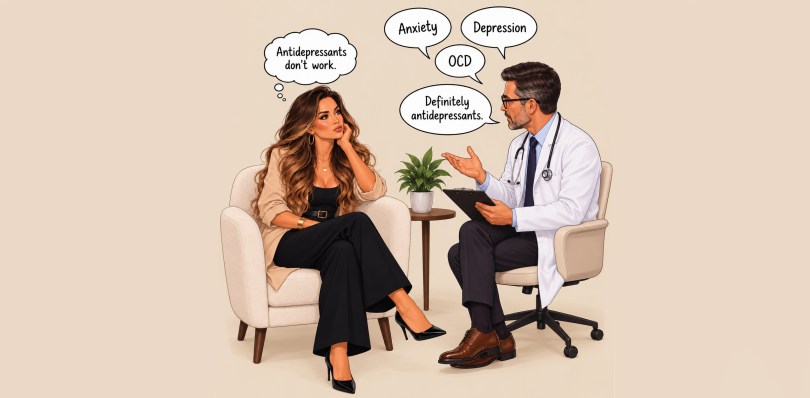
I was speaking to a psychiatrist today, and it got me thinking about how many women reach their 30s and 40s before anyone realises they are autistic.
For decades, their difficulties may have been labelled as anxiety.
Depression, PTSD, being “too sensitive”, Being “overly emotional”, Being difficult, being unable to cope and sometimes, they are simply given antidepressants and sent on their way.
“Why is everything so overwhelming?”
Not just:
“Are you anxious?”
But:
“What has your relationship with the world, people and change always been like?”
Not just:
“Why can’t you move on from this relationship?”
But:
“What exactly is your brain trying to process about what happened?”
Because sometimes the woman who has spent her entire life wondering why she finds everything so much harder than everybody else isn’t broken.
She isn’t lazy, she isn’t dramatic, she isn’t anxious, she isn’t a recluse and She isn’t too sensitive.
She may simply have spent decades trying to navigate a world that wasn’t designed around the way her brain works and for some women, an autism diagnosis in their 30s or 40s isn’t discovering something new.
It’s finally being given an explanation for a lifetime of things that never quite made sense, and a final chance to understand their selves as a whole.
For me personally, getting my own diagnosis was a long and difficult process. For a long time, I had essentially been written off as ADHD, but I always felt that there were parts of me that didn’t quite fit that explanation. I felt that so many of my traits were much more aligned with autism, but getting someone to actually look at the bigger picture wasn’t straightforward.
There were several assessments, a lot of questioning and a lot of trying to make sense of things I’d experienced throughout my life. Then, finally, I got my autism diagnosis, and I cried, because these two Doctors understood everything and said what I was experiencing was just ‘My way’ and that I had been putting up a fight all my life, to conform to a Neurotypical world.
What surprised me most wasn’t just receiving the diagnosis itself, but how much my understanding of autism changed afterwards. I had always associated the word “autism” with disability and, if I’m completely honest, I had my own stigma around it. It wasn’t until my son was diagnosed that I started looking at autism differently and becoming much more accepting of it.
Then, when I began to understand my own autism, I started seeing the benefits too. I started understanding that my brain isn’t wrong , it simply works differently. It helped me look back at my life and understand why I’ve always been different, why I’ve always been quirky, why I’ve always had this intensity to me, why I experience emotions so deeply and why certain things that seem completely ordinary to other people can feel overwhelming to me.
I realised why so many past lovers, had always said I become utterly fixated in the bedroom, ‘I apparently get a look in my eyes and I don’t focus on how I look, or bull shit, I’m just completely in the Sex Zone’, and this is actually down to Monotropism, where Autistic attention can become extremely concentrated on one thing. In an intimate situation, that intense focus can mean you’re completely in the experience, rather than simultaneously thinking about how you’re appearing, what you should be doing next, or what your partner thing, and it’s one of the only times an autistic brain can be silenced, and become quiet because the intensity in sex in which you’re engaged in becomes the only thing your senses want.
Now Monotropism doesn’t mean every Autistic woman is passionate or sexually responsive, but emotional responses, intense attraction, becoming absorbed, fixations and experiences sensory experiences different, is a high of intensity, and many of the Neurotypical people you’re Intimate with can be totally mind blown or on the other hand often intimidated.
So, whilst this doesn’t mean Autistic women can be better in bed, it just means, autistic women can experience intimacy, attraction and sensory experiences more intensely.
With my diagnosis, it even made me reconsider things people have said to me throughout my life. My child’s father, for example, would often tell me that I “lead with emotion and not logic.” Friends have said things to me that I don’t necessarily believe they intended to be hurtful, but I couldn’t understand why they were saying them because I genuinely assumed that people thought in the same way I did. I couldn’t comprehend why they couldn’t see things the way I could, just as they couldn’t comprehend why I saw things so differently.
I think that’s one of the biggest misunderstandings between neurotypical and neurodivergent people: we can look at the same situation through completely different neurological lenses and assume the other person is simply being difficult, irrational, intense or weird. They’re not necessarily being any of those things. Their brain may simply be processing the world differently. My diagnosis has given me a completely different way of understanding myself. Instead of asking, “What’s wrong with me?” I’m learning to ask, “Why does my brain work this way?” And that shift has been enormous for me.
But what if we started looking at the whole picture?
What if we asked questions about how that woman has actually experienced life from childhood onwards?
Did she always prefer having one really close friend, rather than a big group?
Did having one person she trusted make friendships feel much easier?
Did she always prefer staying at home rather than going out?
Did social situations exhaust her, even when she seemed perfectly capable of handling them?
Did she become overwhelmed incredibly easily?
Did she struggle when plans changed?
Did she retreat from the world when everything became too much?
Did she spend enormous amounts of time thinking about decisions, analysing every possible outcome and then struggle to actually make the decision?
Did she have intense interests or become completely absorbed in particular subjects?
Did she repeatedly buy books, research things obsessively or become fixated on a new interest?
Did she experience a profound sense of injustice when something felt unfair?
And perhaps most interestingly…
Did she struggle to let go of people, situations or relationships that she felt had treated her unfairly? Because.. stop the press, this is something I think deserves far more understanding and discussing!!
There are women who become completely consumed by an ex-partner, a baby father, a friendship breakdown or a relationship that ended years ago, for what seems like most of their lives…
And their friends might say:
“Why are you still talking about him?”
“You need to let it go.”
“He’s moved on. Why haven’t you?”
But sometimes it isn’t simply that the woman is “hung up” on somebody.
There can also be a difference in how an autistic woman processes the ending of a relationship. If someone sits down with her, explains clearly that they don’t want to continue the relationship, gives her a reason and there is some sense of closure, she may actually be able to accept it, even if it hurts deeply. But when somebody suddenly disappears, ends things without explanation, changes their behaviour overnight, cheats or leaves her with unanswered questions, it can be much harder to process. The brain can get stuck on the why. What happened? What changed? What did I miss? Why wasn’t I told? Why wasn’t I given the opportunity to understand? And that unresolved sense of injustice or lack of closure can become something she keeps returning to. It isn’t necessarily that she wants the person back, it can be that she simply cannot make sense of what happened.
For some autistic women, when something doesn’t have a logical ending, the mind can keep trying to solve it long after the relationship itself has ended. Sometimes there is a combination of fixation, emotional intensity, difficulty processing an unresolved situation and a powerful sense of injustice.
If something doesn’t make sense to her, if she believes she has been treated unfairly, or if there are unanswered questions, her brain may continue returning to it.
Not because she necessarily wants the person back. Not because she is deliberately dwelling on it, but because her brain hasn’t reached a sense of resolution and this is where autism can sometimes be misunderstood.
That doesn’t mean every woman who struggles to move on from an ex is autistic. It doesn’t mean every woman with anxiety is autistic. It doesn’t mean every woman who stays at home, overthinks, feels overwhelmed or experiences relationship difficulties is autistic.
But there is a growing recognition that autistic women can present very differently from the stereotypical picture of autism , particularly women who have spent their lives masking, adapting and trying desperately to appear as though everything is fine.
They can become incredibly good at functioning.
Until they aren’t.
They can hold everything together until the demands of life become too much.
Then they may experience burnout, shutdown, anxiety, depression or what looks like an inability to cope.
And because the autism underneath it hasn’t been recognised, the treatment focuses on the symptoms rather than understanding the underlying reason for them. So, they get fed anti-depressants, higher dose, after higher dose, this tablet, that tablet, and still they feel the same…
So perhaps we need to start asking different questions.
Not just:
“Are you depressed?”
But:
“Why is everything so overwhelming?”
Not just:
“Are you anxious?”
But:
“What has your relationship with the world, people and change always been like?”
Not just:
“Why can’t you move on from this relationship?”
But:
“What exactly is your brain trying to process about what happened?”
Because sometimes the woman who has spent her entire life wondering why she finds everything so much harder than everybody else isn’t broken.
She isn’t lazy.
She isn’t dramatic.
She isn’t too sensitive.
She may simply have spent decades trying to navigate a world that wasn’t designed around the way her brain works.
For some autistic women, social situations can involve a constant awareness of social conformity and how they are being perceived. A woman might be walking into the playground to pick up her child while her mind is already running through a hundred questions:
Do I fit in here?
Does that mum like me?
Have I said something wrong?
Why aren’t they talking to me?
Do they think I’m strange?
She might walk into a Pilates class and instinctively choose a place at the back, not because she doesn’t want to participate, but because she isn’t sure how she will be received or whether she might embarrass herself. This constant monitoring can make ordinary social situations exhausting.
There can also be a tendency to analyse relationships and social dynamics very deeply, noticing changes in people’s tone, behaviour or body language and trying to work out what they mean. Forming friendships can also be different. Rather than wanting a large social circle, some autistic women may feel much more comfortable with one or two deep, trusted friendships where there is less need to constantly work out the rules of the group. Learning to step back from social conformity can sometimes help: instead of asking “Do these people like me?”, it can be more useful to ask “What do these people actually bring to my life, and how relevant are their opinions to me?” That shift doesn’t necessarily remove social awareness , autistic women can be extremely perceptive about other people, however it can help separate noticing someone’s reaction from feeling responsible for it. Someone else’s opinion doesn’t have to determine how a woman feels about herself, and she doesn’t have to change who she is simply to fit into a social environment. I learned long ago to look at people and think ‘What fucking joy do you bring to my lovely life’ – and most of the time it was Fuck all!! So what relevance do these people have, does it even matter if they like you or not, their judgement is on them, and not you. You be you, and realise you don’t need everyone to like you in this life, you are beautiful and just wired differently.
And for some women, an autism diagnosis in their 30s or 40s isn’t discovering something new.
It’s finally being given an explanation for a lifetime of things that never quite made sense.

