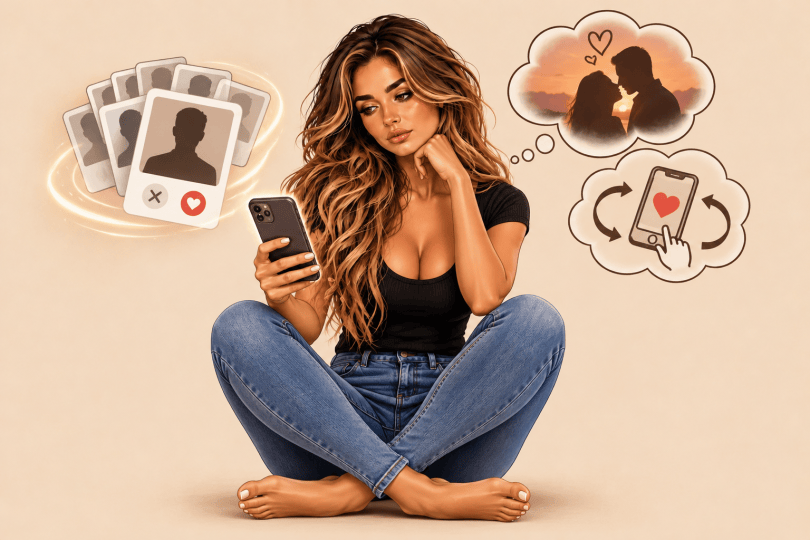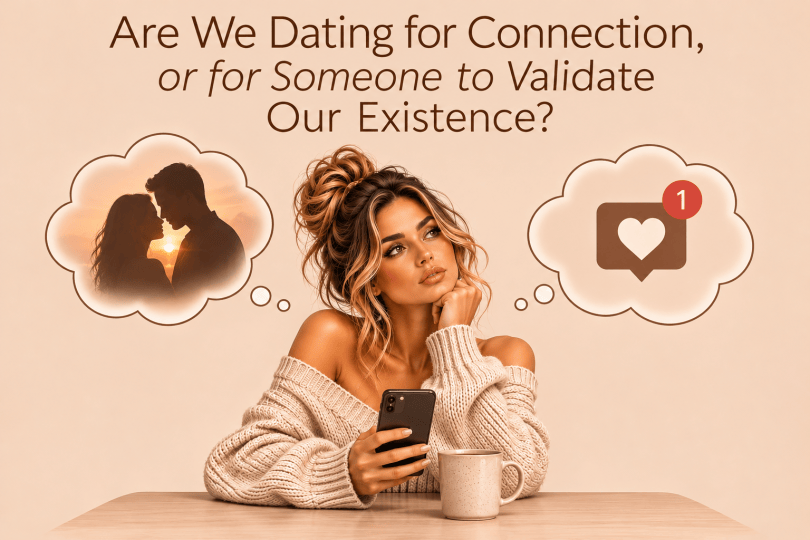
Are We Dating for Connection, or Are We Waiting for Someone to Validate Our Existence?

Have we outsourced our self-worth to people who can’t even manage to reply to a WhatsApp message?

Let’s talk about modern dating. Not the usual conversations about red flags, situationships, attachment styles or whether someone who takes six hours to reply is genuinely busy or simply not that interested.

I want to talk about something a little deeper.

Something that might explain why so many of us seem to be emotionally exhausted by dating before we’ve even established whether we actually like the person we’re dating.

Are we becoming so dependent on external validation that we’ve forgotten how to evaluate ourselves?

More importantly, are we allowing other people’s opinions, behaviour and attention to determine how we feel about our own worth? Because if we’re honest, there’s something quite extraordinary about the amount of emotional power we can hand over to someone we’ve known for approximately three weeks.

One minute we’re perfectly happy, getting on with our lives, feeling reasonably confident. The next, somebody hasn’t replied to a message, and suddenly we’re conducting a full forensic investigation into our personality.

Did I say something wrong? Was I too keen? Was I not keen enough? Did I come across as desperate? Was that joke a bit much? Was I not good looking enough?

And before we know it, we’re analysing a conversation that lasted eleven minutes as though we’re preparing evidence for the Crown Court.

But perhaps the problem isn’t always the person who hasn’t texted back.

Perhaps it’s what their silence has come to mean to us.

Enter Carl Rogers: Conditions of Worth

In person-centred psychology, Carl Rogers introduced the concept of conditions of worth.

The basic idea is that we develop an understanding of our own value through the conditions we believe we must meet to receive acceptance, affection and approval from others.

In an ideal world, we’re raised experiencing unconditional positive regard. We’re accepted as individuals, rather than feeling that love and approval must be earned through our behaviour, achievements or ability to meet somebody else’s expectations.

Unfortunately, real life isn’t always quite so straightforward. We can grow up learning, consciously or unconsciously, that we’re more lovable when we’re agreeable, more acceptable when we’re successful, more deserving of affection when we’re attractive, helpful, accommodating or easy to be around.

Eventually, these external expectations can become internalised.

We begin to believe that our worth is conditional.

We might not consciously think, “I’m only worthy if somebody chooses me,” but our behaviour can suggest otherwise and this is where modern dating becomes particularly interesting. Because how many of us have found ourselves measuring our attractiveness, desirability or even our basic worth against whether another person wants us?

We say we want a relationship, but sometimes what we’re desperately seeking is confirmation that we’re wanted.

There’s a difference.

One is about connection. The other is about validation.

And confusing the two can get us into a whole world of trouble.

The Locus of Evaluation: Who Gets to Decide Your Worth?

Another important concept in Rogers’ theory is the locus of evaluation.

Put simply, this concerns where we look when evaluating ourselves and deciding what we think, feel and believe about our experiences.

An internal locus of evaluation means we’re increasingly able to assess ourselves using our own values, experiences and feelings.

We can listen to other people’s opinions without allowing those opinions to become the final verdict on who we are.

An external locus of evaluation, on the other hand, means we’re placing greater emphasis on other people’s judgements, expectations and approval when deciding how to feel about ourselves.

Now, let’s apply that to dating.

Imagine you’ve been on a date. You’ve had a lovely evening, enjoyed the conversation, laughed, felt comfortable and thought there was a genuine connection.

You get home feeling quite positive.

Then you don’t hear from them the following day…. Your stomach ends up in knots, you suddenly feel anxious..

Suddenly, your evaluation of the entire evening changes.

Was it actually that good? Did they find me attractive? Did I talk too much? Perhaps I wasn’t their type after all. Did they lie about the chemistry?

Notice what has happened.

Your original experience was positive. You enjoyed yourself. You felt comfortable. But somebody else’s subsequent behaviour has suddenly become more important than your own experience.

You’ve effectively handed them the authority to rewrite your evening.

And this is the bit I find fascinating…. Because we’re all caught in this fucked up washing machine cycle, of analysing everything!


I can actually relate to this from personal experience. Last year, I was in a relationship with somebody who I would describe as having strong narcissistic traits, well actually I’m being kind there, he was a full on Narcissist! When I initially entered that relationship, I was confident in myself. I knew who I was, I was comfortable in my own skin and I didn’t particularly need anybody else’s approval to validate me. But as the relationship progressed, something started to change. I gradually found myself questioning myself, feeling as though I wasn’t good enough and becoming increasingly conscious of whether I was meeting his expectations. Almost everything I did felt as though it needed his approval or validation. I found myself looking externally for reassurance that I had previously been able to find within myself.

Looking back, what I find particularly interesting is that I hadn’t necessarily entered the relationship with those insecurities. They developed within the dynamic of the relationship itself. It was almost as though my internal locus of evaluation had gradually shifted towards an external one. His opinions, reactions and approval began to carry more weight than my own feelings and judgement and I think that’s something worth recognising: sometimes we don’t realise how much of our self-concept has become influenced by another person until we step outside the relationship and begin to find ourselves again.

Why does somebody else’s lack of interest suddenly make us question our own value?

They might not be compatible with us. They might not be emotionally available. They might have different priorities, preferences or expectations.

Or perhaps they simply didn’t fancy us…. That’s allowed. We’re not everybody’s cup of tea.

But why does their preference become a judgement about our worth?

Somewhere along the way, we’ve confused being chosen with being valuable and those two things are not remotely interchangeable.

The WhatsApp Waiting Room: When Someone Else Controls Your Mood

Let’s talk about the modern dating ritual that deserves its own psychological diagnosis.

Waiting for a text.

You send a message. Nothing…

You put your phone down. Pick it up again. Check whether they’re online. Notice they’ve viewed your story. Wonder why they can apparently operate Instagram but cannot locate the WhatsApp application.

You check the last-seen status.

You analyse the punctuation in their previous message.

You consider whether the full stop was passive-aggressive.

God forbid they were previously sending good morning messages with kisses and have suddenly reduced their communication to “Morning”… or Nothing!

What the actual fuck happened???

But underneath the humour is something worth examining.

When we’re waiting for a message to determine how we feel, we’re potentially placing our emotional wellbeing in somebody else’s hands.

Their attention provides reassurance. Their enthusiasm provides a temporary boost. Their silence creates uncertainty and we can become increasingly preoccupied with obtaining the next little piece of reassurance.

It’s worth distinguishing between the psychological theories here. Rogers’ locus of evaluation helps us understand why we might rely on somebody else’s response to judge ourselves. Behavioural psychology also offers useful ways of understanding how unpredictable rewards can reinforce checking behaviours.

When attention arrives inconsistently, we can become particularly focused on when it might arrive again. We don’t know whether we’ll receive affection, enthusiasm or silence.

So we check.

And check again.

And again… FUCK ME! You want to stop checking your phone but cant!

We’re not necessarily waiting for a meaningful conversation anymore. Sometimes we’re waiting for the emotional relief that comes with knowing we’re still wanted.

That’s quite a distinction.

And perhaps the most uncomfortable question is this:

If that person never messaged again, would we miss them, or would we miss how they made us feel about ourselves?

Because those are two very different experiences.

Self-Concept: Are We Seeing Ourselves Clearly?

Rogers also placed considerable importance on self-concept: the collection of beliefs and perceptions we hold about ourselves.

This includes our self-image, the person we believe we are, and our ideal self, the person we would like to become.

He also explored the relationship between our self-concept and our experiences. When there’s a significant gap between how we experience ourselves and how we believe we should be, psychological tension can develop.

Dating can expose this gap rather dramatically.

We might see ourselves as independent, confident, emotionally intelligent people who know exactly what we want. Yet, when somebody we’re attracted to becomes distant, we find ourselves abandoning our usual boundaries.

We might tolerate behaviour we wouldn’t normally accept, make excuses for inconsistency or become preoccupied with winning back somebody’s attention.

Suddenly, the person who was quite happy being single is wondering whether they should send another message. The person who said they wanted emotional availability is making allowances for somebody who communicates like a faulty satellite.

The person who knows their worth is trying to negotiate a better price for it and perhaps that’s where we need to examine the difference between what we say we value and what we actually demonstrate through our behaviour.

Because self-worth isn’t simply about telling ourselves we’re wonderful.

It’s about whether we can maintain our sense of self when somebody else doesn’t see us in the way we’d hoped.

Are We Making Decisions Based on Someone Else’s Verdict?

Here’s another question.

How often do we actually stop and ask ourselves whether we like the person we’re dating?

Not whether they like us, Not whether they fancy us, Not whether they’re going to ask us out again.

But whether we genuinely like them.

Are they kind? Are they emotionally available? Do we enjoy their company? Do our values align? Do we feel comfortable being ourselves around them?

Or have we become so preoccupied with being selected that we’ve forgotten we’re supposed to be selecting too? I mean, has it just become one shitty game, we’re all addicted to.

I think this is one of the biggest traps in modern dating.

We can become so focused on securing somebody else’s approval that we stop evaluating whether they’re suitable for us.

We start auditioning.

We become more conscious of how we’re presenting ourselves, whether we’re saying the right things, whether we’re being too available, too enthusiastic, too independent or too much of anything and dating starts to resemble a job interview where both candidates are pretending not to care whether they get the position.

Meanwhile, neither of them has actually checked whether the job comes with decent working conditions.

Perhaps we’re not always looking for compatibility.

Perhaps sometimes we’re looking for confirmation.

Confirmation that we’re attractive. Desirable. Interesting. Worth pursuing.

And when somebody doesn’t provide that confirmation, we experience it as rejection, even when we might not have been particularly interested in them ourselves.

The Gender Question: Are Men and Women Playing Different Versions of the Same Game?

It’s tempting to think this is predominantly a female issue, particularly when we consider the pressures women experience around appearance, desirability, ageing and being chosen.

Women can find themselves measuring their value against whether they’re considered attractive enough, young enough, feminine enough or desirable enough.

Social media hasn’t exactly helped.

We’re constantly exposed to carefully curated versions of other people’s relationships, appearances and lifestyles and dating apps can make romantic attention feel measurable.

Matches, likes, messages, dates and followers become little indicators of perceived desirability.

However men aren’t necessarily immune to the same psychological process.

Men can experience conditions of worth around success, financial security, status, physical attractiveness, sexual performance and being perceived as desirable. Some may feel their value is tied to being wanted, admired, successful or sexually validated.

Others may seek reassurance through romantic or sexual attention without necessarily being comfortable with emotional vulnerability.

Of course, these aren’t universal male or female characteristics. People experience validation differently, and social expectations can influence how they express it.

But perhaps both sexes are participating in a similar psychological dance.

One person is waiting to feel chosen.

The other is waiting to feel desired.

Both are potentially looking outside themselves for reassurance.

And neither necessarily feels particularly secure.

The Disaster of Conditional Dating

Here’s where I think things can become particularly problematic.

If our self-worth is heavily dependent on external approval, dating can become less about finding a compatible partner and more about managing our own insecurities.

We might pursue people who are emotionally unavailable because their approval feels particularly rewarding. We might become more interested when somebody withdraws their attention. We might interpret inconsistency as a challenge rather than information. We might overlook incompatibility because we’re too invested in being chosen.

And we might confuse the intensity of our emotional response with the depth of our connection…

Sometimes, the person we’re most preoccupied with isn’t necessarily the person who makes us happiest.

They’re simply the person whose approval we haven’t secured, and we like to chase.

That uncertainty can keep us emotionally invested long after the relationship has stopped offering anything particularly meaningful and that’s a dangerous place to find ourselves.

Because when somebody else’s behaviour determines our emotional state, we’re no longer making decisions entirely from our own values.

We’re reacting to their behaviour. We’re adjusting ourselves around their availability. We’re waiting for their approval before allowing ourselves to feel okay again and eventually, we can lose sight of what we actually wanted in the first place.

So, How Do We Get Our Internal Locus of Evaluation Back?

Perhaps the answer isn’t to stop caring what other people think.

We’re human. We want connection, affection, acceptance and intimacy. There’s absolutely nothing wrong with wanting to be loved or wanted. Nor does having an internal locus of evaluation mean ignoring feedback or refusing to acknowledge when we’ve made mistakes.

It’s about developing the ability to consider other people’s opinions without automatically treating them as the truth.

It’s about being able to say: I enjoyed that date, regardless of whether they enjoyed it.

I found that person attractive, but that doesn’t mean they’re right for me.

I’d like them to message, but my evening doesn’t need to revolve around whether they do.

I’m disappointed that they aren’t interested, but their lack of interest doesn’t diminish my value and perhaps most importantly:

I don’t need somebody else to choose me before I decide that I’m worth choosing.

That last one is worth sitting with.

Because when we begin to develop a more internal sense of evaluation, something changes. We stop treating every interaction as a referendum on our desirability. We become more interested in how people make us feel rather than how we make them feel. We become better at recognising incompatibility without interpreting it as personal failure and we become less willing to abandon ourselves in exchange for somebody else’s attention.

Final Thoughts: Perhaps We Need to Stop Auditioning

I think modern dating has created an environment where external validation is incredibly accessible, but genuine emotional security can feel increasingly elusive.

We can receive hundreds of likes, matches and messages and still question whether we’re desirable. We can have somebody tell us we’re beautiful and still need them to tell us again tomorrow. We can receive attention from multiple people and still become fixated on the one person who isn’t giving us any and perhaps that’s because validation and self-worth are not the same thing.

External validation can make us feel good. It can reassure us, excite us and make us feel desirable.

But it cannot permanently resolve an underlying belief that we’re somehow not enough.

That work has to happen internally.

Perhaps the real question we should be asking ourselves when dating isn’t simply, “Do they like me?”

It’s:

“Do I like them?”

“Do I feel comfortable being myself?”

“Am I enjoying this experience?”

“Am I acting in accordance with my own values?”

And, most importantly:

“Would I still feel good about myself if this person decided they weren’t interested?”

Because we cannot spend our lives waiting for other people to issue us with a certificate confirming that we’re attractive, lovable and worthy of affection and if somebody’s inability to send a text message can dismantle your entire sense of self, perhaps it’s time to take a little of that power back.

Stop waiting for somebody else’s verdict. You’re not applying for the position of being worthy.

And for fuck’s sake, put your phone down.

You’ve got a life to live.
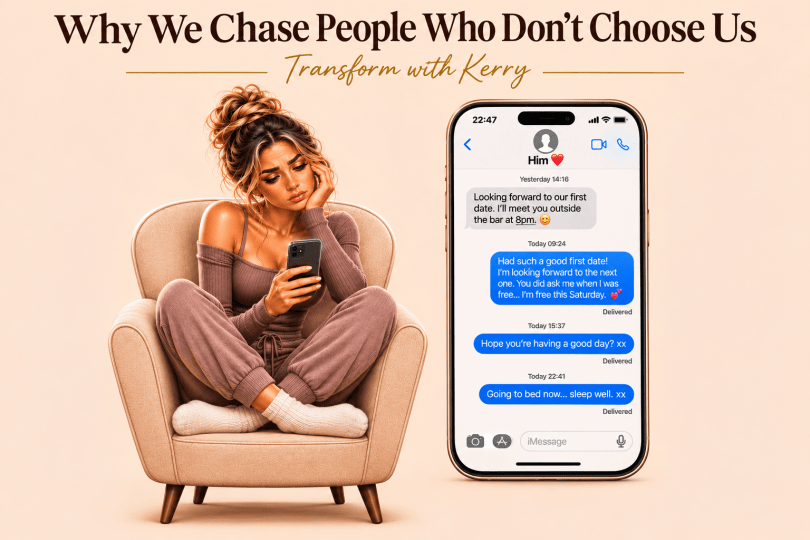
Why We Chase People Who Don’t Choose Us – The Psychology of Rejection sensitivity, Validation and Self-respect

An honest look at modern dating, emotional attachment, the grief of potential and why we sometimes abandon ourselves in the pursuit of being wanted.

Why do we chase?

Have you ever found yourself becoming more emotionally invested in someone precisely when they seem to be becoming less available? Have you found yourself analysing messages, checking whether someone has viewed your stories, questioning a change in their tone or wondering what you did wrong when their attention suddenly shifts?

Perhaps you’ve told yourself you’re not going to message again, only to find yourself looking for another reason to make contact. I remember being there at the start of 2026, and now I look back and like ‘WTF Kerry’ !! Perhaps you’ve replayed a date in your head, searching for clues that might explain why somebody who appeared so bloody interested has suddenly become distant and perhaps the most difficult part is that you recognise what’s happening.

You know you’re overthinking. You know you’re giving somebody more headspace than they have earned, I mean have they even earned a fraction.. Yet somehow, knowing that doesn’t immediately make the feelings disappear.

Why do we do this? Why can another person’s attention, or lack of it, have such a powerful effect on how we feel about ourselves? And why, sometimes, do we find ourselves chasing reassurance from the very situation that is making us feel insecure?

I think these are important questions, particularly in a dating culture where communication is constant, connections can begin and end within days, and social media gives us endless opportunities to monitor somebody else’s attention.

One concept that helps us explore this is rejection sensitivity. It can influence how we interpret other people’s behaviour, how quickly we become emotionally invested and how we respond when we sense that somebody might not want us in the way we want them.

But there is another part of this conversation that I think deserves just as much attention: the grief of potential. Sometimes we aren’t grieving a relationship that we’ve actually had. We’re grieving the relationship we imagined might happen and somewhere between wanting to be chosen and hoping something will develop, we can lose sight of the one person whose feelings and needs we should never be prepared to abandon: ourselves.

Understanding rejection sensitivity

Rejection sensitivity is the tendency to anxiously expect, readily perceive and react strongly to the possibility of rejection. It doesn’t necessarily mean somebody has actually rejected us. Sometimes the emotional response begins before we know what is happening.

A delayed reply, a change in someone’s communication, a cancelled plan or a perceived lack of enthusiasm can become loaded with meaning. We might interpret uncertainty as rejection, distance as disinterest or a change in behaviour as evidence that we are no longer wanted.

The emotional reaction can feel much bigger than the situation itself. We may experience anxiety, sadness, frustration, embarrassment or an overwhelming need to find out where we stand.

It’s important to understand that rejection sensitivity isn’t exclusive to any particular group of people. Most of us will experience some degree of sensitivity to rejection at different points in our lives. For some, however, the experience is much more intense and can have a significant impact on relationships, confidence and emotional wellbeing.

The term rejection sensitive dysphoria, often shortened to RSD, is frequently used in discussions about ADHD and emotional sensitivity. However, it isn’t a formal standalone clinical diagnosis, and we should be careful not to treat every experience of rejection as a medical condition.

What matters is understanding the experience itself: why certain situations affect us so deeply, what they bring to the surface and how we can respond without allowing the emotion to take control of our behaviour.

Where does rejection sensitivity come from?

There isn’t one universal explanation. Rejection sensitivity can develop through a combination of experiences, relationships, temperament and the way we learn to understand ourselves and other people.

For some people, childhood experiences may play an important role. Growing up with emotional neglect, inconsistent affection, criticism, abandonment or a lack of reassurance can influence how safe we feel in relationships later in life.

When a child experiences inconsistent care or doesn’t feel emotionally secure, they may become particularly alert to changes in other people’s behaviour. They might learn to monitor moods, anticipate disappointment or work hard to maintain connection because, at some point, connection hasn’t felt reliable.

These experiences don’t automatically mean someone will develop rejection sensitivity. Nor does experiencing rejection sensitivity mean somebody must have experienced childhood trauma. Human development is much more complicated than that.

However, it is worth considering whether some of our adult reactions are connected to feelings that began much earlier in life.

Sometimes the person in front of us isn’t the whole reason we’re hurting. Their behaviour may be touching an older feeling: not being wanted, not being important, not being enough or not being chosen and when that happens, the emotional response can feel disproportionate because we’re not necessarily responding to just one moment. We’re responding to what that moment represents to us.

The impact of ADHD and autism

Although rejection sensitivity can affect anybody, neurodivergence can add another layer of complexity for some people.

ADHD is associated with difficulties with emotional regulation for some individuals. Emotions can feel particularly intense, and it may take longer to settle after something upsetting. Uncertainty, perceived criticism and changes in interpersonal relationships can therefore become difficult to navigate.

Autistic people may also experience particular challenges around social uncertainty, interpreting ambiguous communication or making sense of changes in another person’s behaviour. This varies enormously between individuals, and it would be wrong to assume that every autistic person experiences rejection in the same way.

I think it’s important to make this distinction because rejection sensitivity is not an ADHD or autism issue alone. It is a human experience, although neurodivergence, childhood experiences and other individual circumstances can influence how it presents.

The more we understand the different factors involved, the less likely we are to judge ourselves for having an emotional response that we don’t yet fully understand.

My own experience: learning to understand rejection sensitivity

This is something I’ve had to explore personally, and I will be honest: it wasn’t something I initially understood particularly well.

Even through my own personal development and therapist-related learning, I found that I had to go away and investigate it further. I wanted to understand what rejection sensitivity actually meant, where it could come from, why it could feel so intense and, perhaps most importantly, why certain situations seemed to affect me more than others.

As somebody who has experienced childhood trauma, neglect and the absence of a father figure, I’ve had to reflect on how those early experiences may have influenced the way I experience emotional connection, distance and rejection as an adult.

I can’t say that one experience explains everything, and I don’t think we should reduce our entire emotional world to our childhood. But I do think there is value in asking ourselves whether some of the things that hurt us today connect with feelings we experienced much earlier in life.

As a neuro-divergent woman with autism and ADHD, I’ve also had to consider how my own way of processing emotions, uncertainty and relationships can add another layer to the experience.

There have been a couple of occasions in my adult life when I’ve experienced rejection sensitivity particularly intensely. What I found interesting was how much emotional energy I could give to a situation, sometimes far more than the actual relationship or circumstances warranted.

I had to start looking at the underlying reasons rather than simply criticising myself for how I felt. I wanted to understand the triggers, recognise the patterns and learn how to respond differently and I think that is where real personal growth begins. Not in pretending we don’t care, not in becoming emotionally unavailable and certainly not in convincing ourselves that we should never feel hurt. It begins with developing enough self-awareness to recognise what is happening inside us and choosing not to let every emotion dictate our next move.

The validation loop: when we start chasing reassurance

One of the most difficult patterns associated with rejection sensitivity is the need for reassurance.

Imagine meeting somebody and having a genuinely lovely experience. There’s chemistry, conversation, attraction and the feeling that something could develop. You come away feeling positive, perhaps even excited about the possibility of seeing them again.

Then something changes. Their messages become less frequent. The enthusiasm seems to dip. They don’t initiate conversation in the same way, or perhaps they are still watching your social media stories but aren’t making any real effort to communicate.

Suddenly, your attention shifts.

Instead of enjoying the possibility of getting to know someone, you’re trying to work out whether they still like you. You’re analysing the timing of messages, reading between the lines, checking online activity and looking for reassurance that the connection hasn’t disappeared.

You might find yourself wanting to contact them, not necessarily because you have something meaningful to say, but because you want to relieve the discomfort of not knowing.. and this is where we can become caught in a cycle.

We feel uncertain, so we seek reassurance. We receive a little reassurance and feel better temporarily. But if the underlying situation remains inconsistent, the uncertainty returns. We then find ourselves looking for reassurance again.

The problem is that we can become dependent on the very person whose inconsistency is triggering the insecurity.

I sometimes think of this as a form of emotional self-sabotage. We repeatedly expose ourselves to a situation that makes us feel unsettled, hoping that the next interaction will finally give us the reassurance we need, but how much of our emotional energy are we willing to spend trying to obtain certainty from somebody who isn’t offering it naturally?

And at what point do we stop asking what they think of us and start asking what their behaviour is telling us?

The grief of potential: are we attached to the person or the possibility?

This is one of the most interesting parts of modern dating, and I think it is something many people will recognise.

Sometimes we become attached to what a person represents rather than what we actually know about them.

We have a wonderful first date. We experience chemistry, laughter, affection and a sense of connection. We start imagining what might happen next. We picture future dates, weekends away, conversations and the possibility of something meaningful.

Our minds begin building a future around a person we may have only met once or twice. Then, when the connection doesn’t develop, we experience disappointment that can feel surprisingly intense.

But what exactly are we grieving?

Are we grieving the person, or are we grieving the possibility of what we thought could happen?There is a difference between losing an established relationship and losing an imagined future. Both can hurt, but they are not the same experience.

When we become emotionally invested in potential, we can end up mourning something that never really existed outside our imagination. We may miss the excitement, the anticipation, the feeling of being wanted and the future we had quietly started to picture.

This doesn’t make the feelings silly or invalid. Hope is a natural part of getting to know somebody. It’s lovely to feel excited about a new connection.

But we need to be careful not to confuse the promise of something with the reality of what is being offered.

Chemistry isn’t compatibility. Attraction isn’t emotional availability. A wonderful first date isn’t a guarantee of a relationship. And somebody’s potential isn’t the same as their willingness to build something with us.

We need to give people the time and space to show us who they are through consistent behaviour, rather than filling in the gaps with what we hope they might become.

When rejection sensitivity meets modern dating

I think modern dating has created an environment where rejection sensitivity can be particularly difficult to navigate.

Dating apps have made it easier than ever to meet people, but they have also changed the way many of us experience connection. We can move from one conversation to another, meet several people in a short period of time and feel as though there is always somebody else just a swipe away.

Social media adds another dimension. We can see when someone is online, whether they have viewed our stories and sometimes what they are doing, without having any meaningful communication with them.

This can create a strange situation where we have more access to information about somebody’s activity but not necessarily more understanding of their intentions.

A person can watch every story and still make no effort to arrange a date. They can send a message one evening and disappear for several days. They can show enthusiasm in person but struggle to communicate consistently afterwards and because so much of modern dating takes place through a screen, we can find ourselves trying to interpret tiny pieces of information that may not tell us very much at all.

A viewed story isn’t a declaration of interest. An online status isn’t an invitation. A delayed reply doesn’t automatically mean rejection.

But when we’re already feeling emotionally vulnerable, these small details can become the focus of an enormous amount of mental energy.

I don’t think dating apps are inherently bad, nor do I think everyone who communicates inconsistently is deliberately trying to hurt somebody. People have different expectations, circumstances and levels of emotional availability.

However, I do think we need to recognise how an environment of constant access, ambiguity and perceived choice can make it harder to feel secure when we’re getting to know someone.

We can become so busy trying to work out where we stand with another person that we forget to ask whether we actually like how the situation is making us feel.

Why are we in such a rush?

I think this is a question worth asking.

Why do we feel the need to establish where something is going almost immediately? Why do we sometimes become so invested in a connection before we’ve had enough time to understand whether the other person is right for us?

There is nothing wrong with wanting a relationship. There is nothing wrong with being intentional about dating or knowing what you want, But there is a difference between being open to a relationship and trying to force one to develop before it has had the opportunity to grow naturally.

When we rush emotionally, we can become attached to an outcome rather than paying attention to the experience itself.

We start looking for signs that somebody likes us instead of asking whether their behaviour demonstrates the qualities we want in a partner. We focus on whether we’re being chosen rather than considering whether we would actually choose them and perhaps this is where we need to change our perspective.

If somebody wants to speak to you, allow them the opportunity to speak to you. If they want to arrange another date, let them show that through their actions. If they want you to be part of their life, there should be some natural movement towards that.

This isn’t about playing games, withholding affection or pretending to be less interested than we are. It’s about allowing a connection to be mutual.

You don’t need to carry the entire conversation, organise every meeting, initiate every interaction or continually remind somebody that you exist.

Let people meet you halfway.

And if they don’t, you have information that can help you decide whether this is something you want to continue investing in.

Self-respect: Stop abandoning yourself to be chosen

This is probably the most important part of the whole conversation for me.

Self-respect isn’t about being cold, arrogant or emotionally unavailable. It doesn’t mean pretending you don’t care when you do. It doesn’t mean refusing to message first or turning dating into a competition about who can appear least interested.

It means understanding that your worth doesn’t increase when somebody wants you, and it doesn’t decrease when somebody doesn’t.

It means being able to enjoy another person’s company without making their attention the measure of your happiness.

It means recognising when you’re starting to compromise your own emotional wellbeing in order to keep a connection alive.

It means being prepared to walk away from something that isn’t meeting your needs, even when you had hoped it might become something special.

I think many of us have, at some point, found ourselves trying to become more appealing, more accommodating or more available because we are worried that somebody might lose interest.

We might overlook behaviour that makes us uncomfortable, minimise our own expectations or convince ourselves that if we are just patient enough, understanding enough or attractive enough, things will eventually change.

But a healthy connection shouldn’t require us to continually negotiate our own worth.

We can be understanding of somebody else’s circumstances without making ourselves responsible for their emotional availability. We can recognise that somebody may be busy, healing or working through their own experiences without waiting indefinitely for them to decide whether they want us and we can be disappointed when something doesn’t work out without turning that disappointment into a judgement about ourselves.

How do we begin to break the cycle?

The first step is awareness. We cannot change a pattern we haven’t recognised, and we cannot make healthier decisions if we don’t understand what is driving our behaviour.

When you notice yourself becoming preoccupied with somebody’s attention, try to pause before reacting. Ask yourself whether you’re responding to something that has actually happened or to something you’re afraid might happen.

There is a difference between facts and interpretations. The fact might be that somebody hasn’t replied today. The interpretation might be that they’ve lost interest, met somebody else or decided you’re not good enough. Those interpretations may feel convincing, but they are not necessarily true.

Give yourself permission to sit with uncertainty rather than immediately trying to eliminate it.

Try to maintain your own life while getting to know somebody. Keep seeing your friends, pursuing your interests, working towards your goals and enjoying the things that make you feel like yourself. A new connection should add something to your life, not become the entire focus of it.

Be mindful of repeatedly checking social media, monitoring online activity or seeking reassurance when you feel anxious. These behaviours may offer temporary relief, but they can also keep your attention fixed on the uncertainty.

Most importantly, pay attention to how somebody behaves over time. Look for consistency, communication, respect and genuine effort. You don’t need to make excuses for someone, but you also don’t need to jump to conclusions based on one delayed message and if rejection sensitivity is causing significant distress or affecting your relationships and everyday life, speaking to a suitably qualified mental health professional can help you explore the underlying patterns and develop strategies that work for you.

The aim isn’t to stop caring. It’s to learn how to care without losing yourself.

Learning not to let feelings dictate behaviour

One of the biggest changes I’ve noticed in my own thinking is that I no longer believe every feeling needs an immediate response.

I can meet somebody, enjoy their company, feel attracted to them and genuinely hope that something develops. I can be excited about the possibility of seeing them again.

However, I can also recognise that if they don’t want the same thing, that is okay. It doesn’t mean I wasn’t interesting enough, attractive enough or good enough. It doesn’t mean I’ve missed my only opportunity for happiness. It simply means that this particular connection may not be right, mutual or available.

Of course, that doesn’t mean rejection never hurts. I’m human. I can still feel disappointed, and I can still have moments when I wish something had worked out differently. The difference is that I don’t have to allow those feelings to dictate my behaviour.

I don’t have to chase somebody to prove that I’m worth choosing. I don’t have to keep looking for reassurance from someone who isn’t offering it. And I don’t have to turn somebody else’s lack of interest into a personal failure.

There will always be other people to meet, other experiences to have and other opportunities for connection.

That isn’t arrogance. It isn’t pretending that people are disposable. It’s understanding that one person’s decision doesn’t define my value.

And I think there is a real freedom in reaching that point.

Stop grieving the future and start looking at the present

Perhaps one of the most important things we can learn in dating is to stop falling in love with what something could become before we’ve had the chance to understand what it actually is.

We need to give people the opportunity to show us who they are, rather than becoming attached to the version of them we’ve created in our minds.

We need to recognise that attraction is only one part of compatibility, that chemistry doesn’t guarantee emotional availability and that potential means very little without consistent action.

We also need to be kinder to ourselves. If rejection affects us deeply, there is usually something worth understanding beneath that feeling. We don’t need to shame ourselves for being sensitive, wanting connection or hoping to be loved.

However, we do need to take responsibility for how we respond.

We can acknowledge our past without allowing it to determine our future. We can recognise our triggers without allowing them to control our decisions. We can want somebody without needing them to want us back in order to feel whole.

And perhaps the question we should ask ourselves when we find ourselves chasing somebody’s attention isn’t simply, “Do they like me?”

Perhaps it’s:

“Why am I chasing something that doesn’t appear to be choosing me?”

Because the goal isn’t to become somebody who never feels rejection. It’s to become somebody who understands that rejection is not a measure of their worth.

You can be open-hearted without being endlessly available. You can be interested without becoming invested too quickly. You can hope for something beautiful without abandoning yourself in the process.

And you can walk away from a connection you wanted, knowing that you are still worthy of the connection you deserve. I learned a hard lesson in January 2026, and its one that’s helped me evolve so deeply and emotionally, take every situation you face as growth..

Don’t lose yourself trying to be chosen by somebody else. Choose yourself first.

Are We Dating to Find Love, or Addicted to the Search?

The psychology of dating apps, the business of loneliness and why modern romance might be in trouble.

When did finding love become an endless shopping experience?

We live in a time when we have more opportunities than ever to meet people. With a few taps on a phone, we can access hundreds, sometimes thousands, of potential romantic partners. We can browse profiles, swipe through photographs, exchange messages and arrange dates without ever having to leave the comfort of our homes.

On paper, this should be the golden age of romance. Yet something rather peculiar seems to be happening.

People are increasingly talking about dating fatigue, emotional exhaustion, ghosting, situationships and the difficulty of finding someone who genuinely wants a relationship. We have an extraordinary amount of choice, but are we actually becoming any better at choosing?

And perhaps a more uncomfortable question: Are dating apps designed to help us find love, or have we become the product of an industry that makes money from our continued search for it?

The business model behind looking for love

I recently had a conversation with somebody who works in analytics and algorithms. They raised an interesting point about the economics of dating platforms. Their argument was that a relatively small proportion of men receive a disproportionate amount of attention, while a much larger proportion experience considerably less success. Those who receive fewer matches may consequently spend more time on the platforms, purchase subscriptions, pay for boosts and invest money in trying to improve their visibility.

It got me thinking.

There is a popular theory circulating online known as the 80/20 rule of dating apps. It suggests that a small proportion of men receive the majority of female attention.

You will also hear variations of this as the 90/10 rule.

However, it is important to distinguish internet theories from established research. There is no reliable universal statistic proving that 10% of men receive 90% of all matches across dating apps.

What we do have is some interesting evidence.

A 2016 academic study, A First Look at User Activity on Tinder, conducted by researchers including Gareth Tyson at Queen Mary University of London, examined almost half a million Tinder users using a combination of controlled profiles and survey research.

The researchers identified significant differences in how men and women interacted with the platform. Women tended to be more selective, while men tended to swipe right on a much larger proportion of profiles.

This created what the researchers described as a feedback loop: men became less selective in the hope of securing matches, while women became increasingly selective because their likes were more likely to result in matches.

The result was an unequal experience of the same platform.

This doesn’t prove that a fixed percentage of men monopolise all the attention. But it does demonstrate that dating apps can create very different experiences for different groups of users.

Oh and the commercial implications are interesting.

If somebody is repeatedly unsuccessful, they may be more inclined to keep trying. They might purchase premium membership, pay to see who has liked them, increase their profile visibility or buy additional features.

Meanwhile, somebody receiving hundreds of likes may find themselves overwhelmed by choice and struggle to establish meaningful connections. Two very different experiences. Potentially the same commercial outcome: continued engagement, addiction and lack of love.

The psychology of the swipe

So why are these apps so difficult to put down? Part of the answer lies in behavioural psychology.

Dating apps use a mechanism that has a lot in common with variable reward systems.

Think about a slot machine. You don’t know when the next reward is coming. Sometimes you get nothing. Sometimes you get a small reward. Occasionally, you get something that feels particularly exciting.

The uncertainty is part of what makes the experience compelling. A dating app can operate in a similar psychological environment.

You swipe through several profiles. Nothing particularly interesting happens. Then suddenly, a match appears.

Someone attractive. Someone interesting. Someone who looks as though they might tick every box.

There is a little rush of excitement. Perhaps a notification, a message or a compliment.

You begin imagining the possibilities, but then the interaction might fade, the person might stop replying, or the date might never materialise.

And so you return to the app….Perhaps the next swipe will be different.

This is not to say that every dating app user is addicted or that every notification produces a predictable dopamine response. Human behaviour is much more complicated than that.

But intermittent rewards, anticipation, novelty and uncertainty are well-established psychological mechanisms that can reinforce repeated behaviour.

The interesting thing is that the reward isn’t necessarily the relationship itself.

Sometimes, it is simply the possibility of one.

The addiction to the new crush

I think this is one of the most fascinating aspects of modern dating.

Why do we become so excited about somebody we barely know?

A new match can generate an extraordinary amount of anticipation. You exchange messages, learn little details about each other, start imagining what meeting might be like and perhaps begin to picture a future.

There is an element of fantasy involved.

Because when we first meet somebody, we don’t know them particularly well. We are often responding to the potential of who they might be, rather than the reality of who they are.

The early stages of attraction are exciting precisely because there is so much we don’t know. Every message can feel significant. Every compliment can reinforce our interest. Every little sign of attention can make us want more.

Psychologically, anticipation can sometimes be more exciting than the eventual reward and this creates an interesting problem.

Once we have actually met somebody, the mystery begins to disappear. We move from imagining a person to getting to know an actual human being.

Real relationships require patience, communication, compromise and consistency. They also involve ordinary moments that aren’t particularly exciting, but if we become accustomed to the constant stimulation of new profiles, new matches and new conversations, could the ordinary process of getting to know somebody start to feel less exciting by comparison?

Are we becoming better at starting connections but worse at allowing them to develop?

Why are we still swiping after a brilliant date?

Imagine this.

You meet somebody. The date is wonderful. You laugh, there’s chemistry, the conversation flows and you feel genuinely attracted to each other.

You go home feeling happy.

There is every possibility that this could develop into something meaningful… maybe?

Yet the following morning, while lying in bed, you open your dating app again.

Why?

Perhaps you’re not entirely convinced that the person is right for you.

Perhaps you’re worried about becoming too invested too quickly.

Perhaps you simply want to know that other options are still available.

Or perhaps the app has conditioned you to believe that there is always somebody else around the corner.

This is where the psychology of choice becomes particularly interesting.

When we believe there are endless alternatives available, committing to one possibility can feel like closing the door on hundreds of others.

What if the next person is more attractive? More successful? Funnier? More compatible? What if somebody even better is only three swipes away?

This is sometimes referred to as the paradox of choice.

More options can create more opportunities, but they can also make decisions harder and increase the fear of missing out.

Research published in 2025 by Marina Thomas, Alice Binder and Jörg Matthes examined how the number of profiles people evaluate affects their decision-making. Their experiment involved 401 participants.

Those who evaluated more profiles were less likely to accept a potential partner than those presented with fewer profiles. Greater numbers of profiles also increased feelings of choice overload.

The study also found that the way people made decisions mattered. More intuitive, rapid decision-making was associated with less favourable self-evaluations.

Think about what that means.

The more people we browse, the more difficult it may become to feel satisfied with any individual choice.

Perhaps the problem isn’t that we haven’t found somebody good enough.

Perhaps we’ve become accustomed to looking for somebody better.

The evidence: Are dating apps making us unhappy?

There is growing academic interest in the psychological effects of dating app use.

A 2023 research paper published in Telematics and Informatics, titled 99+ Matches but a Spark Ain’t One, examined the adverse psychological effects associated with excessive swiping.

The researchers identified links between excessive swiping and:

  • Upward social comparison.
  • Fear of being single.
  • Partner choice overload.

The study also found that excessive swiping helped explain the relationship between frequent dating app use and these negative psychological experiences.

In other words, simply having access to dating apps isn’t necessarily the whole issue. How much we use them, and how we interact with them, matters.

A further systematic review and meta-analysis published in Communications Psychology in 2026 examined 27 studies involving 21,263 participants.

It found small-to-moderate associations between dating app use and emotional distress, appearance concerns, body image disturbance, behavioural dysregulation and interpersonal sensitivity. The strongest associations were found in behavioural dysregulation and body-related outcomes.

Importantly, the researchers also highlighted that these findings do not establish that dating apps cause these problems. Individual circumstances, pre-existing vulnerabilities and social context all matter.

Nevertheless, it raises an important question about the psychological environment in which modern dating now takes place.

When your romantic prospects are presented as a continuous stream of photographs, profiles and first impressions, it is easy to start evaluating yourself in the same way.

Am I attractive enough? Am I getting enough matches? Why hasn’t that person replied? Why have they viewed my profile but not messaged?

Something that began as an attempt to find companionship can gradually become another source of comparison and self-doubt.

The legal challenges: Are dating apps being held accountable?

Interestingly, concerns about the business practices and psychological effects of dating platforms have moved beyond online discussions.

There have been actual legal challenges.

1. The Match Group addiction lawsuit – 2024

In February 2024, nine users filed a proposed class action in the United States against Match Group, the company behind Tinder, Hinge and The League.

The plaintiffs alleged that the platforms were deliberately designed to encourage compulsive use, using features that kept users engaged and encouraged them to purchase increasingly expensive subscriptions.

Their argument was that the companies’ commercial interests were in conflict with users’ stated objective of finding lasting relationships.

In December 2024, a federal judge ruled that the claims had to proceed through individual arbitration rather than as a federal class action, relying on arbitration provisions in the companies’ user agreements.

This was a procedural decision. It was not a finding that the addiction allegations were proven.

Match Group disputed the allegations.

Nevertheless, the case brought an important question into the legal arena: should technology companies be held accountable if the design of their products encourages patterns of behaviour that users struggle to control?

2. The Federal Trade Commission versus Match Group

Another significant case involved the United States Federal Trade Commission.

In 2019, the FTC sued Match Group over allegations concerning deceptive advertising, billing and subscription practices on Match.com.

Among the allegations was that the platform used potentially fraudulent or fake romantic interest notifications to encourage non-paying users to subscribe.

In September 2025, Match Group agreed to pay $14 million to resolve the FTC’s charges.

The agreement also required changes to its advertising representations, account practices and cancellation processes.

This case was not a court finding that the company had deliberately engineered romantic addiction. It was a consumer protection case concerning commercial practices.

But it does demonstrate that the way dating platforms make money, market their services and treat paying customers is a legitimate area of regulatory scrutiny.

3. The wider question of accountability

These cases raise a much bigger issue.

Social media platforms have faced increasing scrutiny over engagement-driven design, and dating apps are beginning to attract similar questions.

Should a company whose customers are seeking romantic relationships be judged purely on how many people use its platform, how long they stay or how much they spend?

Or should we also be asking whether its business model genuinely supports the outcome those customers are paying for?

There is a fundamental difference between a business that helps you find something and one that makes money from you continuing to look for it.

That distinction deserves closer examination.

The numbers behind modern dating

Let’s look at the UK picture.

According to Ofcom’s 2024 Online Nation research, approximately 4.9 million UK adults used an online dating service during the year.

In May 2024:

  • Tinder reached approximately 1.9 million UK adults.
  • Hinge reached approximately 1.4 million.
  • Bumble reached approximately 1.1 million.
  • Men accounted for 65% of adult visitors to online dating services overall.
  • Women accounted for 35%.

Interestingly, Hinge was the only one of the top ten services where women outnumbered men, accounting for 53% of its adult visitors.

Ofcom also reported that nearly two million adults visited dating services on Valentine’s Day 2024, spending an average of 19 minutes looking for love online that day.

These figures tell us something important.

Dating apps are not a small niche industry. They have become a substantial part of how people meet, interact and pursue relationships.

And yet, more access to potential partners doesn’t automatically translate into more meaningful relationships.

Are we creating a culture of disposable relationships?

Perhaps one of the biggest cultural changes is the way we perceive potential partners. When we meet someone in everyday life, we tend to encounter them as a whole person. We might meet through friends, work, church, social activities or a shared interest.

Attraction develops through conversation, familiarity, humour, shared experiences and the little things that make somebody interesting.

Dating apps change that starting point.

We are presented with a profile. A photograph. An age. A location. A short description. Before we’ve even spoken, we have often made a decision about whether somebody is worth our time and if we don’t immediately feel excited, we can simply move on.

There is always another profile waiting.

Could this be encouraging a more disposable attitude towards people?

Are we becoming less tolerant of imperfections because we believe there is an endless supply of alternatives?

Do we abandon connections at the first sign of uncertainty because we have become accustomed to instant gratification?

And what happens when two people who might actually be compatible never give themselves the opportunity to find out?

Of course, not every relationship deserves a second chance. Nobody should feel obliged to pursue someone they aren’t interested in.

But there is a difference between recognising genuine incompatibility and constantly searching for an imaginary perfect person.

Real people are not profiles. They have difficult days, insecurities, responsibilities, histories and imperfections.

The challenge of a relationship is learning whether two real people can build something together.

That requires a little more than a swipe.

Are we heading towards a lonelier society?

It would be unfair to blame dating apps for loneliness.

Loneliness is influenced by many factors, including social isolation, changing family structures, work patterns, financial pressures and the decline of some traditional community connections.

But it is worth looking at the wider picture.

The UK Government’s Community Life Survey for 2024/25 reported that approximately 6.6% of adults in England felt lonely often or always.

Among adults aged 16–24, that figure was 9%.

For those aged 25–34, it was 8%.

These statistics don’t tell us that dating apps are responsible. They do, however, remind us that loneliness remains a significant social issue and there is an interesting contradiction here.

We can have hundreds of conversations in our phones and still feel disconnected.

We can receive constant notifications and still feel unwanted.

We can have multiple matches and still struggle to find somebody who genuinely wants to spend time with us.

Digital access to people is not the same thing as emotional intimacy.

Perhaps we have become very good at making contact but less confident about building connection.

So how do we change the way we date?

I don’t believe the answer is necessarily to delete every dating app or return to a world where people can only meet through friends.

Dating apps can be wonderful. They have introduced people who might otherwise never have crossed paths. They can be particularly valuable for people with busy lives, those who have moved to new areas and those who find approaching strangers difficult.

There is absolutely nothing wrong with using technology to meet someone.

The question is whether we are using it intentionally. Perhaps we need to rethink some of our habits.

What if, after a genuinely enjoyable date, we allowed ourselves to enjoy the experience rather than immediately returning to the search?

What if we gave somebody the opportunity to show us who they are over a few meetings, rather than deciding whether they are our future partner after two hours?

What if we stopped treating every interaction as an opportunity to assess whether somebody is better than the last person? And what if we became a little more comfortable with the idea that choosing one person means temporarily putting other possibilities aside?

That isn’t settling. It’s recognising that meaningful relationships are built through attention, consistency and time.

You cannot cultivate something while constantly digging it up to see whether something better might be growing elsewhere.

The question we should all be asking

Perhaps the most important question isn’t whether dating apps are ruining relationships.

It’s whether we have allowed the culture of endless choice to change what we expect from relationships in the first place.

We want excitement, but also stability.

We want somebody emotionally available, but sometimes struggle to make ourselves available.

We want to be someone’s first choice, while keeping our own options open.

We want meaningful connection, but can become impatient with the ordinary process of getting to know another human being and perhaps the biggest irony of all is that the very technology designed to bring us closer together can sometimes leave us feeling that nobody is quite enough.

There is a difference between being open to meeting somebody and being permanently available to the possibility of somebody better.

Maybe we need to rediscover the ability to pause…

To enjoy a date.

To be curious about a person rather than their next potential replacement.

To recognise that chemistry is a beginning, not a finished relationship, and that something meaningful needs room to grow… or at least enjoy…

Because if we spend all our time searching for the next exciting possibility, we might eventually overlook the person sitting right in front of us.

Perhaps we don’t have a shortage of potential partners. Perhaps we have a shortage of people willing to put down their phones long enough to discover one another… rather than seeking constant validation.

And that is a much bigger problem than dating apps alone

The Missing Ingredient: Are We So Busy Living That We’ve Forgotten to Love?

I feel like, in today’s day and age, we’re forgetting our age.

We’re forgetting how quickly time passes us by.

We’re spending so many years trying to cling on to our youth. Desperate to be seen. Desperate to be validated. Desperate to keep our options open. Desperate to have variety when it comes to sex. Desperate not to settle down too soon, commit too quickly, or somehow miss out on something better that might be waiting around the corner.

But in doing all of that, I wonder if we’re actually missing one of the most crucial ingredients of a genuinely happy life.

Love.

Meaningless hookups don’t make a happy life.

Yes, they might leave you feeling happy for a night. Maybe even for 24 hours. There’s excitement. There’s attraction. There’s validation. There’s that temporary high of being wanted.

But then what? 

Who do you call when something incredible happens?

Who hugs you when you’ve achieved something you’ve worked years for?

Who knows the tiny details of your life that wouldn’t mean anything to anybody else?

Who do you turn to and say, “Fuck it. Should we just go on holiday?”

Who do you build the memories with?

I seldom talk about myself personally in my blogs. As a coach and trainee therapist, I’m conscious of boundaries and how much of myself I bring into the work that I do, but on this occasion, I thought, why not… because recently I’ve started to realise something that actually brings me a great deal of sadness.

Some of the best years of my life, I’m spending alone.

We all look towards the future and think, I don’t want to grow old and be lonely.

But what if we’re looking too far ahead?

What if some of us are spending the best years of our lives alone right now?I’m in my 40s. I feel good in myself. I’ve done an enormous amount of healing, I’ve worked on myself, body and mind, I’ve built a life. I’m raising my child, I’m studying, I’m working,I’m travelling. I’m achieving things I’m proud of. Yet, sometimes, I look around at my friends who are in relationships.

They’re off to Italy. Mykonos. America. Australia.

They’re seeing the world. they’re going for date nights, they’re having weekends away. they’re building a collection of memories that belong to the two of them.

And then there’s me…. 

Going on my solo trips, Travelling with my child, waiting to see who can get childcare and plan that once a year night out…

And don’t misunderstand me, I absolutely love travelling with my child. Those memories are some of the most precious memories of my life. 

I have friends. I have family. I have a child I adore, I mean I’m not always sitting at home with nobody in my life… lol, But sometimes I sit there and think:

I’d love some romance in my life.

I’d love somebody to share all of this with.

I thought, last year, that maybe I’d found that.

It wasn’t meant to be.

If I’m completely honest, it felt like 50% of the relationship was love bombing and the final three months were spent with me acting as a personal therapist. The push pull dynamic, never knowing where you stand is Toxic, and not for my own attachment style at all..

Wrong person… Wrong relationship. 

Perhaps even the wrong relationships can teach us something about what we actually want. I remember being in Ibiza once and going on a date with a gorgeous Portuguese guy called Francisco. We had such a good date.He took me for a beautiful dinner. We went for drinks. We talked.

And at one point, he looked at me and said:

“Kerry, do you get lonely?” as we talked about what it’s like to be single..

And I said no.

Because I’m not lonely… Not in the traditional sense of the word, more so in an empty bed kind of way! As a mother, I have my child. I have friends. I have family. I have people I love and people who love me.

But there’s a particular kind of connection I miss.

I miss my person.

Recently, I completed another year of study. I got the message congratulating me on passing and in that moment, I missed having somebody there to congratulate me.

Someone to give me a hug.

Someone to ask how I felt.

Someone who understood how much work had gone into getting there.

And equally, I miss being that person for somebody else.

I miss praising someone.

I miss making somebody feel good.

I miss having someone walk through the door and being genuinely excited to hear about their day.

I miss having somebody say:

“Fuck it. Should we just go on holiday?”

Or:

“Should we go out tonight?”

I miss the spontaneity that comes from having somebody to do life with.

And recently I’ve realised something.

Life is just passing by.

We’re such slaves to work. Slaves to money. Slaves to our schedules. Slaves to this idea that we need to have everything sorted before we’re allowed to make room for love.

We tell ourselves:

I’m too busy.

I’ve got too much going on.

I haven’t got the capacity for a relationship.

Maybe when work calms down.

Maybe when the children are older.

Maybe when I’ve healed a little bit more.

Maybe when I’ve achieved this.

Maybe when I’ve sorted that.

But when exactly is life going to become completely uncomplicated?

Probably never.. and I think I’ve been guilty of this too.

Sometimes I push people away because I tell myself I’m not ready.

I tell myself I don’t have the time or capacity for a relationship because I’m so busy with work, but maybe they just haven’t been the right people.

Because there’s an important distinction here.

I don’t need anybody, but I would like somebody.

There’s a huge difference.

But I also wonder whether some of us have become a little too good at not needing anybody.

We celebrate independence. We celebrate the person who has been hurt, picked themselves back up, built their own life and learnt how to stand completely on their own two feet and rightly so.

However, psychologically, there’s something interesting that can happen when you’ve spent a long time having to rely on yourself. Independence can become more than a strength. It can become protection.

You become so accustomed to solving your own problems that asking for help feels uncomfortable. So used to carrying everything yourself that letting somebody carry something for you feels almost unnatural. So capable of regulating your own life that allowing another person into it starts to feel like a disruption rather than an addition and perhaps that’s where hyper-independence can creep in.

There’s a difference between I can do this alone and I must do this alone.

There’s a difference between choosing independence and being so afraid of depending on another human being that you never allow yourself to experience interdependence, the healthy middle ground where two capable people choose to lean on each other without losing themselves.

I think that’s something I’ve had to question within myself.

Am I genuinely too busy for a relationship?

Or have I become so accustomed to doing everything myself that I’ve convinced myself there simply isn’t room for another person?

Because maybe the goal was never to need nobody.

Maybe the goal was to know that I could survive alone, while still allowing myself to admit that life might be nicer shared.

I don’t want somebody because I can’t survive alone. I’ve already proved that I can. I don’t need someone to rescue me. I don’t need somebody to financially support me. I don’t need somebody to give me an identity.

I’ve built my own life.

But being capable of doing life alone doesn’t necessarily mean I want to do all of it alone. I want somebody who matches my energy.

I want somebody who asks me how I am in the morning.

“Good morning, baby. How did you sleep?”

Someone who checks in during the day.

“How’s your day going?”

Someone who says goodnight.

“Goodnight, darling.”

It doesn’t have to be constant communication. We’re adults. We’re busy. We have jobs. Children. Responsibilities.

However, I miss those little moments of knowing that somewhere in the world, somebody is thinking about you.

That ten-minute phone call at night:

“I just thought I’d ring you. I miss your voice.”

That’s what I miss.

That person checking in.

That person to share it all with.

Although, I have female best friends whom I’m incredibly grateful for, I miss having a best friend who is also my partner.

Someone who’s your lover, your teammate, your safe place and the person you laugh with over something nobody else would find remotely funny.

When I became single and left my child’s father, I left because I needed to find myself, I needed to find happiness, I needed to heal. I needed to grow and spread my wings like a butterfly.

I had been in an unhappy relationship, but I was also very unhealed and very unhappy within myself at the time.

So I left, I found myself, I built a different life and somewhere in the back of my mind, I think I always assumed I’d meet somebody.

When I met someone in 2025, I remember thinking:

Yeah. I’m ready for this.

Sadly, he wasn’t the right person.

I chose wrong.

However that doesn’t mean wanting the relationship was wrong.

Lately, I’ve had the strangest feeling, I can’t even properly comprehend it. I almost feel like maybe there’s a relationship around the corner. Of course I’ve chatted to people. I’ve been on a couple of dates over the past couple of years, but recently I’ve found myself looking at the people in my life and wondering:

Have I already met him?

Is it somebody I’ve never had a relationship with before?

Could it be somebody from my past?

For me, it’s rarely going to be somebody old because I don’t particularly like looking backwards, an ex is an ex for a reason….

Or is he somebody I haven’t met yet?

I genuinely don’t know.

I just have this weird gut feeling I’ve had for the last few weeks that maybe there is somebody out there for me.

Perhaps the bigger realisation is this:

Maybe I have to make myself available for him.

Not available in the sense of downloading every dating app and desperately searching for a relationship.

Emotionally available.

Making space.

Stop telling myself I’m too busy.

Stop telling myself I’ve got too much stress.

Stop telling myself I’ve got too much pressure.

Maybe if I let the right person in, some of that stress wouldn’t feel quite so heavy. Maybe life isn’t supposed to be something we carry entirely by ourselves.

So what are we doing as human beings?

Why do we push away good things because we tell ourselves we haven’t got time for them? the irony is we’re right.

We haven’t got time.

Just perhaps not in the way we think.

We haven’t got unlimited time.

We’re spending it every single day.

We’re just not always spending it on the things that will matter when we look back.

I look at my own life and think:

I’m always working.

I’m studying.

I’ve got my child.

Where exactly am I supposed to fit a relationship into all of this?

But then I think about last year, I had fewer staff, I was arguably even busier.

Yet somehow I fitted a relationship in perfectly.

It worked, It worked around childcare, It worked around work.

We gave each other time.

Sometimes it was simply a couple of nights a week being in his arms and it was nice.

Again, wrong person.

Perhaps that relationship taught me something important. When the cards are actually on the table and a relationship is genuinely on offer, I can make space for it.

Maybe I do want a relationship…. Actually, I know I do.

Because I don’t want to spend the best years of my life, in my prime, creating all these incredible memories and have nobody beside me who remembers them too.

I don’t want to meet somebody in my 50s and say:

“Do you remember when I did this?”

“Do you remember when I went there?”

And then realise: No. Of course they don’t.

Because they weren’t there.

Sometimes I look at older couples who’ve spent decades together. They’re old, they’re grey, life has slowed down, yet they have this enormous invisible library between them.

A lifetime of memories.

“Do you remember that holiday?”

“Do you remember when the children were little?”

“Do you remember that ridiculous restaurant?”

“Do you remember when we got completely lost?”

“Do you remember when we couldn’t stop laughing?”

Their bodies have aged, their lives have changed, but they have decades of remember whens. I’ve come to realise something I genuinely didn’t think I’d ever say.

I’m not just ready for love.

I’m ready for somebody to share my life with.

I’m ready to build memories with somebody.

I’m ready to grow alongside somebody.

I’m ready to create a family life together.

I’m ready for a partner.

..and believe me, I’m quite stubborn. It’s taken me a while to admit that.

Because our culture celebrates independence—and rightly so.

We tell people:

You don’t need anyone.

Learn to love yourself.

Be happy alone.

Don’t settle.

Know your worth.

And all of those things are important.

But I wonder whether somewhere along the way we’ve taken a healthy message and pushed it too far. We’ve started confusing independence with emotional isolation. We’ve started treating needing connection as weakness. We’ve become so frightened of appearing needy that sometimes we’re afraid to admit we have needs at all. We tell ourselves that the second somebody doesn’t meet every expectation, we should cut them off.

That there’s always another option.

Another swipe.

Another person.

Another date.

Another body.

We’ve created endless choice while somehow becoming increasingly disconnected and I wonder whether modern dating has inadvertently taught us to approach human beings like products.

We scroll. We swipe. We compare.

Too short.

Too tall.

Too available.

Not available enough.

Too keen.

Not keen enough.

Wrong job.

Wrong location.

Wrong shoes.

Next.

Of course, having standards is important. Boundaries are important. Compatibility matters enormously, but the paradox of having so much choice is that sometimes, instead of making us more certain, it can make us less satisfied with whatever we choose.

There’s always the lingering possibility that somebody better might be one swipe away and relationships don’t work particularly well when we’re constantly looking over somebody’s shoulder to see who else has just walked into the room.

I also wonder if we’ve created something of an avoidant dating culture.

Not because everyone is avoidantly attached, that would be far too simplistic, but because many of the behaviours modern dating normalises can look remarkably similar to emotional avoidance.

Keeping things casual, Keeping your options open, Not defining the relationship. Pulling away when things become emotionally intense. Ghosting rather than having an uncomfortable conversation.

Moving on to somebody new rather than working through vulnerability with the person standing in front of you.

We call it freedom.

Sometimes it is.

But sometimes, I wonder if what we’re actually doing is becoming incredibly skilled at avoiding attachment, because real intimacy isn’t found in endlessly meeting new people. It’s built when you stay long enough for somebody to actually know you. Not the version of you on the first date. Not your best photographs. Not your funny stories. Not the version who is effortlessly cool and definitely doesn’t care whether they text back.

You.

And perhaps that’s the uncomfortable thing about love. At some point, you have to stop browsing.

You have to choose.

And then you have to allow yourself to be chosen too.

Maybe that’s why some of us are still single.

Not because there’s nobody good enough out there, Not because we’re broken, Not because love isn’t meant for us, but because somewhere along the way, we became so good at protecting our peace that we forgot love requires us to open the door occasionally.

Of course, boundaries matter, Mine certainly do. If somebody consistently doesn’t give me attention, effort or emotional availability, I will walk away.

I don’t need to chase anybody.

There’s a difference between having boundaries and building walls. There’s a difference between recognising the wrong person and never giving the right person enough room to get close and perhaps that’s the question some of us need to ask ourselves:

Are we genuinely unavailable because life is too busy, or are we using busyness to protect ourselves from being vulnerable again?

Because love does require vulnerability. It requires making room. It requires allowing another human being to matter to you and yes, that means they could hurt you.

But they could also love you. They could also make an ordinary Tuesday feel like something worth remembering. They could be the person sitting beside you decades from now saying:

“Do you remember when…?”

So I asked myself a very simple question.

What do I actually want?

Do I want money? Not particularly.

As long as I have enough to pay my bills and live my life, I’m happy.

Do I want a healthy, happy child? More than anything in the world.

Do I want love? Yes.

Do I want happy memories? Yes.

Do I want a lifetime of togetherness? Yes.

I do.

Maybe that’s the ingredient we’re missing.

Not another achievement, Not another pay rise, Not another follower. Not another person finding us attractive. Not another meaningless hookup. Not another opportunity to prove we don’t need anybody.

Maybe it’s simply having somebody beside you who makes you feel glad you’re alive.

Someone to witness your life.

Someone whose life you get to witness too.

Someone to celebrate with.

Someone to comfort.

Someone to travel with.

Someone to laugh with.

Someone to come home to.

Someone who remembers.

Because one day, if we’re lucky, we’ll all grow old and perhaps the question isn’t only:

Who will be there when I’m old?

Maybe the question we should be asking ourselves now is:

Who do I want to build the memories with that we’ll talk about when we get there?

I don’t need somebody to complete my life.

My life is already full.

But I’ve finally realised… I’d quite like somebody to share it with.

Maybe I’ve spent long enough telling myself I’m too busy for love, because the truth is, life isn’t waiting for any of us to become less busy.

It’s happening now and I don’t want to miss it….

Celibacy and Masturbation: Can Self-Pleasure Be Part of a Celibate Journey?

In a world that constantly talks about sex, relationships, and connection with others, we rarely talk about something quieter but just as meaningful: our relationship with our own body.

For some people, celibacy is a religious choice, For others, it’s a period of healing, reflection, or simply a break from the emotional complexity of relationships.

But one question often sits quietly underneath the surface:

If you’re practicing celibacy, is masturbation still okay?

It’s a question that doesn’t always have a clear answer. Some people believe celibacy should include abstaining from all sexual activity, including self-pleasure. Others believe masturbation can actually be a healthy part of understanding and respecting our bodies.

For me, the conversation around this topic feels very personal.

There have been long stretches of time in my life where I’ve chosen celibacy. Sometimes it came from heartbreak, sometimes from exhaustion with dating, and sometimes simply from the desire to focus on myself, and my own healing journey.

During those times, I noticed something interesting.

Even while stepping away from intimacy with others, my body didn’t stop being alive and sometimes, masturbation became a surprisingly grounding experience.

Rediscovering the Body When You’re Alone

One thing that celibacy can do is shift your attention inward. When you’re not thinking about someone else’s touch, expectations, or desires, you begin to notice your own body differently. For me, masturbation during celibacy has sometimes felt less like sexual indulgence and more like a form of self-connection.

There’s a strange kind of peace in knowing that your body belongs entirely to you.

No pressure.

No performance.

No wondering what someone else wants or expects.

Just you.

And sometimes, that simple experience can bring unexpected comfort.

There have been mornings where the day felt heavy, where getting out of bed felt like a challenge. In those moments, something as simple as self-pleasure gave me a little spark of energy, a reminder that my body is still capable of joy, that life isn’t always so depressing!! Let’s call it the ultimate self validation hey!

It’s not always about sexuality, Sometimes it’s about feeling alive again, sometimes its just about the Ooooooh and Aaaaah!

The Biology of Masturbation and the Brain

From a biological perspective, masturbation isn’t just psychological, it’s neurological. When the body experiences sexual arousal or orgasm, the brain releases several important chemicals:

Dopamine – associated with pleasure and reward

Oxytocin – often called the bonding hormone

Endorphins – natural pain and stress relievers

Prolactin – linked with relaxation after orgasm

These chemicals affect our mood, stress levels, and overall well-being.

This is one reason why masturbation can sometimes feel like a natural mood booster. The body responds with a chemical cascade that can reduce tension and create a sense of calm.

Some studies even suggest that sexual release may help with:

  • Stress reduction
  • Better sleep
  • Improved mood
  • Relief from physical tension

In this sense, masturbation isn’t necessarily separate from overall health. It’s part of the body’s natural reward system. However like many things tied to dopamine and pleasure, balance matters.

When Masturbation Becomes Habit Rather Than Choice

While masturbation can be healthy, it’s also possible for it to become automatic rather than intentional. Modern technology has changed the way we experience sexual stimulation. Endless access to digital content can overstimulate the brain’s reward system, leading to patterns where pleasure becomes more about dopamine hits than genuine connection with the body.

This is one of the reasons some people choose complete abstinence during celibacy.

Taking a break from sexual stimulation can allow the brain’s reward pathways to reset. People sometimes report feeling clearer, more focused, or more emotionally grounded during periods of abstinence.

But this doesn’t necessarily mean masturbation itself is unhealthy. The key difference often lies in how we approach it.

Is it a conscious experience of self-connection?

Or a quick escape from boredom, loneliness, or stress?

Those motivations can lead to very different outcomes.

The Spiritual Perspective on Sexual Energy

Beyond biology and psychology, many spiritual traditions have explored sexuality and self-pleasure for thousands of years. In some traditions, sexual energy is viewed as one of the most powerful forces within the human body. Certain schools of Taoism and yoga teach that sexual energy can be transformed into creative or spiritual energy. Practices related to celibacy sometimes encourage people to conserve this energy rather than release it.

From this perspective, abstaining from masturbation is believed to strengthen discipline, mental clarity, and vitality.

However, other spiritual traditions take a very different view.

Some tantric teachings emphasise conscious awareness of the body, suggesting that sexuality, including self-pleasure, can be part of spiritual exploration if approached with mindfulness and respect. Rather than something to suppress, sexual energy becomes something to observe, understand, and honor. In that sense, masturbation could be seen not as indulgence, but as a way of cultivating presence within the body. The truth is that spirituality rarely offers a single answer. Instead, it invites us to explore our relationship with our own energy and intention.

Celibacy as a Relationship With Yourself

One of the most surprising things about celibacy is that it can teach you a lot about yourself. Without the distraction of romantic or sexual relationships,

You start to notice patterns.

You notice how you seek comfort.

You notice how you cope with loneliness.

You notice how you treat your own body.

For many people, celibacy becomes less about denying desire and more about building a healthier relationship with themselves. That relationship might include masturbation, or it might not. What matters is the intention behind the choice. If self-pleasure comes from curiosity, appreciation, and self-love, it can feel empowering. However, if it becomes a way of avoiding emotions or constantly chasing stimulation, it may be worth stepping back and reflecting.

The Power of Self-Ownership

One of the things I’ve come to appreciate most during celibate periods is the simple idea that my body belongs to me.

In relationships, we sometimes forget that. We become aware of another person’s desires, expectations, and needs. Even healthy relationships involve a kind of shared physical space.

Celibacy creates a different dynamic.

It reminds you that your body isn’t something that exists for someone else’s pleasure.

It exists for you.

That awareness can make masturbation feel less like a taboo subject and more like a quiet act of self-ownership. It’s a reminder that you don’t need someone else to validate your physical existence.

Sometimes your own touch is enough.

Finding a Personal Balance

So should someone masturbate during celibacy?

The honest answer is that there isn’t a universal rule. For some people, abstaining completely from sexual stimulation helps them feel focused and emotionally grounded. For others, occasional self-pleasure feels natural and healthy.

The important thing is to remain aware of your motivations and how your choices affect your well-being.

You might ask yourself questions like:

  • Does this make me feel connected to my body or disconnected from it?
  • Am I doing this consciously or out of habit?
  • Does this support my emotional healing or distract from it?
  • Does this align with why I chose celibacy in the first place?

These questions can help guide a relationship with sexuality that feels authentic rather than imposed.

Celibacy Isn’t About Denying Pleasure

One of the biggest misconceptions about celibacy is that it’s about repression, But for many people, it’s actually about clarity.

Stepping away from sexual relationships can create space to understand our desires more deeply. It allows us to notice where pleasure comes from, what intimacy means to us, and how we relate to our own bodies. In that sense, celibacy isn’t the absence of sexuality. It’s a chance to experience sexuality in a more conscious way.

Sometimes that includes self-pleasure.

Sometimes it means abstaining completely.

Both paths can lead to growth if they’re chosen intentionally.

Final Thoughts: Listening to Your Body

If there’s one thing celibacy has taught me, it’s that our bodies have their own quiet wisdom.

We often try to fit our lives into rules about what we should or shouldn’t do, yet sexuality rarely works that way.

Sometimes the healthiest thing we can do is simply listen.

Listen to our emotions.

Listen to our energy levels.

Listen to how our body responds.

For me, there have been moments during celibacy when masturbation brought a small spark of joy on an otherwise depressing day A reminder that my body still holds warmth, curiosity, and life and there have been other moments where abstaining felt more aligned with the kind of clarity I was seeking. For instance now, abstaining since my last serious relationship has been soul saving, just knowing, I will enjoy intimacy when I meet my person and both experiences taught me something valuable.

Celibacy isn’t about shutting down desire, It’s about becoming aware of it.

And sometimes that awareness begins with the simplest realisation of all:

Your body is yours.

How you choose to care for it, explore it, or honor it is a deeply personal journey.

What Would Happen If We Walked Away From Dating Apps in 2026?

Dating apps promised connection. Instead, they’ve left many of us anxious, disposable, and lonelier than ever.

My mum doesn’t believe me when I tell her that the only real way people meet these days is through dating apps. She’s from a different generation, one where people met through friends, work, chance encounters, or simple introductions. You met someone, you liked them, and you tried to make it work.

Today, dating feels nothing like that… it’s even hard to imagine, life was that simple, once!!

In 2026, dating apps dominate modern romance, yet, more people than ever feel emotionally burnt out, disconnected, and deeply unsure about love. So I keep asking myself the same question:

What would actually happen if we all made a conscious decision to walk away from dating apps?

Dating Apps and the Rise of Modern Dating Anxiety

There’s no denying it, dating apps have rewired how we connect.

Psychologically, they operate on the same reward systems as gambling: dopamine hits, intermittent validation, endless novelty. You swipe, you match, you wait. You check notifications. You compare. You question your worth.

Research over the last few years has consistently linked dating apps to:

  • Increased anxiety and stress
  • Lower self-esteem
  • Addictive usage patterns
  • Emotional burnout

So much so that users have attempted to sue dating apps, claiming the platforms are deliberately designed to encourage compulsive behaviour, emotional dependence, and prolonged singlehood rather than healthy relationships.

And honestly? I believe it, I have seen it with my own eyes, and my eyes are so tired of it..

Recently, I deleted Tinder and Bumble completely, I barely used Raya and have now set it to friends only. I thought everything was gone — until I realised I still had Hinge on my work phone. I hadn’t checked it in weeks.

There were 236 notifications.

And I didn’t feel excited. I didn’t feel curious.

I felt sick.

I didn’t even want to open it. I just wanted my pictures offline. I didn’t want to exist digitally anymore. That, in itself, says everything about what dating apps do to us. As soon as I clicked onto it, to delete, the universe spoke, on a dark reminder of why I want to be offline, lay before me on my screen, It was like I was being told… yes delete, delete, delete, because bad people lurk here…

The Illusion of Endless Choice

Dating apps sell the idea that more choice equals better outcomes, however psychologically, the opposite is often true.

Too much choice leads to:

  • Paralysis
  • Dissatisfaction
  • Constant comparison
  • A belief that something “better” is always out there

We find a diamond and still keep fucking digging anyway… why???

People become disposable, A face, A profile, A moment of interest, then… replaced. Not because something is wrong — but because the swipe never ends. It’s so cruel, not just to others but to ourselves..

We’ve become fickle and the apps reward it.

The Scariest Part of Online Dating: The 3–4 Week Pattern

This is the part nobody wants to admit — because once you see it, you can’t unsee it.

You meet someone, You talk every day, The connection feels consistent, Warm and Promising.

Then you hit week three or week four.

And something changes.

Replies slow down, Effort drops, the tone shifts. Suddenly they’re busy. Work is stressful. Life is overwhelming. They’ve got so much on.

The good mornings , the good nights disappear. The curiosity fades.

And you’re left asking:

Why does it always seem to end here? Why do people stop trying at the exact same point?

Dating apps encourage people to fantasise rather than commit, its all words and no action, To chase excitement without responsibility. To invest emotionally just enough, until someone else catches their eye.

Because someone always does.

A girl drops into their DMs. A new face swipes right. And before you know it, the excuses begin:

“I didn’t get a chance to reply.”

“I’ve been exhausted.”

“I’ve just been really busy.”

It’s not that they suddenly became busy.

It’s that their attention moved elsewhere… and it hurts…

When You Have a Good Heart, This Hurts More

This pattern cuts deeper when you’re someone who leads with sincerity, when your heart is pure, and you just simply hope for a glimmer of happiness in love…

When you like someone, you focus. You don’t browse. You don’t keep your options open “just in case.” Once you’ve met someone, you don’t feel the need to even look at an app.

So when things fade — again — it makes you question everything:

Who do I get close to?

Who do I trust?

When is it safe to let my barriers down?

As a woman, I sometimes wish I could be colder, more guarded, less emotionally available. Like friends of mine who can detach easily and give nothing away, and play the complete bitch, and they get treated like absolute royalty..

But I can’t help who I am.

And that softness — in a swipe culture — feels like a liability…

The Emotional Cost of Subtle Withdrawal

What makes this even harder is how quiet the withdrawal is.

If you’re intuitive, you feel it instantly. You notice the shift before it’s acknowledged. The delayed replies. The lack of effort. The energy change.

So when it happens again, it’s not just disappointment — it’s exhaustion.

It makes you not want to date at all. Not because you don’t want love, but because you’re tired of walking the same emotional loop with different faces.

Sometimes, you wish the internet didn’t exist, because people used to learn how to love. They worked through boredom. They chose each other. They didn’t disappear when novelty wore off.

Now, instead of asking “Can I grow with this person?”

People ask “Who else is out there?”

And that question alone destroys connection.

This is why celibacy is so key, because we can give part of our souls, but at least our body can remain untouched and we can hold onto some dignity. The real sadness these days, is how a lot of women, do give their bodies up too early, too freely, and the men take take take.. so you’ve given everything and feel left with nothing, and it hits you twice as hard.

Are Dating Apps Really How Most People Meet?

Despite how dominant apps feel, the data tells a different story.

While dating app usage has skyrocketed over the last decade, most long-term relationships still don’t start online. Even now, the majority of couples meet through:

  • Friends
  • Work
  • Social circles
  • Shared interests
  • Real-world environments

Apps feel unavoidable, but they aren’t the only way. They’ve just become the loudest.

What If We Walked Away From Dating Apps in 2026?

If we collectively stepped back, even temporarily, something interesting might happen.

  • Effort would return — because access wouldn’t be endless
  • Presence would matter more than performance
  • People would have to communicate instead of disappearing
  • Traditions would slowly reinstall themselves

When temptation isn’t constantly in your pocket, you’re more likely to lean into what’s in front of you.

And maybe — just maybe — if we stepped away from apps once we met someone, we’d actually try. We’d communicate. We’d work through discomfort instead of escaping it.

Choosing Depth in a World Addicted to Dopamine

As I step into 2026, I don’t have all the answers when it comes to love. I don’t know where life will take me romantically. What I do know is that I’m no longer willing to participate in something that leaves me feeling anxious, disposable, or disconnected from myself. I have hopes, I have dreams, I have affection, right now even desire, and I know where my heart points… but still trying to remain the ever optimist, and hope somewhere in this big wide world, a good man who aligns still exists.. somewhere.. maybe an ocean away… but there will be that man in the world, who brings calm, brings smiles, and brings a genuine love…

Right now, I’m single and you know what I’m okay with that… because I know my worth and what I deserve… and what’s more so If I feel the tone change, trust me, I will switch off quicker than any guy saying ‘Sorry Ive had a busy day’ – FU and FU …

So until a man asks me to be his girlfriend, his girl, until there is clarity, intention, and consistency — I choose to remain exactly where I am. Open-hearted, hopeful, but no longer available for half-effort, fantasy, or emotional breadcrumbs, darling, you we’re great for the 3 week Disney story, now I have shit to do, but yes, I use the word hopeful… you just never know, what’s around the corner!

Sadly Dating apps have trained us to believe that being alone is something to fix quickly, rather than something to sit with consciously. They’ve taught us that love is abundant but shallow, that connection is instant but disposable, and that if something feels hard, there’s always another option waiting.

But real love has never worked like that.

Love requires patience. It requires discomfort. It requires staying, even when the novelty fades and perhaps that’s why so many people feel lost now: not because love no longer exists, but because we’ve forgotten how to nurture it.

We’re living in a time where people want the feeling of connection without the responsibility of maintaining it. Where intimacy is mistaken for attention. Where consistency feels rare, and emotional safety feels almost radical.

And yet — despite all of this — I don’t believe love is gone.

I believe it’s quieter now. Slower. Less performative. I believe it exists in real conversations, in shared experiences, in moments that aren’t filtered or curated for an audience. I believe it grows when temptation isn’t constantly whispering in your pocket, telling you someone else might be better.

Maybe walking away from dating apps isn’t about rejecting modern dating entirely. Maybe it’s about reclaiming our nervous systems. Relearning how to be present. Choosing depth over dopamine.

Because when you remove endless choice, what’s left is intention.

When you remove constant comparison, what’s left is appreciation.

And when you remove distraction, what’s left is the possibility of something real.

So perhaps the question isn’t “How do we find love in 2026?”

But rather:

“How do we protect it when it shows up?”

And maybe — just maybe — the answer starts with putting the phone down, stepping back into the world, and allowing connection to unfold the way it always did… slowly, imperfectly, and humanly. Maybe the olden day love is still out there, maybe we just need to allow our eyes to glance further than our phone screens, and maybe we should just cherish the connections we do make.. making our own Hollywood ending…

You never know, maybe love is already in your life.. and you’ll find it when the distractions cease…

The WhatsApp Graveyard – The Hidden sadness behind the Archived chats.

There’s a sadness attached to the WhatsApp archived box that I don’t think people talk about enough. For me, it isn’t just a folder. It isn’t a feature. It isn’t even practical….

It’s a graveyard.

A quiet cemetery of conversations that once lit up my screen, once lit up my heart, once got me all excited, and then, slowly, silently – went dark. Every time I open it, I’m reminded not just of people I’ve spoken to, but people I had hope for. People who came, touched my life for a moment, said all the right things, and then floated out just as easily.

And I ask myself:

‘Kerry how did we end up here?’ How did words that felt full of potential turn into silence? How did light turn into dimness?

What the Archived Box Means to Me

The archived box feels like the place I put people when I can’t bear to see them dwindle down my chat list. Watching someone slide further and further down, past the group chats, past the random acquaitance chats, past the family you rarely reply to, is painful. It’s a visual reminder of how long it’s been since they cared enough to speak… or since I cared enough to try again.

I don’t like putting people in the archived box. I don’t enjoy the symbolic burial of a conversation that once mattered, but sometimes keeping them in my main inbox hurts even more, because every day they drift further down, it’s like watching a candle burn out in slow motion.

So I archive them, Not because I don’t care, But because maybe… I care too much.

“Out of sight, out of mind” never really works – but it gives me a moment of peace.

Why We Put People There – Psychologically Speaking

From a psychologist point of view, the archiving someone is a coping mechanism. It’s emotional self-preservation. It’s the digital version of pushing a painful memory into a drawer so it doesn’t stab you every time you pass it.

However as you know I love to do this, let’s break it down, Here’s what’s actually happening:

We’re protecting ourselves from dopamine withdrawal

When communication drops, dopamine drops. It feels like a crash. We’re wired to attach to patterns of attention, affection, and consistency… and when that suddenly stops, the brain reads it as rejection, danger, loss, and fuck me, it starts to hurt!

Archiving becomes a way to minimise triggers. In a way it’s managing pain rejection. Even psychology textbooks say the brain processes social rejection like physical pain. Seeing their name every time we open the app hurts. Archiving puts a plaster on the bruise.

We’re grieving potential – not just a person

We call this ambiguous loss. It’s grief with no closure.

The archive holds:

  • potential relationships that never became real
  • stories that could have been beautiful
  • versions of people we hoped they were
  • versions of ourselves we were becoming

When someone pulls away, we feel powerless. Archiving gives us one small act of agency and dignity…

One small click that says: “I won’t let this hurt me every day.”

The Hope That Lives in the Archive

What makes it even sadder is that the archived box isn’t just grief – it’s hope. Every time a WhatsApp notification pops up, there’s a flicker of excitement. A tiny spark. A second of wondering if one of the voices from the archive has come back to life.

And sometimes… it’s just AliExpress… That sigh of disappointment says everything. Just seeing that (1) feels like a gamble, like Russian Roulette.. The archived box is where hope and heartbreak sit next to each other, quietly. Sad isn’t it.

So I know you’re wondering, what chats and who are in your archived Kerry.. it’s very simple

My Ex Husband (RIP), My best friend who passed 7 years ago, 4 Old business chats, Two men I fell for, and 6 men I got bored of chat with, and one who didn’t know if he was coming or going… 2017 – 2025!

When Do I Decide to Archive Someone?

For me, it’s when communication starts to hurt more than it feels good. When messages slow.When replies turn into half-hearted sentences. When 10 minute podcasts turn into ‘You ok’ … Noooo Inconsistency and emotional immaturity, does not work for me! Sorry but true!

When someone who once told you they liked you begins to backtrack internally… inventing flaws in you that don’t exist, inventing “I’ve been busy”, “I’ve got so much on” , bull shit with the excuses hun, In or OUT, it’s simple.. we don’t do bread crumbing!

That’s when I archive… NOT because I want to, but because watching the decline pains me, I see it as a Soft goodbye, a gentle retreat, it could have been.. but you fucked it mate! It’s my way of saying, I deserve more!!

Are We in Someone’s Archived Box Too?

We’ll never know for sure, but we know when communication drops. We know when someone judges us silently. We know when enthusiasm fades.

And the sad truth is:

we end up in their archive the same way they end up in ours – through silence, avoidance, miscommunication, fear, or simply choosing someone else.

The Graveyard of “Almost” Relationships

When I scroll through my archive, it feels like looking at a cemetery of could-have-beens.

People I let go, People who let me go. Opportunities that slipped away, Men who chose the wrong partner over me and now speak about feeling unloved, stay in my orbit, like I am the one that got away… No Darling, you let me get away!

I sit there thinking:

If you were that unhappy… why didn’t you see me? Why didn’t you realise I’m the opposite of everything that broke you? Why didn’t you recognise sincerity when it stood right in front of you?

They didn’t. The sad thing is by the time people realise they want you, their games and inconsistency, the communication stopping…

Me being archived… Or they being archived… It’s all just a digital tombstone for a story that might have been.

Maybe the Archive Tells Us More About Them Than About Us

In the end, people often put themselves in the archived box through:

  • mixed signals
  • fear
  • avoidance
  • emotional immaturity
  • choosing comfort over connection
  • choosing chaos over calm

And maybe that’s the real graveyard – not the WhatsApp folder, but the emotional space inside someone who never let themselves love fully. Those miss out, because out of self preservation, they talk theirselves out of real happiness, and maybe you could of helped them to find real happiness..

As much as the archive feels like a graveyard, I’m learning that I don’t have to keep visiting it like a mourner. Moving on isn’t about deleting people – it’s about understanding why the story didn’t progress and why that’s okay…

How I heal, and how I move on…

1. I Accept That Silence Is an Answer

Lack of communication is communication. Confusion is clarity.

2. I Focus on My Behaviour, Not Theirs

I can’t control why someone pulled away – but I can control how I respond.

3. I Reduce Triggers Without Punishing Myself

Archiving is a soft boundary, not a failure.

4. I Let Myself Feel the Micro-Grief

Losing potential hurts – but only for a moment, not forever.

5. I Remember That Genuine Connection Doesn’t Need Forcing

The right person won’t need convincing, won’t need chasing, just to boost their own ego, they could feel scared of the whole situation, but you know what… They still show up!

6. I Let New Conversations Start Fresh

Healing is attachment repair, not emotional replacement.

7. I Rewrite the Meaning of the Archive

It’s not a grave anymore.

It’s a record of how I’ve grown.

And that’s where the shift begins: when you stop chasing the ones who keep you guessing and start choosing the ones who make you feel safe, seen, and certain. When you realise that consistency isn’t boring – it’s calming. That genuine interest isn’t overwhelming – it’s reassuring. That real connection doesn’t spike your anxiety, their emotional chaos doesn’t throw you in fight or flight, – it steadies your nervous system, you feel at home, at peace.. You can’t wait to be in their arms again!

The moment you understand this, you reclaim your attention from the chaos and redirect it toward people who actually show up. People who don’t leave you hanging in the grey area. People who don’t make you fight for scraps of effort. People who choose you in a way you don’t have to earn.

Because the right connection won’t make you overthink – it will make you exhale.

And once you’ve felt that difference, the old patterns stop feeling tempting.