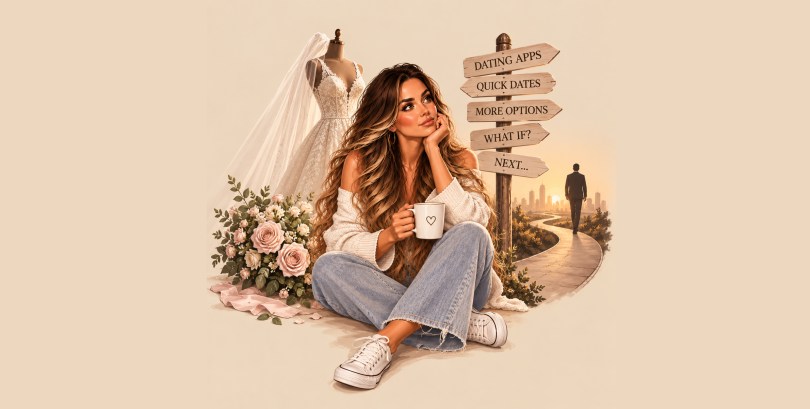
As I drive past a wedding dress shop today driving to my studio, I look through the window and think, oh my God. I’m in love.
Not necessarily with a particular dress, not even necessarily with the idea of the wedding itself, but with what those dresses represent.
Love.
Commitment.
Romance.
Two people standing in front of the people they love and saying, I choose you.
Not just today, not just while it feels easy, not just while we agree.
But I choose you.
Perhaps that is why I find myself wondering something that feels increasingly uncomfortable to ask in 2026:
Is marriage dead?
I don’t want to believe it is, Actually, I really don’t.
As a Christian woman, I believe in marriage. I believe in the beauty of making a commitment to another person. I believe in getting married in a church, standing before God and making promises that mean something.
I know not everybody believes the same way and that’s absolutely okay, but what I do wonder about is when we collectively started treating commitment as though it were somehow embarrassing.
When did marriage become just a piece of paper?
When did two people declaring their love, respect, dedication and commitment to each other become something we could dismiss with one sentence?
“It’s only a piece of paper.”
Really?
Because that piece of paper represents a promise.
And perhaps the promise is the bit we’ve forgotten how to value.
We don’t want to settle anymore and that’s a good thing.
Let me be clear about something before anybody starts shouting at me. I am not suggesting that people should stay in unhappy, abusive, neglectful or destructive marriages.
Absolutely not.
For generations, people stayed in relationships they should never have been expected to stay in. Women, in particular, were often financially dependent on their husbands, socially pressured to remain married and told that leaving was shameful.
We have every reason to be grateful that things have changed.
You don’t have to stay somewhere that destroys you. You don’t have to tolerate abuse in the name of commitment. You don’t have to spend your life desperately trying to make something work when the other person is unwilling to meet you halfway.
But somewhere between “I don’t have to settle” and “I don’t have to tolerate anything I don’t like”, I wonder whether we’ve lost something.
The ability to try.
Because there is a difference between settling for someone who isn’t right for you and learning how to love someone who isn’t perfect.
And none of us are perfect.
Not you.
Not me.
Not the person sitting opposite you at dinner.
The statistics tell us something is changing
Marriage hasn’t disappeared.
In England and Wales, there were 231,949 marriages and civil partnerships in 2023, with marriage still overwhelmingly the most common form of legal partnership formation. But the longer-term picture shows that marriage is changing. The number of marriages in England and Wales was 20.8% lower in 2022 than it had been in 1992.
And in 2025, married or civil-partnered people were still the largest legal partnership group among adults aged 18 and over in England and Wales, but their share had fallen from 52.3% in 2015 to 51.1%. At the same time, the proportion who had never married or civil partnered had risen from 32.6% to 34.9%.
So no, marriage isn’t dead, however it isn’t what it once was, and perhaps that’s not necessarily a bad thing.
People are marrying later. In 2023, the median age at marriage for opposite-sex couples was 34.8 for men and 33.0 for women. More than nine in ten couples marrying in 2021 or 2022 were already living together before marriage.
We’re taking longer, We’re thinking more carefully, We’re choosing differently, but are we also becoming less willing to work at love?
That’s the question I’m interested in.
When did we become a throwaway culture?
I sometimes wonder whether dating has become a little bit like online shopping.
Swipe.
Match.
Message.
Meet.
Evaluate.
Reject.
Next.
There are always more options.
And when there are always more options, why would I work on the one in front of me?
Maybe there’ll be somebody better.
Maybe somebody more attractive.
Maybe somebody more exciting.
Maybe somebody who doesn’t annoy me.
Maybe somebody who agrees with me more.
Maybe somebody who gives me more butterflies.
And so we keep searching.
But here’s the problem.
Eventually, you can become so obsessed with finding the perfect person that you never learn how to build something imperfect with a real one.
You have one disagreement.
“This isn’t going to work.”
They don’t text in exactly the way you want.
“They’re emotionally unavailable.”
You have a difficult conversation.
“We’re incompatible.”
You sleep together sooner than you intended and suddenly the excitement changes.
“I don’t think I’m feeling it anymore.”
And off we go.
Next…Next….Next.
At what point did people become replaceable?
Whatever happened to wooing somebody?
Maybe I’m a traditionalist, actually, I know I am, but I like romance.
I like getting dressed up for a date, I like putting effort into how I look. I like somebody making an effort with me and no, before anybody says it, I’m not talking about wanting somebody to pay for my dinner.
I’ll happily pay fifty-fifty.
It’s not about getting a free meal.
It’s about effort.
It’s about anticipation.
It’s getting ready and wondering what they’re going to wear.
It’s butterflies in your stomach.
It’s sitting across from someone and talking over each other because you’ve got so much to say.
It’s losing track of time.
It’s that moment when they reach across the table and touch your hand.
It’s smiling when their name appears on your phone.
It’s going home thinking, Oh my God, I really like them.
It’s being giddy.
Perhaps we’ve become so afraid of looking foolish that we’ve stopped allowing ourselves to be romantic.
We don’t want to seem too keen.
Don’t reply too quickly.
Don’t text first.
Don’t show too much interest.
Don’t get attached.
Don’t let them know you like them.
Don’t give them too much power.
Keep your options open.
And suddenly two people who genuinely like each other are both sitting there pretending they couldn’t care less.
What a strange way to fall in love.
The 20-minute coffee date
And this is where modern dating really makes me laugh.
“Let’s just grab a quick coffee.”
Twenty minutes.
Thirty minutes.
Something casual.
Something easy.
No pressure.
No effort.
No risk.
And I understand why people do it.
Dating can be exhausting.
Nobody wants to spend three hours with someone they discover they don’t like. I sometimes wonder whether we’ve become so frightened of wasting our time that we’re not giving people enough time to show us who they are. What can you really learn about somebody in twenty minutes?
You might learn whether they are attractive to you.
You might learn whether conversation flows.
You might get a feeling.
But you probably haven’t seen how they treat the waiter.
You haven’t heard them talk about their childhood.
You haven’t discovered what makes them laugh until they can’t breathe.
You haven’t seen how they respond when something doesn’t go their way.
You haven’t heard their hopes.
You haven’t seen their vulnerability.
You haven’t watched them become comfortable enough to stop performing.
And maybe that’s the problem.
We’re assessing people before we’ve actually met them.
And then there’s sex
This is another area where I think we’ve complicated dating enormously.
Two people meet.
There’s chemistry.
They sleep together.
And suddenly the rules change.
The dopamine rush settles.
The chase disappears.
And instead of asking:
“Who is this person?”
we sometimes start asking:
“Why did they sleep with me so quickly?”
Or:
“Why didn’t they make me wait?”
Or:
“Do they do this with everyone?”
And suddenly we’re judging the person based on the speed at which intimacy happened.
But what about everything else they’ve shown you?
Are they kind?
Are they funny?
Are they honest?
Are they emotionally generous?
Do they listen?
Do they make you feel safe?
Do they have integrity?
Do they show up?
Do they treat people well?
Are they interesting?
Do they make you laugh?
Do they make you feel like yourself?
Why can one decision about sex suddenly erase everything else?
I’m not saying people shouldn’t have boundaries.
Of course they should.
I’m saying that perhaps we’ve become very good at reducing complicated human beings to one decision, one mistake, one night or one moment.
And then we discard them.
The divorce paradox
Here’s the really interesting part.
In England and Wales, the divorce rate actually peaked decades ago.
ONS data shows that divorce numbers reached their highest point in 1993, while the longer-term divorce rate has since declined. In 2023, there were 102,678 divorces, with the divorce rate at 8.6 per 1,000 married men and 8.5 per 1,000 married women.
So perhaps the story isn’t simply that everyone is getting divorced. It’s more complicated than that. Marriage itself is less common.
People marry later.
More people cohabit.
More people remain unmarried.
And when people do marry, they have more legal and social freedom to leave relationships that aren’t working.
That’s progress in many ways.
But perhaps we now have a different problem.
Not “Why can’t I leave?”
But:
“Do I leave too quickly?”
There’s a huge difference.
The other side of the world
I was curious about what this looks like elsewhere too, particularly because so many people who read my work are in America and China.
And what I found was fascinating.
China isn’t some romantic haven where everyone stays together forever.
Quite the opposite.
Marriage rates have been falling significantly there too. In the first half of 2024, 3.43 million couples registered marriages, the lowest first-half figure since 2013. Full-year 2024 registrations subsequently fell by around a fifth, according to reporting based on official Chinese data. Researchers and officials have pointed to factors including the cost of marriage and raising children, economic uncertainty, demographic change and shifting attitudes among younger people.
Japan is experiencing its own dramatic changes.
Its government has become sufficiently concerned about declining marriage and birth rates that Tokyo has even developed initiatives designed to help people meet potential partners, including an AI-supported matchmaking service. Reuters reported that the initiative was launched against a backdrop of declining marriage rates and a significant number of unmarried middle-aged people and young adults who had never dated.
And America?
Again, it isn’t a simple story.
The US marriage rate has remained relatively stable over the longer period examined by the Census Bureau, while its divorce rate has declined substantially from 2008 to 2022.
So we can’t simply point at another country and say, “They value relationships more than we do.”
Human beings are complicated.
Culture matters.
Economics matter.
Religion matters.
Gender expectations matter.
Housing matters.
Childcare matters.
Dating apps matter.
And people’s individual experiences matter.
But there is one thing that seems to be happening across many developed societies:
Marriage and long-term relationships are changing.
Have we confused standards with perfection?
This is where I think we need to be really honest with ourselves. Having standards is healthy, having boundaries is healthy, knowing what you won’t tolerate is healthy, however there is a danger in turning a list of standards into a search for a flawless human being.
Because eventually, somebody will disappoint you.
They’ll say the wrong thing.
They’ll have a bad day.
They’ll misunderstand you.
They’ll irritate you.
You’ll irritate them.
You’ll disagree.
You’ll have different needs.
You’ll have an argument.
And that’s when the relationship actually begins.
Because the first few months of dating aren’t really a test of whether you can get along. You’re both on your best behaviour.
The real test is what happens when the fantasy meets reality.
Do we communicate?
Do we apologise?
Do we listen?
Do we compromise?
Do we seek counselling?
Do we learn about attachment?
Do we understand each other’s wounds?
Do we take responsibility for our own behaviour?
Do we try to become better partners?
Or do we simply decide that the person is defective and start looking for a replacement?
What if the person isn’t the problem?
This is something I think we desperately need to talk about.
Sometimes the person in front of you isn’t wrong for you.
Sometimes you aren’t ready for what a healthy relationship requires.
Maybe you’ve spent years protecting yourself.
Maybe intimacy scares you.
Maybe you’re avoidant.
Maybe you’re anxious.
Maybe you’ve never learned how to communicate.
Maybe conflict sends you running.
Maybe you expect rejection.
Maybe you’ve never seen a healthy relationship modelled.
Maybe you don’t know how to receive love.
Maybe you’ve never learned how to give it properly.
And none of those things make you broken.
But they might mean you have work to do.
And imagine if instead of saying:
“This relationship isn’t working.”
we sometimes said:
“What can I learn from this?”
What if we went to therapy?
What if we learned to communicate?
What if we confronted our own patterns?
What if we became a better version of ourselves, not because somebody demanded it, but because we genuinely wanted to love somebody well?
That isn’t settling.
That’s growth.
Perhaps we’ve become too good at protecting ourselves
We talk a lot about self-protection now.
Protect your peace.
Protect your energy.
Don’t let anybody disturb your peace.
Cut them off.
Block them.
Walk away.
And sometimes that advice is absolutely necessary.
But if we take it too literally, we can end up building such a fortress around ourselves that nobody can get in.
And then we wonder why we’re lonely.
You cannot have deep intimacy without vulnerability.
You cannot have commitment without risk.
You cannot build a lifelong relationship without occasionally being disappointed.
And you certainly cannot love somebody without sometimes being hurt.
The answer isn’t to avoid every possible source of pain.
The answer is learning how to recognise the difference between normal relationship difficulty and genuine harm.
One requires communication.
The other may require leaving.
We need to know the difference.
I still believe in the wedding dress
So when I drive past that wedding dress shop and look at those beautiful dresses, I don’t feel silly for getting a little bit emotional.
I still believe in it.
I believe in the romance.
I believe in getting dressed up.
I believe in flowers.
I believe in walking down the aisle.
I believe in holding someone’s hand and promising to stand beside them.
I believe in marriage.
And as a Christian, I believe there is something deeply meaningful about making that commitment before God.
But I also believe the wedding is the easy bit.
The photographs are easy.
The flowers are easy.
The dress is easy.
The champagne is easy.
The Instagram post is easy.
The marriage is the work.
It’s waking up beside someone when you’re annoyed with them and choosing kindness anyway.
It’s having the difficult conversation.
It’s saying sorry.
It’s forgiving.
It’s asking for help.
It’s learning.
It’s changing.
It’s laughing when things go wrong.
It’s holding each other when life becomes unbearable.
It’s choosing each other again and again.
Not because you have to.
Because you want to.
Maybe marriage isn’t dead. Maybe patience is.
Perhaps marriage isn’t dead in 2026.
Perhaps patience is.
Perhaps we’ve become so accustomed to instant gratification that we’ve forgotten that the most beautiful things in life often take time.
We want instant chemistry.
Instant certainty.
Instant compatibility.
Instant answers.
Instant happiness.
And the moment something becomes difficult, we’re told there is another option waiting around the corner.
But what if there isn’t?
What if the person you walked away from was actually wonderful?
What if the argument could have been repaired?
What if the relationship could have grown?
What if you hadn’t needed another person?
What if you needed to become a different version of yourself?
And I’m not saying this because I think everybody should stay in every relationship. I’m saying it because I think we should become more honest about our own behaviour. Before you decide they’re the problem, ask yourself what part you played. Before you decide they’re not right for you, ask yourself whether you’ve actually given the relationship a chance. Before you walk away, ask yourself whether you’re walking away because the relationship is genuinely wrong for you…
or because intimacy is frightening.
Because commitment is frightening.
Because vulnerability is frightening.
Because you’ve been hurt before.
Because another person cannot give you the perfect relationship you imagined and before you start looking for somebody better, ask yourself whether you’re actually capable of loving the person in front of you.
Because perhaps the greatest tragedy of modern dating isn’t that there are no good people left.
Perhaps it’s that good people are finding each other and then throwing each other away before they’ve had the chance to become something extraordinary.
And maybe, just maybe, we need to start trying again.
We need to court again.
We need to woo again.
We need to make an effort again.
We need to put our phones down and talk.
We need to dress up.
We need to flirt.
We need to hold hands.
We need to let ourselves get butterflies.
We need to stop pretending we don’t care.
We need to learn how to disagree without destroying everything.
We need to stop expecting perfect people.
And perhaps we need to remember that love isn’t just a feeling that happens to us.
Love is something we participate in.
Something we nurture.
Something we protect.
Something we build.
Something we choose.
And maybe that’s why I still look at wedding dresses and think:
Oh my God.
I’m in love.
Not because I believe marriage guarantees happiness.
But because I still believe there is something incredibly beautiful about two imperfect human beings looking at each other and saying:
“Out of everyone in this world, I choose you.”
And then waking up the next morning…
and choosing each other again.
And again.
And again.
Maybe marriage isn’t dead.
Maybe we just need to remember why we wanted it in the first place.
 The Girl Who