Exploring communication, ambition, emotional availability, marriage, children and the difference between being busy and having relationship capacity
Why do high achieving men struggle with relationships? Explore ambition, communication, emotional availability, marriage, children and relationship capacity.
There is a particular kind of dating confusion that can happen when you meet a highly successful man.
He works hard, he travels, he has a demanding career, he has meetings, dinners, networking events, friends, family, the gym, projects, responsibilities and a diary that appears to have been organised by someone with a personal vendetta against free time.
He is ambitious. Driven, Successful, Independent… and then there is you.
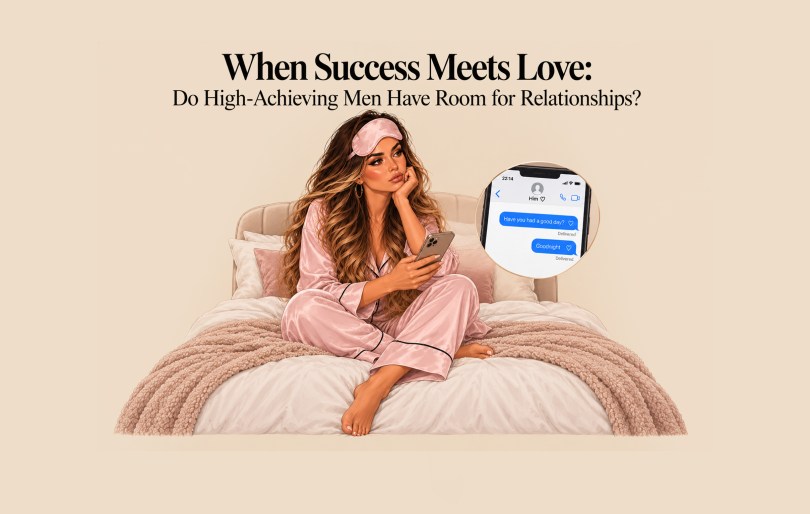
Waiting for the good morning text…Wondering why there wasn’t a goodnight message.
Looking at your phone and thinking:
He said he’d call. Then, at 10.47pm:
“Sorry, just got in. Crazy day.” And you think:
Is he genuinely that busy? Does he actually like me? Is this just what successful men are like? Am I expecting too much?
Or does he simply not have the capacity for a relationship?
This is where dating becomes less about reading messages and more about understanding behaviour, because being busy and being emotionally unavailable are not necessarily the same thing.
However sometimes, they can look remarkably similar…
High achievement does not automatically equal relationship capacity
We often make assumptions about successful people. If someone has built a successful company, developed an impressive career, accumulated wealth, travelled the world or reached a senior position, we can unconsciously assume they must also be highly emotionally intelligent and capable in relationships. However career competence and relationship competence are different skill sets.
Someone can be exceptional at business and struggle with intimacy. Someone can be brilliant at negotiation and terrible at expressing feelings. Someone can manage a team of hundreds of people and struggle to communicate consistently with one person they are dating. Someone can be incredibly disciplined professionally and chaotic romantically.
Achievement tells us something about what someone can accomplish.
It does not necessarily tell us how much emotional space they have available for another person.
And that distinction matters.
Is it a London thing?
Let’s get this out of the way.
It is not that London men are genetically incapable of sending a text.
Although sometimes, after dating for a while, you might reasonably begin to wonder. London has a particular rhythm.
Fast careers, Long working hours, Commuting, Client dinners, Networking, Travel, Property, Finance, Law, Entrepreneurship, Corporate life and Social commitments. There are people who genuinely work extraordinarily long hours, but there is another cultural element too.
Some highly successful people become exceptionally good at functional communication.
They can negotiate a multimillion pound deal.
They can manage a team.
They can organise a property development.
They can coordinate ten people across three countries.
But ask:
“How are you feeling about us?”
And suddenly the WiFi goes down.
Functional communication is easy.
“Meeting at seven.”
“I’m in Manchester.”
“Can’t do Thursday.”
“Call you tomorrow.”
Relational communication requires something different. It requires curiosity, vulnerability, consistency, emotional presence… And some people have simply never developed those muscles.
A high achieving man can still make room for connection
This is the bit I think women sometimes need reminding of.
A genuinely busy man can still send:
“Morning you. Crazy day today, but I’ll call you tonight.”
That takes seconds.
Or:
“Just got home and I’m absolutely shattered. Hope you’ve had a lovely day. Sleep well.”
Again, seconds.
Communication is not necessarily about having hours available.
It is about making room for connection within the time you actually have.A person does not need to be permanently attached to their phone to demonstrate interest, but they do need to demonstrate that the relationship exists somewhere within their priorities.
That is the difference…
There is a difference between being busy and being unavailable
A busy but emotionally available person might say:
“I’ve got a manic day today, but I’ll call you tonight.”
And then they call.
They might not message constantly, but they keep you informed.
They make plans.
They follow through.
They remember things you’ve told them.
They show curiosity about your life.
They don’t leave you perpetually guessing.
Someone with very little relationship capacity may look different.
They disappear for long periods.
Plans remain vague.
You initiate most of the contact.
They repeatedly cancel.
Communication happens when it suits them.
You receive affection in bursts rather than consistency… and you find yourself spending more time interpreting their behaviour than actually enjoying the relationship.
That’s exhausting.
The real issue may be consistency
We often ask:
“Does he like me?”
But perhaps the better question is:
“Is he consistent?”
Because someone can absolutely like you and still be a terrible communicator. Someone can be hugely attracted to you and still not have the emotional bandwidth to build a relationship. Someone can think you’re wonderful and still have a lifestyle that leaves no meaningful space for intimacy and someone can communicate brilliantly in the beginning because they are pursuing you, only to become inconsistent once the initial excitement settles.
So communication frequency is not necessarily the measure of interest.
Consistency, initiative and follow through are much more revealing.
A man does not have to text you every hour.
He does not need to report his movements.
He does not have to be permanently attached to his phone.
But you should be able to understand the rhythm of his communication.
You should not constantly be wondering where you stand.
Does he actually have relationship capacity?
This, for me, is the more interesting question.
We talk endlessly about whether somebody is attractive enough, successful enough, funny enough, wealthy enough, interesting enough or compatible enough.
But what about capacity?
Someone can have enormous financial capacity.
Career capacity.
Social capacity.
Sexual capacity.
And still have very little relationship capacity.
A person can be extraordinarily successful and genuinely have almost nothing left emotionally by the end of the day.
That does not make them a bad person, It does not mean they do not care. However it may mean they are not currently able to offer the kind of relationship another person needs. You cannot create emotional availability for somebody else. You cannot love someone into having more capacity. You cannot become sufficiently attractive, interesting or sexually compatible to manufacture time and emotional bandwidth that simply is not there.
And then there is the question we do not always want to ask
Is it because he does not like me enough?
Sometimes, yes.
But not always.
And I think this is where dating advice can become unnecessarily simplistic.
“If he wanted to, he would.”
It is catchy.
It is also not always true.
Adults have jobs.
Children.
Businesses.
Families.
Responsibilities.
Travel.
Stress.
Life.
People can care deeply about someone and still be inconsistent communicators, but the reverse is also true. Someone can tell you they are incredibly interested while giving you very little actual relationship behaviour. That is why words alone are not enough.
Look at the pattern.
Do not become a detective
This is perhaps one of the most emotionally draining parts of modern dating. You start analysing everything. He did not say good morning.
Why?
He normally calls at lunchtime.
He did not today.
Is he losing interest?
He said he was working late.
Was he really?
He has been online.
Why has he not replied?
He sent a heart yesterday and nothing today.
What does that mean?
Suddenly you are not dating anymore.
You are conducting an investigation.
And if you spend more time analysing someone’s communication than experiencing their companionship, something needs to change.
Not necessarily because they are doing something terrible.
But because the relationship is creating too much uncertainty.
Intermittent communication can become strangely powerful
There is another psychological reason inconsistent communication can feel so consuming. When attention and reassurance arrive unpredictably, they can become disproportionately attention grabbing.
One day there is affection, attention and connection.
Then silence.
Then a lovely message.
Then distance.
Then suddenly they are intensely interested again.
That unpredictability can make the connection feel more significant rather than less.
You start waiting for the next little hit of reassurance and that can create a cycle where you are constantly monitoring the relationship. This is why consistency matters so much.
Healthy connection does not need to be relentless.
It needs to be predictable enough that your nervous system is not constantly asking whether you are safe in the relationship.
What about the good morning and goodnight texts?
I love this conversation because people sometimes dismiss these things as needy.
They are not inherently needy.
They are preferences.
Some people genuinely enjoy little moments of contact throughout the day.
A good morning message.
A quick call.
A goodnight text.
A little:
“Thinking of you.”
Those things can create a feeling of continuity.
Other people do not naturally communicate that way.
Neither person is automatically wrong.
The question is whether their communication styles are compatible.
You do not need somebody who communicates exactly like you.
But you probably do need somebody whose communication style does not leave you chronically deprived.
High achievement can create a very autonomous lifestyle
There is something else worth considering. The more successful someone’s life becomes, the more independent it can become. They may be used to making their own decisions.
Controlling their diary.
Travelling when they want.
Working when they want.
Living where they want.
Spending their money how they want.
Managing their own environment.
That independence can be wonderful.
But relationships require something slightly different.
They require consideration.
Negotiation.
Compromise.
Flexibility.
Making decisions with another person’s needs in mind.
The question is not whether a successful man should give up his independence.
Of course he should not.
The question is whether he has learned how to integrate another person into an already highly autonomous life.
Because a relationship is not simply adding another person to your existing lifestyle. At some point, two lives have to begin making room for each other.
High achievement does not equal emotional maturity
This is another trap in dating. We can unconsciously assume that because someone is successful, intelligent, wealthy or highly accomplished, they must also be emotionally sophisticated.
Not necessarily.
Someone can run a successful business and struggle with intimacy.
Someone can be brilliant at negotiation and terrible at expressing feelings.
Someone can be highly disciplined professionally and chaotic romantically.
Someone can have enormous ambition and very little emotional availability.
Oh and sometimes, the very qualities that helped someone become successful can make relationships more challenging…
Drive can become workaholism.
Independence can become emotional distance.
Confidence can become an unwillingness to compromise.
A packed diary can become a life where nobody else really fits.
None of these things are inevitable.
But they are worth noticing.
If marriage and children are the goal, when do you make room for them?
There is another part of this conversation that we do not talk about enough.
What happens when a highly successful man reaches his 40s and says:
“I want to get married.”
“I want a wife.”
“I want children.”
Those are wonderful ambitions.
But if they are genuinely important, they cannot remain permanently in the category of “one day.”because relationships take time.
You do not simply meet someone on Tuesday, decide you want marriage on Wednesday and have a family by Friday.
You have to meet.
Date.
Get to know one another.
Work out whether your values align.
Discover whether you communicate well.
Establish sexual and emotional compatibility.
Navigate differences.
Build trust.
Develop commitment.
For couples who want children, there is another reality that needs to be acknowledged.
Fertility is not completely under our control.
Female fertility declines with age, particularly from the mid 30s onwards, and fertility difficulties become more common as women get older. That does not mean women in their 40s cannot have healthy pregnancies. They absolutely can. It does not mean every couple will experience fertility difficulties either.
But it does mean that fertility should not be treated as an unlimited resource that can simply be dealt with later.
This is where I think some high achieving men may need to have a more honest conversation with themselves. If you genuinely want marriage and children, when are you going to create the space for the relationship that could lead to them?
Because waiting until your mid 40s and then assuming:
“I’ll just find a younger woman.”
is not necessarily the straightforward solution people imagine.
Firstly, the woman has to want you.
Secondly, she has to want the same kind of relationship.
Thirdly, your values and lifestyles need to align.
Fourthly, she has to want children with you.
And fifthly, you still have to build an actual relationship.
Age does not magically manufacture compatibility.
A younger woman is not a fertility strategy. She is a person.
She has her own ambitions.
Her own timeline.
Her own relationship history.
Her own standards.
Her own hopes for marriage and family.
And she gets to decide whether the life someone is offering is one she wants.
This is not about blaming men for prioritising their careers
Ambition is not a problem, Success is not a problem. Wanting financial security before having children is not a problem. Building a career before settling down is not a problem.
The issue is whether the life you are building leaves room for the life you say you want.
If marriage and children are genuinely important, then partnership needs to become part of the architecture of your life rather than something you hope will somehow fit into the leftover space.
And there is an uncomfortable irony here.
Some highly successful men spend their 30s and early 40s building extraordinary careers, businesses, wealth and independence, while telling themselves that relationships and family can be prioritised later.
Then later arrives.
And suddenly they discover that dating is not an Amazon Prime catalogue where you simply select the age bracket you would like delivered to your door.
There are real human beings involved.
Women have their own ambitions.
Their own children or desire for children.
Their own fertility considerations.
Their own relationship histories.
Their own standards.
And they get to decide whether the life someone is offering is one they want.
And women have agency too
This conversation is not about telling women to wait patiently for a successful man to eventually decide he is ready.
We are allowed to ask questions.
What are you actually looking for?
Do you want marriage?
Do you want children?
What kind of timeline do you have in mind?
Do you actually have the capacity to build that relationship?
Those are not unreasonable questions when two adults are dating with serious intentions.
We do not have to be endlessly understanding of someone’s career while quietly putting our own needs on hold.
We do not have to become the easiest woman in the world to accommodate.
And we do not have to pretend that our time, our emotional energy and our hopes for the future are somehow less important because someone else’s career is impressive.
You cannot build a family with someone’s potential
This might be one of the most important lessons in the entire conversation. You cannot build a relationship with someone’s potential. You cannot build a marriage with what someone says they will eventually become. You cannot build a family with a future version of someone who might one day have more time.
You build it with the person who is actually showing up.
That does not mean someone needs to have everything figured out before they meet you…None of us do.
But there needs to be evidence that they are capable of creating space for the life they say they want.
So how do you know whether there is room for you?
Perhaps not by counting texts.
Perhaps not by analysing how quickly he responds.
Perhaps not by deciding that three hours without a reply means he has lost interest.
Look at the broader pattern.
Does he make plans?
Does he keep them?
Does he communicate when plans change?
Does he check in?
Does he remember?
Does he call when he says he will?
Does he ask questions?
Does he listen?
Does he show curiosity about your life?
Does he make space?
And perhaps most importantly:
Do you feel like a person he is building a life around, or an appointment he is fitting into one?There is a huge difference.
You do not need to win a place in someone’s diary
I think this is perhaps the biggest lesson. When we are attracted to someone who is highly successful, it can be easy to start treating their availability as a prize.
He gave me Thursday.
He called me.
He’s fitting me in.
He’s finally got some time.
But a relationship should not permanently feel like you are trying to secure an appointment.
You do not need to compete with someone’s career.
You do not need to become the easiest woman in the world to accommodate.
You do not need to suppress your needs so you do not look demanding.
You need to discover whether there is mutual room.
Because ultimately, relationships are not built from spare time.
They are built from intentional time.
And perhaps this is the real question
Not:
“Is he busy?”
Not:
“Does he like me?”
Not even:
“Why doesn’t he text more?”
But:
“Does this person have the capacity to build the kind of relationship I actually want?”
Because a man can be wonderful.
He can be successful, kind, attractive, funny, interesting, ambitious and driven.
He can genuinely like you…And still not have the capacity to give you the consistency and communication you need.
That does not necessarily make him wrong.. And girl, it does not make you needy.
It may simply mean your lives, expectations and emotional rhythms do not fit and that is something worth discovering early, because the goal of dating is not to convince somebody to make room for you.
It is to find out whether there is naturally enough room for both of you.
And sometimes, the most useful piece of information a person gives you is not what they say.
It is the pattern of what they repeatedly do.
 The Girl Who