The Missing Ingredient: Are We So Busy Living That We’ve Forgotten to Love?

I feel like, in today’s day and age, we’re forgetting our age.

We’re forgetting how quickly time passes us by.

We’re spending so many years trying to cling on to our youth. Desperate to be seen. Desperate to be validated. Desperate to keep our options open. Desperate to have variety when it comes to sex. Desperate not to settle down too soon, commit too quickly, or somehow miss out on something better that might be waiting around the corner.

But in doing all of that, I wonder if we’re actually missing one of the most crucial ingredients of a genuinely happy life.

Love.

Meaningless hookups don’t make a happy life.

Yes, they might leave you feeling happy for a night. Maybe even for 24 hours. There’s excitement. There’s attraction. There’s validation. There’s that temporary high of being wanted.

But then what? 

Who do you call when something incredible happens?

Who hugs you when you’ve achieved something you’ve worked years for?

Who knows the tiny details of your life that wouldn’t mean anything to anybody else?

Who do you turn to and say, “Fuck it. Should we just go on holiday?”

Who do you build the memories with?

I seldom talk about myself personally in my blogs. As a coach and trainee therapist, I’m conscious of boundaries and how much of myself I bring into the work that I do, but on this occasion, I thought, why not… because recently I’ve started to realise something that actually brings me a great deal of sadness.

Some of the best years of my life, I’m spending alone.

We all look towards the future and think, I don’t want to grow old and be lonely.

But what if we’re looking too far ahead?

What if some of us are spending the best years of our lives alone right now?I’m in my 40s. I feel good in myself. I’ve done an enormous amount of healing, I’ve worked on myself, body and mind, I’ve built a life. I’m raising my child, I’m studying, I’m working,I’m travelling. I’m achieving things I’m proud of. Yet, sometimes, I look around at my friends who are in relationships.

They’re off to Italy. Mykonos. America. Australia.

They’re seeing the world. they’re going for date nights, they’re having weekends away. they’re building a collection of memories that belong to the two of them.

And then there’s me…. 

Going on my solo trips, Travelling with my child, waiting to see who can get childcare and plan that once a year night out…

And don’t misunderstand me, I absolutely love travelling with my child. Those memories are some of the most precious memories of my life. 

I have friends. I have family. I have a child I adore, I mean I’m not always sitting at home with nobody in my life… lol, But sometimes I sit there and think:

I’d love some romance in my life.

I’d love somebody to share all of this with.

I thought, last year, that maybe I’d found that.

It wasn’t meant to be.

If I’m completely honest, it felt like 50% of the relationship was love bombing and the final three months were spent with me acting as a personal therapist. The push pull dynamic, never knowing where you stand is Toxic, and not for my own attachment style at all..

Wrong person… Wrong relationship. 

Perhaps even the wrong relationships can teach us something about what we actually want. I remember being in Ibiza once and going on a date with a gorgeous Portuguese guy called Francisco. We had such a good date.He took me for a beautiful dinner. We went for drinks. We talked.

And at one point, he looked at me and said:

“Kerry, do you get lonely?” as we talked about what it’s like to be single..

And I said no.

Because I’m not lonely… Not in the traditional sense of the word, more so in an empty bed kind of way! As a mother, I have my child. I have friends. I have family. I have people I love and people who love me.

But there’s a particular kind of connection I miss.

I miss my person.

Recently, I completed another year of study. I got the message congratulating me on passing and in that moment, I missed having somebody there to congratulate me.

Someone to give me a hug.

Someone to ask how I felt.

Someone who understood how much work had gone into getting there.

And equally, I miss being that person for somebody else.

I miss praising someone.

I miss making somebody feel good.

I miss having someone walk through the door and being genuinely excited to hear about their day.

I miss having somebody say:

“Fuck it. Should we just go on holiday?”

Or:

“Should we go out tonight?”

I miss the spontaneity that comes from having somebody to do life with.

And recently I’ve realised something.

Life is just passing by.

We’re such slaves to work. Slaves to money. Slaves to our schedules. Slaves to this idea that we need to have everything sorted before we’re allowed to make room for love.

We tell ourselves:

I’m too busy.

I’ve got too much going on.

I haven’t got the capacity for a relationship.

Maybe when work calms down.

Maybe when the children are older.

Maybe when I’ve healed a little bit more.

Maybe when I’ve achieved this.

Maybe when I’ve sorted that.

But when exactly is life going to become completely uncomplicated?

Probably never.. and I think I’ve been guilty of this too.

Sometimes I push people away because I tell myself I’m not ready.

I tell myself I don’t have the time or capacity for a relationship because I’m so busy with work, but maybe they just haven’t been the right people.

Because there’s an important distinction here.

I don’t need anybody, but I would like somebody.

There’s a huge difference.

But I also wonder whether some of us have become a little too good at not needing anybody.

We celebrate independence. We celebrate the person who has been hurt, picked themselves back up, built their own life and learnt how to stand completely on their own two feet and rightly so.

However, psychologically, there’s something interesting that can happen when you’ve spent a long time having to rely on yourself. Independence can become more than a strength. It can become protection.

You become so accustomed to solving your own problems that asking for help feels uncomfortable. So used to carrying everything yourself that letting somebody carry something for you feels almost unnatural. So capable of regulating your own life that allowing another person into it starts to feel like a disruption rather than an addition and perhaps that’s where hyper-independence can creep in.

There’s a difference between I can do this alone and I must do this alone.

There’s a difference between choosing independence and being so afraid of depending on another human being that you never allow yourself to experience interdependence, the healthy middle ground where two capable people choose to lean on each other without losing themselves.

I think that’s something I’ve had to question within myself.

Am I genuinely too busy for a relationship?

Or have I become so accustomed to doing everything myself that I’ve convinced myself there simply isn’t room for another person?

Because maybe the goal was never to need nobody.

Maybe the goal was to know that I could survive alone, while still allowing myself to admit that life might be nicer shared.

I don’t want somebody because I can’t survive alone. I’ve already proved that I can. I don’t need someone to rescue me. I don’t need somebody to financially support me. I don’t need somebody to give me an identity.

I’ve built my own life.

But being capable of doing life alone doesn’t necessarily mean I want to do all of it alone. I want somebody who matches my energy.

I want somebody who asks me how I am in the morning.

“Good morning, baby. How did you sleep?”

Someone who checks in during the day.

“How’s your day going?”

Someone who says goodnight.

“Goodnight, darling.”

It doesn’t have to be constant communication. We’re adults. We’re busy. We have jobs. Children. Responsibilities.

However, I miss those little moments of knowing that somewhere in the world, somebody is thinking about you.

That ten-minute phone call at night:

“I just thought I’d ring you. I miss your voice.”

That’s what I miss.

That person checking in.

That person to share it all with.

Although, I have female best friends whom I’m incredibly grateful for, I miss having a best friend who is also my partner.

Someone who’s your lover, your teammate, your safe place and the person you laugh with over something nobody else would find remotely funny.

When I became single and left my child’s father, I left because I needed to find myself, I needed to find happiness, I needed to heal. I needed to grow and spread my wings like a butterfly.

I had been in an unhappy relationship, but I was also very unhealed and very unhappy within myself at the time.

So I left, I found myself, I built a different life and somewhere in the back of my mind, I think I always assumed I’d meet somebody.

When I met someone in 2025, I remember thinking:

Yeah. I’m ready for this.

Sadly, he wasn’t the right person.

I chose wrong.

However that doesn’t mean wanting the relationship was wrong.

Lately, I’ve had the strangest feeling, I can’t even properly comprehend it. I almost feel like maybe there’s a relationship around the corner. Of course I’ve chatted to people. I’ve been on a couple of dates over the past couple of years, but recently I’ve found myself looking at the people in my life and wondering:

Have I already met him?

Is it somebody I’ve never had a relationship with before?

Could it be somebody from my past?

For me, it’s rarely going to be somebody old because I don’t particularly like looking backwards, an ex is an ex for a reason….

Or is he somebody I haven’t met yet?

I genuinely don’t know.

I just have this weird gut feeling I’ve had for the last few weeks that maybe there is somebody out there for me.

Perhaps the bigger realisation is this:

Maybe I have to make myself available for him.

Not available in the sense of downloading every dating app and desperately searching for a relationship.

Emotionally available.

Making space.

Stop telling myself I’m too busy.

Stop telling myself I’ve got too much stress.

Stop telling myself I’ve got too much pressure.

Maybe if I let the right person in, some of that stress wouldn’t feel quite so heavy. Maybe life isn’t supposed to be something we carry entirely by ourselves.

So what are we doing as human beings?

Why do we push away good things because we tell ourselves we haven’t got time for them? the irony is we’re right.

We haven’t got time.

Just perhaps not in the way we think.

We haven’t got unlimited time.

We’re spending it every single day.

We’re just not always spending it on the things that will matter when we look back.

I look at my own life and think:

I’m always working.

I’m studying.

I’ve got my child.

Where exactly am I supposed to fit a relationship into all of this?

But then I think about last year, I had fewer staff, I was arguably even busier.

Yet somehow I fitted a relationship in perfectly.

It worked, It worked around childcare, It worked around work.

We gave each other time.

Sometimes it was simply a couple of nights a week being in his arms and it was nice.

Again, wrong person.

Perhaps that relationship taught me something important. When the cards are actually on the table and a relationship is genuinely on offer, I can make space for it.

Maybe I do want a relationship…. Actually, I know I do.

Because I don’t want to spend the best years of my life, in my prime, creating all these incredible memories and have nobody beside me who remembers them too.

I don’t want to meet somebody in my 50s and say:

“Do you remember when I did this?”

“Do you remember when I went there?”

And then realise: No. Of course they don’t.

Because they weren’t there.

Sometimes I look at older couples who’ve spent decades together. They’re old, they’re grey, life has slowed down, yet they have this enormous invisible library between them.

A lifetime of memories.

“Do you remember that holiday?”

“Do you remember when the children were little?”

“Do you remember that ridiculous restaurant?”

“Do you remember when we got completely lost?”

“Do you remember when we couldn’t stop laughing?”

Their bodies have aged, their lives have changed, but they have decades of remember whens. I’ve come to realise something I genuinely didn’t think I’d ever say.

I’m not just ready for love.

I’m ready for somebody to share my life with.

I’m ready to build memories with somebody.

I’m ready to grow alongside somebody.

I’m ready to create a family life together.

I’m ready for a partner.

..and believe me, I’m quite stubborn. It’s taken me a while to admit that.

Because our culture celebrates independence—and rightly so.

We tell people:

You don’t need anyone.

Learn to love yourself.

Be happy alone.

Don’t settle.

Know your worth.

And all of those things are important.

But I wonder whether somewhere along the way we’ve taken a healthy message and pushed it too far. We’ve started confusing independence with emotional isolation. We’ve started treating needing connection as weakness. We’ve become so frightened of appearing needy that sometimes we’re afraid to admit we have needs at all. We tell ourselves that the second somebody doesn’t meet every expectation, we should cut them off.

That there’s always another option.

Another swipe.

Another person.

Another date.

Another body.

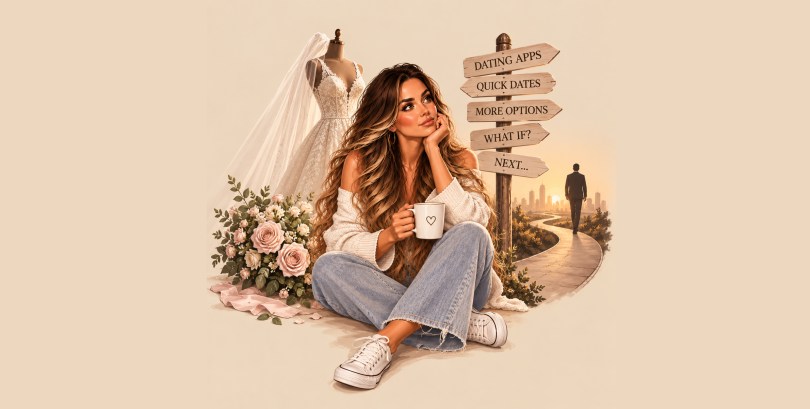
We’ve created endless choice while somehow becoming increasingly disconnected and I wonder whether modern dating has inadvertently taught us to approach human beings like products.

We scroll. We swipe. We compare.

Too short.

Too tall.

Too available.

Not available enough.

Too keen.

Not keen enough.

Wrong job.

Wrong location.

Wrong shoes.

Next.

Of course, having standards is important. Boundaries are important. Compatibility matters enormously, but the paradox of having so much choice is that sometimes, instead of making us more certain, it can make us less satisfied with whatever we choose.

There’s always the lingering possibility that somebody better might be one swipe away and relationships don’t work particularly well when we’re constantly looking over somebody’s shoulder to see who else has just walked into the room.

I also wonder if we’ve created something of an avoidant dating culture.

Not because everyone is avoidantly attached, that would be far too simplistic, but because many of the behaviours modern dating normalises can look remarkably similar to emotional avoidance.

Keeping things casual, Keeping your options open, Not defining the relationship. Pulling away when things become emotionally intense. Ghosting rather than having an uncomfortable conversation.

Moving on to somebody new rather than working through vulnerability with the person standing in front of you.

We call it freedom.

Sometimes it is.

But sometimes, I wonder if what we’re actually doing is becoming incredibly skilled at avoiding attachment, because real intimacy isn’t found in endlessly meeting new people. It’s built when you stay long enough for somebody to actually know you. Not the version of you on the first date. Not your best photographs. Not your funny stories. Not the version who is effortlessly cool and definitely doesn’t care whether they text back.

You.

And perhaps that’s the uncomfortable thing about love. At some point, you have to stop browsing.

You have to choose.

And then you have to allow yourself to be chosen too.

Maybe that’s why some of us are still single.

Not because there’s nobody good enough out there, Not because we’re broken, Not because love isn’t meant for us, but because somewhere along the way, we became so good at protecting our peace that we forgot love requires us to open the door occasionally.

Of course, boundaries matter, Mine certainly do. If somebody consistently doesn’t give me attention, effort or emotional availability, I will walk away.

I don’t need to chase anybody.

There’s a difference between having boundaries and building walls. There’s a difference between recognising the wrong person and never giving the right person enough room to get close and perhaps that’s the question some of us need to ask ourselves:

Are we genuinely unavailable because life is too busy, or are we using busyness to protect ourselves from being vulnerable again?

Because love does require vulnerability. It requires making room. It requires allowing another human being to matter to you and yes, that means they could hurt you.

But they could also love you. They could also make an ordinary Tuesday feel like something worth remembering. They could be the person sitting beside you decades from now saying:

“Do you remember when…?”

So I asked myself a very simple question.

What do I actually want?

Do I want money? Not particularly.

As long as I have enough to pay my bills and live my life, I’m happy.

Do I want a healthy, happy child? More than anything in the world.

Do I want love? Yes.

Do I want happy memories? Yes.

Do I want a lifetime of togetherness? Yes.

I do.

Maybe that’s the ingredient we’re missing.

Not another achievement, Not another pay rise, Not another follower. Not another person finding us attractive. Not another meaningless hookup. Not another opportunity to prove we don’t need anybody.

Maybe it’s simply having somebody beside you who makes you feel glad you’re alive.

Someone to witness your life.

Someone whose life you get to witness too.

Someone to celebrate with.

Someone to comfort.

Someone to travel with.

Someone to laugh with.

Someone to come home to.

Someone who remembers.

Because one day, if we’re lucky, we’ll all grow old and perhaps the question isn’t only:

Who will be there when I’m old?

Maybe the question we should be asking ourselves now is:

Who do I want to build the memories with that we’ll talk about when we get there?

I don’t need somebody to complete my life.

My life is already full.

But I’ve finally realised… I’d quite like somebody to share it with.

Maybe I’ve spent long enough telling myself I’m too busy for love, because the truth is, life isn’t waiting for any of us to become less busy.

It’s happening now and I don’t want to miss it….

Why Modern Dating Hurts So Much: Attachment, Rejection, and Healing in Today’s Post-COVID World

Modern dating is changing us. Not just how we meet partners, but how we relate to ourselves, our self-worth, our boundaries, our hope for connection. Something in today’s dating culture is making us forget who we are, what we deserve, and how to love ourselves first.

I’ve been watching, not just in my life, but in conversations, in friends’ stories, in what feels like the general pulse of modern love, and I’ve realised there’s something dark and quiet happening inside us. There’s something about today’s post-COVID dating world that’s not just reshaping the way we date, but the way we see ourselves. and I think it’s worth calling it out and us taking time to visit this…

Today’s post-COVID dating world is fast, unpredictable, and constantly in motion. Apps give us swipe-based access to hundreds of faces we never would have met 20 years ago. On paper, it looks like endless choice. In reality, it often produces:

  • emotional burnout
  • attachment anxiety
  • confusion and insecurity
  • fear of intimacy
  • fear of rejection

We’re wired for love – but we’re living in a culture that prioritises availability over authenticity and options over depth.

We’re wired for connection – but the environment keeps pulling us away

As human beings, our biology and psychology are designed for connection, belonging, intimacy. From the moment we were born, being seen, held, accepted mattered. Security, attachment, we evolved to crave these things because they helped us survive and thrive.

But fast forward to now, apps, social media, endless options, midnight messages, “situationships,” and ghosting. On paper, we have more “freedom” and “choice” than ever. But in practice, many of us are more isolated, more anxious, more starved for real connection.

We’ve built a dating culture that normalises disposability and emotional detachment, a culture where it’s normal to treat intimacy like a transaction, and then wonder why we feel hollow.

So when someone shows even a gesture of interest, a kind smile, a compliment,  a deep chat, even just attention, our nervous system reacts like it’s light. We crave that light. We lean into that possibility of warmth the way a plant leans toward the sun. It’s instinct, it awakens us, we WANT the light!

The biology of intimacy – why “casual” doesn’t stay casual

We tell ourselves we’re fine with casual. However our biology often thinks differently. Intimacy, emotional or physical – releases chemicals: hormones like oxytocin, bound up with bonding and trust; neurotransmitters like dopamine, tied with reward, pleasure, anticipation. Touch, warmth, closeness – they make us feel safe, seen, wanted.

Human beings aren’t built for disposability. Physically, emotionally, chemically:

  • Oxytocin (bonding + connection hormone)
  • Dopamine (reward + longing chemical)
  • Vasopressin (attachment + pair-bonding hormone)

These aren’t psychological myths — they’re biology. Intimacy signals to the brain:

Once those signals hit us, we begin to tether, Not necessarily consciously, but deep in our limbic system: “This person made me feel something real.” Maybe for a night, Maybe for a conversation. But real enough.

When that tether is formed, the weight of rejection doesn’t just feel like a lost relationship – it feels like a disruption of safety, of attachment, of self-value.

That’s why sometimes, after the “casual thing,” heartbreak doesn’t feel casual at all. It feels raw, visceral, heavy, because we attached, and tried to convince ourselves “We just wanted fun”. 

Attachment styles, vulnerability and the modern dating trap

Part of the struggle lies in our variation in attachment styles. Some of us find comfort in closeness; some recoil at it; some oscillate between the two. Roughly a third to two-fifths of adults show some kind of insecure attachment style (anxious, avoidant or disorganised). Among those, some lean toward anxious attachment – craving closeness and validation, but haunted by fear of abandonment or rejection.

In a dating environment rife with uncertainty (ghosting, mixed signals, hot-and-cold behaviour, ambiguous “situationships”), anxious people get caught in a loop:

  • They seek validation: “If I can just get this person to like me – text me, stay with me – I’ll feel safe.”
  • They become available, open, emotionally generous, seeking connection.
  • But availability sometimes gets misinterpreted as access, not value.
  • They stay, hoping for stability or love; but often meet inconsistency, indifference, or rejection.
  • Their own emotional need is dismissed, ignored, or undercut – and they’re left feeling replaceable.

That leaves a deeper wound than just being single. It chips away at self-worth. It consumes us. We try to convince ourselves we have the power, but we don’t! We don’t at all, but our conscious mind will do anything to convince us, ‘We’re ok!’ 

The paradox of “availability” vs “value” in modern dating

Here’s the painful paradox I keep seeing and not only that, what I have experienced myself:

  • If a person (often a woman) is warm, available, open to love – they are ready for connection. They offer emotional honesty, clarity, possibility.
  • Yet, sometimes the people who are genuinely looking for that kind of connection don’t recognise its value. They expect something easier: fun, convenience, less emotional labour.
  • On the other hand, a person who seems harder to get – more aloof, more “mysterious,” more reserved – can sometimes be perceived as more desirable simply because there’s a sense of challenge, of scarcity, of chase.

Sociologically and psychologically, it’s a glaring mismatch between what we need (authentic connection, emotional honesty, mutual respect) and what gets rewarded (scarcity, challenge, detachment).

It’s not about “blame” – it’s about recognising that the marketplace of modern dating values the wrong things and for those who come to it with softness, vulnerability, readiness for love –  it’s often the hardest place to find what they genuinely seek.

Rejection: more than just “loss” it’s an identity fracture

When we get rejected, when someone disappears, or treats us like we were never a priority, it doesn’t just sting. It shakes something deeper. I myself have struggled over the years with this, even trying with various therapists to understand the root cause of it all, and I know the answers now, however for most of my life, I was left feeling unwanted, unloved and rejected..

  • Validation-based self-worth: If a lot of our self-esteem depends on “being wanted,” then rejection becomes proof of inadequacy, unworthiness, or invisibility.
  • Attachment rupture: Because our nervous system may have already started to bond, rejection doesn’t feel like a story that ends , it feels like a safe place collapsing, and our whole world is crumbling
  • Internalising blame: We tend to whisper (or shout) to ourselves: “I’m too much / not enough / unlovable.” And instead of seeing that the system is what’s broken, we turn the mirror on ourselves.

In today’s environment, rejection isn’t just a breakup. It’s often felt like a personal failure.

What are we really chasing and what’s missing?

Maybe what we’re seeking is not another person. Maybe we’re seeking:

  • To be seen, to feel that someone understands us beyond the surface.
  • To be valued, to believe that who we are, what we bring, matters.
  • To be safe , emotionally, physically, mentally.
  • To belong,  to connect, to share, to build.

What so many of us discover and sometimes too late, is that these things likely begin with self. If we don’t see ourselves as worthy, safe, valuable, and whole … then no external validation can truly fill that void.

And what gets missing in that chase is often self-respect, self-compassion, self-understanding.

Healing isn’t about “not wanting love” – it’s about redefining where love starts

We can’t necessarily change the system. We can’t rename apps. We can’t make society stop valuing challenge over emotional availability. But we can start changing ourselves. We can build a different inner story. One grounded not in external validation, but internal integrity.

Here’s a rough “healing script” I’m writing for myself , maybe you, or anyone reading this, might relate too:

  1. Recognise my own worth – independent of attention. I am worthy whether someone texts me or not. I am love; I don’t need someone else to confirm it.
  2. Slow down intimacy – emotional and physical. Intimacy doesn’t have to be fast. I give my body, my heart the time to read: “Is this person safe? Do I feel respected?” before I lean in. Of course as any sexual being, of course I crave intimacy, but after my celibacy journey I realised, what I have holds value to me.
  3. Cultivate inner validation, with self-care, self-love, self-respect. I get to look in the mirror and say: “You matter. You deserve respect. You don’t need to chase love – you need to walk towards it.”
  4. Seek emotional clarity – not just physical. I value people who show up with words and actions that match. I’m not afraid to ask: “What do you want? Why are you here?”!!! Don’t be afraid to as that! Sleeping with someone will not suddenly make them fall in love with you! Trust me im pretty confident in the bedroom, but it doesn’t cast them under some love spell!
  5. Set boundaries – protect my time, energy, heart. I will not compromise my self-respect just to feel desired or accepted. I will leave what feels like convenience rather than connection.
  • Find belonging in my community and self-worth in purpose. Real love, trust, and belonging may come from friendships, passions, creativity – not just romantic pursuit.
  • Hold space for growth, patience, and self-compassion. Healing takes time. I might stumble, I might be impatient. I choose to believe that I and the people who deserve me, are worth waiting for.

Conclusion: Relearning love from the inside out

This isn’t a manifesto against dating, sex, or modern love. I still believe in love. I still believe in connection. I still believe in the power of human closeness.

What we’re really fighting against,  what we need to heal from, is the dissonance between what our hearts and bodies crave, and what this fast-moving world offers.

We’re not broken for wanting love, or for wanting closeness. We’re human. We’re wired for bonding, for care, for tenderness.

But maybe the first step is to stop chasing love as a drug. Maybe the first step is to reclaim love from within, to remind ourselves that we are already whole, already worthy, already enough. To remind ourselves its all just chemical reactions… 

Maybe then, when we do open ourselves to another person, it won’t be out of desperation, longing, or validation-hunger, but out of a surplus of self-love.

Because the love we truly deserve isn’t transactional. It’s not earned by being “easy to get” or “hard to win.” It’s simply a reflection, of how much we respect ourselves, believe in ourselves, and hold ourselves worthy of loyalty, kindness, and care.

Maybe, if enough of us do that , change the way we love ourselves first,  we begin to change the way we let others love us.

Why Dating Feels Hard in 2025: Romance, Apps & Real Connection

Modern dating feels harder than ever. From dating apps to emotional disconnect, here’s why relationships feel complicated in 2025 , and why real romance isn’t dead.

How Do We Meet People These Days , and Can We Still Find Something Real?

There was a time when meeting someone happened almost by accident. You’d bump into someone in the supermarket, catch a stranger’s eye in a coffee shop, (we all know this happens to me all the time lol) or be introduced through a friend, and romance seemed to unfold naturally. Our grandparents didn’t have dating apps, social media or an endless stream of profiles. If they found someone attractive, they simply had to talk to them or the moment would pass forever and sometimes I do wonder whether that made them braver. Not necessarily more confident, just more present in real life because they didn’t have another option.

These days, even if you see someone across a cafe whom you’re drawn to, you probably look away, second-guess yourself, or assume they’re unavailable. I’m the girl on a night out, who gets called ‘stuck up’ because I wear an engagement ring, when I’m single, and refuses to talk to anyone, and so be it, if people want to knock me for that, but I have this deep rooted personal issue, of not wanting to give people the wrong idea, and then when someone is attractive I’m too bloody shy to chat anyway, so apps have been for me the only way to truly meet someone.

Modern dating culture has conditioned us to believe that real-life connection is unusual, almost surprising, when not so long ago it was the most natural way people met. It’s not that our confidence has disappeared; it’s that the world around us has changed. Our social circles have become smaller, our work-life routines more insular, and the unspoken rule now is that if you’re single, you should be on a dating app.

In 2025, dating apps have become the dominant way to meet people. You match, chat, hope, and repeat. And while dating apps open doors, they also create complications. There’s choice overload, emotional burnout, lack of effort, and this strange feeling that everything has become disposable. Even though a large percentage of newly married couples meet online now, and around a third of adults have used apps, not all of them feel that deeper sense of connection or relationship satisfaction. In fact, some research suggests that couples who meet offline tend to feel more stable and more connected long term. So while apps give us access to more people, they don’t necessarily make it easier to find something meaningful.

What feels hardest in modern dating is how quickly things shift when two people start to genuinely like each other. You can meet someone amazing, feel a spark, be open and honest about how you feel, and suddenly the other person goes cold. It’s a pattern so many of us recognise now, and it hurts. Honesty, which should bring people closer, often seems to push one person away, And in 2025, people are terrified of being seen as “too keen,” “love bombing,” or “moving too fast,” so they hold their feelings back and hope the other person will magically intuit how they feel, and it all falls to shit! Sorry to be blunt but it does, ‘He’s not into me’ is what I think, and then as soon as I call it off, he’s like, ‘I really like you’ – TOO Late, i’ve checked out!

There are psychological and biological layers to this. When we meet someone who excites us, our bodies release dopamine and adrenaline the “new attraction” chemicals. It feels intense, addictive, hopeful. But after a few weeks, those chemicals naturally settle. If the connection doesn’t develop into deeper bonding — the oxytocin stage — the initial rush fades. Many women tend to become more emotionally invested during that bonding period, while some men may start feeling pressure, uncertainty or emotional withdrawal. It isn’t universal, but it helps explain why one person leans in while the other pulls back, and even the emotionally stable, can still be like this, I have seen men and women so incredibly self aware, not understand the biology of this period.

Then there’s the lifestyle side of modern dating. So many people say they want a relationship, yet their behaviour shows something different. They want the companionship, but not the compromise. They want closeness, but not change. We’ve normalised this idea of “this is my life — if you want me, you fit into it,” making relationships feel like something that must not disrupt personal freedom. The result? Many people like the idea of love far more than they like the reality of having to make space for it. Everyone these days is like “I love my own space”, “I enjoy my own company” – Great, good for you, but are you realising a real relationship that won’t fail = Adaptations, effort and change!

This is especially painful when you’re a giver. I know this personally. I’m a selfless person by nature — I care, I give, I show up for others emotionally and physically and because of that, people often take me for granted. I’ve experienced it in dating, friendships and even family. People get used to you being the one who understands, who adjusts, who nurtures, who comforts, who puts in the extra effort and they begin to rely on it without ever matching it. Takers are often drawn to givers because givers make their lives easier and givers, hoping for reciprocity, often hold on longer than they should. It’s a hard, painful imbalance that has become more visible in today’s dating world. I mean we are not going back to the Giraffe and Lion story, you don’t have to be a narcissist to feed off others…

It also ties into something else: fear of losing freedom. Modern dating has created a culture where people want emotional security without sacrificing independence. They want someone, but they don’t want to change anything about their life to accommodate that someone. They want connection, but not commitment that requires effort, and unless two people are equally ready to show up emotionally and practically, dating becomes an exhausting game of mismatched expectations.

But even with all of this, the apps, the fear, the disposability, the emotional imbalance, I do still believe romance exists. Not in a grand, cinematic way, but in the quiet, steady ways two people show up for each other. There are people who want to go above and beyond emotionally. People who want to care deeply, build a partnership, prioritise each other, and make their partner feel chosen and valued. These people are absolutely out there, even if they get overshadowed by the noise of modern dating apps, they could very well sat on dating apps, and they could be sat there with an inbox full, but waiting for someone like you, to show up!

The truth is, being on your own isn’t a failure. If anything, it’s where your strength grows. Being single gives you space to understand who you are, what you want, what you deserve, and what your boundaries are. Your independence becomes an asset, not a barrier. When you stand strong in yourself, you choose better. You stop tolerating less than you deserve. You recognise taking behaviour sooner. And you attract people who value your strength instead of draining it. You need to look in the mirror and love who looks back a you, love that person, and realise they need nurturing above anyone and all else. I make this a priority of mine, I look in the mirror or I take a selfie, and tell myself, Kerry you are worth more.. so do the same and never stop.

So yes, dating apps might be the main way to meet someone in 2025, and spontaneous real-life encounters might be rarer, however that doesn’t mean real love has disappeared. It means we approach dating with more awareness, more intention, and more self-worth. It means we stay open, but grounded. Hopeful, but realistic and it means we believe that the right person, whether found on an app, in a coffee shop, or through a friend, will match our effort, not take advantage of it. They will make space for us, not ask us to shrink. They will honour our giving nature, not drain it.

Romance is still alive. Good people do still exist. And no matter how complicated modern dating becomes, it’s always worth giving someone a chance when they show you they’re ready to show up too.

If we don’t keep taking chances , how will we ever know…

Understanding sexualisation — Why women are still sexualised? And how we can break free!

Why do men sexualise women – Even when we cover up, even when we say no, even when we swear we are off dating? I dive into the truth being objectification, biology and culture, and why real love can only truly begin with respect and a natural alignment.

All about being seen, mis-seen, and owning your story!

I’ve spent a lot of time thinking about how I’ve experienced the world as a woman: how I’ve been seen, how I feel used, how I feel sexualised. It’s a weird mixture of vulnerability, strength, frustration, even anger.

This is me writing to carry that girlhood, to bear witness to it, to ask the hard questions: why do men, regardless of religion, background, race, so often treat women as sexual objects? And why, as women, do we sometimes allow it? How much of this is about biology, how much about culture, how much about power? And what happens when your own history (for me: childhood sexual abuse) means you’ve always felt marked, always felt like the woman people want for one thing, but not for more.

My story (just enough)

I grew up feeling a certain constant, the sense that I was always the woman people saw in a certain way. Even when I didn’t want to be seen in that way. As a young girl, as I discovered my body, my femininity, my style and body, I realised other people were looking, not just looking, but categorising. The “one-night-stand” woman, the affair partner, the glamorous woman who’s fun but not serious, the girl who had brains, but was ‘just a model’. Kerry the model. In all honesty I grew up not knowing any better, my young mind warped… And then I have the memory of abuse. Childhood sexual abuse means your relationship to your own body and your own woman-self is tangled: you know you mattered, you know you were seen, and you know it was wrong. You also know that others’ seeing you has perhaps always been complicated, we personalise even the slightest look, and sit there wondering how that person is judging us.

So when, later, I try to live my womanhood fully, I take care of my appearance, I have long hair, I might get fillers, I choose to be glamorous, and still I’m treated as a sexual object, I post a selfie and often think am I allowed to take pride in how I look, the questions arise: Are we not allowed to be glamorous? To look good? To love our appearance? And why on earth doesn’t that permit us to also be respected as full human beings?

The hard questions

Why do men sexualise women in this way?

There isn’t a single simple answer, but there are strands worth pulling.

Biology & chemistry.

Men and women are different in many ways. One thing that biology offers is that men, on average, have higher levels of testosterone; a hormone often associated with sexual drive. Some argue this means men are more driven sexually, more likely to think with desire, more likely to objectify. But it’s not a justification. Hormones don’t excuse behaviours. And sexualising someone isn’t the same as a healthy sexual interest in someone consenting. Biological impulses are real, but culture, upbringing, self-control and empathy matter hugely.

Mindset, power and culture.

Sexualising a woman often isn’t just about the sexual act. It’s about power. If a man treats a woman as an object, he is seeing her as “other”, reducing her to her body or her sexual availability, not her personhood. Society still carries hierarchies: men are “allowed” to look, to pursue, to demand; women often are taught to tolerate, to receive, to hope for more than the sexual.

Our culture promotes the look-and-be-seen idea: glamorous women get attention. But then that attention becomes entitlement in someone else’s mind. A one-night stand becomes justification: “You looked that way, you must want it, you’re fair game.” The sad fact is, you can decide to sleep with someone quite quickly, however what follows the next week is a whole tornado of ‘self abuse’ – Why did I do that? Are they judging me? Am I cheap? And when women do say no, or want more than the sexual, they’re cast as “difficult”, “cold”, “too high maintenance”. It’s unfair. But it’s real. Men will want you in the moment, but then sadly a lot of guys, especially those who aren’t self aware, will mark you as ‘Not the girlfriend type’, and trust me girls, I won’t sleep with 99% of the guys I date, but because of my look, my strong personality, I still get that ‘Yeah not sure’! In all respect to those I have dated, I have become to recognise when a guy isn’t self aware, and cut my losses, and not pursued, the last few dates I have been on, straight away, I’ve had them figured out, and through my own journey as a coach and therapist training, I feel I have antennas looking for signs straight away. However why should how we look determine how desirable we are in. some circumstances, and I say ‘Some’ because women covering fully in hijabs are still victim…

Why covering up doesn’t always protect you.

You might ask: “If a woman covers up or wears a hijab, why can she still be a victim of sexual violence?” Because the root isn’t always about what she wears, but how the perpetrator sees. If he already views women as objects, or sees her body or vulnerability as a target, then what she wears may shift the context, but not the dynamic.

Here are some reference numbers:

  • According to a key charity, more than 1 in 4 women have been raped or sexually assaulted as an adult.  
  • For child sexual abuse: about 7.5% of all adults in England & Wales are estimated to have been sexually abused before age 16.  
  • As per the Office for National Statistics (ONS) the survey found that for year ending March 2022, 86% of sexual offence victims recorded by police were female; 91% of rape victims recorded were female.  

These aren’t just statistics—they reflect the lived reality of so many of us.

Relationship between men’s drive and women’s responses

There’s an imbalance in how men and women are taught to relate to sex and relationships.

Men’s drive / women’s response.

Men are often socialised to pursue, to conquer, to take. Women are often socialised to be pursued, to respond, to hope. If a man’s sexual drive is given free rein, and his empathy or accountability not sufficiently nurtured, sexualising becomes easy and relationship-building becomes harder.

Women meanwhile may yearn for connection, for being seen beyond the body, for being loved. That yearning, when combined with social messages like “you’ll be alone without a man” or “you’re nothing without love”, can mean we put our heart into new relationships too fast, or we accept less than we deserve.

Swipe-culture, first-date sex, casual affair mentality—all of that can feed the pattern. Women can ask: why are we letting men take advantage? Why do we give our first date, first night, so much of our self-worth? Because we want to be loved, wanted, affirmed. Because we’ve been taught our value includes being desirable. But the flaw is when desirable becomes the only value. Then we are easily used, not honoured. I have tried so many different ‘experiments’ lets call them, with my dating life, and still whatever side of my personality I show, whatever side of my sexuality I show, the result has been the same, and I came to realise through so much research and reading – is that us women take it personally, however this problem isn’t with us, its the men who have changed, and that’s fact.

For instance, every few months I will attempt the apps, and just last week, I started chatting to a couple of people, and wow, the dopamine fix for men having a flavour of the week, was too much for me to handle, because you know a week later, they’ll be swiping again, when you can’t give them the attention they think they deserve (from a stranger, ODD yes), so they swipe, and move on. No-one is really trying to find any depth other than the superficial. Yawn fucking Yawn! Although I will say if they can last a week and still peak my interest and there is a deeper alignment, then hallelujah!

Are we sexualising men more?

Yes, the culture changes. Women now have more public profiles, more sexual agency, more freedom to pursue men or express desire. But the asymmetry remains: when women sexualise men, men are less socially permitted to complain or to be objectified in the same way, fact girls. The power structure is different. So yes, perhaps women are more sexual in their expression now, but we are not (at least not yet) the overseers of objectification. The system still treats women differently, and how can we move away from this, can we???

What about us—the women who say “enough”

You say you’re going to swear to celibacy. That’s powerful. Whether you choose celibacy, choose slower relationships, choose deeper connection, your decision is yours, and it’s a statement: I will not be used. I will not be reduced.

Do we have to reject glamour, fillers, long hair, looking good, posting an instagram selfie? Absolutely not, I love seeing who I am now, what I represent, as I don’t see beauty, I see growth, the story of Kerry. Feminine beauty is not a sin. Wanting to feel good in your body is not an invitation to be sexualised as an object. Wanting to be seen as beautiful, to have fun, to feel empowered, that is your right. The problem isn’t you. The problem is the viewer who won’t let you be.

So, you owe nothing but your full self to anyone. If someone says “I want you just for one night,” you are allowed to say No. You are allowed to say I am worth more. You are allowed to say I want connection, I want respect, I want mutual desire and mutual regard. And if you don’t get that, you walk away. None of us are desperate enough, that we hurt ourselves in the pursuit of love.

Mindset change & how to find real love

Because here’s the truth, no one is going to find real love this way, not deep, lasting, meaningful love—if the foundation is “I want you for the night, for the moment, for the body”. That’s not love. That’s use, that’s being abused by yourself and others.

And if we keep playing that game (even passively) we become complicit in the cycle. Mindset shift time.

What we need to shift – as women

  • From “Am I desirable?” → to “Am I worthy of respect?”
  • From “Do they want me?” → to “Do they value me?”
  • From “Can I make this work?” → to “Will this bring me happiness, safety, growth?”
  • From “I’ll settle to be loved” → to “I’ll wait to be loved deeply”

What we need to shift – culture and for men

  • From “She looked that way therefore…” → to “Her appearance doesn’t give you rights.”
  • From “Pursuit equals proof of worth” → to “Willingness to stay, to walk the long road, matters more than the chase.”
  • From “Casual is fine if consenting” → to “Even consenting should bring mutual regard, not just use.”

What to do: practical steps

  • Set clear boundaries: Know what you will accept, what you won’t. Practice saying the words (in your mind or out loud – I deserve love)! Say it loud and clear!
  • Slow things down: If someone meets you and all they want is the sexual yet they neglect to ask your story, your mind, your soul, walk away. Real love takes time.
  • Check the foundation: When you meet someone, ask: “Do I feel safe? Do I feel known? Do I feel valued?” If the answer isn’t “yes, absolutely,” step back.
  • Honor your history: If your history involves sexual abuse, you have every right to heal, to protect your boundaries, to choose differently. That makes you stronger, not broken.
  • Seek community & role models: Talk with women who are choosing differently, men who are doing differently. Your story matters, your values matter.
  • Redefine your worth: Gaining respect, kindness, depth matters more than gaining “likes”, “matches”, “attention”. Your beauty, your glamour, it’s yours, enjoy it. Just make sure it’s rooted in you, not in someone else’s idea of you.

Why the system still fails—and what gives me hope

It’s not enough to talk about individual men or women. The system fails in many ways:

  • So many sexual offences go unreported, under-prosecuted. For example, for the year ending March 2024, rape made up 36% of all sexual offences, yet only around 2.6% of rape offences resulted in a charge/summons.  
  • Child sexual abuse remains huge: Children make up only 20% of the population but are victims in 40% of all sexual offences.  
  • And despite the glamour, the independence, the strength of many women, we still live in a culture that “allows” men to treat women as less, to use women as bodies instead of full beings.

But, I’m hopeful. Because more women are speaking, more men are rethinking, more boundaries are being drawn. You swearing to celibacy isn’t shame, it’s power. Saying you will not be reduced is fierce. Yes I find celibacy can be lonely, you will crave the touch and excitement, and sorry but however much I have tried, I struggle, however sometimes its better to have your mind and body, kept for you and only you.

And as women step into full ownership of their stories, full ownership of their beauty, full agency over their bodies and relationships, that is where change happens.

My Final thoughts…. or let’s call it Kerrys conclusion

To the girl you were, to the woman you are becoming: you are not here just to be looked at. You’re here to be seen, yes, but to be known. You’re not just a body, you’re a brain, a heart, a soul. And the fact you’ve felt sexualised, misunderstood, used doesn’t mean you accept it forever.

Men might have hormones, might have impulses, might have culture training them wrongly. But you have the power to choose how you respond, who you let in, what you demand. You have the power to glam, to glow, to live your femininity, on your terms.

If someone wants you only for one night and nothing more, that’s their choice, and you don’t have to play the part they wrote for you. You can write your own.

Carry your girlhood. Honour your story. Choose respect. And if anyone tells you your beauty is the problem, you know better. Your beauty is your gift. Your self-worth is not negotiable.