The Stories We Never Knew We Were Telling Ourselves: How Unconscious Bias Shapes Our Careers, Relationships and Happiness

“The biggest barriers in our lives are often the ones we cannot see.”

Most of us like to believe we’re open minded.

We believe we judge people fairly. We tell ourselves we make decisions based on facts, personality and experience. We assume our opinions are our own.

But what if many of our decisions are being influenced by something we’ve never consciously questioned?

This is known as unconscious bias.

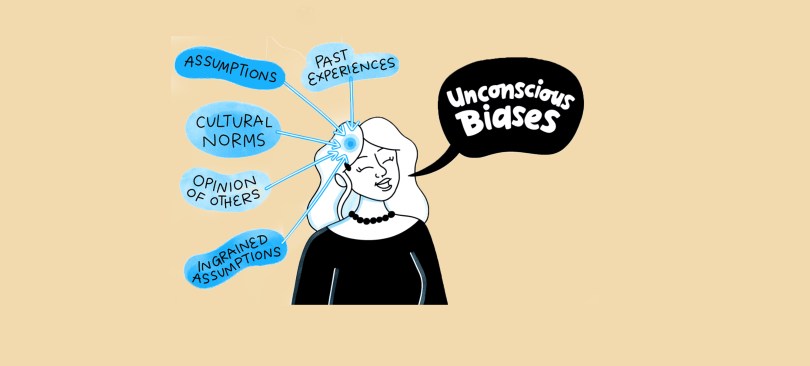
Unconscious bias refers to the automatic assumptions, beliefs and mental shortcuts our brains develop over time. These patterns are influenced by childhood experiences, family, culture, education, previous relationships, social media, television and even the conversations we overhear growing up.

They help our brains process information quickly, but they can also lead us to make unfair judgements without realising we’re doing it.

The truth is, every single one of us has unconscious biases. The difference isn’t whether we have them. It’s whether we’re willing to become aware of the,.

The Brain Likes Shortcuts

Imagine meeting someone for the first time. Within seconds you’ve already noticed their appearance, clothing, body language, accent, age and confidence. Your brain has begun creating a story before they’ve even finished introducing themselves.

Sometimes those stories are accurate, however quite often they aren’t.

The human brain is designed to look for patterns because it keeps us safe. Thousands of years ago this was useful for survival. Today, those same shortcuts can influence promotions at work, dating choices, friendships and even how we treat ourselves.

A prime example lies in meeting someone who looks like an ex partner who perhaps deceived our trust, we can meet someone with a resemblance, and before we know it, we are disregarding them without realising.

Unconscious Bias at Work

Think about a typical workplace. A manager interviews two candidates with identical qualifications. One reminds them of someone they worked well with years ago.

The other has a different communication style, dresses differently or appears quieter.

Without intending to, the manager may naturally feel more comfortable with the first candidate. Neither decision feels biased.

It simply feels like instinct.

But instinct is often influenced by previous experiences rather than objective evidence.

Unconscious bias can affect who gets hired, who receives opportunities, who gets promoted and who is viewed as having leadership potential. It can also affect how feedback is given.

Confident people may be described as natural leaders.

Quiet people may be labelled disengaged.

Someone who thinks differently may be seen as difficult rather than innovative.

This is especially important when we consider neurodiversity. Many people with ADHD, autism or dyslexia communicate differently. They may process information differently, avoid eye contact, interrupt through excitement or need additional thinking time.

These differences are not character flaws.

Yet unconscious bias can lead others to misinterpret these behaviours as lack of interest, poor attitude or incompetence. When organisations become aware of unconscious bias, they often discover hidden talent that was overlooked simply because it didn’t fit traditional expectations.

It Doesn’t Stop at the Office Door.. Look at our love lives…

The same thing happens in our love lives. How often have we dismissed someone because they weren’t physically our usual type?

How often have we assumed someone wasn’t interested because they appeared quiet?

How often have we believed confidence equals emotional maturity?

Or assumed attractive people must be happier?

Perhaps you’ve met someone who looked perfect on paper. Successful career, Great appearance, Confident, Funny,

Yet emotionally unavailable.

Meanwhile someone else may have been overlooked because they were nervous on a first date, shy in conversation or didn’t immediately create fireworks. Our unconscious bias often creates a checklist of what love should look like.

Height.

Career.

Income.

Age.

Body type.

Social status.

Confidence.

Lifestyle.

But very few of those things predict whether someone will make us feel emotionally safe, respected or loved. Sometimes we reject wonderful people because they don’t match the picture we’ve created in our minds, or we are comparing them and instantly our mind tells us ‘Unsafe’.

Sometimes we chase people who repeatedly hurt us and reject those who could love us deeply, because of their jobs weight etc etc..

The Stories We Tell Ourselves

Bias isn’t only about how we judge others. It’s also about how we judge ourselves.

Many people carry beliefs they never chose.

“I’m too old.”

“I’m too much.”

“People always leave.”

“No one finds people like me attractive.”

“I’ll never be successful.”

Those thoughts often feel like facts.

But where did they come from?

A childhood experience?

An ex partner?

A teacher?

A parent?

A single painful rejection years ago?

Our brains are incredibly good at collecting evidence to support beliefs we’ve carried for years. We rarely stop to question whether those beliefs are actually true.

Why Coaching Matters

This is one of the reasons I believe coaching can be so powerful. Coaching isn’t about giving people the answers. It’s about helping them discover the questions they’ve never thought to ask.

Why do I always choose emotionally unavailable partners?

Why do I keep avoiding opportunities at work?

Why do I assume people won’t like me?

Why do I believe I’m not good enough?

Why do I keep repeating the same patterns?

Why do I shut down when someone I’m genuinely interested in comes into my orbit?

Many of the answers lie beneath conscious awareness.

A coach helps bring those hidden patterns into the light.

Not through judgement, but through curiosity.

Together you begin noticing the automatic thoughts that influence behaviour. You explore where those thoughts originated. You test whether they’re still serving you and gradually you begin replacing automatic assumptions with conscious choices.

Looking Beyond Behaviour

One of the biggest shifts coaching creates is helping people separate behaviour from identity.

Someone interrupting you may not be rude. They may simply process conversations differently. This happens a lot with Neuro Diverse people.

Someone cancelling plans may not be rejecting you. They may genuinely be overwhelmed.

Someone who seems quiet in meetings may have brilliant ideas but need more time to think.

Equally, someone who appears incredibly confident may actually be masking insecurity.

The more curious we become, the fewer assumptions we make.

Curiosity almost always creates stronger relationships than certainty.

Flawed Thinking Isn’t Failure

One of the most common things coaching uncovers is flawed thinking. Psychologists often refer to these as cognitive distortions. These include believing we know what others are thinking.

Expecting the worst outcome.

Overgeneralising from one experience.

Seeing situations in black and white.

Filtering out positive experiences while focusing only on negatives.

These thinking patterns quietly influence both our personal and professional lives.

If one relationship ended badly, we may assume every future relationship will.

If one interview went poorly, we may decide we’re not capable.

If one manager criticised us, we may stop applying for promotions altogether.

The event ends.

The belief remains.

Coaching helps challenge those beliefs before they become permanent truths.

Awareness Changes Everything

The goal isn’t perfection. No one can completely eliminate unconscious bias.

We’re human.

Our brains will always create shortcuts.

The goal is awareness. Awareness gives us choice. Instead of immediately believing every thought, we become curious. Instead of reacting automatically, we pause. Instead of assuming we know someone’s story, we ask questions.

That pause can completely change a conversation.

It can save relationships.

It can create more inclusive workplaces.

It can open doors we never realised we’d closed.

Imagine What Could Change

Imagine interviewing someone without letting first impressions dominate your decision.

Imagine going on a date with genuine curiosity rather than comparing them with every previous partner.

Imagine recognising when your inner critic is speaking instead of accepting every thought as fact.

Imagine leading a team where different ways of thinking are valued rather than judged.

Imagine choosing people based on emotional compatibility instead of a checklist.

Imagine not judging people on. decisions they’ve made for their lives, just because they don’t match up to your values.

Those small shifts have enormous consequences.

Not only for careers and relationships, but for confidence, wellbeing and happiness.

Final Thoughts

Some of the most important conversations we’ll ever have are the ones we have with ourselves.

Every assumption deserves to be questioned.

Every belief deserves to be explored.

Every pattern deserves our curiosity.

Because when we become aware of our unconscious biases, we don’t just change the way we see other people.

We change the way we see ourselves and that may be the most powerful transformation of all.

If you’ve ever found yourself repeating the same relationship patterns, doubting your own potential or wondering why certain situations keep playing out in your life, coaching offers a space to explore those patterns without judgement. Together, we can uncover the beliefs driving your decisions, challenge thinking that no longer serves you and help you make choices that are aligned with who you are today, rather than who your past taught you to be.

Sometimes, changing your life doesn’t begin with changing your circumstances.

It begins with changing the story you’ve been unconsciously telling yourself.

The Context we Meet in: Why we judge women by circumstance instead of Character

There is a scene in Pretty Woman that has stayed with me for years.

Edward, played by Richard Gere, looks at Vivian and says, “I’ve never treated you like a prostitute.”

Her response is immediate.

“You just did.”

For a long time, I watched that scene and thought it was simply about a man saying the wrong thing. As I have grown older, spent more time listening to people’s stories and worked with women from all walks of life, I have come to realise that the scene is about something much bigger than a wealthy businessman falling in love with an escort. It is about judgement. It is about the labels we place on people. Most importantly, it is about how often women are judged by the circumstances in which they are found rather than the character they possess.

What strikes me most about that exchange is that Vivian never asks the obvious question. Why is she carrying the burden of judgement when Edward was equally involved? He may have been the wealthy businessman and she may have been the escort, but both of them participated in the same encounter. Without Edward, there is no transaction. Without his choices, there is no story. Yet somehow society finds it easier to judge Vivian than it does Edward. He is seen as successful. She is seen as shameful. He is allowed complexity. She is reduced to a label, she could be incredibly successful in her own right, but it’s always the man casting judgement, without the understanding.

That scene has always felt like a reflection of something much bigger that still exists today. Women continue to be judged differently for the very same situations that men willingly participate in. The details may have changed. Dating apps have replaced chance meetings in bars. Social media has transformed how people connect. Entire industries have emerged that did not exist twenty years ago. Yet the underlying double standard remains surprisingly familiar.

A woman can meet a man on Tinder, spend an evening talking, laughing and building what she believes is a genuine connection, sleep with him, and then discover she has been quietly disqualified from relationship status because she slept with him too quickly. The irony is extraordinary. He was there too. He made the same decision. He participated in exactly the same experience. Yet somehow he walks away feeling entitled to judge her for behaviour he willingly took part in himself.

What fascinates me is that many women do not think this way. They are often looking at the bigger picture. They are wondering whether there is chemistry, whether there is potential, whether this person could become a meaningful part of their life. Of course there are exceptions. Both men and women can be manipulative. Both men and women can seek validation. Both men and women can be dishonest. This is not about pretending one gender is innocent and the other is guilty. Human beings are complicated. What interests me is the imbalance in how judgement is applied. Society still seems far more comfortable attaching shame to women than it does to men.

One of the most interesting questions in modern dating is why some men automatically assume that a woman on Hinge is more suitable for a relationship than a woman they meet in a lap dancing club or who perhaps has worked as an escort. Why? What evidence do they actually have? Have they spent time understanding her values? Do they know how she treats people? Do they know whether she is loyal, emotionally available, trustworthy or kind? Usually the answer is no. What they are really judging is not the woman herself. They are judging the story attached to her, and the crazy thing is from my day to day life, I actually hear that ‘BodyCount’ can often reign higher in the women they perceive as ‘Marriage material’.

The woman on Hinge is viewed as someone searching for love. The woman in the club is viewed as someone selling fantasy. One is placed into a socially approved category. The other is placed into a socially disapproved category. Yet neither label tells us very much. The woman in the club may have stronger boundaries than anyone the man has ever met. She may have spent years single because she refuses to settle for relationships that do not meet her standards. She may be fiercely loyal once she commits to someone. She may have had fewer sexual partners than many of the women being praised as relationship material. Meanwhile, the woman on Hinge may be dating multiple people, have no interest in commitment and be seeking validation rather than connection. Or the opposite may be true. The point is that nobody knows.

Character cannot be determined by profession. It cannot be determined by appearance. It cannot be determined by where somebody happened to meet you. Yet people continue to make assumptions every single day based on these things. They judge a book by its cover and then convince themselves they know the entire story.

What I have learned over the years is that public image and private reality are often worlds apart. We live in a culture where people carefully curate how they are perceived. Dating profiles are curated. Social media accounts are curated. Influencer brands are curated. Even ordinary people curate versions of themselves for public consumption. We look at photographs, captions and carefully selected moments and convince ourselves we know somebody. The truth is that we rarely do.

There are women with enormous social media followings who are admired by millions. There are reality television personalities, influencers and public figures who have built highly successful brands around their image. Some have found ways to monetise their beauty, fame and desirability in ways previous generations could never have imagined, and behind closed doors are being sent out on secret Whatssap groups for £10k for the night. Personally, I do not see anything wrong with that. If somebody has built an audience, worked hard to create opportunities and found a way to capitalise on their success, then fair play to them. What interests me is not what they do. What interests me is how society responds to them depending on what information is publicly available.

The same man who judges a woman working openly within the adult industry may spend years admiring, following and fantasising about a public figure whose private life he knows nothing about. The difference is not necessarily morality. The difference is visibility. One woman is judged because people know. The other escapes judgement because people do not. Yet both may be making similar choices in private. This is why assumptions are so dangerous. They are built on incomplete information and presented as certainty.

Another aspect of this conversation that deserves far more compassion is the reality that some women carry experiences most people know nothing about. Some women working within parts of the adult industry have histories of childhood sexual abuse, rape, domestic violence, coercive relationships or profound emotional neglect. Of course this is not true of everyone and it would be wrong to make assumptions. Every woman’s story is different. Yet it is important to recognise that for some women, their relationship with their body, sexuality and sense of control has been shaped by experiences that occurred long before anyone met them. I work with one lady in the industry, who was date raped, and is simply too scared to date, and maybe she’s lost her way a little, but who are we to sit and judge.

What often frustrates me is how quickly people jump to judgement without any curiosity about what might have brought someone to where they are today. We see a profession and assume we understand a person. We see a choice and assume we know the story behind it. Yet human beings are rarely that simple. For some women, stepping into a space where they choose the terms, set the boundaries and decide what access people have to them can feel very different from experiences where control was taken away. What outsiders may perceive as exploitation, another person may experience as autonomy. Whether people agree with those choices or not is almost irrelevant. The point is that we cannot understand someone’s life by reducing them to a label.

Perhaps that is another reason I find judgement so problematic. It leaves no room for complexity. It leaves no room for empathy. It leaves no room for the possibility that the person standing in front of us has survived things we cannot imagine. We do not know their history. We do not know their struggles. We do not know what they have overcome to become the person they are today. Yet society is often quick to condemn women for the choices they make while showing very little interest in understanding the experiences that shaped those choices in the first place.

As the film draws to a close, something interesting happens. Edward finally understands what he could not see at the beginning. The issue was never Vivian’s profession. It was never the circumstances in which they met. It was never the label he had attached to her. The real obstacle was his inability to look beyond those things. Only when he lets go of his assumptions is he able to see the woman standing in front of him.

If we return back to the film ‘Pretty woman’ in one of the most iconic scenes in the film, Edward arrives with flowers and climbs the fire escape despite his fear of heights. He becomes the knight in shining armour Vivian once dreamed about as a little girl. Of course, we live in a different world now. Most women are not waiting to be rescued. Women build careers, raise families, buy their own flowers and save themselves every single day. The fantasy was never really about being rescued anyway. The fantasy was about being chosen. Being valued. Being seen… finally the little girl who had led such a traumatic and sad life, was seen.

Perhaps that is what so many people are searching for beneath all the noise of modern dating. Not perfection, Not status, Not somebody who ticks every box on paper. Just somebody willing to look beyond the stereotypes, beyond the assumptions and beyond the story attached to how they met.

Because love does not arrive wrapped in social approval. It does not ask whether someone was met through friends, on a dating app, in a club, at work or during the most unexpected chapter of their life. Love only asks whether two people are willing to know each other honestly.

And perhaps that is the real lesson hidden inside Pretty Woman. The greatest relationships are not built by people who meet in the perfect circumstances…. They are built by people brave enough to see beyond them….

Maybe the real question is not where are the women worth loving. Maybe the real question is where are the men willing to put down their judgement long enough to recognise them.

Because the most beautiful love stories have never been about how two people met.

They have always been about what happened when they decided to truly see one another.