Synchronicity in Love: When Coincidences Feel Like Something More

Are some encounters simply coincidence, or are there connections in life that seem to reach beyond our understanding?

Have you ever met someone and experienced a level of alignment that was almost impossible to explain?

Not necessarily an instant attraction, not necessarily love at first sight, but something altogether different. An unusual familiarity. A series of coincidences. Shared experiences that seem almost too similar to be accidental. Conversations that leave you questioning how two people could possibly have so much in common.

Then there are the moments that are harder to explain. Thinking about someone just before they contact you. Hearing their name repeatedly in the most unexpected places. Finding yourself dreaming about someone you haven’t consciously thought about for months, perhaps even years. Discovering that you’re following similar patterns, interests or even algorithms without any obvious explanation.

At what point does coincidence become something that feels meaningful?

This is where the fascinating concept of synchronicity comes into play.

What exactly is synchronicity?

The term synchronicity was introduced by Swiss psychiatrist and psychoanalyst Carl Jung. He described it as the occurrence of two or more events that are meaningfully related, despite there being no apparent causal connection between them.

In simpler terms, synchronicity is when something happens that feels connected to something else in your life, even though you cannot establish a logical reason for that connection. Jung was particularly interested in the relationship between our conscious and unconscious minds, and how experiences, thoughts and external events can sometimes appear to align in ways that feel deeply significant.

His theory wasn’t necessarily about proving that the universe was arranging events for us. Rather, it explored the possibility that certain coincidences carry personal meaning beyond what conventional explanations might account for, and perhaps that’s what makes the subject so fascinating.

Because most of us have experienced something that has made us stop for a moment and think, What are the chances of that?

When two people seem strangely aligned

In romantic connections, synchronicity can take on an entirely different dimension. Sometimes we meet someone and discover that our lives have followed remarkably similar paths. Perhaps we’ve experienced similar childhoods, comparable relationship histories, heartbreak, loss or periods of profound personal change.

We might discover that we’ve overcome similar challenges, share unusual interests, have experienced the same significant life events or even have remarkably similar ways of thinking. There can be an extraordinary sense of recognition.

Psychologically, there are several ways we can begin to understand this.

Shared experiences can create emotional familiarity. When someone understands an experience without requiring us to explain every detail, we can feel seen in a way that is quite rare.

There is also something known as emotional mirroring, where people recognise aspects of their own experiences, values and emotional responses in another person. Our brains are exceptionally good at recognising patterns, and when someone reflects parts of our own story, we may experience a particularly strong sense of connection. But does understanding the psychology necessarily mean we’ve explained everything?

I don’t think we should be quite so quick to assume that it does.

The science behind the feeling

There are some fascinating psychological explanations worth considering.

Our subconscious minds are constantly processing information, making associations and recognising patterns, often without us being consciously aware of it.

Confirmation bias can also influence how we interpret coincidences. When someone becomes emotionally significant to us, we may become more attentive to anything associated with them.

Their name might suddenly seem to appear everywhere. A particular song might remind us of them. Certain places, dates or conversations might take on additional significance.

There is also the frequency illusion, sometimes called the Baader-Meinhof phenomenon. This describes how something we’ve recently become aware of suddenly seems to appear everywhere.

Our brains haven’t necessarily created more occurrences. We’ve simply become more likely to notice them.

And then there’s limerence.

Limerence can involve intrusive thoughts, intense longing, idealisation and a heightened sensitivity to anything connected to the person we’re attracted to.

It is important to distinguish between an intense psychological attachment and the experience of synchronicity. They can sometimes overlap, but they aren’t interchangeable.

Not every recurring thought is a sign. Not every coincidence is a message. And not every powerful attraction is evidence of a destined relationship, but equally, not every meaningful connection needs to be dismissed as limerence.

We can understand the psychological mechanisms while remaining open to the possibility that our experience of human connection is more complex than we currently understand.

Three people, three extraordinary experiences

I’ve always been interested in synchronicity, but I can honestly say there have only ever been three men in my life with whom I’ve experienced what I would describe as extraordinary levels of it.

Three entirely different encounters, at different stages of my life, but each leaving me questioning the extraordinary nature of coincidence.

One was someone I met after my divorce. Another was someone I encountered in Los Angeles, in circumstances so unexpected that I still find myself smiling when I think about them.

Interestingly, I believe that particular encounter served a purpose of its own. It introduced me to a place that I subsequently realised I had an enormous love for. Sometimes a person can enter our lives and reveal something about ourselves that we hadn’t quite discovered yet.

And then there is one particular connection that has stayed with me in a rather different way. It has been several years since we went on a date, and I certainly wouldn’t describe myself as actively pursuing the situation or expecting anything from it. I never really have, its almost like a calmness of no expectation, but this incredible pull I can’t explain, and often avoid. I know this person isn’t available, and I respect that completely.

But the synchronicities have been quite extraordinary.

We have even laughed about how frequently things seem to align between us. There have been conversations where the similarities have been so unusual that you almost have to stop and question them.

Even the most random things, such as discovering that we seem to have remarkably similar algorithms, Bumping into them just before dates, or sometimes when I have just needed someone to talk to, when my head has been so heavy, and they have prompted that familiar reaction of, Seriously, what are the chances?

Then there are the less tangible experiences.

Seeing their name in unexpected places. Dreams that seem to arrive without invitation. Finding someone unexpectedly entering your thoughts when you’re not consciously trying to revisit the connection.

There have been periods when I’ve actively tried to put the experience to one side, concentrate on the present and allow myself to move forward.

And yet, every so often, another unusual coincidence seems to bring the subject back into my awareness.

I’ve questioned it, rationalised it, laughed at myself for overthinking it and tried to find a psychological explanation.

And then there was an experience that made me question things a little further.

I’d recently attended a spiritualist church, one of those open, free services where people can come along and listen to messages from mediums. I’m naturally quite sceptical about these things, and I tend to keep my cards close to my chest. I don’t particularly like giving information away or inadvertently leading someone towards an answer.

During the service, the medium turned her attention towards me and began mentioning a particular sport, a particular country and then a name. A name that was very familiar to me.

She told me that an elderly lady on the other side was bringing this name through, that she particularly wanted me to hear it and that I shouldn’t overlook the situation.

I sat there listening, saying very little. Had I unknowingly given something away through my body language, facial expressions or subconscious responses? Was it simply an educated guess? Or was there something else happening that I couldn’t readily explain?

What made the experience even more difficult to rationalise was that she then mentioned something incredibly specific, something I genuinely couldn’t understand how she would have known, and then I was told, watch for a sign…

And then, just two days later, something rather extraordinary happened.

I was making my way to meet someone for a date. My date was already waiting for me, and completely unexpectedly, I crossed paths with the very person whose name had been brought up at the spiritualist church.

Of all the moments, places and circumstances in which our paths could have crossed, it happened as I was literally on my way to meet somebody else. Now, I appreciate that coincidences happen. I understand probability, pattern recognition and the way our minds attach meaning to emotionally significant experiences. I’m not suggesting that this encounter proves anything supernatural, nor am I claiming to know what the medium’s message meant.

But I would be lying if I said it didn’t make me stop and think.

It was one of those moments where you almost have to laugh at the sheer improbability of the timing and when you add it to the other unusual coincidences surrounding this particular person, you can perhaps understand why I’ve found the whole subject so fascinating.

Was it coincidence? Was my subconscious already making connections I hadn’t consciously recognised? Was it simply a remarkable sequence of events, or was there something spiritual at play?

I honestly don’t know.

And perhaps that’s precisely why I’ve found it so difficult to dismiss. It’s blown my mind, and like I said LA guy especially I had a few moments of cross paths, but nothing like this, and every time I laugh and dismiss the situation, something happens to almost remind me. I even said his name once during sex with someone else, YEP, one of those moments, and I hadn’t even thought about him for months, but obviously my body was telling me something different.

Would I ever approach them and tell them, Hell NO! Somethings are best kept to oneself.

I mean is all this simply pattern recognition? Is it subconscious association? Is it simply the human mind looking for meaning?

Possibly.

But I’ve also learned that sometimes we can acknowledge an experience without pretending to know exactly what it means. I don’t believe every extraordinary feeling should automatically be labelled destiny. Nor do I believe we should convince ourselves that someone is meant to be in our lives simply because the coincidences are compelling.

But I do think there is room for curiosity.

And perhaps a little wonder.

Is synchronicity a connection between souls?

Now we enter a rather more spiritual conversation. Some spiritual traditions suggest that certain people enter our lives because our paths have crossed before. The concept of soul recognition, reincarnation and past-life connections proposes that we may encounter people with whom we share a connection that feels strangely familiar, almost as though we’re recognising rather than meeting them for the first time.

There is no established scientific evidence proving that synchronicity represents souls reconnecting across lifetimes.

But the idea itself is fascinating.

Why do certain people feel familiar almost immediately? Why can a conversation with one person feel effortless, while with another it takes months to establish the same level of emotional understanding?

Could it simply be personality, shared experiences and psychological compatibility?

Of course.

Could there be something about human connection that we haven’t yet fully understood? I don’t think we need to rule out the possibility simply because we cannot currently measure it.

I’m not particularly interested in presenting spirituality as fact, but I do think there is value in allowing people to explore their own beliefs. After all, the absence of a scientific explanation isn’t automatically proof of something supernatural, but neither does it mean that every aspect of human experience has been fully understood.

There is a difference between being open-minded and being certain and perhaps synchronicity invites us to do exactly that: remain open-minded.

Fate, destiny and the timing of love

One of the most interesting aspects of synchronicity is the question of timing.

Why do we meet certain people at particular stages of our lives?Sometimes we meet someone when we’re emotionally unavailable. Sometimes the connection is there, but circumstances aren’t. Sometimes two people recognise something in one another, yet their lives are moving in completely different directions.

And sometimes someone enters our lives briefly but leaves an impression that lasts considerably longer than the relationship itself.

Does that mean we were supposed to meet?

Perhaps.

But I think we need to distinguish between being meant to encounter someone and being meant to spend our lives with them.

Those are two very different things.

Maybe some people arrive to challenge our thinking, introduce us to new experiences, awaken parts of ourselves or simply remind us that connection can still surprise us.

Maybe others arrive at exactly the right time for something neither person could have anticipated.

And perhaps some encounters are simply beautiful mysteries that don’t require an outcome.

We often associate destiny with permanence, but perhaps its meaning is much broader than that.

When the pull is difficult to explain

There is another aspect of synchronicity that I think deserves attention: the feeling of being drawn towards someone despite having no intention of revisiting the connection, or so we think we have no intention.

It can be confusing, particularly when you’re consciously trying to move forward.

You might not be actively thinking about the person. You might be enjoying your life, meeting new people and concentrating on other things and other partners. Yet occasionally, something brings them back into your awareness.

A dream. A familiar name. An unexpected reminder. An unusual coincidence.

From a psychological perspective, our unconscious minds can continue processing emotionally significant experiences long after we’ve consciously moved on.

Memory doesn’t always operate according to our preferred timetable.

Mindfulness can help us notice these thoughts without becoming consumed by them. Rather than trying to suppress every thought or find an explanation for every coincidence, we can acknowledge it and gently return our attention to the present.

But there is something important here.

Feeling a connection doesn’t mean we have to act upon it. Feeling drawn to someone doesn’t mean they are available, that they feel the same way or that we should disregard the boundaries of their existing life.

We can respect reality while still acknowledging that an experience has felt extraordinary.

Perhaps that’s quite a mature way of approaching love.

The truth is, our mind is simply amazing at masking what the heart wants.

So, is it coincidence, psychology or something more?

I suspect the answer might be different for everybody.

For some, synchronicity will be explained through psychology, subconscious associations and the remarkable ability of the human brain to recognise patterns. For others, it will be spiritual. They may believe that certain encounters are guided by something beyond our conscious understanding.

Some will believe in fate. Others will believe in destiny, soul connections or the possibility that certain people are placed in our paths for reasons we may only understand much later.

And there will be people who sit somewhere between all these explanations.

I think that’s perfectly reasonable.

We don’t have to abandon our logical thinking to appreciate the mysterious parts of life. Equally, we don’t have to abandon our sense of wonder simply because something cannot be scientifically demonstrated.

Perhaps the most important thing is to recognise the difference between what we feel, what we know and what we hope might be true.

Because all three can exist together.

Perhaps we should leave a little room for magic

I’m a great believer in understanding human behaviour. I think it’s important to explore attachment, emotional familiarity, the subconscious and the ways our past experiences influence who we’re drawn towards.

But I also think we can become so preoccupied with explaining everything that we sometimes forget to experience it.

Not every connection needs a diagnosis. Not every coincidence needs to be dismantled. Not every feeling needs to be reduced to a chemical reaction, and not every meaningful encounter needs to become a relationship to have mattered.

Perhaps synchronicity is simply one of life’s reminders that there is still so much about human connection we don’t fully understand.

Maybe two people cross paths because of circumstances, timing and chance. Maybe their similarities create an extraordinary sense of recognition. Maybe there is something spiritual that we cannot yet explain.

Or perhaps the truth is somewhere between all these possibilities.

I don’t think we should build our lives around coincidences, wait indefinitely for someone unavailable or mistake an intense feeling for a promise of what is to come.

But I do think we should allow ourselves a little hope.

Because sometimes, when the same person seems to appear in the most unexpected corners of our lives, when conversations align in the strangest ways and when a connection leaves us questioning the probability of it all, it’s perfectly human to pause and wonder.

We may never know whether it was fate, coincidence, psychology or something we or the human race, haven’t yet discovered.

And perhaps we don’t need to.

Not everything meaningful has to be explained to be meaningful. Not every extraordinary connection is a promise of forever. But that doesn’t mean it wasn’t extraordinary.

So, by all means, understand the science. Explore the psychology. Respect the reality of the circumstances in which you find yourself.

But don’t be so quick to dismiss the wonder.

After all, life is full of coincidences.

And every now and again, one comes along that makes you wonder whether coincidence is quite the whole story.
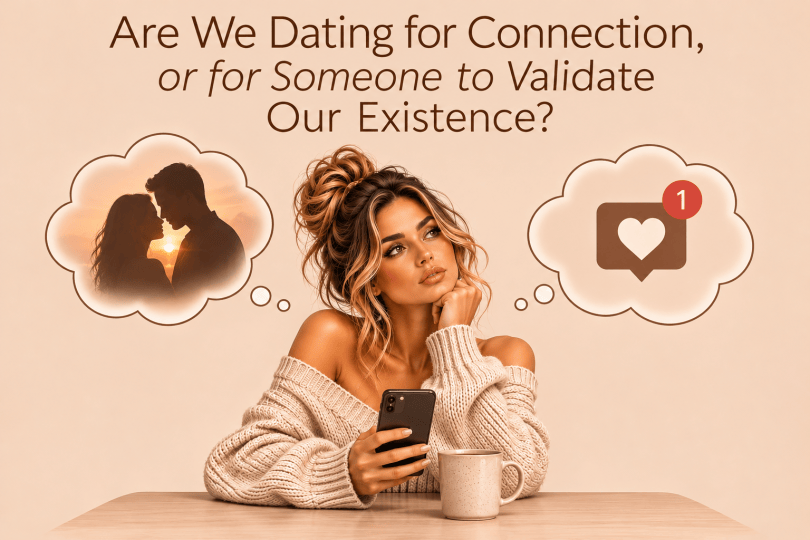

Are We Dating for Connection, or Are We Waiting for Someone to Validate Our Existence?

Have we outsourced our self-worth to people who can’t even manage to reply to a WhatsApp message?

Let’s talk about modern dating. Not the usual conversations about red flags, situationships, attachment styles or whether someone who takes six hours to reply is genuinely busy or simply not that interested.

I want to talk about something a little deeper.

Something that might explain why so many of us seem to be emotionally exhausted by dating before we’ve even established whether we actually like the person we’re dating.

Are we becoming so dependent on external validation that we’ve forgotten how to evaluate ourselves?

More importantly, are we allowing other people’s opinions, behaviour and attention to determine how we feel about our own worth? Because if we’re honest, there’s something quite extraordinary about the amount of emotional power we can hand over to someone we’ve known for approximately three weeks.

One minute we’re perfectly happy, getting on with our lives, feeling reasonably confident. The next, somebody hasn’t replied to a message, and suddenly we’re conducting a full forensic investigation into our personality.

Did I say something wrong? Was I too keen? Was I not keen enough? Did I come across as desperate? Was that joke a bit much? Was I not good looking enough?

And before we know it, we’re analysing a conversation that lasted eleven minutes as though we’re preparing evidence for the Crown Court.

But perhaps the problem isn’t always the person who hasn’t texted back.

Perhaps it’s what their silence has come to mean to us.

Enter Carl Rogers: Conditions of Worth

In person-centred psychology, Carl Rogers introduced the concept of conditions of worth.

The basic idea is that we develop an understanding of our own value through the conditions we believe we must meet to receive acceptance, affection and approval from others.

In an ideal world, we’re raised experiencing unconditional positive regard. We’re accepted as individuals, rather than feeling that love and approval must be earned through our behaviour, achievements or ability to meet somebody else’s expectations.

Unfortunately, real life isn’t always quite so straightforward. We can grow up learning, consciously or unconsciously, that we’re more lovable when we’re agreeable, more acceptable when we’re successful, more deserving of affection when we’re attractive, helpful, accommodating or easy to be around.

Eventually, these external expectations can become internalised.

We begin to believe that our worth is conditional.

We might not consciously think, “I’m only worthy if somebody chooses me,” but our behaviour can suggest otherwise and this is where modern dating becomes particularly interesting. Because how many of us have found ourselves measuring our attractiveness, desirability or even our basic worth against whether another person wants us?

We say we want a relationship, but sometimes what we’re desperately seeking is confirmation that we’re wanted.

There’s a difference.

One is about connection. The other is about validation.

And confusing the two can get us into a whole world of trouble.

The Locus of Evaluation: Who Gets to Decide Your Worth?

Another important concept in Rogers’ theory is the locus of evaluation.

Put simply, this concerns where we look when evaluating ourselves and deciding what we think, feel and believe about our experiences.

An internal locus of evaluation means we’re increasingly able to assess ourselves using our own values, experiences and feelings.

We can listen to other people’s opinions without allowing those opinions to become the final verdict on who we are.

An external locus of evaluation, on the other hand, means we’re placing greater emphasis on other people’s judgements, expectations and approval when deciding how to feel about ourselves.

Now, let’s apply that to dating.

Imagine you’ve been on a date. You’ve had a lovely evening, enjoyed the conversation, laughed, felt comfortable and thought there was a genuine connection.

You get home feeling quite positive.

Then you don’t hear from them the following day…. Your stomach ends up in knots, you suddenly feel anxious..

Suddenly, your evaluation of the entire evening changes.

Was it actually that good? Did they find me attractive? Did I talk too much? Perhaps I wasn’t their type after all. Did they lie about the chemistry?

Notice what has happened.

Your original experience was positive. You enjoyed yourself. You felt comfortable. But somebody else’s subsequent behaviour has suddenly become more important than your own experience.

You’ve effectively handed them the authority to rewrite your evening.

And this is the bit I find fascinating…. Because we’re all caught in this fucked up washing machine cycle, of analysing everything!


I can actually relate to this from personal experience. Last year, I was in a relationship with somebody who I would describe as having strong narcissistic traits, well actually I’m being kind there, he was a full on Narcissist! When I initially entered that relationship, I was confident in myself. I knew who I was, I was comfortable in my own skin and I didn’t particularly need anybody else’s approval to validate me. But as the relationship progressed, something started to change. I gradually found myself questioning myself, feeling as though I wasn’t good enough and becoming increasingly conscious of whether I was meeting his expectations. Almost everything I did felt as though it needed his approval or validation. I found myself looking externally for reassurance that I had previously been able to find within myself.

Looking back, what I find particularly interesting is that I hadn’t necessarily entered the relationship with those insecurities. They developed within the dynamic of the relationship itself. It was almost as though my internal locus of evaluation had gradually shifted towards an external one. His opinions, reactions and approval began to carry more weight than my own feelings and judgement and I think that’s something worth recognising: sometimes we don’t realise how much of our self-concept has become influenced by another person until we step outside the relationship and begin to find ourselves again.

Why does somebody else’s lack of interest suddenly make us question our own value?

They might not be compatible with us. They might not be emotionally available. They might have different priorities, preferences or expectations.

Or perhaps they simply didn’t fancy us…. That’s allowed. We’re not everybody’s cup of tea.

But why does their preference become a judgement about our worth?

Somewhere along the way, we’ve confused being chosen with being valuable and those two things are not remotely interchangeable.

The WhatsApp Waiting Room: When Someone Else Controls Your Mood

Let’s talk about the modern dating ritual that deserves its own psychological diagnosis.

Waiting for a text.

You send a message. Nothing…

You put your phone down. Pick it up again. Check whether they’re online. Notice they’ve viewed your story. Wonder why they can apparently operate Instagram but cannot locate the WhatsApp application.

You check the last-seen status.

You analyse the punctuation in their previous message.

You consider whether the full stop was passive-aggressive.

God forbid they were previously sending good morning messages with kisses and have suddenly reduced their communication to “Morning”… or Nothing!

What the actual fuck happened???

But underneath the humour is something worth examining.

When we’re waiting for a message to determine how we feel, we’re potentially placing our emotional wellbeing in somebody else’s hands.

Their attention provides reassurance. Their enthusiasm provides a temporary boost. Their silence creates uncertainty and we can become increasingly preoccupied with obtaining the next little piece of reassurance.

It’s worth distinguishing between the psychological theories here. Rogers’ locus of evaluation helps us understand why we might rely on somebody else’s response to judge ourselves. Behavioural psychology also offers useful ways of understanding how unpredictable rewards can reinforce checking behaviours.

When attention arrives inconsistently, we can become particularly focused on when it might arrive again. We don’t know whether we’ll receive affection, enthusiasm or silence.

So we check.

And check again.

And again… FUCK ME! You want to stop checking your phone but cant!

We’re not necessarily waiting for a meaningful conversation anymore. Sometimes we’re waiting for the emotional relief that comes with knowing we’re still wanted.

That’s quite a distinction.

And perhaps the most uncomfortable question is this:

If that person never messaged again, would we miss them, or would we miss how they made us feel about ourselves?

Because those are two very different experiences.

Self-Concept: Are We Seeing Ourselves Clearly?

Rogers also placed considerable importance on self-concept: the collection of beliefs and perceptions we hold about ourselves.

This includes our self-image, the person we believe we are, and our ideal self, the person we would like to become.

He also explored the relationship between our self-concept and our experiences. When there’s a significant gap between how we experience ourselves and how we believe we should be, psychological tension can develop.

Dating can expose this gap rather dramatically.

We might see ourselves as independent, confident, emotionally intelligent people who know exactly what we want. Yet, when somebody we’re attracted to becomes distant, we find ourselves abandoning our usual boundaries.

We might tolerate behaviour we wouldn’t normally accept, make excuses for inconsistency or become preoccupied with winning back somebody’s attention.

Suddenly, the person who was quite happy being single is wondering whether they should send another message. The person who said they wanted emotional availability is making allowances for somebody who communicates like a faulty satellite.

The person who knows their worth is trying to negotiate a better price for it and perhaps that’s where we need to examine the difference between what we say we value and what we actually demonstrate through our behaviour.

Because self-worth isn’t simply about telling ourselves we’re wonderful.

It’s about whether we can maintain our sense of self when somebody else doesn’t see us in the way we’d hoped.

Are We Making Decisions Based on Someone Else’s Verdict?

Here’s another question.

How often do we actually stop and ask ourselves whether we like the person we’re dating?

Not whether they like us, Not whether they fancy us, Not whether they’re going to ask us out again.

But whether we genuinely like them.

Are they kind? Are they emotionally available? Do we enjoy their company? Do our values align? Do we feel comfortable being ourselves around them?

Or have we become so preoccupied with being selected that we’ve forgotten we’re supposed to be selecting too? I mean, has it just become one shitty game, we’re all addicted to.

I think this is one of the biggest traps in modern dating.

We can become so focused on securing somebody else’s approval that we stop evaluating whether they’re suitable for us.

We start auditioning.

We become more conscious of how we’re presenting ourselves, whether we’re saying the right things, whether we’re being too available, too enthusiastic, too independent or too much of anything and dating starts to resemble a job interview where both candidates are pretending not to care whether they get the position.

Meanwhile, neither of them has actually checked whether the job comes with decent working conditions.

Perhaps we’re not always looking for compatibility.

Perhaps sometimes we’re looking for confirmation.

Confirmation that we’re attractive. Desirable. Interesting. Worth pursuing.

And when somebody doesn’t provide that confirmation, we experience it as rejection, even when we might not have been particularly interested in them ourselves.

The Gender Question: Are Men and Women Playing Different Versions of the Same Game?

It’s tempting to think this is predominantly a female issue, particularly when we consider the pressures women experience around appearance, desirability, ageing and being chosen.

Women can find themselves measuring their value against whether they’re considered attractive enough, young enough, feminine enough or desirable enough.

Social media hasn’t exactly helped.

We’re constantly exposed to carefully curated versions of other people’s relationships, appearances and lifestyles and dating apps can make romantic attention feel measurable.

Matches, likes, messages, dates and followers become little indicators of perceived desirability.

However men aren’t necessarily immune to the same psychological process.

Men can experience conditions of worth around success, financial security, status, physical attractiveness, sexual performance and being perceived as desirable. Some may feel their value is tied to being wanted, admired, successful or sexually validated.

Others may seek reassurance through romantic or sexual attention without necessarily being comfortable with emotional vulnerability.

Of course, these aren’t universal male or female characteristics. People experience validation differently, and social expectations can influence how they express it.

But perhaps both sexes are participating in a similar psychological dance.

One person is waiting to feel chosen.

The other is waiting to feel desired.

Both are potentially looking outside themselves for reassurance.

And neither necessarily feels particularly secure.

The Disaster of Conditional Dating

Here’s where I think things can become particularly problematic.

If our self-worth is heavily dependent on external approval, dating can become less about finding a compatible partner and more about managing our own insecurities.

We might pursue people who are emotionally unavailable because their approval feels particularly rewarding. We might become more interested when somebody withdraws their attention. We might interpret inconsistency as a challenge rather than information. We might overlook incompatibility because we’re too invested in being chosen.

And we might confuse the intensity of our emotional response with the depth of our connection…

Sometimes, the person we’re most preoccupied with isn’t necessarily the person who makes us happiest.

They’re simply the person whose approval we haven’t secured, and we like to chase.

That uncertainty can keep us emotionally invested long after the relationship has stopped offering anything particularly meaningful and that’s a dangerous place to find ourselves.

Because when somebody else’s behaviour determines our emotional state, we’re no longer making decisions entirely from our own values.

We’re reacting to their behaviour. We’re adjusting ourselves around their availability. We’re waiting for their approval before allowing ourselves to feel okay again and eventually, we can lose sight of what we actually wanted in the first place.

So, How Do We Get Our Internal Locus of Evaluation Back?

Perhaps the answer isn’t to stop caring what other people think.

We’re human. We want connection, affection, acceptance and intimacy. There’s absolutely nothing wrong with wanting to be loved or wanted. Nor does having an internal locus of evaluation mean ignoring feedback or refusing to acknowledge when we’ve made mistakes.

It’s about developing the ability to consider other people’s opinions without automatically treating them as the truth.

It’s about being able to say: I enjoyed that date, regardless of whether they enjoyed it.

I found that person attractive, but that doesn’t mean they’re right for me.

I’d like them to message, but my evening doesn’t need to revolve around whether they do.

I’m disappointed that they aren’t interested, but their lack of interest doesn’t diminish my value and perhaps most importantly:

I don’t need somebody else to choose me before I decide that I’m worth choosing.

That last one is worth sitting with.

Because when we begin to develop a more internal sense of evaluation, something changes. We stop treating every interaction as a referendum on our desirability. We become more interested in how people make us feel rather than how we make them feel. We become better at recognising incompatibility without interpreting it as personal failure and we become less willing to abandon ourselves in exchange for somebody else’s attention.

Final Thoughts: Perhaps We Need to Stop Auditioning

I think modern dating has created an environment where external validation is incredibly accessible, but genuine emotional security can feel increasingly elusive.

We can receive hundreds of likes, matches and messages and still question whether we’re desirable. We can have somebody tell us we’re beautiful and still need them to tell us again tomorrow. We can receive attention from multiple people and still become fixated on the one person who isn’t giving us any and perhaps that’s because validation and self-worth are not the same thing.

External validation can make us feel good. It can reassure us, excite us and make us feel desirable.

But it cannot permanently resolve an underlying belief that we’re somehow not enough.

That work has to happen internally.

Perhaps the real question we should be asking ourselves when dating isn’t simply, “Do they like me?”

It’s:

“Do I like them?”

“Do I feel comfortable being myself?”

“Am I enjoying this experience?”

“Am I acting in accordance with my own values?”

And, most importantly:

“Would I still feel good about myself if this person decided they weren’t interested?”

Because we cannot spend our lives waiting for other people to issue us with a certificate confirming that we’re attractive, lovable and worthy of affection and if somebody’s inability to send a text message can dismantle your entire sense of self, perhaps it’s time to take a little of that power back.

Stop waiting for somebody else’s verdict. You’re not applying for the position of being worthy.

And for fuck’s sake, put your phone down.

You’ve got a life to live.

Are We Dating to Find Love, or Addicted to the Search?

The psychology of dating apps, the business of loneliness and why modern romance might be in trouble.

When did finding love become an endless shopping experience?

We live in a time when we have more opportunities than ever to meet people. With a few taps on a phone, we can access hundreds, sometimes thousands, of potential romantic partners. We can browse profiles, swipe through photographs, exchange messages and arrange dates without ever having to leave the comfort of our homes.

On paper, this should be the golden age of romance. Yet something rather peculiar seems to be happening.

People are increasingly talking about dating fatigue, emotional exhaustion, ghosting, situationships and the difficulty of finding someone who genuinely wants a relationship. We have an extraordinary amount of choice, but are we actually becoming any better at choosing?

And perhaps a more uncomfortable question: Are dating apps designed to help us find love, or have we become the product of an industry that makes money from our continued search for it?

The business model behind looking for love

I recently had a conversation with somebody who works in analytics and algorithms. They raised an interesting point about the economics of dating platforms. Their argument was that a relatively small proportion of men receive a disproportionate amount of attention, while a much larger proportion experience considerably less success. Those who receive fewer matches may consequently spend more time on the platforms, purchase subscriptions, pay for boosts and invest money in trying to improve their visibility.

It got me thinking.

There is a popular theory circulating online known as the 80/20 rule of dating apps. It suggests that a small proportion of men receive the majority of female attention.

You will also hear variations of this as the 90/10 rule.

However, it is important to distinguish internet theories from established research. There is no reliable universal statistic proving that 10% of men receive 90% of all matches across dating apps.

What we do have is some interesting evidence.

A 2016 academic study, A First Look at User Activity on Tinder, conducted by researchers including Gareth Tyson at Queen Mary University of London, examined almost half a million Tinder users using a combination of controlled profiles and survey research.

The researchers identified significant differences in how men and women interacted with the platform. Women tended to be more selective, while men tended to swipe right on a much larger proportion of profiles.

This created what the researchers described as a feedback loop: men became less selective in the hope of securing matches, while women became increasingly selective because their likes were more likely to result in matches.

The result was an unequal experience of the same platform.

This doesn’t prove that a fixed percentage of men monopolise all the attention. But it does demonstrate that dating apps can create very different experiences for different groups of users.

Oh and the commercial implications are interesting.

If somebody is repeatedly unsuccessful, they may be more inclined to keep trying. They might purchase premium membership, pay to see who has liked them, increase their profile visibility or buy additional features.

Meanwhile, somebody receiving hundreds of likes may find themselves overwhelmed by choice and struggle to establish meaningful connections. Two very different experiences. Potentially the same commercial outcome: continued engagement, addiction and lack of love.

The psychology of the swipe

So why are these apps so difficult to put down? Part of the answer lies in behavioural psychology.

Dating apps use a mechanism that has a lot in common with variable reward systems.

Think about a slot machine. You don’t know when the next reward is coming. Sometimes you get nothing. Sometimes you get a small reward. Occasionally, you get something that feels particularly exciting.

The uncertainty is part of what makes the experience compelling. A dating app can operate in a similar psychological environment.

You swipe through several profiles. Nothing particularly interesting happens. Then suddenly, a match appears.

Someone attractive. Someone interesting. Someone who looks as though they might tick every box.

There is a little rush of excitement. Perhaps a notification, a message or a compliment.

You begin imagining the possibilities, but then the interaction might fade, the person might stop replying, or the date might never materialise.

And so you return to the app….Perhaps the next swipe will be different.

This is not to say that every dating app user is addicted or that every notification produces a predictable dopamine response. Human behaviour is much more complicated than that.

But intermittent rewards, anticipation, novelty and uncertainty are well-established psychological mechanisms that can reinforce repeated behaviour.

The interesting thing is that the reward isn’t necessarily the relationship itself.

Sometimes, it is simply the possibility of one.

The addiction to the new crush

I think this is one of the most fascinating aspects of modern dating.

Why do we become so excited about somebody we barely know?

A new match can generate an extraordinary amount of anticipation. You exchange messages, learn little details about each other, start imagining what meeting might be like and perhaps begin to picture a future.

There is an element of fantasy involved.

Because when we first meet somebody, we don’t know them particularly well. We are often responding to the potential of who they might be, rather than the reality of who they are.

The early stages of attraction are exciting precisely because there is so much we don’t know. Every message can feel significant. Every compliment can reinforce our interest. Every little sign of attention can make us want more.

Psychologically, anticipation can sometimes be more exciting than the eventual reward and this creates an interesting problem.

Once we have actually met somebody, the mystery begins to disappear. We move from imagining a person to getting to know an actual human being.

Real relationships require patience, communication, compromise and consistency. They also involve ordinary moments that aren’t particularly exciting, but if we become accustomed to the constant stimulation of new profiles, new matches and new conversations, could the ordinary process of getting to know somebody start to feel less exciting by comparison?

Are we becoming better at starting connections but worse at allowing them to develop?

Why are we still swiping after a brilliant date?

Imagine this.

You meet somebody. The date is wonderful. You laugh, there’s chemistry, the conversation flows and you feel genuinely attracted to each other.

You go home feeling happy.

There is every possibility that this could develop into something meaningful… maybe?

Yet the following morning, while lying in bed, you open your dating app again.

Why?

Perhaps you’re not entirely convinced that the person is right for you.

Perhaps you’re worried about becoming too invested too quickly.

Perhaps you simply want to know that other options are still available.

Or perhaps the app has conditioned you to believe that there is always somebody else around the corner.

This is where the psychology of choice becomes particularly interesting.

When we believe there are endless alternatives available, committing to one possibility can feel like closing the door on hundreds of others.

What if the next person is more attractive? More successful? Funnier? More compatible? What if somebody even better is only three swipes away?

This is sometimes referred to as the paradox of choice.

More options can create more opportunities, but they can also make decisions harder and increase the fear of missing out.

Research published in 2025 by Marina Thomas, Alice Binder and Jörg Matthes examined how the number of profiles people evaluate affects their decision-making. Their experiment involved 401 participants.

Those who evaluated more profiles were less likely to accept a potential partner than those presented with fewer profiles. Greater numbers of profiles also increased feelings of choice overload.

The study also found that the way people made decisions mattered. More intuitive, rapid decision-making was associated with less favourable self-evaluations.

Think about what that means.

The more people we browse, the more difficult it may become to feel satisfied with any individual choice.

Perhaps the problem isn’t that we haven’t found somebody good enough.

Perhaps we’ve become accustomed to looking for somebody better.

The evidence: Are dating apps making us unhappy?

There is growing academic interest in the psychological effects of dating app use.

A 2023 research paper published in Telematics and Informatics, titled 99+ Matches but a Spark Ain’t One, examined the adverse psychological effects associated with excessive swiping.

The researchers identified links between excessive swiping and:

  • Upward social comparison.
  • Fear of being single.
  • Partner choice overload.

The study also found that excessive swiping helped explain the relationship between frequent dating app use and these negative psychological experiences.

In other words, simply having access to dating apps isn’t necessarily the whole issue. How much we use them, and how we interact with them, matters.

A further systematic review and meta-analysis published in Communications Psychology in 2026 examined 27 studies involving 21,263 participants.

It found small-to-moderate associations between dating app use and emotional distress, appearance concerns, body image disturbance, behavioural dysregulation and interpersonal sensitivity. The strongest associations were found in behavioural dysregulation and body-related outcomes.

Importantly, the researchers also highlighted that these findings do not establish that dating apps cause these problems. Individual circumstances, pre-existing vulnerabilities and social context all matter.

Nevertheless, it raises an important question about the psychological environment in which modern dating now takes place.

When your romantic prospects are presented as a continuous stream of photographs, profiles and first impressions, it is easy to start evaluating yourself in the same way.

Am I attractive enough? Am I getting enough matches? Why hasn’t that person replied? Why have they viewed my profile but not messaged?

Something that began as an attempt to find companionship can gradually become another source of comparison and self-doubt.

The legal challenges: Are dating apps being held accountable?

Interestingly, concerns about the business practices and psychological effects of dating platforms have moved beyond online discussions.

There have been actual legal challenges.

1. The Match Group addiction lawsuit – 2024

In February 2024, nine users filed a proposed class action in the United States against Match Group, the company behind Tinder, Hinge and The League.

The plaintiffs alleged that the platforms were deliberately designed to encourage compulsive use, using features that kept users engaged and encouraged them to purchase increasingly expensive subscriptions.

Their argument was that the companies’ commercial interests were in conflict with users’ stated objective of finding lasting relationships.

In December 2024, a federal judge ruled that the claims had to proceed through individual arbitration rather than as a federal class action, relying on arbitration provisions in the companies’ user agreements.

This was a procedural decision. It was not a finding that the addiction allegations were proven.

Match Group disputed the allegations.

Nevertheless, the case brought an important question into the legal arena: should technology companies be held accountable if the design of their products encourages patterns of behaviour that users struggle to control?

2. The Federal Trade Commission versus Match Group

Another significant case involved the United States Federal Trade Commission.

In 2019, the FTC sued Match Group over allegations concerning deceptive advertising, billing and subscription practices on Match.com.

Among the allegations was that the platform used potentially fraudulent or fake romantic interest notifications to encourage non-paying users to subscribe.

In September 2025, Match Group agreed to pay $14 million to resolve the FTC’s charges.

The agreement also required changes to its advertising representations, account practices and cancellation processes.

This case was not a court finding that the company had deliberately engineered romantic addiction. It was a consumer protection case concerning commercial practices.

But it does demonstrate that the way dating platforms make money, market their services and treat paying customers is a legitimate area of regulatory scrutiny.

3. The wider question of accountability

These cases raise a much bigger issue.

Social media platforms have faced increasing scrutiny over engagement-driven design, and dating apps are beginning to attract similar questions.

Should a company whose customers are seeking romantic relationships be judged purely on how many people use its platform, how long they stay or how much they spend?

Or should we also be asking whether its business model genuinely supports the outcome those customers are paying for?

There is a fundamental difference between a business that helps you find something and one that makes money from you continuing to look for it.

That distinction deserves closer examination.

The numbers behind modern dating

Let’s look at the UK picture.

According to Ofcom’s 2024 Online Nation research, approximately 4.9 million UK adults used an online dating service during the year.

In May 2024:

  • Tinder reached approximately 1.9 million UK adults.
  • Hinge reached approximately 1.4 million.
  • Bumble reached approximately 1.1 million.
  • Men accounted for 65% of adult visitors to online dating services overall.
  • Women accounted for 35%.

Interestingly, Hinge was the only one of the top ten services where women outnumbered men, accounting for 53% of its adult visitors.

Ofcom also reported that nearly two million adults visited dating services on Valentine’s Day 2024, spending an average of 19 minutes looking for love online that day.

These figures tell us something important.

Dating apps are not a small niche industry. They have become a substantial part of how people meet, interact and pursue relationships.

And yet, more access to potential partners doesn’t automatically translate into more meaningful relationships.

Are we creating a culture of disposable relationships?

Perhaps one of the biggest cultural changes is the way we perceive potential partners. When we meet someone in everyday life, we tend to encounter them as a whole person. We might meet through friends, work, church, social activities or a shared interest.

Attraction develops through conversation, familiarity, humour, shared experiences and the little things that make somebody interesting.

Dating apps change that starting point.

We are presented with a profile. A photograph. An age. A location. A short description. Before we’ve even spoken, we have often made a decision about whether somebody is worth our time and if we don’t immediately feel excited, we can simply move on.

There is always another profile waiting.

Could this be encouraging a more disposable attitude towards people?

Are we becoming less tolerant of imperfections because we believe there is an endless supply of alternatives?

Do we abandon connections at the first sign of uncertainty because we have become accustomed to instant gratification?

And what happens when two people who might actually be compatible never give themselves the opportunity to find out?

Of course, not every relationship deserves a second chance. Nobody should feel obliged to pursue someone they aren’t interested in.

But there is a difference between recognising genuine incompatibility and constantly searching for an imaginary perfect person.

Real people are not profiles. They have difficult days, insecurities, responsibilities, histories and imperfections.

The challenge of a relationship is learning whether two real people can build something together.

That requires a little more than a swipe.

Are we heading towards a lonelier society?

It would be unfair to blame dating apps for loneliness.

Loneliness is influenced by many factors, including social isolation, changing family structures, work patterns, financial pressures and the decline of some traditional community connections.

But it is worth looking at the wider picture.

The UK Government’s Community Life Survey for 2024/25 reported that approximately 6.6% of adults in England felt lonely often or always.

Among adults aged 16–24, that figure was 9%.

For those aged 25–34, it was 8%.

These statistics don’t tell us that dating apps are responsible. They do, however, remind us that loneliness remains a significant social issue and there is an interesting contradiction here.

We can have hundreds of conversations in our phones and still feel disconnected.

We can receive constant notifications and still feel unwanted.

We can have multiple matches and still struggle to find somebody who genuinely wants to spend time with us.

Digital access to people is not the same thing as emotional intimacy.

Perhaps we have become very good at making contact but less confident about building connection.

So how do we change the way we date?

I don’t believe the answer is necessarily to delete every dating app or return to a world where people can only meet through friends.

Dating apps can be wonderful. They have introduced people who might otherwise never have crossed paths. They can be particularly valuable for people with busy lives, those who have moved to new areas and those who find approaching strangers difficult.

There is absolutely nothing wrong with using technology to meet someone.

The question is whether we are using it intentionally. Perhaps we need to rethink some of our habits.

What if, after a genuinely enjoyable date, we allowed ourselves to enjoy the experience rather than immediately returning to the search?

What if we gave somebody the opportunity to show us who they are over a few meetings, rather than deciding whether they are our future partner after two hours?

What if we stopped treating every interaction as an opportunity to assess whether somebody is better than the last person? And what if we became a little more comfortable with the idea that choosing one person means temporarily putting other possibilities aside?

That isn’t settling. It’s recognising that meaningful relationships are built through attention, consistency and time.

You cannot cultivate something while constantly digging it up to see whether something better might be growing elsewhere.

The question we should all be asking

Perhaps the most important question isn’t whether dating apps are ruining relationships.

It’s whether we have allowed the culture of endless choice to change what we expect from relationships in the first place.

We want excitement, but also stability.

We want somebody emotionally available, but sometimes struggle to make ourselves available.

We want to be someone’s first choice, while keeping our own options open.

We want meaningful connection, but can become impatient with the ordinary process of getting to know another human being and perhaps the biggest irony of all is that the very technology designed to bring us closer together can sometimes leave us feeling that nobody is quite enough.

There is a difference between being open to meeting somebody and being permanently available to the possibility of somebody better.

Maybe we need to rediscover the ability to pause…

To enjoy a date.

To be curious about a person rather than their next potential replacement.

To recognise that chemistry is a beginning, not a finished relationship, and that something meaningful needs room to grow… or at least enjoy…

Because if we spend all our time searching for the next exciting possibility, we might eventually overlook the person sitting right in front of us.

Perhaps we don’t have a shortage of potential partners. Perhaps we have a shortage of people willing to put down their phones long enough to discover one another… rather than seeking constant validation.

And that is a much bigger problem than dating apps alone

Christianity and Sex: What does the Bible really say about Premarital Sex?

The Christian Sex Debate Nobody Wants to Have

From premarital sex and sexual compatibility to fantasies, fidelity, and whether God really cares what happens in the bedroom.

Try Before You Buy? Does Christian sexual morality still make sense in 2026?

Let’s talk about sex.

More specifically, let’s talk about Christianity and sex.

Because there is something rather fascinating about the relationship between the two.

Christianity has a lot to say about love, marriage, fidelity, temptation, desire, self-control and sexual morality. And yet, for something that is such a fundamental part of being human, sex can still be one of those subjects that Christians find incredibly difficult to talk about openly.

And perhaps that is why I wanted to write this.

Not to attack Christianity, not to tell Christians what they should or shouldn’t believe and certainly not to suggest that there is only one way to be a Christian.

I am a Christian woman myself.

I have been married. I have been divorced. I have experienced love, heartbreak, intimacy and betrayal and as someone who has studied therapy and the psychosexual side of relationships, I have spent a lot of time thinking about what actually makes relationships work.

My own beliefs around sex are fairly simple.

I believe intimacy should mean something, I believe commitment matters, I believe trust matters, I believe kindness matters, I believe consent matters and I believe that when you become intimate with somebody, you are stepping into something that can be incredibly vulnerable for both people.

However, does that necessarily mean we have to wait until a wedding ceremony before we can discover whether we are sexually compatible?

Well, that’s where things get interesting.

Does the Bible actually say you can’t have sex before marriage?

The traditional Christian answer is essentially yes.

Catholic teaching is very clear that sexual intercourse belongs within marriage and that unmarried couples are called to live chastely rather than engaging in sexual relations. The Catechism describes marriage as a complete and lifelong mutual gift and says that sexual intimacy becomes part of that marital commitment. (Vatican⁠)

Many conservative Protestant and evangelical churches hold a similar position, interpreting biblical passages concerning sexual immorality, marriage and the “one flesh” relationship as teaching that sex belongs within marriage.

But there is an important distinction. The Bible doesn’t actually contain a simple sentence saying:

“Thou shalt not have sex before marriage.”

The traditional Christian position is an interpretation drawn from a collection of passages and theological principles. The traditional Christian teaching that sex belongs within marriage come from how a number of biblical passages about sexual immorality, marriage and sexual desire and the ‘One flesh’ relationship have been interpreted together, the traditional conclusion is simply very well established. If we look at examples to help us look deeper..

1. 1 Corinthians 6:18–20 – “Flee from sexual immorality”

This is probably one of the strongest passages for the traditional argument.

Paul says:

“Flee from sexual immorality… honour God with your bodies.”

He then connects sexual union with the “one flesh” language from Genesis 2:24. 

The traditional interpretation is essentially:

Sexual union is not morally neutral. Your body belongs to God, and sexual intimacy creates a profound bodily union, so Christians are called to avoid sexual relationships outside God’s intended framework.

The interesting bit is that Paul doesn’t spell out every prohibited scenario. He uses the broad category sexual immorality, which Christians have subsequently interpreted in different ways.

2. 1 Corinthians 7:2 – marriage as the answer to sexual desire

Paul writes:

“Since sexual immorality is occurring, each man should have sexual relations with his own wife, and each woman with her own husband.”

He then discusses mutual sexual responsibilities within marriage. 

The traditional interpretation is fairly obvious:

If sexual desire is difficult to control, marriage provides the appropriate context for sexual intimacy.

That’s one of the passages behind the historic Christian teaching that sex belongs within marriage.

But notice something important for your article: Paul is not writing a modern sex-Ed manual. He’s addressing a particular Christian community with particular questions about sexual behaviour, marriage and celibacy.

So we shouldn’t pretend the verse is more explicit than it actually is.

3. 1 Thessalonians 4:3–7 – “avoid sexual immorality”

This is another major passage.

Paul says:

“It is God’s will that you should be sanctified: that you should avoid sexual immorality…”

He goes on to talk about controlling one’s body “in a way that is holy and honorable” and not wronging or taking advantage of another person. 

Don’t exploit another person.

That fits beautifully with what you’ve been saying about kindness.

The traditional Christian sexual ethic isn’t only about “Don’t have sex.”

It is also about:

self-control + holiness + honour + not taking advantage of another person.

4. Hebrews 13:4 – “the marriage bed”

This is probably one of the most direct verses for the traditional position.

Hebrews says:

“Marriage should be honoured by all, and the marriage bed kept pure…”

and then contrasts the marriage bed with adultery and sexual immorality. 

Traditional Christians have understandably read this as supporting the idea that sexual intimacy has a particular place within marriage.

Again, though, it doesn’t literally say:

“Unmarried people must never have sex.”

It establishes a strong connection between marriage, sexual purity and the marriage bed.

5. Genesis 2:24 – “the two will become one flesh”

This one is incredibly important because it becomes a foundation for later Christian teaching.

Genesis describes marriage:

“A man leaves his father and mother and is united to his wife, and they become one flesh.”

Then Jesus repeats this teaching in Matthew 19:4–6, and Paul uses it again in 1 Corinthians 6:16 when discussing sexual union. 

This is where the traditional Christian concept becomes really interesting.

Sex isn’t regarded simply as:

two people doing a physical activity.

It is associated with becoming “one flesh.”

So the theological argument becomes:

If sexual union creates a “one flesh” relationship, shouldn’t that union belong within the covenant of marriage?

That’s a theological inference rather than a direct prohibition, but you can see exactly how Christians got there.

6. Matthew 19:4–6 – Jesus connects sex, marriage and “one flesh”

Jesus quotes Genesis when discussing marriage and divorce.

He says:

“The two will become one flesh.”

And then:

“Therefore what God has joined together, let no one separate.”

Again, Jesus isn’t specifically answering the question:

“Can an unmarried couple have sex?”

He’s talking about marriage and divorce.

But Christian theology has connected these passages together to develop the idea that sexual union belongs within the permanent marital relationship.

7. Ephesians 5:3 – “among you there must not be even a hint…”

Paul writes that there should not be:

“sexual immorality, or any kind of impurity…” among Christians.

This passage is particularly interesting because Paul places sexual behaviour alongside greed, obscenity, foolish talk and impurity.

So again, the emphasis isn’t simply biological.

It’s about character and how someone lives.

8. Colossians 3:5 – “put to death… sexual immorality”

Paul again tells Christians to put away:

“sexual immorality, impurity, lust, evil desires…”

This becomes part of the traditional Christian argument that Christians are expected to exercise self-control over sexual desire, rather than allowing desire to dictate behaviour.

Christianity isn’t necessarily saying:

“Don’t have sexual desires.”

It’s saying:

“Your desires don’t have to control your actions.”

That’s a very different proposition.

9. Matthew 5:27–28 – Jesus and lust

This is the famous passage where Jesus says:

“You have heard that it was said, ‘You shall not commit adultery.’ But I tell you that anyone who looks at a woman lustfully has already committed adultery with her in his heart.”

This is important because Christianity’s sexual ethic isn’t confined to physical behaviour. Jesus moves the conversation towards intention, desire and the inner life and that is exactly why Christian debates about pornography, masturbation and sexual fantasies become so complicated.

The question becomes:

What happens inside our minds as well as what we physically do?

 “When people say the Bible teaches that sex belongs within marriage, they aren’t pulling that belief out of thin air. There is a substantial biblical foundation for the traditional Christian interpretation however, there is also a difference between saying the Bible contains a number of passages from which this teaching is derived and saying the Bible contains one simple sentence explicitly prohibiting all sex before marriage.”

That doesn’t make the traditional interpretation meaningless. It simply means that interpretation matters and Christians have been interpreting Scripture for centuries.

There isn’t one giant Christian committee sitting somewhere deciding what every Christian in the world must believe about sex.

There are Catholics, Orthodox Christians, Anglicans, Baptists, Methodists, Pentecostals, evangelicals, progressive Protestants and many other traditions.

And… they don’t all agree.

Even the Church of England acknowledges that there are differences within Christianity over relationships, sexuality and family life, and its Living in Love and Faith work has deliberately brought together biblical, theological, historical, scientific and lived-experience perspectives. (Church of England⁠)

Perhaps that’s one of the beautiful things about faith.

We can believe deeply without necessarily believing identically.

So why does traditional Christianity put sex inside marriage?

I actually think Christians deserve a fair hearing here.

Because the traditional Christian argument isn’t simply:

“Sex is dirty.”

In fact, it is almost the opposite.

The traditional argument is that sex is so powerful that it deserves a meaningful framework around it.

Sex can create emotional attachment.

It can create children.

It can create vulnerability.

It can deepen a relationship.

It can expose parts of us that we don’t show everybody and it can hurt enormously when trust is broken.

Christian marriage is therefore supposed to be more than a legal document.It is intended to be a covenant: a promise of love, commitment, fidelity and mutual giving.

The Catholic Catechism describes marital sexuality as part of the total gift spouses make to one another, rather than something merely biological. (Vatican⁠)

And I actually understand that…I really do.

Because when you have experienced what happens when somebody breaks a commitment, you understand that fidelity isn’t just a word. It matters.

But what happens when the world changes?

This is where I think Christians need to have an honest conversation. We don’t live in the same society that existed hundreds or thousands of years ago.

People marry later.

People date differently.

People live together before marriage.

People meet through apps.

People form relationships across countries.

..and perhaps most importantly, sex is more accessible than it has ever been.

You can literally meet someone, message them, flirt with them, exchange photographs and potentially begin an affair without leaving your bedroom.

Technology has changed the landscape of relationships and yet our desire for love, intimacy and connection hasn’t changed very much at all.

British attitudes have also changed dramatically over recent decades.

Research from the National Centre for Social Research shows a significant religious divide in attitudes towards premarital sex, but also demonstrates how much more permissive British society has become. In British Social Attitudes data, 93% of people identifying as non-religious regarded premarital sex as rarely wrong or not wrong at all, compared with 82% of those identifying as Anglican or Roman Catholic and 66% of people identifying as other Christian. (National Centre for Social Research⁠)

So Christianity hasn’t disappeared from the conversation.

But it is now having that conversation in a very different culture.

Try before you buy?

That phrase sounds awful when we’re talking about human beings.

People aren’t cars, People aren’t houses, People aren’t handbags and relationships certainly shouldn’t be treated like Amazon purchases with a fourteen-day return policy, but underneath the rather cheeky phrase is a genuine question.

Should sexual compatibility be something we discover before making a lifelong commitment?

Because we encourage people to discover compatibility in so many other areas.

Do you want children? Do you want to live in the same place? Do you have compatible financial values? Do you communicate well? Do you want the same kind of lifestyle? Can you resolve conflict? Do you share similar values?

Why, then, is sexual compatibility sometimes treated as the one area where we shouldn’t find out anything until after we’ve made the commitment?

The traditional Christian answer is that sex isn’t simply another compatibility test. It’s part of the covenant.

I understand that.

But as somebody who has explored relationships and sexuality from a therapeutic perspective, I also think we have to acknowledge something uncomfortable:

Two people can love each other deeply and still be sexually incompatible.

…and sadly love doesn’t always magically fix that.

What if the sex doesn’t grow?

We’ve all heard the advice:

“Wait for the right person. If you love each other enough, the sex will develop.”

Sometimes it probably does. Sometimes couples learn each other’s bodies.

They communicate.

They become more confident.

They discover what works.

They become safer with one another and the sexual relationship grows alongside the emotional one.

BUT….. sometimes it doesn’t.

One person may have a much higher libido.

One may want more physical affection.

One may have fantasies the other doesn’t share.

One may be adventurous and the other more reserved.

One may see sex as essential to feeling connected while the other doesn’t.

None of that necessarily means either person is bad.

It means they are human beings with different needs and this is why I think sexual compatibility deserves to be discussed without automatically dismissing it as shallow.

Sex isn’t everything, but for many couples, it is something.

What I believe as a Christian woman

This is where I want to make my own position very clear.

I don’t personally believe that a Christian has to follow exactly the same sexual boundaries as every other Christian. We are all individuals with our own minds, and bodies and opinions, and wow isn’t that what makes the world so great!!

Some Christians believe sex should only happen after marriage.

Some Christians believe that sex can be morally acceptable within a deeply committed relationship even if that relationship isn’t formally married.

Some Christians take a much more conservative interpretation of sexual behaviour.

Others are considerably more liberal.

And I think we can have those disagreements without turning on one another.

Personally, I believe commitment matters enormously.

If I were becoming intimate with somebody now, I wouldn’t want it to be casual in the sense of emotionally meaningless.

I would want trust, I would want to know the person, I would want to feel safe, I would want honesty, I would want mutual attraction, I would want emotional connection and I would want to know that if we became intimate, neither of us was treating the other person as disposable.

That, for me, is where my Christianity and my personal values meet.

Not necessarily in a list of sexual positions.

Not in a rulebook.

But in how I treat another human being. So recently for me, I moved away from celibacy and did have intimacy with someone I genuinely looked at and thought.. there was a genuine chance of a future together. 

Because intimacy creates responsibility

I’ve thought about this particularly recently.

When you become intimate with somebody and then that person pulls away, it can leave you sitting with an enormous amount of confusion.

You can find yourself asking: Was it something I did? Did I misread the connection? Did intimacy mean something different to them? Did I become attached? Did they?

Why did it feel close one minute and distant the next?

And whether you’re Christian or not, there is something we need to remember.

There is another human being on the other side of our choices.

That matters….

If you know that intimacy creates vulnerability, then kindness matters. If you know somebody is becoming emotionally attached, honesty matters. If you know you’re not looking for a relationship, communication matters and if you’ve changed your mind, you are still entitled to change your mind.

But you should do so with kindness.

That’s important to me.

Because consent isn’t just about whether somebody agreed to have sex.

A healthy sexual relationship also involves honesty, respect and consideration for the emotional consequences.

Does God ask us to take responsibility for our choices?

I believe Christianity does.

The Bible repeatedly presents human beings as responsible moral agents.

Paul writes in Romans 14:12 that each person will give an account of themselves to God.

Galatians 6:5 speaks about each person carrying their own load.

Christianity’s concept of repentance only really makes sense if our choices matter.

But here’s the beautiful part.

Christianity doesn’t say:

“You must be perfect.”

It says:

“You are responsible for what you do, and when you get it wrong, there is a path back.”

That’s very different from shame and I think that’s something we sometimes lose.

Guilt doesn’t automatically make us better Christians

There is a difference between guilt and shame.

Guilt says:

“I did something I believe was wrong.”

Shame says:

“There is something fundamentally wrong with me.”

Those are not the same thing.

I don’t believe carrying enormous shame about sexuality automatically makes somebody a better Christian.

The Catholic Catechism itself recognises that when assessing personal responsibility, factors including psychological and social circumstances, anxiety, immaturity and habitual behaviour can affect culpability. (Vatican⁠)

Christianity has a concept called grace for a reason.

If the Christian life were simply about never making a mistake, none of us would stand much of a chance.

Are Christians supposed to have vanilla sex?

This might be my favourite question.

Because where exactly does the Bible say that good Christian sex has to be boring? It doesn’t. There isn’t a biblical list saying:

Missionary: yes.

Oral sex: maybe.

Anal sex: absolutely not.

Role play: consult your priest.

Lights on: questionable.

Lights off: definitely holier.

I’m being deliberately ridiculous here because sometimes we talk about Christian sexuality as though God handed humanity a bedroom instruction manual.

The reality is much more complicated.

The Song of Solomon is one of the Bible’s most sensual books, celebrating physical attraction, desire and erotic love.

Christianity isn’t inherently anti-sex.

Traditional Christianity is actually saying something much more interesting:

Sex is good, but it belongs within a particular moral framework.

The disagreement is about what that framework should be.

What about fantasies?

This is another area where Christians disagree.

Jesus’ teaching about lust in Matthew 5:28 has traditionally been interpreted as an important warning about the internal life of desire.

Catholic teaching, for example, places considerable emphasis on purity of heart, self-mastery and the intention behind sexual desire. (Vatican⁠)

But having a sexual thought isn’t necessarily the same thing as acting upon it.

Human beings have imaginations, we have fantasies, we have curiosity, we have desires that sometimes surprise us.

And perhaps the healthier question isn’t:

“Did I have a sexual thought?”

but:

“What do I choose to do with it?”

There is a world of difference between having a fantasy and exploiting another person. There is a difference between imagination and coercion. There is a difference between two consenting adults exploring their sexuality and somebody being pressured into something they don’t want and those distinctions matter.

What about being sexually adventurous within marriage?

Again, Christians disagree.

Some traditions impose considerably more restrictions on sexual behaviour than others.

Catholic teaching, for example, connects marital sexuality with both its unitive and procreative dimensions and places significant limits around what it considers morally permissible. (Vatican⁠)

Other Christians place greater emphasis on mutual consent, love, fidelity, conscience and the absence of harm.

So I don’t think it is fair to say:

“Christian sex must be vanilla.”

Nor is it fair to say:

“Anything goes because you’re married.”

There are Christians on both sides of that conversation.

..and that’s okay. People are allowed to interpret their faith differently. Everything is always down to those two consenting adults.

Catholicism, Protestantism and the importance of context

This is why I think we have to be careful whenever somebody says:

“Christians believe…”

Which Christians?

The Catholic Church has an authoritative Catechism and a very developed theology of sexuality, chastity and marriage.

Protestant Christianity is much more decentralised.

The Church of England is currently continuing its work on relationships, sexuality and gender following the Living in Love and Faith process.

The Methodist Church has also developed its understanding of marriage and relationships over recent years, explicitly acknowledging different understandings within the Church. Its guidance on relationships has described good relationships in terms including commitment, care and mutuality, while recognising that Christians can hold differing convictions. (The Methodist Church⁠)

That doesn’t mean every Protestant church agrees with every other Protestant church.

Quite the opposite and I think that’s worth celebrating rather than fearing.

What about other cultures and religions?

Christianity isn’t the only religion to have a strong sexual ethic.

Islam places significant emphasis on sex within marriage and discourages premarital sexual relationships.

Judaism has its own rich and varied traditions concerning marriage, intimacy and sexual ethics.

Hindu traditions are diverse, with different philosophical and cultural approaches to sexuality, marriage and desire.

Plus secular societies increasingly tend to frame sexual ethics around consent, autonomy, equality, safety and responsibility rather than religious prohibition.

There isn’t one global human consensus about sex.

There never has been.

Cultures develop different answers because sex sits at the intersection of biology, reproduction, family, religion, morality, identity and social organisation.

So perhaps the question isn’t:

“Which culture has the one perfect answer?”

Perhaps the question is:

“What values do we want our sexual relationships to embody?”

What does modern science tell us?

Science can’t tell us whether God considers premarital sex sinful.

That’s a theological question. However science can tell us about sexual health, relationships and the consequences of different forms of education.

The World Health Organization’s current guidance supports comprehensive sexuality education that includes relationships, consent, bodily autonomy, contraception, pregnancy and sexually transmitted infections. It says high-quality comprehensive sexuality education can delay sexual initiation and reduce sexual risk-taking while increasing contraceptive use. It also states that abstinence-only programmes are ineffective at preventing early sexual activity and risk-taking. (World Health Organization⁠)

That doesn’t mean Christians shouldn’t teach abstinence.

If a Christian believes abstinence is part of their faith, they should be free to teach and practise it, but education and personal conviction are two different things.

We can teach young people:

“You don’t have to have sex.”

while also teaching:

“If you do become sexually active, you need to understand consent, contraception, sexual health, boundaries, emotional consequences and respect.”

That’s not undermining morality, That’s responsibility.

Does having sex before marriage make you less of a Christian?

This is perhaps the question underneath all of this.

And I would say:

It depends upon what you mean by “less of a Christian.”

If somebody belongs to a Christian tradition that teaches premarital sex is sinful, then having sex outside marriage would be considered contrary to that teaching.

We shouldn’t pretend otherwise.

But does one sexual decision erase somebody’s faith?

Does it mean they no longer love God?

Does it mean they are incapable of being kind?

Does it mean they cannot repent?

Does it mean they are morally inferior to somebody who has never had sex?

I don’t think we can reduce Christianity to a sexual purity scoreboard.

What actually makes somebody a good person?

This is where I keep coming back to character.

You can be sexually inexperienced and still be cruel.

You can be sexually experienced and incredibly compassionate.

You can be religious and unfaithful.

You can be non-religious and deeply committed.

You can be married and betray somebody.

You can be unmarried and treat someone with extraordinary care.

Sexual history tells us something about a person.

But it doesn’t tell us everything.

And certainly not their worth.

Maybe kindness is the missing piece

Perhaps this is the part I most want to emphasise.

Whether you’re Christian, Muslim, Jewish, Hindu, atheist, agnostic or anything else, kindness should matter in our sexual relationships.

If you know somebody is vulnerable, be careful with them.

If you know they are developing feelings, don’t deliberately exploit that.

If you know you’re not available for a relationship, be honest.

If you change your mind, communicate.

If you make a mistake, own it….

If you hurt somebody, don’t hide behind technicalities.

and if somebody hurts you, remember that their behaviour doesn’t determine your worth.

That, to me, feels deeply compatible with Christianity.

Because Christianity is not simply about rules.

It is about how we love one another.

Love, sex and the reality of compatibility

I don’t believe that sex should be treated as the most important part of a relationship, but I also don’t believe we should pretend it doesn’t matter.

For some people, physical intimacy is a central expression of love. For others, it is less important. Neither person is necessarily wrong.

The challenge comes when two people have fundamentally different needs and neither feels able to talk about them. That is where communication becomes so important.

Perhaps we need to teach people that sexual compatibility isn’t about finding somebody who performs perfectly. It is about finding somebody with whom you can communicate.

Somebody who listens, Somebody who respects boundaries, Somebody who can tell you what they like without humiliating you for what you like. Somebody who can hear “no” without taking it personally, Somebody who can say “I don’t know” without feeling ashamed.

And somebody who can say:

“Let’s work this out together.”

Would I abstain from sex until marriage?

Personally?

No.

Not at this stage of my life. I’m 43. I’m an adult woman. I understand my values. I understand consequences. I take responsibility for my choices and I don’t think being Christian means I have to hand over my entire decision-making process to somebody else’s interpretation of Scripture.

That doesn’t mean I have no boundaries.

Quite the opposite.

There are things I would only explore with somebody I deeply trusted. There are things I would only do within a secure, committed relationship. There are things I would say no to regardless of how much I loved somebody and there are things I might say yes to because they felt right for me and the person I was with.

Those decisions would be mine.

And I Kerry, would take responsibility for them.

Perhaps that is what being liberated actually means

Being sexually liberated doesn’t have to mean:

“I will sleep with anybody and do anything.”

It can mean:

“I know myself.”

“I know my boundaries.”

“I know my values.”

“I can make an informed decision.”

“I can say yes without shame.”

“I can say no without guilt.”

“I can change my mind.”

“I can take responsibility for the consequences of my choices.”

And perhaps most importantly:

“I can respect somebody else’s humanity while still honouring my own.”

That’s a very different definition of sexual liberation.

So, is the Bible a bedroom rule book?

Maybe that’s the question we should leave ourselves with, because I don’t think Christianity needs to be afraid of conversations about sex.

I don’t think Christians need to be embarrassed about having sexual desires. I don’t think having fantasies automatically makes somebody dirty. I don’t think a person’s sexual history determines their spiritual worth and I don’t think sexual liberation automatically means moral recklessness.

But equally, I don’t think we should dismiss the traditional Christian sexual ethic as old-fashioned nonsense.

There is something profoundly valuable in the Christian insistence on fidelity, commitment, self-control, responsibility and the dignity of another person.

Those are values I can get behind.

The question is whether those values necessarily require exactly the same sexual rules for every Christian and I don’t think we can answer that honestly without acknowledging that Christians themselves disagree.

Maybe there isn’t one answer

Some Christians will wait until marriage.

Some won’t.

Some will believe sex outside marriage is sinful.

Some will believe that committed, loving relationships can have a moral sexual foundation even without marriage.

Some Christians will have very traditional sexual boundaries.

Others will be much more adventurous.

Some will have no problem with fantasies.

Others will feel uncomfortable with them.

Some will believe that particular sexual practices are wrong.

Others will believe that between consenting adults in a committed relationship, those decisions belong to the couple.

And I think we can disagree.

Actually, I think we should be able to disagree.

Because faith is personal.

Morality is personal.

Values are personal.

And ultimately, each of us has to live with our own decisions.

The Christian sex debate nobody wants to have

Perhaps the question isn’t:

“Are Christians allowed to have sex?”

Perhaps it’s:

“What makes sex loving?”

Is it marriage?

Is it commitment?

Is it consent?

Is it fidelity?

Is it responsibility?

Is it emotional safety?

Is it all of those things?

And perhaps the answer isn’t exactly the same for everyone. I can respect the Christian who chooses abstinence. I can respect the Christian who believes deeply that sex belongs within marriage and I can also respect the Christian who has wrestled with Scripture, thought deeply about their faith and reached a different conclusion.

What I don’t think we need is shame.

What I don’t think we need is judgement.

And what I definitely don’t think we need is the idea that somebody’s sexual choices automatically tell us whether they are a “good” or “bad” Christian.

Because perhaps the more important question is not simply what happened in the bedroom.

Perhaps it’s what happened between two human beings.

Was there honesty?

Was there kindness?

Was there respect?

Was there consent?

Was there responsibility?

Was there care?

Was there love?

Those questions matter to me.

Perhaps they should matter to all of us, regardless of what we believe happens after we die because if Christianity teaches us anything, surely one of the most important lessons is this:

We are responsible for how we love one another.

Perhaps that’s where sex, faith and morality meet.

Not in a perfect bedroom.

Not in a list of rules.

Not in shame.

But in love, responsibility, kindness and the choices we make when another human being has trusted us with something vulnerable.

When Success Meets Love: Do High Achieving Men Have Room for Relationships?

Exploring communication, ambition, emotional availability, marriage, children and the difference between being busy and having relationship capacity

Why do high achieving men struggle with relationships? Explore ambition, communication, emotional availability, marriage, children and relationship capacity.

There is a particular kind of dating confusion that can happen when you meet a highly successful man.

He works hard, he travels, he has a demanding career, he has meetings, dinners, networking events, friends, family, the gym, projects, responsibilities and a diary that appears to have been organised by someone with a personal vendetta against free time.

He is ambitious. Driven, Successful, Independent… and then there is you.

Waiting for the good morning text…Wondering why there wasn’t a goodnight message.

Looking at your phone and thinking:

He said he’d call. Then, at 10.47pm:

“Sorry, just got in. Crazy day.” And you think:

Is he genuinely that busy? Does he actually like me? Is this just what successful men are like? Am I expecting too much?

Or does he simply not have the capacity for a relationship?

This is where dating becomes less about reading messages and more about understanding behaviour, because being busy and being emotionally unavailable are not necessarily the same thing.

However sometimes, they can look remarkably similar…

High achievement does not automatically equal relationship capacity

We often make assumptions about successful people. If someone has built a successful company, developed an impressive career, accumulated wealth, travelled the world or reached a senior position, we can unconsciously assume they must also be highly emotionally intelligent and capable in relationships. However career competence and relationship competence are different skill sets.

Someone can be exceptional at business and struggle with intimacy. Someone can be brilliant at negotiation and terrible at expressing feelings. Someone can manage a team of hundreds of people and struggle to communicate consistently with one person they are dating. Someone can be incredibly disciplined professionally and chaotic romantically.

Achievement tells us something about what someone can accomplish.

It does not necessarily tell us how much emotional space they have available for another person.

And that distinction matters.

Is it a London thing?

Let’s get this out of the way.

It is not that London men are genetically incapable of sending a text.

Although sometimes, after dating for a while, you might reasonably begin to wonder. London has a particular rhythm.

Fast careers, Long working hours, Commuting, Client dinners, Networking, Travel, Property, Finance, Law, Entrepreneurship, Corporate life and Social commitments. There are people who genuinely work extraordinarily long hours, but there is another cultural element too.

Some highly successful people become exceptionally good at functional communication.

They can negotiate a multimillion pound deal.

They can manage a team.

They can organise a property development.

They can coordinate ten people across three countries.

But ask:

“How are you feeling about us?”

And suddenly the WiFi goes down.

Functional communication is easy.

“Meeting at seven.”

“I’m in Manchester.”

“Can’t do Thursday.”

“Call you tomorrow.”

Relational communication requires something different. It requires curiosity, vulnerability, consistency, emotional presence… And some people have simply never developed those muscles.

A high achieving man can still make room for connection

This is the bit I think women sometimes need reminding of.

A genuinely busy man can still send:

“Morning you. Crazy day today, but I’ll call you tonight.”

That takes seconds.

Or:

“Just got home and I’m absolutely shattered. Hope you’ve had a lovely day. Sleep well.”

Again, seconds.

Communication is not necessarily about having hours available.

It is about making room for connection within the time you actually have.A person does not need to be permanently attached to their phone to demonstrate interest, but they do need to demonstrate that the relationship exists somewhere within their priorities.

That is the difference…

There is a difference between being busy and being unavailable

A busy but emotionally available person might say:

“I’ve got a manic day today, but I’ll call you tonight.”

And then they call.

They might not message constantly, but they keep you informed.

They make plans.

They follow through.

They remember things you’ve told them.

They show curiosity about your life.

They don’t leave you perpetually guessing.

Someone with very little relationship capacity may look different.

They disappear for long periods.

Plans remain vague.

You initiate most of the contact.

They repeatedly cancel.

Communication happens when it suits them.

You receive affection in bursts rather than consistency… and you find yourself spending more time interpreting their behaviour than actually enjoying the relationship.

That’s exhausting.

The real issue may be consistency

We often ask:

“Does he like me?”

But perhaps the better question is:

“Is he consistent?”

Because someone can absolutely like you and still be a terrible communicator. Someone can be hugely attracted to you and still not have the emotional bandwidth to build a relationship. Someone can think you’re wonderful and still have a lifestyle that leaves no meaningful space for intimacy and someone can communicate brilliantly in the beginning because they are pursuing you, only to become inconsistent once the initial excitement settles.

So communication frequency is not necessarily the measure of interest.

Consistency, initiative and follow through are much more revealing.

A man does not have to text you every hour.

He does not need to report his movements.

He does not have to be permanently attached to his phone.

But you should be able to understand the rhythm of his communication.

You should not constantly be wondering where you stand.

Does he actually have relationship capacity?

This, for me, is the more interesting question.

We talk endlessly about whether somebody is attractive enough, successful enough, funny enough, wealthy enough, interesting enough or compatible enough.

But what about capacity?

Someone can have enormous financial capacity.

Career capacity.

Social capacity.

Sexual capacity.

And still have very little relationship capacity.

A person can be extraordinarily successful and genuinely have almost nothing left emotionally by the end of the day.

That does not make them a bad person, It does not mean they do not care. However it may mean they are not currently able to offer the kind of relationship another person needs. You cannot create emotional availability for somebody else. You cannot love someone into having more capacity. You cannot become sufficiently attractive, interesting or sexually compatible to manufacture time and emotional bandwidth that simply is not there.

And then there is the question we do not always want to ask

Is it because he does not like me enough?

Sometimes, yes.

But not always.

And I think this is where dating advice can become unnecessarily simplistic.

“If he wanted to, he would.”

It is catchy.

It is also not always true.

Adults have jobs.

Children.

Businesses.

Families.

Responsibilities.

Travel.

Stress.

Life.

People can care deeply about someone and still be inconsistent communicators, but the reverse is also true. Someone can tell you they are incredibly interested while giving you very little actual relationship behaviour. That is why words alone are not enough.

Look at the pattern.

Do not become a detective

This is perhaps one of the most emotionally draining parts of modern dating. You start analysing everything. He did not say good morning.

Why?

He normally calls at lunchtime.

He did not today.

Is he losing interest?

He said he was working late.

Was he really?

He has been online.

Why has he not replied?

He sent a heart yesterday and nothing today.

What does that mean?

Suddenly you are not dating anymore.

You are conducting an investigation.

And if you spend more time analysing someone’s communication than experiencing their companionship, something needs to change.

Not necessarily because they are doing something terrible.

But because the relationship is creating too much uncertainty.

Intermittent communication can become strangely powerful

There is another psychological reason inconsistent communication can feel so consuming. When attention and reassurance arrive unpredictably, they can become disproportionately attention grabbing.

One day there is affection, attention and connection.

Then silence.

Then a lovely message.

Then distance.

Then suddenly they are intensely interested again.

That unpredictability can make the connection feel more significant rather than less.

You start waiting for the next little hit of reassurance and that can create a cycle where you are constantly monitoring the relationship. This is why consistency matters so much.

Healthy connection does not need to be relentless.

It needs to be predictable enough that your nervous system is not constantly asking whether you are safe in the relationship.

What about the good morning and goodnight texts?

I love this conversation because people sometimes dismiss these things as needy.

They are not inherently needy.

They are preferences.

Some people genuinely enjoy little moments of contact throughout the day.

A good morning message.

A quick call.

A goodnight text.

A little:

“Thinking of you.”

Those things can create a feeling of continuity.

Other people do not naturally communicate that way.

Neither person is automatically wrong.

The question is whether their communication styles are compatible.

You do not need somebody who communicates exactly like you.

But you probably do need somebody whose communication style does not leave you chronically deprived.

High achievement can create a very autonomous lifestyle

There is something else worth considering. The more successful someone’s life becomes, the more independent it can become. They may be used to making their own decisions.

Controlling their diary.

Travelling when they want.

Working when they want.

Living where they want.

Spending their money how they want.

Managing their own environment.

That independence can be wonderful.

But relationships require something slightly different.

They require consideration.

Negotiation.

Compromise.

Flexibility.

Making decisions with another person’s needs in mind.

The question is not whether a successful man should give up his independence.

Of course he should not.

The question is whether he has learned how to integrate another person into an already highly autonomous life.

Because a relationship is not simply adding another person to your existing lifestyle. At some point, two lives have to begin making room for each other.

High achievement does not equal emotional maturity

This is another trap in dating. We can unconsciously assume that because someone is successful, intelligent, wealthy or highly accomplished, they must also be emotionally sophisticated.

Not necessarily.

Someone can run a successful business and struggle with intimacy.

Someone can be brilliant at negotiation and terrible at expressing feelings.

Someone can be highly disciplined professionally and chaotic romantically.

Someone can have enormous ambition and very little emotional availability.

Oh and sometimes, the very qualities that helped someone become successful can make relationships more challenging…

Drive can become workaholism.

Independence can become emotional distance.

Confidence can become an unwillingness to compromise.

A packed diary can become a life where nobody else really fits.

None of these things are inevitable.

But they are worth noticing.

If marriage and children are the goal, when do you make room for them?

There is another part of this conversation that we do not talk about enough.

What happens when a highly successful man reaches his 40s and says:

“I want to get married.”

“I want a wife.”

“I want children.”

Those are wonderful ambitions.

But if they are genuinely important, they cannot remain permanently in the category of “one day.”because relationships take time.

You do not simply meet someone on Tuesday, decide you want marriage on Wednesday and have a family by Friday.

You have to meet.

Date.

Get to know one another.

Work out whether your values align.

Discover whether you communicate well.

Establish sexual and emotional compatibility.

Navigate differences.

Build trust.

Develop commitment.

For couples who want children, there is another reality that needs to be acknowledged.

Fertility is not completely under our control.

Female fertility declines with age, particularly from the mid 30s onwards, and fertility difficulties become more common as women get older. That does not mean women in their 40s cannot have healthy pregnancies. They absolutely can. It does not mean every couple will experience fertility difficulties either.

But it does mean that fertility should not be treated as an unlimited resource that can simply be dealt with later.

This is where I think some high achieving men may need to have a more honest conversation with themselves. If you genuinely want marriage and children, when are you going to create the space for the relationship that could lead to them?

Because waiting until your mid 40s and then assuming:

“I’ll just find a younger woman.”

is not necessarily the straightforward solution people imagine.

Firstly, the woman has to want you.

Secondly, she has to want the same kind of relationship.

Thirdly, your values and lifestyles need to align.

Fourthly, she has to want children with you.

And fifthly, you still have to build an actual relationship.

Age does not magically manufacture compatibility.

A younger woman is not a fertility strategy. She is a person.

She has her own ambitions.

Her own timeline.

Her own relationship history.

Her own standards.

Her own hopes for marriage and family.

And she gets to decide whether the life someone is offering is one she wants.

This is not about blaming men for prioritising their careers

Ambition is not a problem, Success is not a problem. Wanting financial security before having children is not a problem. Building a career before settling down is not a problem.

The issue is whether the life you are building leaves room for the life you say you want.

If marriage and children are genuinely important, then partnership needs to become part of the architecture of your life rather than something you hope will somehow fit into the leftover space.

And there is an uncomfortable irony here.

Some highly successful men spend their 30s and early 40s building extraordinary careers, businesses, wealth and independence, while telling themselves that relationships and family can be prioritised later.

Then later arrives.

And suddenly they discover that dating is not an Amazon Prime catalogue where you simply select the age bracket you would like delivered to your door.

There are real human beings involved.

Women have their own ambitions.

Their own children or desire for children.

Their own fertility considerations.

Their own relationship histories.

Their own standards.

And they get to decide whether the life someone is offering is one they want.

And women have agency too

This conversation is not about telling women to wait patiently for a successful man to eventually decide he is ready.

We are allowed to ask questions.

What are you actually looking for?

Do you want marriage?

Do you want children?

What kind of timeline do you have in mind?

Do you actually have the capacity to build that relationship?

Those are not unreasonable questions when two adults are dating with serious intentions.

We do not have to be endlessly understanding of someone’s career while quietly putting our own needs on hold.

We do not have to become the easiest woman in the world to accommodate.

And we do not have to pretend that our time, our emotional energy and our hopes for the future are somehow less important because someone else’s career is impressive.

You cannot build a family with someone’s potential

This might be one of the most important lessons in the entire conversation. You cannot build a relationship with someone’s potential. You cannot build a marriage with what someone says they will eventually become. You cannot build a family with a future version of someone who might one day have more time.

You build it with the person who is actually showing up.

That does not mean someone needs to have everything figured out before they meet you…None of us do.

But there needs to be evidence that they are capable of creating space for the life they say they want.

So how do you know whether there is room for you?

Perhaps not by counting texts.

Perhaps not by analysing how quickly he responds.

Perhaps not by deciding that three hours without a reply means he has lost interest.

Look at the broader pattern.

Does he make plans?

Does he keep them?

Does he communicate when plans change?

Does he check in?

Does he remember?

Does he call when he says he will?

Does he ask questions?

Does he listen?

Does he show curiosity about your life?

Does he make space?

And perhaps most importantly:

Do you feel like a person he is building a life around, or an appointment he is fitting into one?There is a huge difference.

You do not need to win a place in someone’s diary

I think this is perhaps the biggest lesson. When we are attracted to someone who is highly successful, it can be easy to start treating their availability as a prize.

He gave me Thursday.

He called me.

He’s fitting me in.

He’s finally got some time.

But a relationship should not permanently feel like you are trying to secure an appointment.

You do not need to compete with someone’s career.

You do not need to become the easiest woman in the world to accommodate.

You do not need to suppress your needs so you do not look demanding.

You need to discover whether there is mutual room.

Because ultimately, relationships are not built from spare time.

They are built from intentional time.

And perhaps this is the real question

Not:

“Is he busy?”

Not:

“Does he like me?”

Not even:

“Why doesn’t he text more?”

But:

“Does this person have the capacity to build the kind of relationship I actually want?”

Because a man can be wonderful.

He can be successful, kind, attractive, funny, interesting, ambitious and driven.

He can genuinely like you…And still not have the capacity to give you the consistency and communication you need.

That does not necessarily make him wrong.. And girl, it does not make you needy.

It may simply mean your lives, expectations and emotional rhythms do not fit and that is something worth discovering early, because the goal of dating is not to convince somebody to make room for you.

It is to find out whether there is naturally enough room for both of you.

And sometimes, the most useful piece of information a person gives you is not what they say.

It is the pattern of what they repeatedly do.

I’ve Finally Popped My Dating Cherry

If you’ve followed me for any length of time, you’ll probably know something about me already.

I don’t really date, well I haven’t… not since splitting with my Child father.

That probably sounds ridiculous coming from someone who spends so much time talking and writing about relationships, attachment styles and modern dating, but it’s true.

Throughout my adult life I’ve tended to meet one person, spend weeks talking to them, build an emotional connection, and before I know it, we’re either in a relationship… or I’m left wondering what happened… which has happened really only the last few years, which I do attribute to the whole Dating scene in general these days.

I’ve always been an “all my eggs in one basket” kind of woman.

Until now.

This week, something changed.

Quite unexpectedly, a last minute change of plans led me to a date in Leeds this week, with someone I’d only just matched to, and it was actually really lovely.

It was lovely.

There is no long term future because he’s moving to Dubai, but that’s almost irrelevant. Sometimes people come into your life simply to remind you what healthy interaction feels like.

He was funny, Confident, Direct, No games, No mixed messages, No trying to decode whether he was interested.

No disappearing for several days only to reappear with a vague excuse.

Just… straightforward.

And do you know what surprised me most?

It made me realise what I’m actually attracted to, the kind of man I need..

It’s Not Just About Looks

Anyone who knows me well laughs that I clearly have “a type.”

In fact, my best friend joked yesterday that all my exes look like clones of one another. “Did this one look like a clone too?” she asked, and they really do.

Not quite.

But what attracted me wasn’t actually just his appearance. It was his communication. His confidence, His ability to say exactly what he meant.

It dawned on me that I don’t just find confidence attractive. I find clarity attractive. There’s something incredibly reassuring about someone whose actions match their words.

Someone who isn’t afraid to communicate.

Someone who doesn’t leave you wondering.

Someone who doesn’t make you work out whether they’re interested.

That’s attractive, that’s what creates chemistry.. uncertainty does not equal chemistry.

The Difference Between Online and Real Life

One thing I’ve also realised recently is how easy it is to create assumptions about someone online.

You can read someone’s LinkedIn posts, See polished Instagram captions, follow someones whatssap status, read articulate dating profiles, Watch their videos and naturally you begin building an impression of them, but social media isn’t conversation. The sense of humour and depth people put out to their nearest and dearest, isn’t for new people to presume or judge on, but maybe we give too much of ourselves to people who don’t deserve it, people who haven’t earned that priviledge just yet . I don’t think people do not necessarily judge on purpose, however people form a perception and fill in their own gaps, without giving the person they’ve never met a true opportunity.

Also there are so many people who communicate brilliantly online because they have time to think, edit and even use AI tools to polish what they want to say.

Then you meet them in person…

…and it’s completely different.

Sometimes the confidence disappears.

Sometimes the conversation struggles to flow.

Sometimes the emotional intelligence you imagined simply isn’t there.

It reminded me that chemistry isn’t something you can predict through a phone screen.

I’ve Always Put All My Eggs in One Basket

This has probably been my biggest dating pattern, Meet one person, Focus solely on them, Invest emotionally, Stop noticing everyone else, Build hope, Build expectations.

Wait.

And wait some more.

Looking back now, I can see why.

Psychologists often describe this as an investment strategy. Once we begin emotionally investing in someone, our brain naturally starts filtering out alternatives. People with anxious attachment tendencies, or simply those who value commitment highly, often focus deeply on one connection because exclusivity feels emotionally safer than spreading attention across multiple people.

Research has also shown that once people imagine a future with someone, they’re more likely to overlook incompatibilities and continue investing, even when the relationship isn’t progressing.

I can definitely recognise myself in that.

This Week Felt Different

For the first time, I found myself chatting to more than one person, Not because I’m playing games, Not because I’m collecting options, Not because I enjoy endless messaging.

Quite the opposite, I just know I’m dating with intention. There’s a huge difference, I’m getting to know people, Having conversations. Seeing whether there’s compatibility.

Allowing people the opportunity to show me who they are before emotionally investing everything into one person.

And honestly?

It’s been refreshing, but wow hard work. I’m struggling to chat, but know I have to, and it’s not going too bad.  I’ve realised how much emotional pressure I’d unknowingly placed on previous situations. When you only have one person in your mind, every message matters.

Every delay matters.

Every cancelled plan matters.

Everything feels amplified.

Now?

I’m simply enjoying getting to know people.

There’s far less pressure.

Far less overthinking, Far more curiosity.

Learning From My Last Situation

I’d spent around eight weeks chatting to someone recently. We never actually met. Looking back, there was a clear imbalance. Not necessarily because either of us were bad people. Simply because our communication styles were completely different.

Would we have been compatible in person?

I’ll never know, and that’s okay. Sometimes people aren’t chapters.

They’re lessons.

Rather than feeling disappointed, I found myself naturally friend zoning that situation before deciding to start dating properly, I tried to hold off and felt I gave it my all and showed the full me, understanding, patience, kindness and a part of me that I only show those super close, however I realise, maybe I shouldn’t have shown up like that, when you’ve never met someone they can’t ever know or see the real you.

Moving on wasn’t about replacing anyone.

It was about recognising that if something isn’t moving forwards, it’s okay to keep living your life, and coincidently the night I was going on a date, was the night our communication ceased.

Dating With Intention Isn’t The Same As Dating Casually

I think this is where people sometimes get confused. Dating multiple people doesn’t automatically mean sleeping with multiple people.

Those are two completely different things. For me, dating simply means meeting people.

Having conversations, on the phone (Yep the last situation weirdly spent 8 weeks texting and not one call – Yes I should of read the signs).

Going for Walks, Laughing, Learning. Seeing whether there’s compatibility.

I’m actually clearer now than I’ve ever been.

I don’t want casual sex, I have never felt the need for casual sex, because a few hours of madness, can leave you feeling awful the next few days..

Perosnally for me, I don’t need validation. I’m not looking for excitement for the sake of excitement. 

I’m looking for my person.

The next person I’m intimate with will be someone with whom I’m building something meaningful.

That’s my choice and it feels incredibly peaceful.

A Little Excitement

Last night I caught up with an old flame, We’ve both already agreed it’s not a date, and as he picked me up, he’d brought me a coffee for the journey, laughing at the fact he knows I hate coffee dates. 

It’s simply two people catching up. I felt super comfortable, no pressure, no expectations.

Just two people seeing whether they enjoy each other’s company.

And honestly? I loved wearing a pretty dress, linking arms and walking around the Docks was so pretty, Being myself, with someone who knew me, and although it was essentially just friends catching up, we flirted and it felt nice.

For the first time in a very long time right now, dating doesn’t feel scary.

It feels exciting, its crazy to think I’ve only had half a dozen dates the last few years, but right now, I feel comfy at just the chatting stage and maybe there maybe one or two more dates to pencil, but hey no rush. 

Maybe This Is What Healthy Dating Actually Looks Like

Perhaps I’ve finally realised something important. Dating isn’t about desperately hoping every person becomes “the one.”

It’s about allowing enough space for the right person to reveal themselves, to meet in person, and not judge too early. It’s about curiosity instead of pressure.

Connection instead of obsession.

Intentionality instead of urgency.

I’m still dating for a relationship.

That hasn’t changed.

But I’m no longer dating from scarcity. I’m dating from abundance.

There’s a huge difference.

So yes…

I’ve finally popped my dating cherry.

Not because I’ve suddenly become someone who dates endlessly, I can’t suddenly just change who I am, but because, for the first time, I’m allowing myself to enjoy the process rather than trying to rush towards the destination.

Wish me luck.

I have a feeling this chapter might be a good one… and I thought I would add in a few interesting Dating facts..

• Surveys consistently find that many users of dating apps talk to multiple people at once before becoming exclusive. This isn’t necessarily because they’re less serious, but because it helps them avoid becoming emotionally invested before compatibility has been established.

• As Relationship therapists, we often recommend delaying heavy emotional investment until you’ve spent time together in person. Messaging can create a false sense of intimacy because our brains naturally fill in the gaps with assumptions.

• Studies on modern dating suggest that clear, consistent communication is one of the strongest predictors of relationship satisfaction. It’s often less about saying the “right” things and more about reliability, honesty and emotional availability.

• People who date with intention typically report focusing on shared values, emotional maturity and consistency over initial chemistry alone. While attraction matters, long-term compatibility is built through communication, trust and aligned life goals rather than butterflies alone.

Why Are Some Men Intimidated by Sexually Confident Women?

Through My Own Lens

Relationships, intimacy and confidence are deeply personal, and no two people experience them in exactly the same way. As I’ve grown older, I’ve found myself reflecting on how my own relationship with sex, confidence and femininity has evolved. Along the way, I’ve noticed certain patterns through my own experiences and through conversations with therapy clients. This isn’t about speaking for all men or all women. It’s simply an honest reflection of what I’ve observed, what I’ve lived, and the questions I’ve found myself asking.

Perhaps you’ll recognise some of it. Perhaps your experiences have been completely different. Either way, I hope it encourages a conversation about intimacy, confidence and the way we connect with one another.

For years I saw myself as quite submissive.

I like being feminine. I enjoy looking after myself, my child and my home. In a relationship I naturally fall into a softer role, and in the bedroom I always assumed I was more submissive too, it always felt natural.

But something has changed in that as I have got older.

Not because I became more dominant, god no, not because I suddenly became someone different. I think simply became more comfortable in my own skin.

The way I experience intimacy in my forties is completely different to how I experienced it in my twenties and thirties. Back then, like many women, there was always a little voice in my head.

Do I look okay?

Should I move like this?

Am I attractive enough?

Looking back, I wasn’t fully present. I think many women have sex while carrying insecurities into the room with them. Sometimes we’re performing without even realising it. We become so focused on pleasing someone else that we forget intimacy should also be something we experience for ourselves. As I’ve healed, grown, lost weight, become healthier and far more accepting of my own body, something shifted.

I don’t hide anymore, I don’t overthink, I feel completely at home in my own skin.

Ironically, that’s when I started noticing something unexpected.

Some men seemed incredibly drawn to that confidence, Others seemed… intimidated by it.

Is Sexual Confidence Intimidating?

The answer isn’t yes or no.

It’s that confidence can expose insecurity.

Psychologists have long recognised that confidence in any area of life can sometimes trigger comparison in others. Rather than feeling inspired, some people feel inadequate. Intimacy is no different.

Sexual confidence isn’t about having countless partners.

It isn’t about being loud, outrageous or adventurous for the sake of it.

For me, it’s the opposite.

It’s about being emotionally present.

It’s about knowing what you enjoy, communicating honestly and allowing yourself to experience intimacy without shame.

Research consistently shows that women with greater body appreciation tend to report higher sexual satisfaction, greater communication with partners and lower levels of sexual anxiety. In other words, when we’re comfortable in ourselves, intimacy often becomes deeper rather than more performative.

“You’re Different”

One conversation has always stayed with me.

Last year I was in a committed relationship. Initially everything was wonderful. If I’m honest, it was probably the best sexual connection I’d ever experienced.

One evening we were lying in bed and he turned to me and said,

“You’re different to other women.”

I’ll admit, I braced myself for criticism, (he was the king of narcissism). 

Instead he said,

“I’ve been with a lot of women, but you’re different because you have sex for yourself as well as the other person. Most women don’t.”

That sentence has stayed with me ever since. At the time I didn’t fully understand what he meant. Looking back, I think he recognised something I’d never consciously thought about.

I wasn’t performing. I wasn’t worrying. I wasn’t trying to be someone.

I was simply present, Passionate, Connected.

To me, passion isn’t something reserved for the bedroom.

It’s how I approach life, I’m passionate about my work, About helping people, About healing, About relationships, About being alive.

Perhaps intimacy simply reflects that part of me. I think as with everything in life, I give it my all. 

Does Sexual Maturity Change as We Get Older?

One question I’ve found myself coming back to is whether women and men sometimes experience sexual maturity differently as they get older.

I can only speak from my own experience, but for me, confidence didn’t come from having more sex. It came from knowing myself better.

In my twenties and early thirties, I was far more aware of how I looked, whether I was “doing it right” and whether I was attractive enough. As I’ve got older, all of that has faded into the background. Today, intimacy feels less about performance and much more about presence. I know my body, I’m comfortable communicating, and I allow myself to enjoy the experience just as much as the person I’m with.

When I speak to other women, and to many of my coaching clients, I hear similar stories. Confidence often seems to grow as self-consciousness begins to fall away.

For many men, however, middle age can bring a different set of experiences. Careers become more demanding, family life becomes busier, stress increases, and for some, natural changes in sexual function can start to appear. UK research suggests that concerns about sexual health and performance become more common as men get older, even though many continue to value intimacy and want fulfilling sex lives.

I also can’t ignore something I’ve noticed through countless conversations with people over the years. I’ve spoken to middle-aged men who tell me they haven’t had sex with their partner for weeks, months or sometimes even longer. Equally, I’ve spoken to women who feel emotionally disconnected or who have simply stopped prioritising intimacy. It reminds me that this isn’t a “men’s issue” or a “women’s issue.” Long-term relationships can sometimes drift into companionship, routine and responsibility, leaving very little space for passion unless both people actively protect it.

That makes me wonder whether some couples can find themselves moving in opposite directions. Just as many women are becoming more accepting of themselves and more confident sexually, some men may be carrying pressures they’ve never had before. Not because they’ve become less masculine or less desirable, but because life changes us all.

Perhaps that’s why confidence can sometimes feel confronting.

Not because confident women are “too much”, but because genuine intimacy asks both people to be vulnerable.

I also find myself wondering whether this plays a small part in why some middle-aged men are drawn to younger women. Not because younger women are somehow better, and certainly not because all men seek younger partners, but because relationships where both people are still discovering themselves may sometimes feel less exposing than being with someone who already knows exactly who she is.

It’s simply a thought rather than a conclusion, but I think it’s an interesting question to ask.

Can Confidence Trigger Insecurity?

I’ve worked with enough people now to know I’m not alone in noticing this. Many women I’ve spoken to have shared similar experiences. Sometimes a sexually confident woman challenges expectations.

Some men have become used to being the one who leads, reassures or teaches. When they meet a woman who already knows herself and is comfortable expressing what she enjoys, it can shift the dynamic.

That doesn’t make those men weak. It simply means confidence requires confidence in return. Secure men often welcome openness because it creates honesty and better communication.

Less secure men may start questioning themselves.

Am I good enough? Has she experienced better? Can I satisfy her?

Those thoughts don’t always get spoken aloud, but they can quietly change the atmosphere within a relationship.

Sex Gets Better With Emotional Safety

One thing I’ve realised is that great sex isn’t really about technique. Anybody can have sex, come on you know how true that is… 

But genuine intimacy is different.

The best experiences happen when two people feel emotionally safe enough to stop performing altogether.

When there’s trust, laughter, curiosity, communication, acceptance, and when two people show the fuck up for each other.. they show each other, “I’m here, I’m yours, and I’m not going to fuck this up by playing games”!

That’s where connection lives.

Why I Don’t Date Casually

People are often surprised when I tell them that since the end of my long term relationship with my sons Dad,  I’ve only been sexually intimate in my personal life, with a couple of people over the last four years. Yes I have dated a few, but I have a way with men, where I don’t feel the need to show them who I am through sex. My personal world I guess can be so different, from perhaps any alter ego, I can play or come across as. 

For me, confidence hasn’t led to sleeping with more people. It’s actually had the opposite effect. I’ve become far more selective.

I don’t feel the need to give my body away simply because dating apps make casual intimacy feel normal, I mean what do I gain from that? Apart from making myself feel shit! Where is the reward for me? What a visit to the clinic, because men don’t want to wear protection? No THANKS!

I’ve reached a point where I value connection far more than attention.

Maybe that’s age, Maybe it’s healing, Maybe it’s simply knowing my own worth.

Either way, I no longer believe sex should be something we do because we’re lonely, bored or afraid someone else might come along. I’d rather wait for someone who genuinely values intimacy than collect experiences that leave me feeling empty.

It gives me such insight into the world, having this view, I know porn stars who have sex for money, but the sex they have on film, is not the sex they have with a partner. Many of them are choosing celibacy in their own life,  and you may sit there, not understanding that, but porn stars and sex workers, often become two people, and separate work and private life completely. The person they portray can be a million miles from the person they truly are. 

Are We Really Having Better Sex?

Dating apps have changed modern relationships. They’ve created endless choice, endless comparison and often a conveyor belt approach to dating.

But one question keeps coming back to me.

Are people actually having better sex because they have more opportunities? Or are they simply having more of it?

When I speak to people in long term relationships, it’s surprisingly common to hear things like, “We haven’t had sex for weeks”. Others describe intimacy that feels routine rather than exciting.

The statistics reflect this. Large surveys suggest that sexual frequency tends to decline in many long term relationships over time, and satisfaction depends far more on communication, emotional closeness and relationship quality than on how often couples have sex.

Perhaps the real issue isn’t how much sex we’re having.

It’s how connected we are while we’re having it.

Confidence Isn’t the Enemy

A sexually confident woman isn’t trying to compete.

She isn’t trying to dominate.

She isn’t trying to prove anything.

She’s simply comfortable enough to experience intimacy without apology.

The right man won’t feel threatened by that.

He’ll feel invited into something honest.

Because confidence isn’t about perfection.

It’s about authenticity.

And perhaps that’s the most attractive quality of all.

The Missing Ingredient: Are We So Busy Living That We’ve Forgotten to Love?

I feel like, in today’s day and age, we’re forgetting our age.

We’re forgetting how quickly time passes us by.

We’re spending so many years trying to cling on to our youth. Desperate to be seen. Desperate to be validated. Desperate to keep our options open. Desperate to have variety when it comes to sex. Desperate not to settle down too soon, commit too quickly, or somehow miss out on something better that might be waiting around the corner.

But in doing all of that, I wonder if we’re actually missing one of the most crucial ingredients of a genuinely happy life.

Love.

Meaningless hookups don’t make a happy life.

Yes, they might leave you feeling happy for a night. Maybe even for 24 hours. There’s excitement. There’s attraction. There’s validation. There’s that temporary high of being wanted.

But then what? 

Who do you call when something incredible happens?

Who hugs you when you’ve achieved something you’ve worked years for?

Who knows the tiny details of your life that wouldn’t mean anything to anybody else?

Who do you turn to and say, “Fuck it. Should we just go on holiday?”

Who do you build the memories with?

I seldom talk about myself personally in my blogs. As a coach and trainee therapist, I’m conscious of boundaries and how much of myself I bring into the work that I do, but on this occasion, I thought, why not… because recently I’ve started to realise something that actually brings me a great deal of sadness.

Some of the best years of my life, I’m spending alone.

We all look towards the future and think, I don’t want to grow old and be lonely.

But what if we’re looking too far ahead?

What if some of us are spending the best years of our lives alone right now?I’m in my 40s. I feel good in myself. I’ve done an enormous amount of healing, I’ve worked on myself, body and mind, I’ve built a life. I’m raising my child, I’m studying, I’m working,I’m travelling. I’m achieving things I’m proud of. Yet, sometimes, I look around at my friends who are in relationships.

They’re off to Italy. Mykonos. America. Australia.

They’re seeing the world. they’re going for date nights, they’re having weekends away. they’re building a collection of memories that belong to the two of them.

And then there’s me…. 

Going on my solo trips, Travelling with my child, waiting to see who can get childcare and plan that once a year night out…

And don’t misunderstand me, I absolutely love travelling with my child. Those memories are some of the most precious memories of my life. 

I have friends. I have family. I have a child I adore, I mean I’m not always sitting at home with nobody in my life… lol, But sometimes I sit there and think:

I’d love some romance in my life.

I’d love somebody to share all of this with.

I thought, last year, that maybe I’d found that.

It wasn’t meant to be.

If I’m completely honest, it felt like 50% of the relationship was love bombing and the final three months were spent with me acting as a personal therapist. The push pull dynamic, never knowing where you stand is Toxic, and not for my own attachment style at all..

Wrong person… Wrong relationship. 

Perhaps even the wrong relationships can teach us something about what we actually want. I remember being in Ibiza once and going on a date with a gorgeous Portuguese guy called Francisco. We had such a good date.He took me for a beautiful dinner. We went for drinks. We talked.

And at one point, he looked at me and said:

“Kerry, do you get lonely?” as we talked about what it’s like to be single..

And I said no.

Because I’m not lonely… Not in the traditional sense of the word, more so in an empty bed kind of way! As a mother, I have my child. I have friends. I have family. I have people I love and people who love me.

But there’s a particular kind of connection I miss.

I miss my person.

Recently, I completed another year of study. I got the message congratulating me on passing and in that moment, I missed having somebody there to congratulate me.

Someone to give me a hug.

Someone to ask how I felt.

Someone who understood how much work had gone into getting there.

And equally, I miss being that person for somebody else.

I miss praising someone.

I miss making somebody feel good.

I miss having someone walk through the door and being genuinely excited to hear about their day.

I miss having somebody say:

“Fuck it. Should we just go on holiday?”

Or:

“Should we go out tonight?”

I miss the spontaneity that comes from having somebody to do life with.

And recently I’ve realised something.

Life is just passing by.

We’re such slaves to work. Slaves to money. Slaves to our schedules. Slaves to this idea that we need to have everything sorted before we’re allowed to make room for love.

We tell ourselves:

I’m too busy.

I’ve got too much going on.

I haven’t got the capacity for a relationship.

Maybe when work calms down.

Maybe when the children are older.

Maybe when I’ve healed a little bit more.

Maybe when I’ve achieved this.

Maybe when I’ve sorted that.

But when exactly is life going to become completely uncomplicated?

Probably never.. and I think I’ve been guilty of this too.

Sometimes I push people away because I tell myself I’m not ready.

I tell myself I don’t have the time or capacity for a relationship because I’m so busy with work, but maybe they just haven’t been the right people.

Because there’s an important distinction here.

I don’t need anybody, but I would like somebody.

There’s a huge difference.

But I also wonder whether some of us have become a little too good at not needing anybody.

We celebrate independence. We celebrate the person who has been hurt, picked themselves back up, built their own life and learnt how to stand completely on their own two feet and rightly so.

However, psychologically, there’s something interesting that can happen when you’ve spent a long time having to rely on yourself. Independence can become more than a strength. It can become protection.

You become so accustomed to solving your own problems that asking for help feels uncomfortable. So used to carrying everything yourself that letting somebody carry something for you feels almost unnatural. So capable of regulating your own life that allowing another person into it starts to feel like a disruption rather than an addition and perhaps that’s where hyper-independence can creep in.

There’s a difference between I can do this alone and I must do this alone.

There’s a difference between choosing independence and being so afraid of depending on another human being that you never allow yourself to experience interdependence, the healthy middle ground where two capable people choose to lean on each other without losing themselves.

I think that’s something I’ve had to question within myself.

Am I genuinely too busy for a relationship?

Or have I become so accustomed to doing everything myself that I’ve convinced myself there simply isn’t room for another person?

Because maybe the goal was never to need nobody.

Maybe the goal was to know that I could survive alone, while still allowing myself to admit that life might be nicer shared.

I don’t want somebody because I can’t survive alone. I’ve already proved that I can. I don’t need someone to rescue me. I don’t need somebody to financially support me. I don’t need somebody to give me an identity.

I’ve built my own life.

But being capable of doing life alone doesn’t necessarily mean I want to do all of it alone. I want somebody who matches my energy.

I want somebody who asks me how I am in the morning.

“Good morning, baby. How did you sleep?”

Someone who checks in during the day.

“How’s your day going?”

Someone who says goodnight.

“Goodnight, darling.”

It doesn’t have to be constant communication. We’re adults. We’re busy. We have jobs. Children. Responsibilities.

However, I miss those little moments of knowing that somewhere in the world, somebody is thinking about you.

That ten-minute phone call at night:

“I just thought I’d ring you. I miss your voice.”

That’s what I miss.

That person checking in.

That person to share it all with.

Although, I have female best friends whom I’m incredibly grateful for, I miss having a best friend who is also my partner.

Someone who’s your lover, your teammate, your safe place and the person you laugh with over something nobody else would find remotely funny.

When I became single and left my child’s father, I left because I needed to find myself, I needed to find happiness, I needed to heal. I needed to grow and spread my wings like a butterfly.

I had been in an unhappy relationship, but I was also very unhealed and very unhappy within myself at the time.

So I left, I found myself, I built a different life and somewhere in the back of my mind, I think I always assumed I’d meet somebody.

When I met someone in 2025, I remember thinking:

Yeah. I’m ready for this.

Sadly, he wasn’t the right person.

I chose wrong.

However that doesn’t mean wanting the relationship was wrong.

Lately, I’ve had the strangest feeling, I can’t even properly comprehend it. I almost feel like maybe there’s a relationship around the corner. Of course I’ve chatted to people. I’ve been on a couple of dates over the past couple of years, but recently I’ve found myself looking at the people in my life and wondering:

Have I already met him?

Is it somebody I’ve never had a relationship with before?

Could it be somebody from my past?

For me, it’s rarely going to be somebody old because I don’t particularly like looking backwards, an ex is an ex for a reason….

Or is he somebody I haven’t met yet?

I genuinely don’t know.

I just have this weird gut feeling I’ve had for the last few weeks that maybe there is somebody out there for me.

Perhaps the bigger realisation is this:

Maybe I have to make myself available for him.

Not available in the sense of downloading every dating app and desperately searching for a relationship.

Emotionally available.

Making space.

Stop telling myself I’m too busy.

Stop telling myself I’ve got too much stress.

Stop telling myself I’ve got too much pressure.

Maybe if I let the right person in, some of that stress wouldn’t feel quite so heavy. Maybe life isn’t supposed to be something we carry entirely by ourselves.

So what are we doing as human beings?

Why do we push away good things because we tell ourselves we haven’t got time for them? the irony is we’re right.

We haven’t got time.

Just perhaps not in the way we think.

We haven’t got unlimited time.

We’re spending it every single day.

We’re just not always spending it on the things that will matter when we look back.

I look at my own life and think:

I’m always working.

I’m studying.

I’ve got my child.

Where exactly am I supposed to fit a relationship into all of this?

But then I think about last year, I had fewer staff, I was arguably even busier.

Yet somehow I fitted a relationship in perfectly.

It worked, It worked around childcare, It worked around work.

We gave each other time.

Sometimes it was simply a couple of nights a week being in his arms and it was nice.

Again, wrong person.

Perhaps that relationship taught me something important. When the cards are actually on the table and a relationship is genuinely on offer, I can make space for it.

Maybe I do want a relationship…. Actually, I know I do.

Because I don’t want to spend the best years of my life, in my prime, creating all these incredible memories and have nobody beside me who remembers them too.

I don’t want to meet somebody in my 50s and say:

“Do you remember when I did this?”

“Do you remember when I went there?”

And then realise: No. Of course they don’t.

Because they weren’t there.

Sometimes I look at older couples who’ve spent decades together. They’re old, they’re grey, life has slowed down, yet they have this enormous invisible library between them.

A lifetime of memories.

“Do you remember that holiday?”

“Do you remember when the children were little?”

“Do you remember that ridiculous restaurant?”

“Do you remember when we got completely lost?”

“Do you remember when we couldn’t stop laughing?”

Their bodies have aged, their lives have changed, but they have decades of remember whens. I’ve come to realise something I genuinely didn’t think I’d ever say.

I’m not just ready for love.

I’m ready for somebody to share my life with.

I’m ready to build memories with somebody.

I’m ready to grow alongside somebody.

I’m ready to create a family life together.

I’m ready for a partner.

..and believe me, I’m quite stubborn. It’s taken me a while to admit that.

Because our culture celebrates independence—and rightly so.

We tell people:

You don’t need anyone.

Learn to love yourself.

Be happy alone.

Don’t settle.

Know your worth.

And all of those things are important.

But I wonder whether somewhere along the way we’ve taken a healthy message and pushed it too far. We’ve started confusing independence with emotional isolation. We’ve started treating needing connection as weakness. We’ve become so frightened of appearing needy that sometimes we’re afraid to admit we have needs at all. We tell ourselves that the second somebody doesn’t meet every expectation, we should cut them off.

That there’s always another option.

Another swipe.

Another person.

Another date.

Another body.

We’ve created endless choice while somehow becoming increasingly disconnected and I wonder whether modern dating has inadvertently taught us to approach human beings like products.

We scroll. We swipe. We compare.

Too short.

Too tall.

Too available.

Not available enough.

Too keen.

Not keen enough.

Wrong job.

Wrong location.

Wrong shoes.

Next.

Of course, having standards is important. Boundaries are important. Compatibility matters enormously, but the paradox of having so much choice is that sometimes, instead of making us more certain, it can make us less satisfied with whatever we choose.

There’s always the lingering possibility that somebody better might be one swipe away and relationships don’t work particularly well when we’re constantly looking over somebody’s shoulder to see who else has just walked into the room.

I also wonder if we’ve created something of an avoidant dating culture.

Not because everyone is avoidantly attached, that would be far too simplistic, but because many of the behaviours modern dating normalises can look remarkably similar to emotional avoidance.

Keeping things casual, Keeping your options open, Not defining the relationship. Pulling away when things become emotionally intense. Ghosting rather than having an uncomfortable conversation.

Moving on to somebody new rather than working through vulnerability with the person standing in front of you.

We call it freedom.

Sometimes it is.

But sometimes, I wonder if what we’re actually doing is becoming incredibly skilled at avoiding attachment, because real intimacy isn’t found in endlessly meeting new people. It’s built when you stay long enough for somebody to actually know you. Not the version of you on the first date. Not your best photographs. Not your funny stories. Not the version who is effortlessly cool and definitely doesn’t care whether they text back.

You.

And perhaps that’s the uncomfortable thing about love. At some point, you have to stop browsing.

You have to choose.

And then you have to allow yourself to be chosen too.

Maybe that’s why some of us are still single.

Not because there’s nobody good enough out there, Not because we’re broken, Not because love isn’t meant for us, but because somewhere along the way, we became so good at protecting our peace that we forgot love requires us to open the door occasionally.

Of course, boundaries matter, Mine certainly do. If somebody consistently doesn’t give me attention, effort or emotional availability, I will walk away.

I don’t need to chase anybody.

There’s a difference between having boundaries and building walls. There’s a difference between recognising the wrong person and never giving the right person enough room to get close and perhaps that’s the question some of us need to ask ourselves:

Are we genuinely unavailable because life is too busy, or are we using busyness to protect ourselves from being vulnerable again?

Because love does require vulnerability. It requires making room. It requires allowing another human being to matter to you and yes, that means they could hurt you.

But they could also love you. They could also make an ordinary Tuesday feel like something worth remembering. They could be the person sitting beside you decades from now saying:

“Do you remember when…?”

So I asked myself a very simple question.

What do I actually want?

Do I want money? Not particularly.

As long as I have enough to pay my bills and live my life, I’m happy.

Do I want a healthy, happy child? More than anything in the world.

Do I want love? Yes.

Do I want happy memories? Yes.

Do I want a lifetime of togetherness? Yes.

I do.

Maybe that’s the ingredient we’re missing.

Not another achievement, Not another pay rise, Not another follower. Not another person finding us attractive. Not another meaningless hookup. Not another opportunity to prove we don’t need anybody.

Maybe it’s simply having somebody beside you who makes you feel glad you’re alive.

Someone to witness your life.

Someone whose life you get to witness too.

Someone to celebrate with.

Someone to comfort.

Someone to travel with.

Someone to laugh with.

Someone to come home to.

Someone who remembers.

Because one day, if we’re lucky, we’ll all grow old and perhaps the question isn’t only:

Who will be there when I’m old?

Maybe the question we should be asking ourselves now is:

Who do I want to build the memories with that we’ll talk about when we get there?

I don’t need somebody to complete my life.

My life is already full.

But I’ve finally realised… I’d quite like somebody to share it with.

Maybe I’ve spent long enough telling myself I’m too busy for love, because the truth is, life isn’t waiting for any of us to become less busy.

It’s happening now and I don’t want to miss it….

Trust Me, I Want To… So Why Can’t I?

Surviving the past is one thing. Learning to believe you’re safe enough to love again is something else entirely.

There is a question I hear more than almost any other.

“I want a relationship. I really do. So why, every time someone gets close, do I panic?”

It’s one of the cruellest contradictions trauma leaves behind. Your heart wants connection, Your nervous system wants escape.

One is dreaming about Sunday mornings, shared coffees and someone who feels like home. The other is quietly checking where the exits are.

If you’ve ever found yourself pulling away from someone you genuinely liked, overthinking a text message until it became a twelve episode psychological thriller, or feeling strangely calmer with someone emotionally unavailable than with someone consistently kind, you’re not losing your mind.

You’re experiencing what happens when survival becomes stronger than intention. Trauma doesn’t just change what happened to us, it changes what we expect to happen next.

And that’s a very different thing.

For many people, trust isn’t simply about believing another person won’t cheat or lie. Trust is something much deeper. It is the feeling that if you allow someone close enough to matter, your world won’t collapse if they leave.

That changes everything.

Because suddenly relationships stop being about romance and become about survival.Trauma has a habit of turning up on first dates uninvited. It sits quietly between the bread basket and the drinks menu, whispering things like,“Don’t get too comfortable.” Or, “They’re going to leave eventually.” 

Or my personal favourite, “This is going suspiciously well…”

Dating apps certainly don’t help, I think we all know my view on those… 

Sometimes they feel less like places to find love and more like interviewing strangers for a job nobody seems qualified for.

“Tell me about yourself.”

“I enjoy travelling.”

“So does literally everyone.”

“I love dogs.”

“Congratulations. You’re human.”

We laugh because it’s true, we like the same song, and suddenly, we start fucking thinking we’ve met our soul mate. 

But underneath the humour sits something much heavier.

Many people aren’t simply trying to find a partner.They’re trying to answer a question their nervous system has been asking for years.

Am I finally safe?

The Invisible Suitcase

Imagine every relationship you’ve ever experienced has packed something into an invisible suitcase.

Parents.

Teachers.

Partners.

Friends.

Bullies.

The person who promised forever before disappearing without explanation.

The person who made you feel invisible.

The person who loved you beautifully.

The person who taught you that love came with conditions.

By the time we meet someone new, we rarely arrive carrying just ourselves.

We arrive carrying memories, expectations, beliefs and survival strategies.

Some of those are wonderful, Others are incredibly heavy.

If you’ve experienced childhood abuse, neglect, domestic abuse, coercive control, betrayal or significant emotional trauma, your suitcase may contain something else entirely.

Hypervigilance, Self doubt, People pleasing.

The belief that love has to be earned, The expectation that happiness never lasts, not because they’re true.

Because once upon a time, they kept you safe.

One of the biggest misunderstandings about trauma is that people think it’s purely about memory.

It isn’t.

As trauma psychiatrist Bessel van der Kolk explains, trauma is carried not only in our thoughts, but in our bodies. Even long after danger has passed, our nervous system may continue responding as though the threat is still present.

That’s why someone can logically know they’re safe while simultaneously feeling terrified, and consequently avoidance can happen.

Their body hasn’t received the memo.

When Your Smoke Alarm Becomes Overprotective

Imagine installing the world’s most sensitive smoke alarm.  It doesn’t just go off when there’s a fire. It screams because someone made toast or lit a candle or looked vaguely enthusiastic near the kitchen.

Ridiculous?

Perhaps.

Unless you’re a nervous system.

Trauma often creates an alarm system that becomes brilliantly efficient at spotting possible danger. The difficulty is that it becomes equally brilliant at spotting danger where there isn’t any.

A delayed text message, A slightly different tone of voice, Someone asking for space, A cancelled plan.

To another person, these are everyday experiences.

To a traumatised nervous system, they can feel like the opening scenes of abandonment. Your brain isn’t trying to ruin your relationships. It’s trying to prevent history repeating itself. That’s a very important distinction.

Trauma doesn’t mean you’re broken. It means your brain adapted to survive. Once that clicks, something extraordinary begins to happen.

Instead of asking, “What’s wrong with me?”

You begin asking,

“What happened that taught my brain this was necessary?”

That single question replaces shame with curiosity.

And curiosity is where healing begins.

Why Safety Matters More Than Trust

People often say trauma survivors have trust issues. I’d gently challenge that, because many survivors don’t actually struggle to trust. Quite often, they trust words, Potential, Hope, Promises, Future plans.

The version of someone they believe could exist if everything worked out.

Sometimes they trust far too easily.

The real difficulty isn’t trusting other people. It’s trusting themselves to leave when someone’s behaviour consistently tells them they should.

That feels very different.

Because if childhood taught you that love required endurance…

If previous relationships taught you that chaos was normal…

If your self-worth became tangled up in proving your value…

Walking away doesn’t necessarily feel empowering.. It feels terrifying.

Sometimes staying feels safer simply because it’s familiar, Not because it’s healthy. One of the saddest realities of trauma is that our definition of “normal” can become completely distorted. Healthy can feel unfamiliar.

And unfamiliar often feels unsafe.

Which brings us to one of the greatest ironies in relationships.

Healthy relationships can initially feel boring when your nervous system has been trained to expect chaos. Not because they’re lacking passion but because they’re lacking panic.

Those are two very different experiences.

Attachment: Our First Blueprint For Love

Long before we downloaded dating apps or debated whether replying after seventeen minutes looked too keen, our brains had already started forming expectations about relationships.

Psychologist John Bowlby proposed that our earliest relationships with caregivers become internal blueprints for how we understand connection.

Later, Mary Ainsworth’s research showed that children develop different attachment styles depending on how consistently safe, responsive and emotionally available their caregivers are.

This isn’t about blaming parents.

Life is rarely that simple.

Parents have histories, Stress, Mental health struggles and trauma of their own.

Most were doing the best they could with what they had. However our nervous systems don’t record intentions.

They record experiences.

If your emotional needs were generally met, your brain learned that relationships are safe places to return to.

If care was inconsistent, unpredictable or frightening, your brain learned something very different.

Love became uncertain.

Conditional.

Something that might disappear without warning.

Those lessons don’t stay in childhood. They quietly climb into adult relationships too.

When Love Feels Like An Exam You Keep Failing

People with anxious attachment are often described as “needy.”

I dislike that word.

Most aren’t asking for too much. They’re asking for reassurance because somewhere along the line reassurance became unpredictable.

If love was inconsistent growing up, uncertainty can feel unbearable.

Texts become evidence.

Silence becomes danger.

Distance becomes rejection.

Their nervous system isn’t saying,

“I need constant attention.”

It’s saying,

“Please don’t disappear.”

That’s a very human response when you’ve experienced emotional inconsistency. In todays society, people are so distracted, that sometimes they forget to deliver the basics of consistency, and this delivers as ‘Low Level’ – Deep down we’re all searching for that “Good Morning” or “Good night” message, but people become to preoccupied, and when the basics are asked of them, become overwhelmed, and presume their other half as we said ‘needy’, when deep down, equal effort, can keep both partners settled and content.

Then we have avoidant attachment.

This is perhaps one of the most misunderstood attachment styles of all. Avoidant people are often portrayed as cold or commitment phobic villains who simply don’t care.

Reality is usually much more compassionate. Many learned very early that depending on other people wasn’t safe. Maybe emotions were dismissed. Maybe vulnerability wasn’t welcomed. Maybe independence became survival.

So rather than clinging when relationships become emotionally intense, they unconsciously create distance.

Not because connection doesn’t matter, Because it matters so much that losing it feels unbearable.

Different survival strategy, Same frightened nervous system underneath.

Neither style is “better.”

Neither makes someone bad.

Both are adaptations.

Both deserve compassion.

And both can heal… but taking the time to recognise and truly see the patterns in their behaviours 

The Body Keeps The Score… Even On Date Night

One of the biggest breakthroughs in trauma research has been recognising that healing isn’t simply about changing our thoughts.

It’s also about calming our bodies.

Psychiatrist Judith Herman described recovery as moving through stages of safety, remembrance and reconnection.

Notice the order.

Safety comes first.

Not forgiveness.

Not dating.

Not positive thinking.

Safety.

Because without safety, the nervous system cannot fully relax.

This is why two people can hear exactly the same sentence.

One hears,

“Can we talk later?”

The other hears,

“They’re about to leave me.”

Same words.

Entirely different nervous system.

Our brains constantly predict what comes next based on previous experience. If previous experience included fear, criticism or abandonment, today’s relationships often become filtered through yesterday’s pain.

That doesn’t mean those fears are silly, it means they once served a purpose.

Healing isn’t about pretending those alarm bells don’t exist.

It’s about teaching the nervous system that they don’t need to ring every single time someone gets close and that takes patience.

Not perfection.

It also takes self-compassion, something many trauma survivors generously give everyone else while quietly forgetting themselves.

Perhaps that’s the first place healing really begins, Not with finding the perfect relationship but with becoming the safest relationship you’ve ever had with yourself.

One of the greatest gifts we can give ourselves is learning to pause before reacting. Not because our feelings are wrong.

But because our feelings aren’t always describing the present. Sometimes they’re describing the past.

That distinction can transform relationships.

When Every “Maybe” Feels Like “No”

If you’ve ever spent an entire evening analysing a full stop at the end of a text message, welcome to the wonderfully exhausting world of rejection sensitivity.

Someone replies a little later than usual, Your brain writes a novel. They seem quieter after work.

Your mind has already planned the break up, divided the furniture and chosen your post heartbreak playlist.

Sound familiar?

For many trauma survivors, rejection isn’t simply disappointing.

It feels dangerous.

Psychologist Gabor Maté has written extensively about how our need for attachment is one of our deepest human drives. As children, maintaining connection with our caregivers is essential for survival. If those relationships are inconsistent, frightening or emotionally unavailable, our brains learn to monitor them constantly.

That hyperawareness doesn’t magically disappear when we become adults.

It simply changes clothes.

Instead of scanning our parents’ moods, we scan our partner’s texts. Instead of wondering whether we’ll be comforted, we wonder whether they’ll reply.

The behaviour changes.

The survival strategy doesn’t.

Understanding this isn’t about excusing unhealthy behaviour.

It’s about recognising that behind many reactions is a frightened nervous system trying desperately to prevent old wounds from opening again.

Chemistry Isn’t Always Compatibility

Here’s something that often surprises people.

The strongest spark isn’t necessarily the healthiest relationship.

We’ve all heard someone say,

“I’ve never felt chemistry like this before.”

Sometimes that’s wonderful. Sometimes it’s your nervous system recognising something familiar and familiar doesn’t always mean safe.

If chaos was normal growing up, calm can initially feel unsettling.

Predictability can feel flat.

Kindness can feel suspicious.

Consistency can almost seem… boring.

Not because healthy love lacks depth.

Because your nervous system has been trained to associate emotional intensity with connection.

The butterflies might not always be butterflies.

Sometimes they’re simply adrenaline. Sometimes they’re uncertainty. Sometimes they’re your smoke alarm shouting,

“This feels familiar!”

Unfortunately, it doesn’t always specify whether familiar is healthy or harmful.

One coaching question I often encourage people to sit with is this:

Do I actually like this person, or do I simply like being chosen?

It’s an uncomfortable question.

But an important one.

Because validation can sometimes disguise itself as love.

Another worth reflecting on is:

Am I chasing love, or am I chasing rescue?

If we’re honest, many of us have spent years hoping another person would finally heal wounds that were never theirs to carry.

Love can support healing.

It cannot replace it and perhaps the hardest question of all:

Would I still choose this relationship if I wasn’t afraid of being alone?

Sit with that one.

Don’t rush it.

The answer often tells you everything you need to know.

When Anxiety Borrows Intuition’s Clothes

People often tell me,

“I knew something was wrong. I just ignored my intuition.”

Sometimes that’s true. Sometimes it isn’t.

One of the most important parts of healing is learning the difference between intuition and anxiety, because they feel remarkably similar until you know what you’re looking for.

Intuition tends to arrive quietly.

It doesn’t usually shout.

It doesn’t catastrophise.

It doesn’t demand an immediate decision.

It simply knows.

Anxiety is much louder.

It searches for evidence.

It creates endless what ifs.

It desperately wants certainty in situations where certainty simply doesn’t exist.

As I often say,

Sometimes it’s anxiety carrying a fake Louis Vuitton pretending to be intuition.

It makes me smile every time because it’s surprisingly accurate.

Anxiety can become an exceptional actor.

The challenge is learning not to hand it the lead role in every relationship.

Instead of asking, “How do I stop feeling anxious?” Try asking, “What evidence do I actually have today?”

Bring yourself back to facts, not fears, because trauma predicts.

Healing observes.

Learning To Feel Safe With Intimacy

People often assume survivors struggle because they can’t love. In reality, many struggle because their nervous system has never truly believed love is safe.

There’s a huge difference. Love requires vulnerability. Vulnerability requires safety and safety isn’t created by words.

It’s created through repeated experience.

Someone saying, “You can trust me,” means very little.

Someone consistently showing up, respecting your boundaries, repairing conflict, apologising when they’re wrong and remaining emotionally available…

That’s what teaches the nervous system something new. This is especially true when it comes to sex and intimacy. For some people, physical closeness feels natural. For others, it can activate memories they didn’t even realise their body was holding.

For some survivors of sexual abuse, the greatest challenge isn’t having sex. It’s staying emotionally present during it.

Many describe learning, often from a very young age, to mentally disconnect from what was happening as a way of surviving. Dissociation isn’t a choice. It’s an extraordinary protective response that allows the mind to distance itself from overwhelming experiences when there is no other escape.

The difficulty is that our nervous system doesn’t always recognise when the danger has passed. Years later, during consensual, loving intimacy, that same survival strategy can quietly reappear. Someone may find themselves physically present but emotionally absent, almost as though they’re watching the moment rather than truly living it. It can feel as if they slip into another version of themselves, one created to survive rather than to connect.

Ironically, the safest relationships can sometimes feel the most emotionally exposing. Not because the survivor doesn’t want intimacy, but because they do. Being fully seen by someone you genuinely care about requires a level of vulnerability that a traumatised nervous system may never have learned was safe. Remaining present, allowing yourself to be emotionally and physically connected, can take enormous courage.

This is one reason why some survivors find casual sex or sex work unexpectedly easier than deeply intimate sex. It isn’t necessarily about desire or commitment. Emotional investment changes the experience entirely. When there is little emotional attachment, the nervous system may feel less at risk. But when love enters the equation, so too can the fear of being truly vulnerable.

Many survivors also describe experiencing intimacy in two very different ways. There can be sex that feels emotionally disconnected, where the body is present but the heart and mind remains protected. Then there is deeply connected intimacy, where emotional closeness and physical closeness exist together. The contrast between those experiences can feel profound, and confusing, until we understand that both are shaped by the nervous system’s attempt to keep us safe.

There is nothing shameful about these responses. They are not signs that someone is incapable of love or healthy intimacy. They are evidence of a brain and body that adapted in remarkable ways to survive circumstances no one should ever have had to endure and, like so many survival strategies, with safety, patience and the right support, they can begin to soften.

Trauma isn’t only remembered consciously.

Sometimes the body remembers long before the mind catches up.

That can leave survivors feeling confused.

“Why did I suddenly panic?”

“Why do I freeze?”

“Why do I shut down when nothing bad is happening?”

Again, there is a reason.

Fight, Flight, Freeze, Fawn.

These aren’t personality flaws. They’re survival responses.

Fight protects through confrontation. Flight protects through escape. Freeze protects by becoming still. Fawn protects through pleasing others, often by ignoring our own needs.

Every one of these responses once served a purpose. Healing isn’t about judging them. Healing isn’t about becoming someone different.

It’s about recognising the survival strategies that no longer serve you. When we understand that, shame begins to loosen its grip.

Grieving The Future That Never Happened

One of the most painful parts of heartbreak isn’t always losing the person.

It’s losing the future you imagined with them. The Sunday mornings. The holidays. The family Christmases. The conversations that never happened. The version of life you had quietly built in your mind. Sometimes we aren’t grieving reality. We’re grieving possibility.

That’s why endings can feel so confusing.

We tell ourselves,

“I miss them.”

Sometimes what we actually miss is who we hoped they would become.

There’s a profound difference. That doesn’t make your grief any less real. If anything, it explains why it hurts so much. You’re mourning dreams as well as memories. Allow yourself to grieve both.

Just don’t confuse potential with evidence.

Hope is beautiful, but healthy relationships are built on patterns, not promises.

What Healing Actually Looks Like

Healing is often portrayed as a dramatic breakthrough.

One life changing moment, One perfect therapy session, One inspirational quote.

The truth is usually much quieter.

Healing is replying honestly instead of pretending you’re fine.

It’s recognising a red flag before explaining it away.

It’s choosing peace over unpredictability.

It’s noticing your body becoming anxious and offering yourself compassion instead of criticism.

It’s learning to apologise without believing you’re fundamentally unlovable.

It’s discovering that boundaries aren’t walls.

They’re doors with locks.

The right people knock…They don’t force their way in.

Healing is slowly teaching your nervous system that not everyone who gets close is going to hurt you. That lesson isn’t learned through thinking.

It’s learned through experience.

One safe conversation.

One respectful disagreement.

One healthy relationship.

One repaired rupture.

Over and over again.

Until your body finally believes what your mind has been trying to tell it.

Forgiveness Isn’t A Deadline

Let’s talk about forgiveness, because I think we’ve complicated it far more than necessary.

Forgiveness is deeply personal, It isn’t a competition, It isn’t proof of healing and it certainly isn’t something anybody else gets to demand from you.

Some people find freedom through forgiveness, Others find freedom through acceptance. Some never forgive at all, yet still build beautiful, peaceful lives.

All are valid.

Healing doesn’t require pretending something didn’t hurt. Nor does it require reconciling with people who continue to harm you.

Sometimes forgiveness is simply releasing the hope that the past could have been different.

Sometimes it’s choosing not to carry someone else’s behaviour into every future relationship.

And sometimes it’s quietly saying,

“What happened mattered. It changed me. But it doesn’t get to define the rest of my life.”

That, to me, is extraordinary courage.

From Surviving To Living

If you’ve recognised yourself anywhere in these words, I hope you take one thing away.

There is nothing wrong with you.

Your nervous system has spent years doing exactly what it was designed to do.

Protect you.

The difficulty is that protection and connection don’t always speak the same language.

One says,“Stay back.” The other whispers,“Come closer.”

Healing is learning to let those two parts of yourself have a conversation instead of a battle.It’s understanding that your smoke alarm doesn’t need to sound every time someone walks into the room.

It’s unpacking that invisible suitcase, one belief at a time, and asking,

“Do I still need to carry this?”

Sometimes the answer will be yes, Sometimes it will be no.

Both are okay, because healing isn’t linear.

You’ll have days where you feel calm, secure and hopeful.

You’ll have other days where an unanswered message convinces you the world is ending.

Progress isn’t never becoming triggered again.

Progress is recognising the trigger sooner, responding with greater kindness and returning to yourself more quickly.

That’s growth…Real growth.

You are not too much….You are not difficult to love.

You are not destined to repeat every painful chapter you’ve lived through.

The fact you’re reading this tells me something important…A part of you already believes life can be different.

Hold on to that part.

Feed it.

Protect it.

Because the opposite of trauma isn’t perfection.

It’s safety.

It’s connection.

It’s waking up one day and realising that love no longer feels like something you have to earn. It simply feels like somewhere you belong. Perhaps that’s what healing really is.

Not forgetting the past.

Not pretending it never happened.

But gently teaching your mind, your body and your heart that the danger has passed.

That the alarm can finally grow quieter.

That the person you’ve spent your whole life trying to become…

Was never broken in the first place.

Just brilliantly adapted.

And now, finally, free to do something far more beautiful than survive.

To Live and Love

The Stories We Never Knew We Were Telling Ourselves: How Unconscious Bias Shapes Our Careers, Relationships and Happiness

“The biggest barriers in our lives are often the ones we cannot see.”

Most of us like to believe we’re open minded.

We believe we judge people fairly. We tell ourselves we make decisions based on facts, personality and experience. We assume our opinions are our own.

But what if many of our decisions are being influenced by something we’ve never consciously questioned?

This is known as unconscious bias.

Unconscious bias refers to the automatic assumptions, beliefs and mental shortcuts our brains develop over time. These patterns are influenced by childhood experiences, family, culture, education, previous relationships, social media, television and even the conversations we overhear growing up.

They help our brains process information quickly, but they can also lead us to make unfair judgements without realising we’re doing it.

The truth is, every single one of us has unconscious biases. The difference isn’t whether we have them. It’s whether we’re willing to become aware of the,.

The Brain Likes Shortcuts

Imagine meeting someone for the first time. Within seconds you’ve already noticed their appearance, clothing, body language, accent, age and confidence. Your brain has begun creating a story before they’ve even finished introducing themselves.

Sometimes those stories are accurate, however quite often they aren’t.

The human brain is designed to look for patterns because it keeps us safe. Thousands of years ago this was useful for survival. Today, those same shortcuts can influence promotions at work, dating choices, friendships and even how we treat ourselves.

A prime example lies in meeting someone who looks like an ex partner who perhaps deceived our trust, we can meet someone with a resemblance, and before we know it, we are disregarding them without realising.

Unconscious Bias at Work

Think about a typical workplace. A manager interviews two candidates with identical qualifications. One reminds them of someone they worked well with years ago.

The other has a different communication style, dresses differently or appears quieter.

Without intending to, the manager may naturally feel more comfortable with the first candidate. Neither decision feels biased.

It simply feels like instinct.

But instinct is often influenced by previous experiences rather than objective evidence.

Unconscious bias can affect who gets hired, who receives opportunities, who gets promoted and who is viewed as having leadership potential. It can also affect how feedback is given.

Confident people may be described as natural leaders.

Quiet people may be labelled disengaged.

Someone who thinks differently may be seen as difficult rather than innovative.

This is especially important when we consider neurodiversity. Many people with ADHD, autism or dyslexia communicate differently. They may process information differently, avoid eye contact, interrupt through excitement or need additional thinking time.

These differences are not character flaws.

Yet unconscious bias can lead others to misinterpret these behaviours as lack of interest, poor attitude or incompetence. When organisations become aware of unconscious bias, they often discover hidden talent that was overlooked simply because it didn’t fit traditional expectations.

It Doesn’t Stop at the Office Door.. Look at our love lives…

The same thing happens in our love lives. How often have we dismissed someone because they weren’t physically our usual type?

How often have we assumed someone wasn’t interested because they appeared quiet?

How often have we believed confidence equals emotional maturity?

Or assumed attractive people must be happier?

Perhaps you’ve met someone who looked perfect on paper. Successful career, Great appearance, Confident, Funny,

Yet emotionally unavailable.

Meanwhile someone else may have been overlooked because they were nervous on a first date, shy in conversation or didn’t immediately create fireworks. Our unconscious bias often creates a checklist of what love should look like.

Height.

Career.

Income.

Age.

Body type.

Social status.

Confidence.

Lifestyle.

But very few of those things predict whether someone will make us feel emotionally safe, respected or loved. Sometimes we reject wonderful people because they don’t match the picture we’ve created in our minds, or we are comparing them and instantly our mind tells us ‘Unsafe’.

Sometimes we chase people who repeatedly hurt us and reject those who could love us deeply, because of their jobs weight etc etc..

The Stories We Tell Ourselves

Bias isn’t only about how we judge others. It’s also about how we judge ourselves.

Many people carry beliefs they never chose.

“I’m too old.”

“I’m too much.”

“People always leave.”

“No one finds people like me attractive.”

“I’ll never be successful.”

Those thoughts often feel like facts.

But where did they come from?

A childhood experience?

An ex partner?

A teacher?

A parent?

A single painful rejection years ago?

Our brains are incredibly good at collecting evidence to support beliefs we’ve carried for years. We rarely stop to question whether those beliefs are actually true.

Why Coaching Matters

This is one of the reasons I believe coaching can be so powerful. Coaching isn’t about giving people the answers. It’s about helping them discover the questions they’ve never thought to ask.

Why do I always choose emotionally unavailable partners?

Why do I keep avoiding opportunities at work?

Why do I assume people won’t like me?

Why do I believe I’m not good enough?

Why do I keep repeating the same patterns?

Why do I shut down when someone I’m genuinely interested in comes into my orbit?

Many of the answers lie beneath conscious awareness.

A coach helps bring those hidden patterns into the light.

Not through judgement, but through curiosity.

Together you begin noticing the automatic thoughts that influence behaviour. You explore where those thoughts originated. You test whether they’re still serving you and gradually you begin replacing automatic assumptions with conscious choices.

Looking Beyond Behaviour

One of the biggest shifts coaching creates is helping people separate behaviour from identity.

Someone interrupting you may not be rude. They may simply process conversations differently. This happens a lot with Neuro Diverse people.

Someone cancelling plans may not be rejecting you. They may genuinely be overwhelmed.

Someone who seems quiet in meetings may have brilliant ideas but need more time to think.

Equally, someone who appears incredibly confident may actually be masking insecurity.

The more curious we become, the fewer assumptions we make.

Curiosity almost always creates stronger relationships than certainty.

Flawed Thinking Isn’t Failure

One of the most common things coaching uncovers is flawed thinking. Psychologists often refer to these as cognitive distortions. These include believing we know what others are thinking.

Expecting the worst outcome.

Overgeneralising from one experience.

Seeing situations in black and white.

Filtering out positive experiences while focusing only on negatives.

These thinking patterns quietly influence both our personal and professional lives.

If one relationship ended badly, we may assume every future relationship will.

If one interview went poorly, we may decide we’re not capable.

If one manager criticised us, we may stop applying for promotions altogether.

The event ends.

The belief remains.

Coaching helps challenge those beliefs before they become permanent truths.

Awareness Changes Everything

The goal isn’t perfection. No one can completely eliminate unconscious bias.

We’re human.

Our brains will always create shortcuts.

The goal is awareness. Awareness gives us choice. Instead of immediately believing every thought, we become curious. Instead of reacting automatically, we pause. Instead of assuming we know someone’s story, we ask questions.

That pause can completely change a conversation.

It can save relationships.

It can create more inclusive workplaces.

It can open doors we never realised we’d closed.

Imagine What Could Change

Imagine interviewing someone without letting first impressions dominate your decision.

Imagine going on a date with genuine curiosity rather than comparing them with every previous partner.

Imagine recognising when your inner critic is speaking instead of accepting every thought as fact.

Imagine leading a team where different ways of thinking are valued rather than judged.

Imagine choosing people based on emotional compatibility instead of a checklist.

Imagine not judging people on. decisions they’ve made for their lives, just because they don’t match up to your values.

Those small shifts have enormous consequences.

Not only for careers and relationships, but for confidence, wellbeing and happiness.

Final Thoughts

Some of the most important conversations we’ll ever have are the ones we have with ourselves.

Every assumption deserves to be questioned.

Every belief deserves to be explored.

Every pattern deserves our curiosity.

Because when we become aware of our unconscious biases, we don’t just change the way we see other people.

We change the way we see ourselves and that may be the most powerful transformation of all.

If you’ve ever found yourself repeating the same relationship patterns, doubting your own potential or wondering why certain situations keep playing out in your life, coaching offers a space to explore those patterns without judgement. Together, we can uncover the beliefs driving your decisions, challenge thinking that no longer serves you and help you make choices that are aligned with who you are today, rather than who your past taught you to be.

Sometimes, changing your life doesn’t begin with changing your circumstances.

It begins with changing the story you’ve been unconsciously telling yourself.