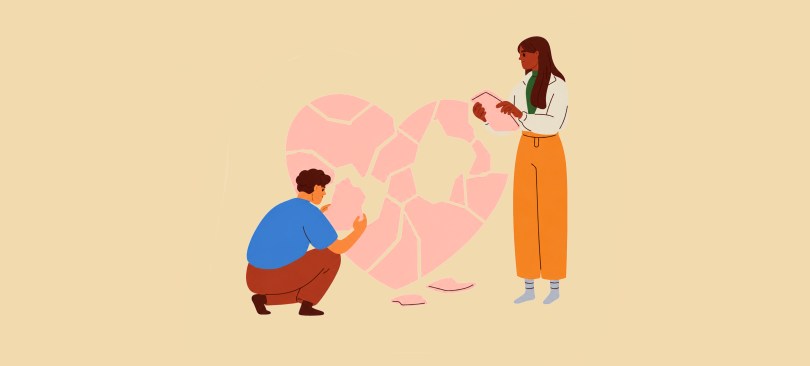
Surviving the past is one thing. Learning to believe you’re safe enough to love again is something else entirely.
There is a question I hear more than almost any other.
“I want a relationship. I really do. So why, every time someone gets close, do I panic?”
It’s one of the cruellest contradictions trauma leaves behind. Your heart wants connection, Your nervous system wants escape.
One is dreaming about Sunday mornings, shared coffees and someone who feels like home. The other is quietly checking where the exits are.
If you’ve ever found yourself pulling away from someone you genuinely liked, overthinking a text message until it became a twelve episode psychological thriller, or feeling strangely calmer with someone emotionally unavailable than with someone consistently kind, you’re not losing your mind.
You’re experiencing what happens when survival becomes stronger than intention. Trauma doesn’t just change what happened to us, it changes what we expect to happen next.
And that’s a very different thing.
For many people, trust isn’t simply about believing another person won’t cheat or lie. Trust is something much deeper. It is the feeling that if you allow someone close enough to matter, your world won’t collapse if they leave.
That changes everything.
Because suddenly relationships stop being about romance and become about survival.Trauma has a habit of turning up on first dates uninvited. It sits quietly between the bread basket and the drinks menu, whispering things like,“Don’t get too comfortable.” Or, “They’re going to leave eventually.”
Or my personal favourite, “This is going suspiciously well…”
Dating apps certainly don’t help, I think we all know my view on those…
Sometimes they feel less like places to find love and more like interviewing strangers for a job nobody seems qualified for.
“Tell me about yourself.”
“I enjoy travelling.”
“So does literally everyone.”
“I love dogs.”
“Congratulations. You’re human.”
We laugh because it’s true, we like the same song, and suddenly, we start fucking thinking we’ve met our soul mate.
But underneath the humour sits something much heavier.
Many people aren’t simply trying to find a partner.They’re trying to answer a question their nervous system has been asking for years.
Am I finally safe?
The Invisible Suitcase
Imagine every relationship you’ve ever experienced has packed something into an invisible suitcase.
Parents.
Teachers.
Partners.
Friends.
Bullies.
The person who promised forever before disappearing without explanation.
The person who made you feel invisible.
The person who loved you beautifully.
The person who taught you that love came with conditions.
By the time we meet someone new, we rarely arrive carrying just ourselves.
We arrive carrying memories, expectations, beliefs and survival strategies.
Some of those are wonderful, Others are incredibly heavy.
If you’ve experienced childhood abuse, neglect, domestic abuse, coercive control, betrayal or significant emotional trauma, your suitcase may contain something else entirely.
Hypervigilance, Self doubt, People pleasing.
The belief that love has to be earned, The expectation that happiness never lasts, not because they’re true.
Because once upon a time, they kept you safe.
One of the biggest misunderstandings about trauma is that people think it’s purely about memory.
It isn’t.
As trauma psychiatrist Bessel van der Kolk explains, trauma is carried not only in our thoughts, but in our bodies. Even long after danger has passed, our nervous system may continue responding as though the threat is still present.
That’s why someone can logically know they’re safe while simultaneously feeling terrified, and consequently avoidance can happen.
Their body hasn’t received the memo.
When Your Smoke Alarm Becomes Overprotective
Imagine installing the world’s most sensitive smoke alarm. It doesn’t just go off when there’s a fire. It screams because someone made toast or lit a candle or looked vaguely enthusiastic near the kitchen.
Ridiculous?
Perhaps.
Unless you’re a nervous system.
Trauma often creates an alarm system that becomes brilliantly efficient at spotting possible danger. The difficulty is that it becomes equally brilliant at spotting danger where there isn’t any.
A delayed text message, A slightly different tone of voice, Someone asking for space, A cancelled plan.
To another person, these are everyday experiences.
To a traumatised nervous system, they can feel like the opening scenes of abandonment. Your brain isn’t trying to ruin your relationships. It’s trying to prevent history repeating itself. That’s a very important distinction.
Trauma doesn’t mean you’re broken. It means your brain adapted to survive. Once that clicks, something extraordinary begins to happen.
Instead of asking, “What’s wrong with me?”
You begin asking,
“What happened that taught my brain this was necessary?”
That single question replaces shame with curiosity.
And curiosity is where healing begins.
Why Safety Matters More Than Trust
People often say trauma survivors have trust issues. I’d gently challenge that, because many survivors don’t actually struggle to trust. Quite often, they trust words, Potential, Hope, Promises, Future plans.
The version of someone they believe could exist if everything worked out.
Sometimes they trust far too easily.
The real difficulty isn’t trusting other people. It’s trusting themselves to leave when someone’s behaviour consistently tells them they should.
That feels very different.
Because if childhood taught you that love required endurance…
If previous relationships taught you that chaos was normal…
If your self-worth became tangled up in proving your value…
Walking away doesn’t necessarily feel empowering.. It feels terrifying.
Sometimes staying feels safer simply because it’s familiar, Not because it’s healthy. One of the saddest realities of trauma is that our definition of “normal” can become completely distorted. Healthy can feel unfamiliar.
And unfamiliar often feels unsafe.
Which brings us to one of the greatest ironies in relationships.
Healthy relationships can initially feel boring when your nervous system has been trained to expect chaos. Not because they’re lacking passion but because they’re lacking panic.
Those are two very different experiences.
Attachment: Our First Blueprint For Love
Long before we downloaded dating apps or debated whether replying after seventeen minutes looked too keen, our brains had already started forming expectations about relationships.
Psychologist John Bowlby proposed that our earliest relationships with caregivers become internal blueprints for how we understand connection.
Later, Mary Ainsworth’s research showed that children develop different attachment styles depending on how consistently safe, responsive and emotionally available their caregivers are.
This isn’t about blaming parents.
Life is rarely that simple.
Parents have histories, Stress, Mental health struggles and trauma of their own.
Most were doing the best they could with what they had. However our nervous systems don’t record intentions.
They record experiences.
If your emotional needs were generally met, your brain learned that relationships are safe places to return to.
If care was inconsistent, unpredictable or frightening, your brain learned something very different.
Love became uncertain.
Conditional.
Something that might disappear without warning.
Those lessons don’t stay in childhood. They quietly climb into adult relationships too.
When Love Feels Like An Exam You Keep Failing
People with anxious attachment are often described as “needy.”
I dislike that word.
Most aren’t asking for too much. They’re asking for reassurance because somewhere along the line reassurance became unpredictable.
If love was inconsistent growing up, uncertainty can feel unbearable.
Texts become evidence.
Silence becomes danger.
Distance becomes rejection.
Their nervous system isn’t saying,
“I need constant attention.”
It’s saying,
“Please don’t disappear.”
That’s a very human response when you’ve experienced emotional inconsistency. In todays society, people are so distracted, that sometimes they forget to deliver the basics of consistency, and this delivers as ‘Low Level’ – Deep down we’re all searching for that “Good Morning” or “Good night” message, but people become to preoccupied, and when the basics are asked of them, become overwhelmed, and presume their other half as we said ‘needy’, when deep down, equal effort, can keep both partners settled and content.
Then we have avoidant attachment.
This is perhaps one of the most misunderstood attachment styles of all. Avoidant people are often portrayed as cold or commitment phobic villains who simply don’t care.
Reality is usually much more compassionate. Many learned very early that depending on other people wasn’t safe. Maybe emotions were dismissed. Maybe vulnerability wasn’t welcomed. Maybe independence became survival.
So rather than clinging when relationships become emotionally intense, they unconsciously create distance.
Not because connection doesn’t matter, Because it matters so much that losing it feels unbearable.
Different survival strategy, Same frightened nervous system underneath.
Neither style is “better.”
Neither makes someone bad.
Both are adaptations.
Both deserve compassion.
And both can heal… but taking the time to recognise and truly see the patterns in their behaviours
The Body Keeps The Score… Even On Date Night
One of the biggest breakthroughs in trauma research has been recognising that healing isn’t simply about changing our thoughts.
It’s also about calming our bodies.
Psychiatrist Judith Herman described recovery as moving through stages of safety, remembrance and reconnection.
Notice the order.
Safety comes first.
Not forgiveness.
Not dating.
Not positive thinking.
Safety.
Because without safety, the nervous system cannot fully relax.
This is why two people can hear exactly the same sentence.
One hears,
“Can we talk later?”
The other hears,
“They’re about to leave me.”
Same words.
Entirely different nervous system.
Our brains constantly predict what comes next based on previous experience. If previous experience included fear, criticism or abandonment, today’s relationships often become filtered through yesterday’s pain.
That doesn’t mean those fears are silly, it means they once served a purpose.
Healing isn’t about pretending those alarm bells don’t exist.
It’s about teaching the nervous system that they don’t need to ring every single time someone gets close and that takes patience.
Not perfection.
It also takes self-compassion, something many trauma survivors generously give everyone else while quietly forgetting themselves.
Perhaps that’s the first place healing really begins, Not with finding the perfect relationship but with becoming the safest relationship you’ve ever had with yourself.
One of the greatest gifts we can give ourselves is learning to pause before reacting. Not because our feelings are wrong.
But because our feelings aren’t always describing the present. Sometimes they’re describing the past.
That distinction can transform relationships.
When Every “Maybe” Feels Like “No”
If you’ve ever spent an entire evening analysing a full stop at the end of a text message, welcome to the wonderfully exhausting world of rejection sensitivity.
Someone replies a little later than usual, Your brain writes a novel. They seem quieter after work.
Your mind has already planned the break up, divided the furniture and chosen your post heartbreak playlist.
Sound familiar?
For many trauma survivors, rejection isn’t simply disappointing.
It feels dangerous.
Psychologist Gabor Maté has written extensively about how our need for attachment is one of our deepest human drives. As children, maintaining connection with our caregivers is essential for survival. If those relationships are inconsistent, frightening or emotionally unavailable, our brains learn to monitor them constantly.
That hyperawareness doesn’t magically disappear when we become adults.
It simply changes clothes.
Instead of scanning our parents’ moods, we scan our partner’s texts. Instead of wondering whether we’ll be comforted, we wonder whether they’ll reply.
The behaviour changes.
The survival strategy doesn’t.
Understanding this isn’t about excusing unhealthy behaviour.
It’s about recognising that behind many reactions is a frightened nervous system trying desperately to prevent old wounds from opening again.
Chemistry Isn’t Always Compatibility
Here’s something that often surprises people.
The strongest spark isn’t necessarily the healthiest relationship.
We’ve all heard someone say,
“I’ve never felt chemistry like this before.”
Sometimes that’s wonderful. Sometimes it’s your nervous system recognising something familiar and familiar doesn’t always mean safe.
If chaos was normal growing up, calm can initially feel unsettling.
Predictability can feel flat.
Kindness can feel suspicious.
Consistency can almost seem… boring.
Not because healthy love lacks depth.
Because your nervous system has been trained to associate emotional intensity with connection.
The butterflies might not always be butterflies.
Sometimes they’re simply adrenaline. Sometimes they’re uncertainty. Sometimes they’re your smoke alarm shouting,
“This feels familiar!”
Unfortunately, it doesn’t always specify whether familiar is healthy or harmful.
One coaching question I often encourage people to sit with is this:
Do I actually like this person, or do I simply like being chosen?
It’s an uncomfortable question.
But an important one.
Because validation can sometimes disguise itself as love.
Another worth reflecting on is:
Am I chasing love, or am I chasing rescue?
If we’re honest, many of us have spent years hoping another person would finally heal wounds that were never theirs to carry.
Love can support healing.
It cannot replace it and perhaps the hardest question of all:
Would I still choose this relationship if I wasn’t afraid of being alone?
Sit with that one.
Don’t rush it.
The answer often tells you everything you need to know.
When Anxiety Borrows Intuition’s Clothes
People often tell me,
“I knew something was wrong. I just ignored my intuition.”
Sometimes that’s true. Sometimes it isn’t.
One of the most important parts of healing is learning the difference between intuition and anxiety, because they feel remarkably similar until you know what you’re looking for.
Intuition tends to arrive quietly.
It doesn’t usually shout.
It doesn’t catastrophise.
It doesn’t demand an immediate decision.
It simply knows.
Anxiety is much louder.
It searches for evidence.
It creates endless what ifs.
It desperately wants certainty in situations where certainty simply doesn’t exist.
As I often say,
Sometimes it’s anxiety carrying a fake Louis Vuitton pretending to be intuition.
It makes me smile every time because it’s surprisingly accurate.
Anxiety can become an exceptional actor.
The challenge is learning not to hand it the lead role in every relationship.
Instead of asking, “How do I stop feeling anxious?” Try asking, “What evidence do I actually have today?”
Bring yourself back to facts, not fears, because trauma predicts.
Healing observes.
Learning To Feel Safe With Intimacy
People often assume survivors struggle because they can’t love. In reality, many struggle because their nervous system has never truly believed love is safe.
There’s a huge difference. Love requires vulnerability. Vulnerability requires safety and safety isn’t created by words.
It’s created through repeated experience.
Someone saying, “You can trust me,” means very little.
Someone consistently showing up, respecting your boundaries, repairing conflict, apologising when they’re wrong and remaining emotionally available…
That’s what teaches the nervous system something new. This is especially true when it comes to sex and intimacy. For some people, physical closeness feels natural. For others, it can activate memories they didn’t even realise their body was holding.
For some survivors of sexual abuse, the greatest challenge isn’t having sex. It’s staying emotionally present during it.
Many describe learning, often from a very young age, to mentally disconnect from what was happening as a way of surviving. Dissociation isn’t a choice. It’s an extraordinary protective response that allows the mind to distance itself from overwhelming experiences when there is no other escape.
The difficulty is that our nervous system doesn’t always recognise when the danger has passed. Years later, during consensual, loving intimacy, that same survival strategy can quietly reappear. Someone may find themselves physically present but emotionally absent, almost as though they’re watching the moment rather than truly living it. It can feel as if they slip into another version of themselves, one created to survive rather than to connect.
Ironically, the safest relationships can sometimes feel the most emotionally exposing. Not because the survivor doesn’t want intimacy, but because they do. Being fully seen by someone you genuinely care about requires a level of vulnerability that a traumatised nervous system may never have learned was safe. Remaining present, allowing yourself to be emotionally and physically connected, can take enormous courage.
This is one reason why some survivors find casual sex or sex work unexpectedly easier than deeply intimate sex. It isn’t necessarily about desire or commitment. Emotional investment changes the experience entirely. When there is little emotional attachment, the nervous system may feel less at risk. But when love enters the equation, so too can the fear of being truly vulnerable.
Many survivors also describe experiencing intimacy in two very different ways. There can be sex that feels emotionally disconnected, where the body is present but the heart and mind remains protected. Then there is deeply connected intimacy, where emotional closeness and physical closeness exist together. The contrast between those experiences can feel profound, and confusing, until we understand that both are shaped by the nervous system’s attempt to keep us safe.
There is nothing shameful about these responses. They are not signs that someone is incapable of love or healthy intimacy. They are evidence of a brain and body that adapted in remarkable ways to survive circumstances no one should ever have had to endure and, like so many survival strategies, with safety, patience and the right support, they can begin to soften.
Trauma isn’t only remembered consciously.
Sometimes the body remembers long before the mind catches up.
That can leave survivors feeling confused.
“Why did I suddenly panic?”
“Why do I freeze?”
“Why do I shut down when nothing bad is happening?”
Again, there is a reason.
Fight, Flight, Freeze, Fawn.
These aren’t personality flaws. They’re survival responses.
Fight protects through confrontation. Flight protects through escape. Freeze protects by becoming still. Fawn protects through pleasing others, often by ignoring our own needs.
Every one of these responses once served a purpose. Healing isn’t about judging them. Healing isn’t about becoming someone different.
It’s about recognising the survival strategies that no longer serve you. When we understand that, shame begins to loosen its grip.
Grieving The Future That Never Happened
One of the most painful parts of heartbreak isn’t always losing the person.
It’s losing the future you imagined with them. The Sunday mornings. The holidays. The family Christmases. The conversations that never happened. The version of life you had quietly built in your mind. Sometimes we aren’t grieving reality. We’re grieving possibility.
That’s why endings can feel so confusing.
We tell ourselves,
“I miss them.”
Sometimes what we actually miss is who we hoped they would become.
There’s a profound difference. That doesn’t make your grief any less real. If anything, it explains why it hurts so much. You’re mourning dreams as well as memories. Allow yourself to grieve both.
Just don’t confuse potential with evidence.
Hope is beautiful, but healthy relationships are built on patterns, not promises.
What Healing Actually Looks Like
Healing is often portrayed as a dramatic breakthrough.
One life changing moment, One perfect therapy session, One inspirational quote.
The truth is usually much quieter.
Healing is replying honestly instead of pretending you’re fine.
It’s recognising a red flag before explaining it away.
It’s choosing peace over unpredictability.
It’s noticing your body becoming anxious and offering yourself compassion instead of criticism.
It’s learning to apologise without believing you’re fundamentally unlovable.
It’s discovering that boundaries aren’t walls.
They’re doors with locks.
The right people knock…They don’t force their way in.
Healing is slowly teaching your nervous system that not everyone who gets close is going to hurt you. That lesson isn’t learned through thinking.
It’s learned through experience.
One safe conversation.
One respectful disagreement.
One healthy relationship.
One repaired rupture.
Over and over again.
Until your body finally believes what your mind has been trying to tell it.
Forgiveness Isn’t A Deadline
Let’s talk about forgiveness, because I think we’ve complicated it far more than necessary.
Forgiveness is deeply personal, It isn’t a competition, It isn’t proof of healing and it certainly isn’t something anybody else gets to demand from you.
Some people find freedom through forgiveness, Others find freedom through acceptance. Some never forgive at all, yet still build beautiful, peaceful lives.
All are valid.
Healing doesn’t require pretending something didn’t hurt. Nor does it require reconciling with people who continue to harm you.
Sometimes forgiveness is simply releasing the hope that the past could have been different.
Sometimes it’s choosing not to carry someone else’s behaviour into every future relationship.
And sometimes it’s quietly saying,
“What happened mattered. It changed me. But it doesn’t get to define the rest of my life.”
That, to me, is extraordinary courage.
From Surviving To Living
If you’ve recognised yourself anywhere in these words, I hope you take one thing away.
There is nothing wrong with you.
Your nervous system has spent years doing exactly what it was designed to do.
Protect you.
The difficulty is that protection and connection don’t always speak the same language.
One says,“Stay back.” The other whispers,“Come closer.”
Healing is learning to let those two parts of yourself have a conversation instead of a battle.It’s understanding that your smoke alarm doesn’t need to sound every time someone walks into the room.
It’s unpacking that invisible suitcase, one belief at a time, and asking,
“Do I still need to carry this?”
Sometimes the answer will be yes, Sometimes it will be no.
Both are okay, because healing isn’t linear.
You’ll have days where you feel calm, secure and hopeful.
You’ll have other days where an unanswered message convinces you the world is ending.
Progress isn’t never becoming triggered again.
Progress is recognising the trigger sooner, responding with greater kindness and returning to yourself more quickly.
That’s growth…Real growth.
You are not too much….You are not difficult to love.
You are not destined to repeat every painful chapter you’ve lived through.
The fact you’re reading this tells me something important…A part of you already believes life can be different.
Hold on to that part.
Feed it.
Protect it.
Because the opposite of trauma isn’t perfection.
It’s safety.
It’s connection.
It’s waking up one day and realising that love no longer feels like something you have to earn. It simply feels like somewhere you belong. Perhaps that’s what healing really is.
Not forgetting the past.
Not pretending it never happened.
But gently teaching your mind, your body and your heart that the danger has passed.
That the alarm can finally grow quieter.
That the person you’ve spent your whole life trying to become…
Was never broken in the first place.
Just brilliantly adapted.
And now, finally, free to do something far more beautiful than survive.
To Live and Love

